Imagine oceans not of water, but of liquid methane, sulfuric acid, or even molten rock. How would waves behave on such exotic worlds, under gravities vastly different from Earth’s? Scientists are now challenging our planet-centric intuition, revealing that alien ocean waves could defy everything we expect. A groundbreaking new model is redefining planetary wave dynamics, offering unprecedented insights into the mysteries of extraterrestrial oceans and preparing us for future missions to distant worlds like Titan. This research provides a crucial framework for understanding the diverse and dramatic behaviors of liquid surfaces across the cosmos.
A Revolutionary Model for Alien Ocean Waves
For decades, scientists have puzzled over how waves might form and evolve beyond Earth. Previous models often made simplified assumptions, largely focusing on gravitational differences or relying solely on Earth-like conditions. Now, a powerful new tool, dubbed the PlanetWaves model, is changing the game. Developed by researchers at MIT and the Woods Hole Oceanographic Institution, this sophisticated model simulates wave formation under entirely different planetary conditions.
Unlike its predecessors, PlanetWaves integrates all critical factors influencing wave behavior. It meticulously accounts for a planet’s unique gravity, its atmospheric pressure, and the intricate physical properties of its surface liquids. This includes crucial details like a liquid’s density, its resistance to motion (viscosity), and its surface tension. By considering these variables together, the model allows scientists to move beyond mere speculation. It explores a much wider spectrum of planetary environments with remarkable accuracy.
Andrew Ashton, a study author, notes how this new approach challenges our preconceived notions. “On Earth, we get accustomed to certain wave dynamics,” he explains, “but with this model, we can see how waves behave on planets with different liquids, atmospheres, and gravity, which can kind of challenge our intuition.” The team validated their innovative model by comparing its predictions against decades of observed wave data from Earth’s own Lake Superior, finding a close and accurate match. This validation underpins its reliability for predicting conditions on alien worlds.
Taylor Perron, the Cecil and Ida Green Professor of Earth, Atmospheric and Planetary Sciences at MIT, highlights the model’s fundamental premise. “Anywhere there’s a liquid surface with wind moving over it, there’s potential to make waves,” Perron states. This universal principle, combined with the comprehensive factors considered by PlanetWaves, opens the door to understanding vast oceans of methane, ethane, or even more exotic liquids scattered throughout the solar system and beyond.
Titan’s Mysterious Seas: Giant, Slow-Motion Waves
Saturn’s largest moon, Titan, stands as perhaps the most compelling target for this revolutionary research. It is the only known world beyond Earth with stable surface liquids, boasting lakes and seas filled with liquid hydrocarbons like methane and ethane. Yet, direct observations of these alien seas have been limited, leaving many questions about their dynamics unanswered.
The PlanetWaves model brings Titan’s enigmatic waterways into sharp focus. According to simulations, Titan waves could appear dramatically different from anything we experience on Earth. Lead author Una Schneck describes a surreal scenario: “It kind of looks like tall waves moving in slow motion.” She explains that even a soft breeze on Titan could generate enormous, slow-moving swells, potentially several meters or even 10 feet high. This is a stark contrast to Earth, where similar gentle winds would only create slight ripples on water bodies.
This counterintuitive phenomenon stems from several unique factors. Titan possesses lower gravitational force than Earth, combined with a dense, planet-like atmosphere and lighter liquid compositions in its lakes. These conditions allow wind energy to transfer into liquid motion far more efficiently than on our home planet. Consequently, if you were standing on Titan’s shore, you might feel only a mild gust of wind, yet witness colossal alien ocean waves flowing majestically towards you. This implies that Titan’s seas may be far more dynamic than previously imagined, with significant implications for the moon’s geology and climate.
Beyond Titan: Diverse Wave Dynamics Across the Cosmos
The predictive power of the PlanetWaves model extends far beyond Titan, offering fascinating insights into the diverse planetary wave dynamics of other celestial bodies. It serves as a crucial tool for exploring potential wave behaviors across a wide range of extreme environments.
For instance, applying the model to ancient Mars reveals a profound shift in its hydrological past. As Mars gradually lost its atmospheric pressure over time, wave formation would have become increasingly challenging. The model suggests that progressively stronger winds would have been required to produce even modest wave effects on any ancient Martian lakes or seas. This offers a new lens through which to interpret the geological history of the Red Planet.
Looking further afield to exoplanets, the model uncovers even more extreme scenarios. For Venus-like exoplanets, which might harbor lakes of corrosive sulfuric acid, the PlanetWaves model indicates that only powerful, near-hurricane-force winds would be capable of generating even small ripples. The high density and viscosity of such liquids would resist motion far more intensely than water.
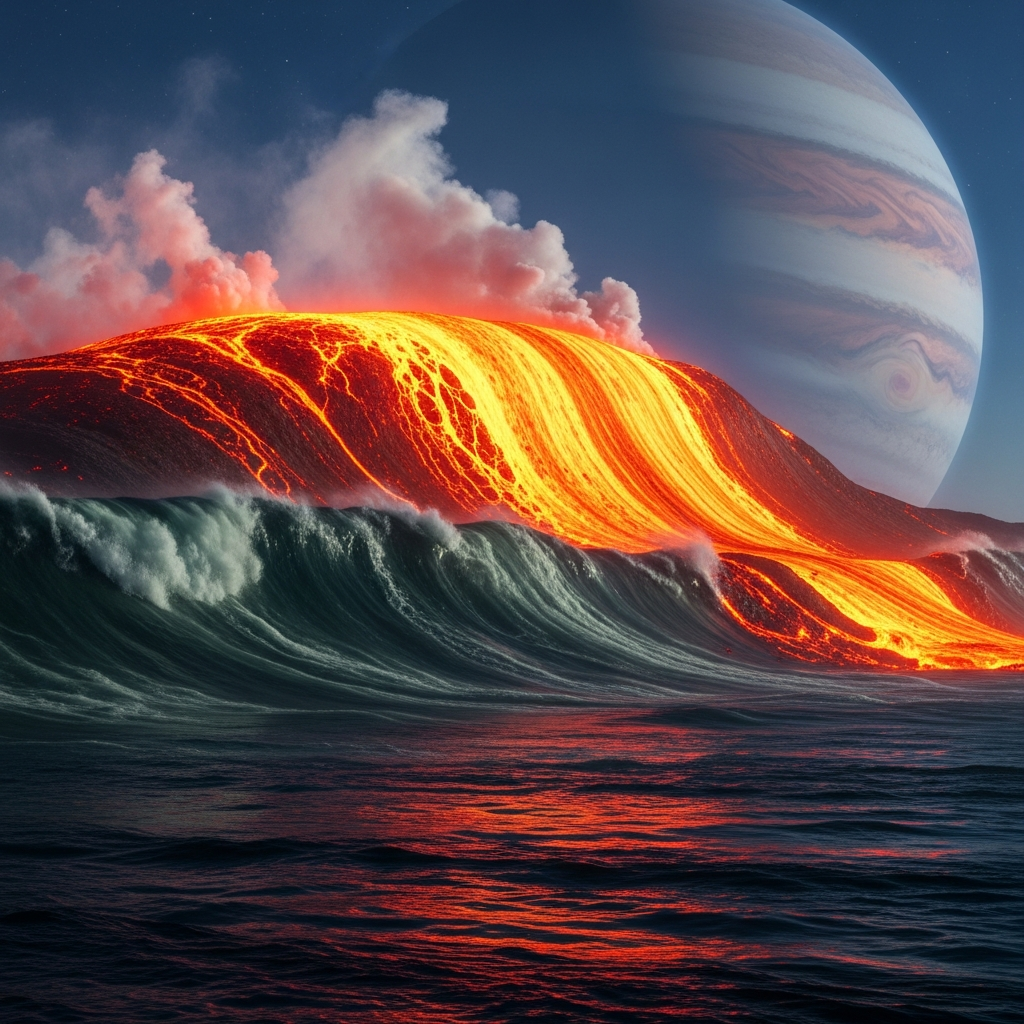
The model also tackles the exotic realm of lava worlds. On exoplanets believed to host oceans of molten rock, like 55 Cancri e, the predictions are astonishing. Even hurricane-force winds would likely result in only incredibly shallow waves, measuring mere centimeters in height. This is attributed to the exoplanet’s exceptionally high gravitational force and the immensely denser, more viscous nature of its surface liquid compared to any liquid found on Earth. These findings collectively underscore that wave behavior is fundamentally contingent upon a planet’s specific environmental conditions.
Practical Implications for Future Space Exploration
Understanding these complex extraterrestrial oceans and their unique wave behaviors is not merely a theoretical exercise. It has profound practical consequences for future space missions and the exploration of alien worlds. Engineers designing probes, landers, or floating instruments must meticulously account for the forces these waves could exert.
This research is especially relevant for proposed missions to Titan, such as NASA’s upcoming Dragonfly rotorcraft. Such landers or floating platforms will directly interact with liquid surfaces, making accurate wave predictions crucial for their survival and operational success. Una Schneck emphasizes this point, noting that mission planners “would want to build something that can withstand the energy of the waves, so it’s important to know what kind of waves these instruments would be up against.” Robust design is paramount to ensure these sophisticated instruments can endure dynamic conditions.
Furthermore, the PlanetWaves model offers clues to long-standing geological puzzles across the solar system. Taylor Perron raises a striking question about Titan: “Unlike on Earth where there is often a delta where a river meets the coast, on Titan there are very few things that look like deltas, even though there are plenty of rivers and coasts. Could waves be responsible for this?” By simulating how Titan waves redistribute sediments along shorelines, researchers may finally explain why the moon’s coastlines appear so dramatically different from Earth’s, providing a deeper understanding of planetary geomorphology.
Redefining Our Understanding of Planetary Surfaces
The study marks a significant turning point in how scientists approach and model alien ocean waves. By integrating critical variables previously overlooked, such as the composition of the liquid itself, the PlanetWaves model achieves an unprecedented level of realism. This advancement allows scientists to generate far more accurate predictions about shoreline erosion, sediment transport, and the long-term evolution of diverse planetary landscapes.
This new framework is not limited to our own solar system. It offers a unified approach that can be applied to a multitude of worlds, from icy moons orbiting gas giants to distant exoplanets potentially harboring liquid surfaces. The research effectively challenges our Earth-centric intuition, demonstrating how fundamental physical processes, like wave formation, can manifest in astonishingly varied ways across the cosmos. It significantly enhances our ability to explore and characterize worlds beyond our own.
Frequently Asked Questions
What is the “PlanetWaves” model and what factors does it consider?
The PlanetWaves model is a groundbreaking scientific tool developed by MIT and the Woods Hole Oceanographic Institution. It simulates how waves form and behave on alien oceans. Unlike previous models, PlanetWaves is the first to integrate all critical factors: a planet’s gravity, its atmospheric pressure, and the specific physical properties of its surface liquids, including density, viscosity, and surface tension. This comprehensive approach allows for accurate predictions across diverse planetary environments.
How do waves on Titan differ from Earth’s oceans, according to the new research?
According to the PlanetWaves model, waves on Saturn’s moon Titan are dramatically different from Earth’s. Due to Titan’s lower gravity, lighter liquid hydrocarbon composition (methane/ethane), and denser atmosphere, even gentle breezes can generate “tall waves moving in slow motion,” potentially several meters or 10 feet high. On Earth, similar gentle winds would only create slight ripples, showcasing how drastically wave dynamics can change on extraterrestrial oceans.
Why is understanding alien wave behavior important for space missions?
Understanding alien wave behavior is crucial for future space exploration. Accurate predictions of wave dynamics are essential for designing robust probes, landers, and floating instruments that can withstand the forces exerted by waves on extraterrestrial oceans, such as those on Titan. This knowledge ensures missions like NASA’s Dragonfly can successfully operate. Additionally, the model can help solve geological puzzles, like the scarcity of river deltas on Titan, by analyzing how waves redistribute sediments, informing our understanding of planetary geomorphology.
This revolutionary work not only deepens our scientific understanding of the universe but also provides vital tools for future endeavors. As we continue to gaze out into the cosmos, this model will be indispensable in our quest to explore and comprehend the extraordinary diversity of liquid worlds beyond Earth. The next frontier in space exploration will be better prepared thanks to these insights into the strange physics of alien ocean waves.