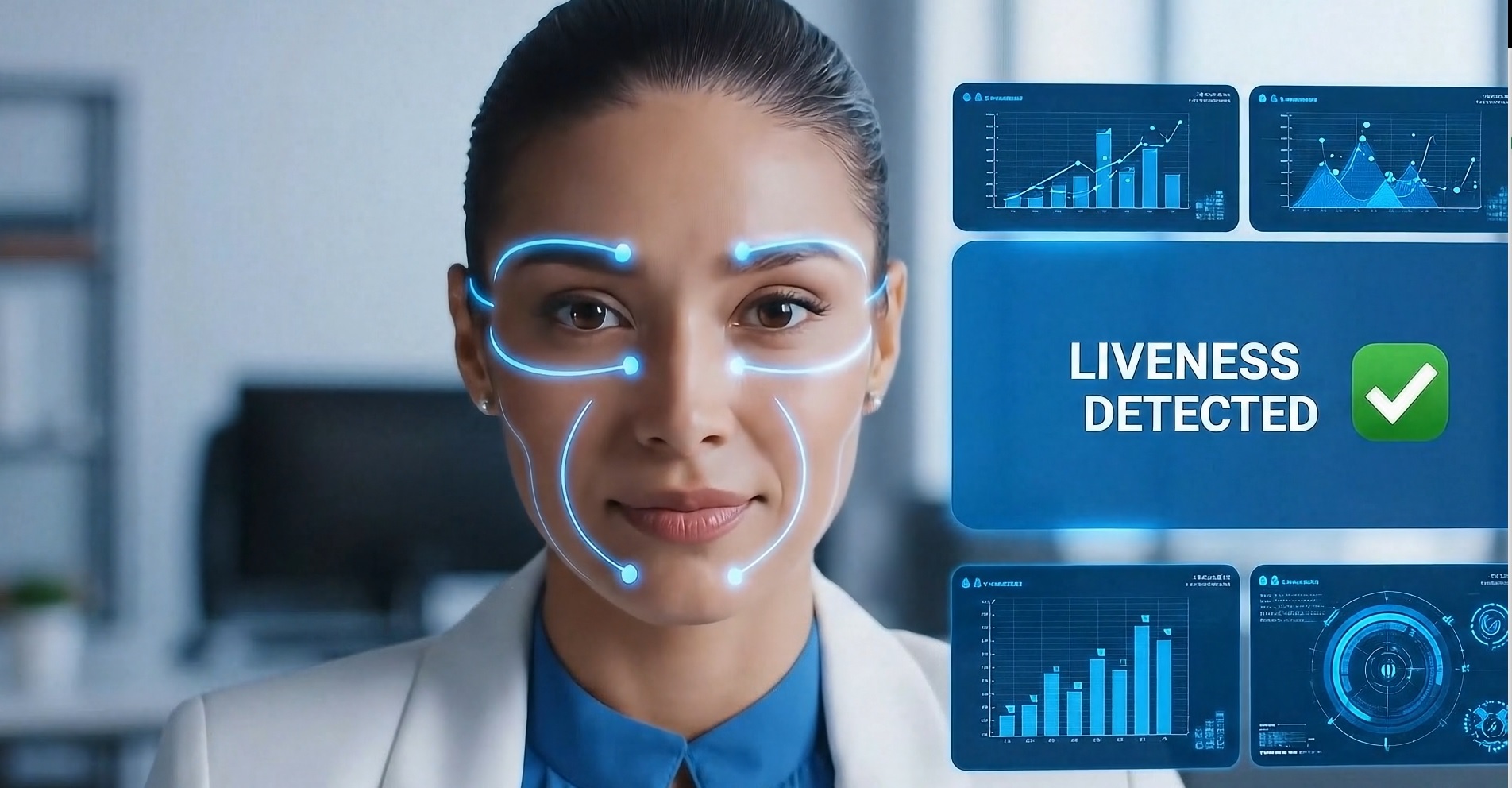
In 2024, identity systems somewhere in the world faced a deepfake attack roughly every five minutes, while digital document forgeries jumped 244% in a single year. By 2025, AI-driven “sophisticated fraud” had risen 180%. And Gartner’s prediction that by 2026 most enterprises would stop trusting face biometrics on their own? That is no longer a forecast — it is where we are now.
If your platform still verifies people by matching a selfie to an ID photo, you are already exposed. This guide explains what liveness detection actually is, why active and passive modes matter, how deepfake and injection attacks slip past weak systems, what to demand from a provider (especially if you operate in Africa or another emerging market), and how an all-in-one liveness + KYC + document + fingerprint API closes the gap.
Why a selfie no longer proves a real person is there
Matching a live selfie to the photo on an ID only proves that two images look alike. It says nothing about whether a real, living human actually took the selfie at that moment. That single gap is what modern fraud exploits.
Attackers no longer just hold up a printed photo. They replay recorded video, wear 3D masks, generate deepfakes, and run “injection” attacks — feeding a fabricated video stream straight into the camera pipeline through a virtual camera, so the app believes it is seeing a live feed. According to iProov’s threat research, virtual-camera injection attacks spiked by more than 2,600% and face-swap attacks rose around 300% in a single year.
The uncomfortable part: people cannot catch this on their own. In controlled tests, only about 0.1% of participants could reliably tell a real face from a high-quality deepfake. Manual review is not a defence. Detection has to be automated, and it has to happen at the moment of capture.
The bottom line: “Does this selfie match the ID?” is the wrong question in 2026. The right question is “Is a real, live human actually present right now — and not a photo, a replay, a mask, or a deepfake?” That question is what liveness detection answers.
What liveness detection actually does
Liveness detection confirms that a genuine, living person is physically present at the moment of verification. Think of it as an automated “are you actually here, right now?” check that runs before you trust anything else about the user.
There are two modes, and the difference matters for both security and conversions:
- Passive liveness works silently in the background from a single selfie or short capture. The user does nothing extra, so friction is minimal — ideal for high-volume onboarding where every abandoned check costs you a customer.
- Active liveness asks the user to perform an action — blink, smile, or turn their head — so the system can confirm a real, responsive human. It adds a step but raises the bar against certain attacks.
The category term security and compliance teams use is Presentation Attack Detection (PAD), measured against the international ISO/IEC 30107-3 standard and validated through independent iBeta testing. When you evaluate any vendor, ask three questions: Do they conform to ISO/IEC 30107-3? What iBeta level have they reached? And — crucially — how do they handle injection attacks, not just presentation attacks? Many older tools stop printed photos and replays but fall apart against virtual-camera and deepfake injection, which is exactly where fraud is now concentrating.
Liveness is only half the job — KYC is the other half
Liveness proves a user is real and present. It does not prove who they are. That second question is the domain of KYC (Know Your Customer) verification, and a complete flow ties the two together:
- Capture and read the identity document with OCR (passport, driver’s licence, or national ID).
- Check the document for validity and tampering.
- Run liveness on the live selfie to confirm a real person.
- Match that live face to the photo on the document.
On top of that sits compliance. KYC and anti-money-laundering (AML) obligations apply across virtually every market — FICA in South Africa, NIN-based verification in Nigeria, Maisha Namba in Kenya, and equivalents elsewhere — alongside data-privacy regimes such as GDPR and CCPA. A serious solution has to be both secure and privacy-preserving, with biometric data encrypted end to end. Verification that leaks data, or that blocks legitimate users, fails the business as surely as fraud does.
Why “global” liveness tools quietly fail in emerging markets
This is the part most vendors will not tell you. The majority of enterprise liveness and KYC tools are tuned for stable, high-bandwidth connections, standardised “formal” identity documents, and predictable user behaviour. Across much of Africa and many other emerging markets, those assumptions simply break — and when they do, global tools tend to either over-block real customers or under-protect the system.
The demand, meanwhile, is enormous and accelerating. Africa ran more than 110 million identity-verification checks in 2024, and the Middle East & Africa identity-verification market is projected to grow from USD 1.17 billion in 2025 to USD 2.38 billion by 2030. Mobile-money operators, digital lenders, fintechs, telcos handling SIM registration, gig-economy apps, and trading platforms all need verification that works on a low-end Android phone, over a shaky connection, with documents that do not always match a Western template — and they need it at pricing that fits an early-stage budget, not an enterprise procurement cycle.
There is also a fingerprint dimension that global face-only tools miss entirely. In many of these markets, national IDs, SIM registration, and voter rolls are fingerprint-based. Contactless (“touchless”) fingerprint capture — taking a usable print from an ordinary phone camera, with no dedicated scanner hardware — is a real unlock for onboarding and de-duplication where fingerprints are the legal standard.
What to look for in a liveness + KYC provider
Before you sign with anyone, run them against this checklist:
- Both passive and active liveness, with resistance to deepfakes and injection attacks — not just printed photos and replays.
- Document OCR and face matching in the same flow, so you integrate one API instead of stitching three vendors together.
- API-first, with SDKs for web, mobile, and desktop, and a live sandbox or demo you can actually test today.
- Works on low-end devices and low bandwidth — test it on a cheap phone before you believe the marketing.
- KYC/AML, GDPR, and CCPA alignment, with encrypted biometric processing.
- Local context and support for your market and your document types, in your timezone.
- Transparent, scalable pricing that fits your stage instead of punishing early growth.
Meet QuantoSei’s all-in-one Liveness Detection & KYC API
QuantoSei’s AI-powered Liveness Detection & KYC Verification API was built to tick every box above — and to work in exactly the conditions where global tools struggle.
It combines liveness detection, facial recognition, document OCR, and contactless 4-finger fingerprint capture in a single platform:
- Real-time face tracking and blink detection read natural movement and micro-expressions to confirm a live user and reject static images or replays.
- Deep-learning anti-spoofing is engineered to distinguish real faces from synthetic media for strong resistance to deepfakes.
- Document OCR automatically scans and extracts data from passports, driver’s licences, and national IDs, then matches the live face to the document photo in real time.
- Contactless 4-finger capture turns an ordinary phone into a fingerprint reader — no extra hardware — for markets where prints are the legal standard.
- Designed to meet KYC/AML, GDPR, and CCPA requirements, with encrypted handling of biometric and identity data.
- Seamless API integration across web, mobile, and desktop, engineered for the connectivity and device realities of African and emerging markets.
- Built and supported from Maputo — close to the markets you serve, in your timezone, and ready to adapt to local document types and workflows.
The fastest way to judge it is to try it. Run the live demo at kyc.quantosei.com, or install the Android touchless-fingerprint demo on any phone and watch it work on real hardware.
Frequently asked questions
What is liveness detection?
Liveness detection is technology that confirms a real, living person is physically present during a verification check, rather than a photo, a recorded video, a mask, or a deepfake. It runs at the moment of capture, before any identity match is trusted.
What is the difference between active and passive liveness detection?
Passive liveness works silently in the background from a single selfie or short capture and requires no action from the user, which keeps friction low. Active liveness asks the user to perform an action such as blinking, smiling, or turning their head. Many platforms use a combination to balance security and user experience.
Can liveness detection stop deepfakes?
Strong liveness systems combine real-time face tracking, micro-expression analysis, and deep-learning models to resist deepfakes and synthetic media. The key is choosing a provider that defends against injection attacks (fake video fed through a virtual camera), not only presentation attacks like printed photos and replays.
Is liveness detection the same as KYC?
No. Liveness detection proves a user is real and present. KYC (Know Your Customer) proves who they are, typically by reading their ID document, checking it, and matching their live face to the document photo. A complete identity-verification flow uses both together, along with KYC/AML compliance steps.
Does it work on low-end Android phones and slow connections?
It should, and many global tools do not. QuantoSei’s solution is engineered for the device and connectivity realities of African and emerging markets, so it is designed to perform on affordable Android phones and over unstable networks. The recommended test is to run the live demo on a low-cost device yourself.
Is it GDPR and KYC/AML compliant?
The QuantoSei system is designed to meet KYC/AML regulations and global data-privacy standards including GDPR and CCPA, with encrypted processing of biometric and identity data. Your specific compliance obligations will also depend on your jurisdiction and industry.
How do I add liveness detection and KYC to my app?
QuantoSei provides a single API with SDKs for web, mobile, and desktop, so you can integrate liveness, facial recognition, document OCR, and fingerprint capture without combining multiple vendors. Start with the live demo, then contact the team to scope your integration.
Stop deepfake fraud before it reaches your platform
Face-matching alone no longer holds the line. See real liveness detection, KYC, and contactless fingerprint capture working together — then integrate in days, not months.
Try the Live Demo → See the full platform
Talk to us: info@quantosei.com · +258 82 52 99 215 · Maputo, Mozambique