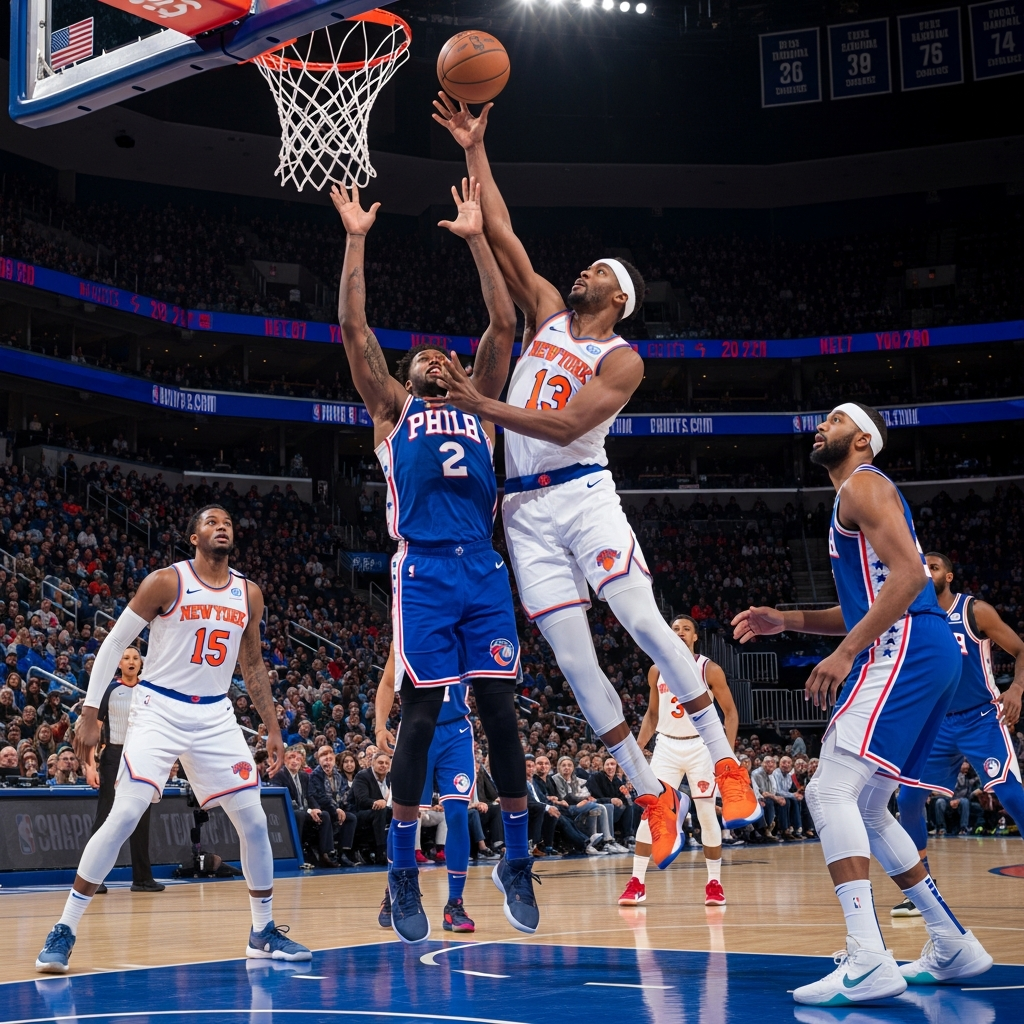
As the 2026 NBA Eastern Conference Semifinals reached a pivotal Game 3, the New York Knicks held a commanding 2-0 lead over the Philadelphia 76ers. This was more than just another playoff matchup; it was a do-or-die moment for Philadelphia, historically facing daunting odds. Let’s delve into the key factors and strategic elements that were slated to define this crucial contest, and then analyze how the drama unfolded on the court, ultimately impacting the trajectory of the series.
The Stakes Were Sky-High in Game 3
The Philadelphia 76ers, despite their past resilience in overcoming deficits, faced a monumental challenge. Entering Game 3 down 0-2, the pressure was immense. History shows that no team has ever recovered from an 0-3 deficit in a best-of-seven NBA playoff series (0-161 record). The Knicks, meanwhile, had been a dominant force, outscoring their playoff opponents by 19.4 points per 100 possessions, showcasing an elite level of play. This game was their chance to take a stranglehold on the series, pushing Philadelphia to the brink of elimination.
Three Critical Battlegrounds for Game 3
Originally, analysts pointed to several key areas that would dictate the outcome of Game 3. These strategic points shaped the narrative leading into Friday night’s matchup. Understanding them helps contextualize the eventual result.
Health Concerns: Pivotal Players on the Sideline?
Injuries loomed large over both squads, potentially shifting game plans significantly. The absence or limited capacity of star players creates undeniable ripples.
Joel Embiid (76ers): His availability was a constant question mark. The 76ers’ playoff record without him stood at 1-3. While 3-2 with him, two of those losses were by a combined 71 points. In Game 1, the Knicks exploited Embiid defensively. Specifically, when he guarded Jalen Brunson in pick-and-rolls, New York scored a stunning 160 points per 100 possessions in Embiid’s 25 minutes. His return would bring star power but also potential defensive vulnerabilities if not strategically managed.
OG Anunoby (Knicks): New York’s two-way star was questionable with a right hamstring strain from Game 2. Anunoby had been an offensive revelation, averaging 21.4 points on 62% shooting (54% from three) and an astounding 75.5% true shooting. However, his defensive absence would be a bigger blow, reducing the Knicks’ perimeter size. Smaller guards like Miles McBride, Jordan Clarkson, Jose Alvarado, and Landry Shamet would need to step up. This could leave them vulnerable to isolations, as Tyrese Maxey demonstrated in Game 2.
Mitchell Robinson (Knicks): The Knicks’ backup center was probable after missing Game 2 with an illness. His return would be crucial, especially given the consistent foul trouble often encountered by Karl-Anthony Towns (for the Knicks). The Sixers might even consider intentional fouling Robinson to disrupt the Knicks’ rhythm or get him off the floor.
Tyrese Maxey’s Offensive Strategy Against the Blitz
Tyrese Maxey’s ability to navigate the Knicks’ aggressive blitz defense was another crucial storyline. How he responded would heavily influence Philadelphia’s offensive flow.
Knicks’ Defensive Shift: New York drastically increased its blitzing of Maxey’s ball-screens. They went from just 16% in Game 1 to a hefty 41% in Game 2.
Philadelphia’s Efficiency: Initially, the Sixers scored efficiently against the blitz (1.16 points per chance). This strategy notably contributed to a season-high nine corner 3-pointers in Game 1.
Maxey’s Adjustments: However, in later Game 2 instances, Maxey struggled to make quick decisions. He passed to covered corners, losing the offensive advantage. The key for Game 3 was quicker decision-making and ball movement. This was especially vital if Embiid’s return led to less blitzing, demanding Maxey adapt his reads.
Domination in the Paint: A Recurring Theme
The paint disparity remained a glaring issue for the 76ers. Their inability to score and defend inside was a major factor in their 0-2 deficit.
Knicks’ Interior Dominance: New York overwhelmingly outscored Philadelphia 114-62 (+52) in the paint across the first two games. They shot an incredible 69.5% (57-for-82) in the paint, a mark that would be the best in any playoff series in 30 years. Players like OG Anunoby, Mikal Bridges, and Karl-Anthony Towns (all listed for the Knicks in this hypothetical series) combined for an astonishing 77.5% (31-for-40) in the paint.
Sixers’ Struggles: Philadelphia took only 39.9% of their shots in the paint, a significant drop from their 49.6% regular-season average. Even players like Paul George (for the 76ers) struggled to attack the rim, taking only two of his 29 shots in the paint over two games. While the Sixers held a 15-point free-throw advantage (48-33), it wasn’t enough to offset New York’s interior dominance. Game 3 demanded a renewed focus on paint scoring and defense from Philadelphia.
Game 3 Outcome: Knicks Secure Dominant 3-0 Lead
The much-anticipated Game 3 saw the New York Knicks defeat the Philadelphia 76ers 108-94. This victory extended their series lead to an insurmountable 3-0. This historic win places the Knicks on the precipice of advancing and reinforces the daunting reality for the 76ers.
Key Performers for New York
The Knicks showcased balanced scoring and clutch performances, demonstrating why they’ve been one of the league’s top teams.
Jalen Brunson: Led New York with a game-high 33 points. He also added 9 assists and 5 rebounds. This performance marked his 24th 30-point playoff game, setting a new Knicks franchise record.
Mikal Bridges: Contributed significantly with 23 points, 3 rebounds, and 2 steals, maintaining his strong scoring form throughout the series.
Landry Shamet: Provided crucial bench firepower, scoring 15 points on efficient 5-for-6 shooting in just 26 minutes. His offensive spark was vital in igniting the Knicks’ second-quarter rally.
Team Dominance: The Knicks controlled key statistical categories by halftime. They led in paint scoring (36-24), bench points (16-0), second-chance points (15-6), and total rebounds (29-19). This collective effort secured their sixth consecutive postseason victory.
Philadelphia’s Efforts and Early Leads Falter
Despite an aggressive start, the 76ers couldn’t sustain their momentum, allowing the Knicks to pull away. This inability to maintain consistency proved costly.
Kelly Oubre Jr.: Led Philadelphia with 22 points and 8 rebounds, providing a much-needed offensive boost.
Joel Embiid: Finished with 18 points, 6 rebounds, 5 assists, and 3 blocks, contributing across multiple statistical categories.
Tyrese Maxey: Added 17 points and 7 assists, attempting to ignite the Sixers’ offense.
Paul George: Started strong, scoring all of his 15 points in the first quarter on 6-for-9 shooting. This early burst helped the Sixers build a 12-point early lead. However, he went 0-for-9 from the field for the rest of the game, a critical drop-off that halted Philadelphia’s momentum.
Second Quarter Collapse: Philadelphia’s early 12-point advantage dissolved as they were outscored 33-21 in the second quarter. This allowed the Knicks to take a 60-52 halftime lead they never relinquished.
Beyond Game 3: Looking Ahead to a Do-or-Die Game 4
With the Knicks now leading 3-0, the Philadelphia 76ers face a monumental task. The historical precedent is clear: no NBA team has ever come back from an 0-3 deficit. Game 4 becomes an absolute must-win for Philadelphia, a desperate attempt to avoid a sweep and salvage pride. For the Knicks, it’s an opportunity to close out the series decisively and gain valuable rest before the next round of the NBA Playoffs.
Tactical Deep Dive: Game 2 Lessons for the 76ers
Prior to Game 3, Philadelphia had several areas identified for significant adjustment, stemming from their Game 1 and Game 2 struggles. These lessons remain crucial for any potential future contests in the series.
Containing Jalen Brunson: Philadelphia’s Defensive Quandary
Jalen Brunson’s scoring outburst in Game 1 (35 points on 12-for-18 shooting) highlighted the Sixers’ defensive struggles. Coach Mike Brown’s team recorded its worst defensive showing, allowing 1.49 points per possession. The Knicks effectively used 1-5 pick-and-rolls, with Brunson initiating against Joel Embiid’s defender.
Potential defensive adjustments included:
Embiid in Drop Coverage: This required Brunson’s defender (perhaps Paul George) to navigate screens more effectively. The goal was to deny comfortable pull-up jumpers, a skill the Sixers didn’t execute well initially.
Blitzing Brunson: This tactic aimed to force the ball out of his hands, though it risked pulling Embiid from the paint.
Switching Matchups: Assigning perimeter defenders like George or Kelly Oubre Jr. to guard opposing centers. This would allow for switches on 1-5 pick-and-rolls.
Unleashing Joel Embiid in the Post
Despite limited post-up opportunities in Game 1, Embiid proved highly efficient. He scored 8 points on 6 possessions against single coverage. Against double-teams, he scored 5 points on 3 possessions, demonstrating excellent court vision (3.22 playoff assist/turnover ratio). Analysts suggested Embiid needed more post touches to exploit his individual matchups. This would draw double-teams and create opportunities for teammates.
Igniting Tyrese Maxey’s Drive
Tyrese Maxey, despite his ability to attack bigs in pick-and-rolls, struggled to get downhill consistently in Game 1. The key was to empower Maxey to drive to the basket, draw fouls, and create for himself and others. Specifically, using Karl-Anthony Towns (for the Knicks) as a ball-screen target proved “amazing” in previous games, yielding 1.73 points per chance. Maximizing Maxey’s penetration was a clear priority.
Knicks’ Internal Reflection: Fouling and Shooting Sustainability
Even with their dominant Game 1 and 2 victories, the Knicks identified areas for improvement. Coach Mike Brown specifically highlighted these concerns, demonstrating the team’s commitment to perfection.
Addressing Foul Trouble: Coach Brown’s Mandate
Excessive fouling was a significant concern for New York. The 76ers attempted 34 free throws in Game 1, largely due to “crafty or flopping” plays by Joel Embiid. This put Knicks centers in early foul trouble. Coach Brown emphasized the need for defenders to “show your hands and stay down on the shot fakes” against Embiid. He also instructed his team to apply “multiple efforts” against Tyrese Maxey. Reducing fouls was critical for maintaining defensive integrity without sacrificing aggression.
Can the Historic Shooting Percentages Hold Up?
The Knicks’ extraordinary 63.1% shooting from the field in Game 1 (even higher before deep bench play) raised questions about sustainability. While OG Anunoby’s consistent 59.4% from three-point range throughout the postseason was a bright spot, the team knew replicating such overall efficiency would be challenging. Maintaining focus and defensive intensity, rather than relying on unsustainable shooting, was emphasized for future games. This approach underscores a long-term playoff strategy.
Frequently Asked Questions
What were the key factors that analysts predicted would decide Knicks-76ers Game 3?
Analysts prior to Game 3 focused on three main areas: the health statuses of critical players like Joel Embiid (76ers), OG Anunoby, and Mitchell Robinson (Knicks); Tyrese Maxey’s ability to effectively counter the Knicks’ aggressive blitzing defense; and the significant disparity in paint scoring, where the Knicks had dominated the first two games. These elements were expected to dictate strategic adjustments and player performances in the pivotal matchup.
How did the Knicks’ players perform in Game 3 to secure their 3-0 series lead?
In their Game 3 victory, Jalen Brunson led the Knicks with a game-high 33 points, 9 assists, and 5 rebounds, setting a new franchise record for 30-point playoff games. Mikal Bridges contributed 23 points, while bench player Landry Shamet added 15 points on highly efficient 5-for-6 shooting. The team demonstrated overall dominance by leading in paint scoring, bench points, second-chance points, and rebounds, especially by halftime, solidifying their sixth consecutive postseason win.
What is the historical significance of the 76ers falling to an 0-3 deficit in the NBA Playoffs?
Falling to an 0-3 deficit in a best-of-seven NBA playoff series is historically insurmountable. No team in NBA history has ever come back from such a disadvantage, with teams holding an 0-161 record when down 0-3. For the Philadelphia 76ers, this means Game 4 against the Knicks is a do-or-die scenario to avoid a sweep and preserve their playoff hopes, facing unprecedented odds if they wish to extend the series.
Conclusion:
Game 3 of the Eastern Conference Semifinals was a moment of truth, and the New York Knicks seized it emphatically. By defeating the Philadelphia 76ers and taking a commanding 3-0 series lead, the Knicks have placed themselves in an enviable position. Meanwhile, the 76ers stare down the barrel of NBA history. The strategic battlegrounds of player health, tactical adjustments against stars like Maxey and Brunson, and the perennial struggle for paint dominance all played out with defining consequences. As the series moves to Game 4, Philadelphia must find a way to rewrite history, while New York aims for a decisive sweep to continue their impressive playoff run.