The recent Supreme Court decision on the Voting Rights Act (VRA) is embroiled in controversy, following revelations that Justice Samuel Alito’s majority opinion relied heavily on statistical data now widely deemed misleading. This critical data point, central to arguments that racial discrimination in voting no longer necessitates robust federal oversight, has been unmasked by in-depth analyses. The findings raise serious questions about the evidentiary basis for a ruling that significantly weakens a cornerstone of American civil rights law, potentially undermining electoral fairness for millions.
The Core Controversy: Flawed Data Undermines a Landmark Ruling
In a recent landmark decision concerning Louisiana’s congressional map (Louisiana v. Callais), Justice Samuel Alito, writing for the conservative majority, asserted that “vast social change has occurred throughout the country,” leading to Black voters participating at rates similar to, or even higher than, white voters in recent presidential elections. This claim was pivotal for his argument that the discrimination the Voting Rights Act was designed to combat is largely a thing of the past, thereby justifying a diminished role for Section 2 of the VRA.
However, a thorough review, including analysis by The Guardian, reveals that Alito’s assertion was drawn almost verbatim from a friend-of-the-court brief filed by the Justice Department (DoJ). This DoJ brief, and consequently Alito’s opinion, presented voter turnout statistics that employed a highly questionable methodology, directly impacting the ruling’s perceived validity and its far-reaching consequences for voting rights nationwide.
Unpacking the “Misleading” Methodology
At the heart of the controversy is how “voter turnout” was calculated. The DoJ brief cited by Alito measured Black and white voter turnout in Louisiana as a proportion of each racial group’s total population over the age of 18 – also known as the Voting Age Population (VAP). This approach, while seemingly straightforward, is widely rejected by experts in electoral statistics.
Why is VAP problematic for turnout analysis? The general over-18 population includes individuals legally ineligible to vote, such as non-citizens, those with felony convictions, or people deemed mentally incapacitated. By including these individuals in the denominator, the DoJ’s method artificially inflates the turnout rate for certain demographics, creating a skewed picture. Using this flawed methodology, the DoJ concluded that Black voter turnout exceeded white voter turnout in Louisiana in both the 2012 and 2016 presidential elections.
Expert Voices Call Out Deliberate Manipulation
Leading experts in voter turnout have sharply criticized the DoJ’s chosen method, suggesting it served a specific agenda. Michael McDonald, a political science professor at the University of Florida and a nationally recognized authority on voter turnout, unequivocally stated that the DoJ’s approach is “misleading because they’re including ineligible voters in the denominator.” McDonald didn’t mince words, adding, “If I wanted to manipulate the numbers in a way that was favorable to the government’s interest, I would be using voting age population.” He further noted that the Census Bureau’s Current Population Survey, upon which the DoJ’s analysis was based, is prone to producing misleading turnout statistics, concluding, “Someone knew what they were doing” to arrive at those numbers without accounting for standard methodological issues like the margin of error.
When directly questioned about this statistical choice, a Justice Department spokesperson acknowledged using the total voting age population but refused to explain the rationale behind it. The Supreme Court similarly offered no comment on the methodology.
The True Picture: Widening Turnout Gaps Ignored
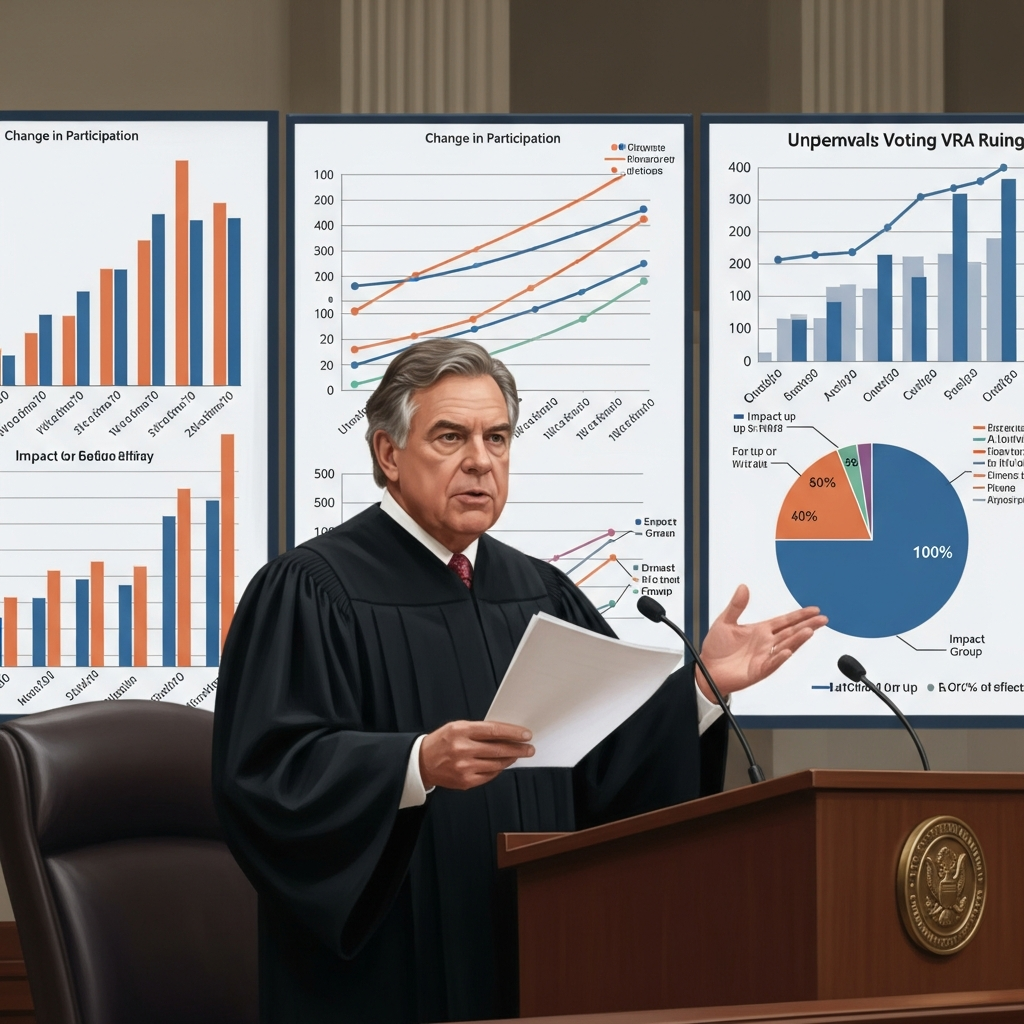
When analysts applied the widely accepted methodology – calculating turnout as a proportion of the Citizen Voting Age Population (CVAP) or the voter eligible population (which excludes ineligible individuals) – a dramatically different reality emerged. The Guardian’s analysis of Louisiana data using CVAP found that Black voter turnout exceeded white turnout in only one of the last five presidential elections: 2012. Furthermore, using data from the Louisiana secretary of state’s office, which calculates turnout as a percentage of registered voters, Black turnout has not surpassed white turnout in any of the last five presidential cycles in Louisiana.
Beyond Louisiana, Alito’s claim about national turnout also fails to capture a more recent and concerning trend: a widening racial turnout gap. While Black turnout was indeed higher than white turnout in 2008 and 2012 (when Barack Obama was on the ballot), in the three most recent presidential elections since then, Black voter turnout has consistently lagged behind white voter turnout. Kevin Morris, a researcher at the Brennan Center for Justice, highlighted this stark reality, stating that “In zero out of the last three presidential elections, did Black turnout come anywhere close to parity,” and that the national turnout gap has “exploded” over the last 15 years. This renders Alito’s claim “simply not factual.” Christopher Warshaw, a Georgetown University professor, accused the DoJ and Alito of “cherry picking a particular year, they’re cherry picking a particular method and they’re ignoring this long term more concerning trend in the data.”
A Pattern of Disregard for Facts and Precedent?
The reliance on demonstrably flawed data in a critical VRA ruling is not an isolated incident in the eyes of many legal observers. Critics, including the Brennan Center for Justice and Daily Kos, point to a perceived pattern of conservative justices employing what they term “hermetically sealed logic” and “brute power” to reshape legal landscape, often “untethered from modern American life, from previous Court rulings, and from the Constitution itself.”
The Louisiana v. Callais decision, which effectively “updated” the Gingles test (the standard for determining Section 2 VRA violations), is viewed as another step in this project. The majority opinion introduced new requirements for plaintiffs, such as providing alternative maps that “fully achieve all the State’s legitimate goals” (including protecting incumbents) and controlling for partisan affiliation in bloc voting analysis. These “updates,” as Justice Elena Kagan lamented in her dissent, render Section 2 “all but a dead letter” by making challenges nearly impossible without “smoking-gun evidence” of racial discrimination.
This disregard for established fact and precedent is exemplified in other recent high-profile cases. In Dobbs v. Jackson Women’s Health Organization, Alito dismissed Roe v. Wade as “egregiously wrong,” effectively disregarding decades of judicial stability. Other instances, such as Justice Neil Gorsuch’s alleged fabrication of details in Bremerton v. Kennedy (the praying football coach case) or the reportedly fabricated premise of the 303 Creative LLC v. Elenis case (involving a designer refusing to create same-sex wedding websites), further fuel concerns about an increasing willingness to distort facts or history to achieve partisan judicial outcomes. The use of “misleading ‘statistics'” in the VRA ruling is thus seen as part of a larger, troubling trend.
The Impact on Democracy and Future Elections
The Supreme Court’s Louisiana v. Callais decision, fueled by the misleading data, has significant implications for American democracy. By gutting the effectiveness of Section 2 of the VRA, the ruling empowers states to implement redistricting maps that could dilute minority voting power without easily facing legal challenge. This opens the door for further racial gerrymandering and makes it significantly harder for communities of color to achieve fair political representation.
Historically, the VRA, enacted in 1965, dramatically narrowed ugly racial disparities in voting across the Southern US, leading to a surge in Black voter registration and elected officials. The period after 2012, however, saw Black voter turnout drop and trail white turnout, especially following the Supreme Court’s 2013 decision in Shelby County v. Holder. That ruling eliminated the VRA’s pre-clearance requirement, freeing states with a history of discrimination to implement election changes without federal approval, a move directly linked to the widening racial turnout gap.
Kareem Crayton, also from the Brennan Center, criticized Alito’s argument that decreasing disparities negate the VRA’s necessity, calling it a “ruse” to suggest the “project is over” simply because initial improvements were made. The current Court’s trajectory, particularly its “bankrupt and sad vision of democracy,” as described by Kevin Morris, suggests a prioritization of “power” over “fairness and access above outcomes.” The decision stands as a stark reminder of the ongoing struggle for equitable voting rights in the United States and the critical role of accurate data in judicial decision-making.
Frequently Asked Questions
What was Justice Alito’s core argument regarding Black voter turnout in his Voting Rights Act ruling?
Justice Samuel Alito argued in the Supreme Court’s majority opinion for Louisiana v. Callais that significant social change has occurred, leading Black voters to participate in elections at rates similar to, or even higher than, white voters. He specifically claimed Black voter turnout exceeded white turnout in two of the five most recent presidential elections nationally and in Louisiana. This was a critical point for his conclusion that the VRA’s Section 2 was less necessary now, effectively undermining its strength.
How did the Justice Department’s methodology for calculating voter turnout mislead the Supreme Court?
The Justice Department (DoJ) brief, cited by Justice Alito, calculated voter turnout using the “Voting Age Population” (VAP), which includes all residents over 18, regardless of eligibility. This method includes non-citizens and those with felony convictions who cannot vote. Experts criticize this as misleading because it inflates turnout rates by using an inaccurate denominator. Widely accepted methods use “Citizen Voting Age Population” (CVAP) or “eligible voters,” which reveal Black turnout exceeded white turnout in Louisiana in only one (2012) of the last five elections, not two.
What are the broader implications of the Supreme Court’s Louisiana v. Callais decision for the Voting Rights Act and future elections?
The Louisiana v. Callais decision significantly weakens Section 2 of the Voting Rights Act (VRA). The majority “updated” the Gingles test, making it substantially harder for plaintiffs to challenge discriminatory voting maps. Critics argue this move, influenced by misleading data, effectively makes the VRA “all but a dead letter” for combating racial gerrymandering. This could lead to a rollback of protections, potentially allowing states to implement redistricting plans that dilute minority voting power and making it more challenging to ensure fair political representation in future elections.