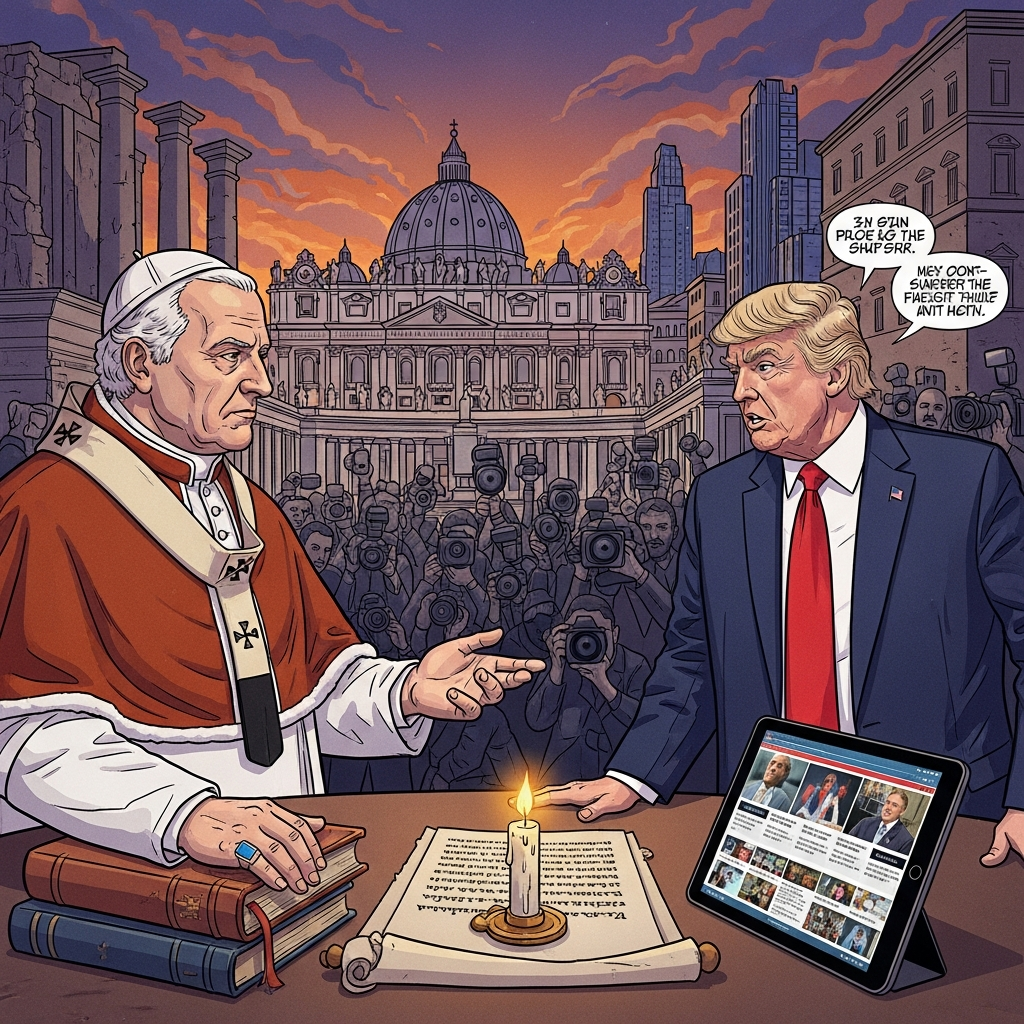
The public dispute between Pope Leo XIV and U.S. President Donald Trump marks a truly unprecedented chapter in modern papal-presidential relations. Unlike past diplomatic exchanges, this “war of words” is defined by direct insults, sharp counter-criticism, and the unique circumstances surrounding the first American pontiff. Religious experts and historians agree that while popes have long engaged with political issues, the intensity and personal nature of this conflict, particularly amid the escalating war in Iran, stand alone.
The escalating tension began with Pope Leo XIV’s fervent calls for peace in the Iran conflict. He warned against the “delusion of omnipotence,” stating unequivocally that “God does not bless any conflict.” President Trump quickly escalated the rhetoric, publicly accusing Leo of being “WEAK on Crime” and “terrible for Foreign Policy.” He also made unsubstantiated claims that the Pope favored Iran acquiring nuclear weapons. These accusations intensified through social media, with Trump referencing alleged protest deaths in Iran and challenging Leo’s understanding of global affairs.
A Pope Undeterred: Leo XIV’s Bold Stance
Despite the aggressive broadsides from Washington, Pope Leo XIV has remained steadfast in his mission for peace. From Algiers, during an 11-day tour of Africa, he famously declared, “I have no fear of neither the Trump administration nor of speaking out loudly about the message in the Gospel.” This defiance underscores a core difference from historical papal responses. Vatican–U.S. tensions surrounding the Iran war have clearly reached a critical point.
Vice President Vance, a Catholic himself, also weighed in, cautioning the Pope to “be careful when he talks about matters of theology.” However, Christopher White, associate director at Georgetown University’s Initiative on Catholic Social Thought and Public Life, characterized Trump’s actions as an “unprecedented, unhinged attack.” White suggested the attacks were intended to intimidate, but Leo’s firm response demonstrates his unwavering commitment to his spiritual duties.
Historical Papal Interventions: A Different Approach
Throughout modern history, popes have not shied away from political commentary, often challenging world leaders. Michele Dillon, a sociology professor at the University of New Hampshire, notes that popes typically “point out the objective moral law” rather than taking partisan sides. However, these interactions were historically characterized by a greater degree of diplomacy and decorum.
Pope Paul VI, in 1965, made history as the first pontiff to address the United Nations, famously urging “No more war, war never again” in reference to the Vietnam War. He later pressed President Lyndon Johnson for peace negotiations, receiving a cordial and appreciative response from the U.S. leader. Similarly, Pope John Paul II addressed the United Nations in 1979, advocating for human rights, peace, and resolutions to conflicts in the Middle East. He met President Jimmy Carter, discussing various global challenges with mutual respect. John Paul II, a Polish pope, also played a less public but significant role in supporting the Polish opposition to the Soviet Union, a factor often credited with contributing to the fall of the Berlin Wall. He later opposed the 2003 U.S. invasion of Iraq, sending representatives to Washington and Baghdad to plead for peace, though his appeals were ultimately disregarded. Despite disagreements with Presidents Clinton and George W. Bush on social issues like abortion and stem cell research, these differences never escalated into public disrespect or personal attacks.
More recently, Pope Francis actively intervened in global affairs, calling for a vigil for peace in Syria in 2013 and writing to Russian President Vladimir Putin to oppose military intervention. He was a tireless advocate for peace in Gaza and played a significant role in shaping public opinion on climate change after releasing a key document in 2015. Even Francis’s 2016 criticism of then-candidate Trump’s stance on building walls – where he said a person “who thinks only about building walls… and not building bridges, is not Christian” – initially drew a “disgraceful” retort from Trump, but the situation was quickly smoothed over. These examples highlight a consistent pattern of papal engagement, but with a distinct difference in tone and presidential response compared to the current clash.
The Directness of Pope Leo XIV: A New Papal Tactic
A significant aspect making the current conflict unique is Pope Leo XIV’s directness. Historically, popes have often employed subtle language, avoiding direct naming of individuals in their criticisms to maintain an image of neutrality. Pope Pius XII, for example, faced criticism for not directly denouncing Adolf Hitler during World War II, and Pope Francis used ambiguous references regarding Russia’s invasion of Ukraine.
In stark contrast, Leo XIV has openly referred to President Trump by name. Christopher White, who authored “Pope Leo XIV: Inside the Conclave and the Dawn of a New Papacy,” described this as a “new tact” for the papacy. Leo directly appealed to Trump, effectively “pointing the finger” to state: “You started this war, you have the power to end this war.” While popes generally aim to be a “pope for the universal church and for all people,” the current situation appears to have necessitated a more direct approach from Leo, who believes that “appeasement has a moral price.”
Trump’s Religious Rhetoric and Imagery
Another contributing factor to Pope Leo XIV’s outspokenness is the Trump administration’s frequent and overtly religious rhetoric and imagery. Experts have observed a distinct escalation in how religion is invoked by the administration. Trump, for instance, shared an AI-generated image depicting him as a Jesus-like figure laying hands on a sick man, later claiming it was an image of him as a doctor. He also posted an image of himself being embraced by Jesus and, notably, the White House once posted an image of Trump as the pope.
Robert Orsi, a professor of religious studies at Northwestern University, called these connotations “alarming” and the overall exchange “unprecedented in U.S. history.” Margaret Thompson, a history and political science professor at Syracuse University, noted that the administration is “speaking out in more overtly religious terms than even somebody like Jimmy Carter,” a devout evangelical Christian. This pervasive use of religious imagery and claims of divine support for U.S. military actions, such as in Iran, may have compelled Pope Leo to respond personally and directly, emphasizing that “God is good and God wants to see people taken care of.”
The American Pope: A Unique Perspective
Pope Leo XIV is the first American pontiff, a factor that undoubtedly influences the dynamic of this conflict. Although he sees himself as the “Holy Father for everyone,” as noted by former U.S. diplomat Peter Martin, his American background shapes perceptions. Michele Dillon suggests that an American pope criticizing a great power like the U.S. carries more weight than a foreign pontiff, whose critiques might be dismissed as “anti-America.”
Born and raised in Chicago, Pope Leo’s American identity lends a particular resonance to his appeals. His direct call to the American people to “seek ways to communicate… with congressmen, with authorities, saying that we don’t want war, we want peace” is, according to White, unparalleled in papal history. This direct civic engagement is a distinctly American approach that no previous pope has taken. Jesuit priest James Martin observed widespread dismay among Catholics, from progressives to traditionalists, regarding Trump’s words, viewing the attack on Leo as an “attack on the church” itself.
The Iran War as a Catalyst
The war in Iran serves as the primary backdrop and catalyst for much of this unprecedented clash. Pope Leo XIV has consistently condemned the violence, asserting that God “does not listen to the prayers of those who wage war, but rejects them.” This stance was seen as a direct rebuke to U.S. officials who had claimed divine endorsement for military action. Leo’s condemnation of Trump’s threat to annihilate Iranian civilization as “truly unacceptable” directly ignited many of the President’s public broadsides.
The Pope has leveraged his apostolic journeys, such as his visit to Algeria, to articulate a vision of unity and dialogue, explicitly contrasting it with the ongoing conflict. He recounted standing in silent prayer at the Great Mosque of Algiers, emphasizing the need for peace between different beliefs and ways of life. This implicitly highlights his concern for the humanitarian consequences of the conflict, reiterating his urgent plea to de-escalate violence and promote diplomacy for the welfare of all peoples.
Frequently Asked Questions
What makes the public conflict between Pope Leo XIV and President Trump unprecedented in modern history?
The conflict is unprecedented due to several factors. It features direct, personal insults from a U.S. president towards a sitting pope, a departure from past diplomatic exchanges. Pope Leo XIV’s direct responses, including naming Trump and appealing to American citizens to contact their representatives, represent a “new tact” for the papacy. Additionally, Leo is the first American pope, giving his criticisms unique weight in the U.S. Finally, the Trump administration’s frequent and overtly religious rhetoric, including AI-generated images of Trump as a Jesus-like figure, further intensified the situation, compelling Leo to speak out against what he perceived as a “moral price” for appeasement.
How do Pope Leo XIV’s interactions with President Trump compare to historical engagements between popes and U.S. presidents?
Historically, popes have frequently engaged with U.S. presidents on political and social issues, but typically with greater diplomatic decorum. Popes like Paul VI and John Paul II used platforms like the United Nations to advocate for peace and human rights, and while they disagreed with presidents on specific policies (e.g., Vietnam War, abortion, Iraq War), these differences were conveyed respectfully and did not escalate into public insult. Pope Francis also criticized Trump’s policies, but the disputes were eventually smoothed over. In contrast, the exchanges between Pope Leo XIV and President Trump are marked by direct, personal attacks and an absence of traditional diplomatic restraint, making them stand out significantly.
What role does Pope Leo XIV’s American identity play in the impact and reception of his political statements?
Pope Leo XIV’s status as the first American pope significantly impacts the reception and weight of his statements, particularly within the United States. While he views himself as the “Holy Father for everyone,” his background as someone born and raised in Chicago lends a unique credibility to his criticisms among American audiences. Experts suggest that an American pope’s critique of U.S. policy might be perceived as less “anti-America” and carry more influence than that of a foreign pontiff. His direct appeal to the American people to “call your congressman” for peace is also seen as a distinctly American approach, further amplifying the impact of his papacy.
In conclusion, the clash between Pope Leo XIV and President Trump represents a profound shift in the dynamics between the Vatican and the White House. This unprecedented conflict, fueled by the Iran war and intensified by unique personalities and circumstances, has shattered traditional diplomatic norms. Pope Leo’s unwavering commitment to the Gospel message of peace, coupled with his directness and American identity, has set a new benchmark for papal engagement in global politics, leaving an indelible mark on religious and political discourse.