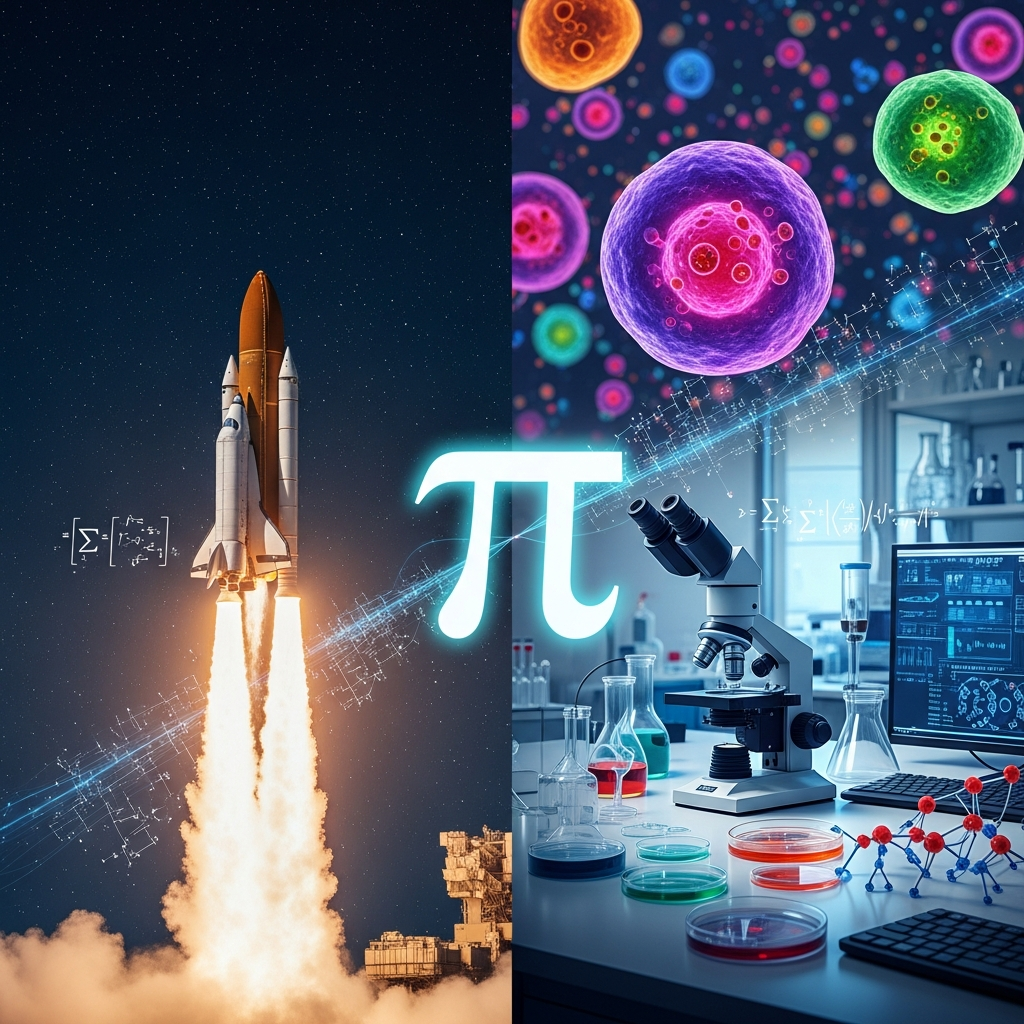
Beyond the classrooms, the mathematical constant pi (π) quietly underpins much of our modern world. From the precision guiding rockets into deep space to the intricate science fighting cancer, pi is an essential, often unseen, force. This ubiquitous number, celebrated annually on Pi Day, isn’t just for geometry problems; it’s a fundamental tool driving breakthroughs in science and engineering every single day.
Unpacking Pi: The Constant That Defines Circles
At its core, pi represents a simple yet profound relationship: the ratio of a circle’s circumference to its diameter. Approximately 3.14159, this irrational number boasts digits that stretch into infinity without repeating. While many first encounter pi when calculating the area of a circle or the volume of a cylinder in school, its real-world applications extend far beyond these basic exercises, touching nearly every corner of our existence.
The global appreciation for this unique constant culminates each year on March 14th (3/14), a date chosen to reflect pi’s initial digits. This special occasion, known as Pi Day, brings together scientists, educators, and enthusiasts alike to celebrate the beauty and utility of mathematics.
Celebrating Pi Day: A Global Tradition
The concept of Pi Day was born in 1988, thanks to Larry Shaw, a physicist at the Exploratorium science museum in San Francisco. Shaw envisioned the day as an engaging way to introduce people to the sheer “joy of mathematical learning.” His expansive view created an opportunity to make an abstract concept tangible and fun.
What began as a modest staff gathering, often featuring actual pies, quickly evolved into a vibrant public event. Today, hundreds of visitors flock to the Exploratorium, participating in a grand procession around a “pi shrine.” Many attendees proudly carry individual digits of pi, some even sporting pi tattoos. The celebration itself symbolically kicks off at 1:59 p.m., mirroring the next three digits of the constant (3.14159…). This quirky tradition underscores the cultural impact of a number central to so much scientific advancement.
Pi in the Cosmos: Fueling Space Exploration
In the ambitious realm of mechanical and aerospace engineering, pi isn’t merely useful; it’s absolutely fundamental. Artur Davoyan, a professor at the University of California, Los Angeles (UCLA), states that pi is embedded in “literally every single formula” engineers use. These calculations cover everything from spacecraft motion and material properties to cutting-edge propulsion systems.
Pi’s indispensable nature stems from its connection to anything round, cyclical, or repetitive. Radio waves, for instance, inherently involve pi. Even complex, irregular shapes that don’t appear circular can be mathematically broken down into a series of progressively smaller circles. This decomposition allows engineers to apply pi for precise analysis.
Davoyan’s research, for example, focuses on developing advanced propulsion systems. His goal is to enable spacecraft to travel faster and reach the far corners of our solar system more efficiently. Consider NASA’s Voyager 1 and 2 probes. Launched in 1977, they took decades (until 2012 and 2018 respectively) to finally reach interstellar space. Accelerating future missions depends heavily on calculations that rely on pi.
Communicating with these distant probes requires incredible precision. NASA must calculate Earth’s exact orbital position around the sun. They also design highly specialized antennas for signal transmission and reception. Both tasks are impossible without pi. Davoyan even offers a fascinating hypothetical: if humanity were to receive a complex, unknown signal from extraterrestrial life, the initial step of breaking it into simpler, understandable functions would naturally involve pi.
Pi in Microcosms: Revolutionizing Medicine and Diagnostics
The impact of pi is equally profound at the microscopic level, especially in bioengineering. Dino Di Carlo, chair of the bioengineering department at the UCLA Samueli School of Engineering, frequently encounters pi in his research on small fluid volumes. His team creates minuscule polymer particles that function as “tiny test tubes” for individual cells. This groundbreaking technique allows scientists to closely examine cells and unravel their complex functions and contents.
Pi is crucial in numerous stages of this process. It helps calculate the precise formation of these droplets. It’s essential for determining surface tension, which dictates how droplets break apart. Furthermore, pi allows researchers to accurately control the minute size and volume of these cellular test tubes.
These microfluidic principles, powered by pi, have significant biomedical applications. Di Carlo’s research uses this technique to identify antibodies—the body’s disease-fighting proteins—that can effectively block signals emitted by cancer cells. This could lead to innovative cancer therapies.
Pi also plays a vital role in understanding how liquids flow through tubes and barriers. A familiar example is the slow, lateral flow of a fluid sample in a common take-home COVID-19 test. By applying these fluid dynamics principles, Di Carlo developed an innovative Lyme disease test. This new diagnostic can deliver results in a mere 20 minutes, a dramatic improvement over previous methods that often required days or even weeks. For engineers and scientists like Di Carlo, pi is so ingrained in their daily work that it’s often “just a part of life,” a fundamental constant seamlessly integrated into every calculation.
The Unseen Threads: Why Pi Matters Everywhere
From the vastness of space to the intricacies of human cells, pi is far more than an abstract mathematical curiosity. It’s a foundational constant, underpinning our deepest understanding of the universe and our most advanced technological innovations. Whether designing the perfect curve for an airplane wing, analyzing the efficiency of a power grid, or even rendering lifelike graphics in video games, pi is present. Its ubiquitous nature means it’s often taken for granted, even by the experts who rely on it daily.
This mathematical constant connects diverse scientific disciplines, providing a universal language for describing cyclical phenomena and spatial relationships. The genuine value pi offers to readers lies not just in knowing its definition, but in appreciating its pervasive, silent influence. It’s a testament to how fundamental mathematical concepts provide the bedrock for solving some of humanity’s greatest challenges and pushing the boundaries of what’s possible.
Frequently Asked Questions
What is Pi Day and why is it celebrated on March 14th?
Pi Day is an annual celebration of the mathematical constant pi (π). It’s observed on March 14th because the date, 3/14, represents the first three significant digits of pi (3.14). The holiday was founded in 1988 by physicist Larry Shaw at the Exploratorium museum in San Francisco. He created it as a fun way to engage the public with mathematical learning, evolving into a widely recognized event with unique traditions, often starting at 1:59 p.m. to symbolize pi’s next digits.
How does pi impact cutting-edge space exploration and rocket science?
Pi is absolutely fundamental to aerospace engineering. According to UCLA Professor Artur Davoyan, it’s integral to “literally every single formula” for calculations involving spacecraft motion, material properties, and propulsion systems. Pi is used for designing antennas to communicate with distant probes, calculating Earth’s orbital position, and analyzing cyclical phenomena like radio waves. Even breaking down complex shapes or hypothetical alien signals into simpler functions naturally involves pi, making it essential for deep space missions and future propulsion advancements.
What role does pi play in modern medical research, like cancer or diagnostic tests?
In bioengineering, pi is crucial for microfluidics research, particularly in creating tiny test tubes for cells. UCLA’s Dino Di Carlo utilizes pi to calculate the formation of microscopic droplets, determine surface tension for droplet breakup, and precisely control their size. This technology helps identify antibodies for cancer cell research and understand how liquids flow in diagnostic devices. For instance, Di Carlo leveraged these principles, reliant on pi, to develop a rapid 20-minute test for Lyme disease, significantly improving upon previous methods.
Conclusion
The journey from a simple ratio of a circle’s circumference to its diameter, to an indispensable constant in rocket science and bioengineering, highlights the profound and often understated power of pi. Its infinite digits reflect an equally boundless capacity to unlock scientific mysteries and drive technological innovation. As we continue to push the frontiers of knowledge, the mathematical constant pi will undoubtedly remain a silent, yet foundational, partner in shaping our world. The next time you encounter pi, remember its vital role, from the cosmos to the minute complexities within us.