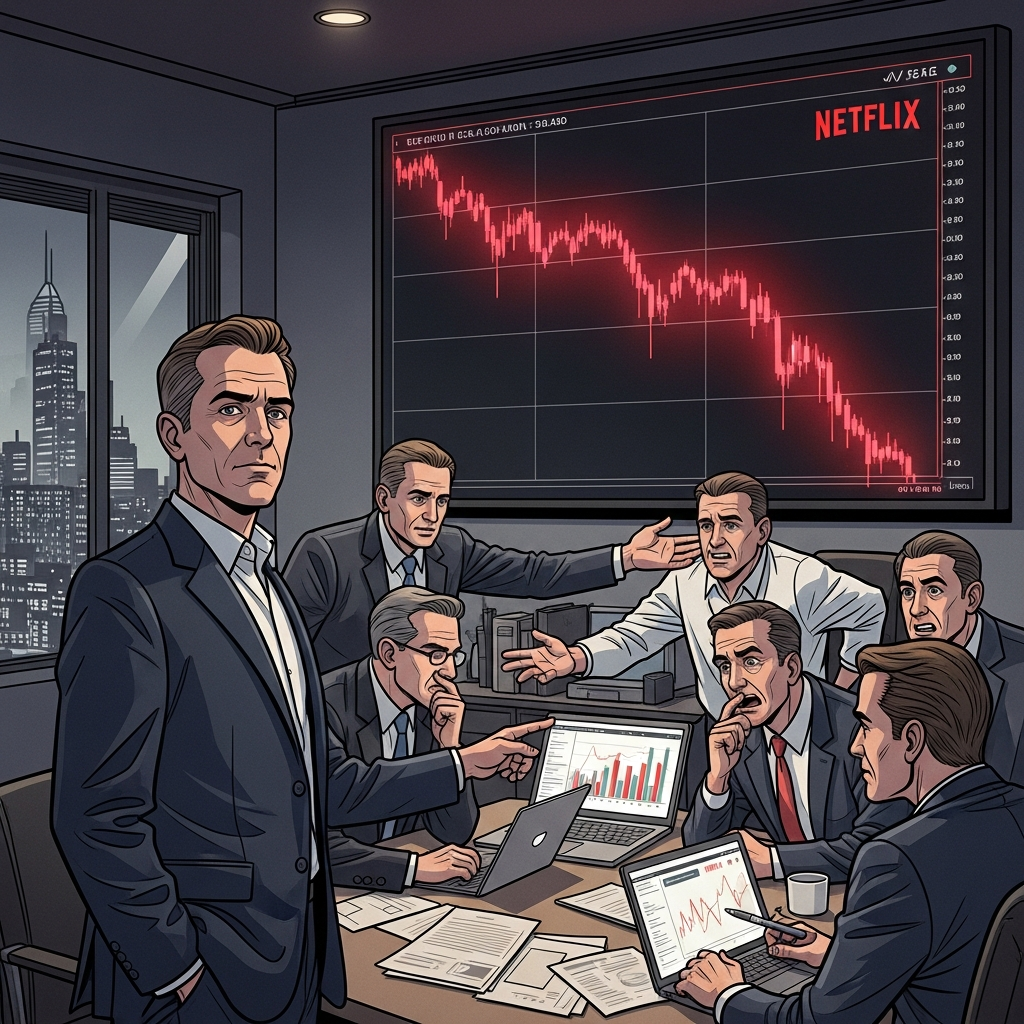
Netflix, the streaming giant, faced a significant setback as its stock plummeted 10% on Friday. This sharp decline ignited intense discussions among Wall Street analysts, who are now openly questioning the company’s future strategic direction. Investors grapple with uncertainty following Netflix’s latest earnings report and the departure of co-founder Reed Hastings, marking a pivotal moment for the entertainment leader.
The stock tumble reversed an impressive year-to-date run, which saw shares climb over 15% before earnings. This earlier momentum was fueled by news of price increases and a general sense of relief among investors. Many were reassured that Netflix would avoid a massive acquisition of traditional media assets. However, the latest financial guidance has thrown cold water on that optimism.
Unpacking Netflix’s Q1 Results and Future Guidance
Despite beating revenue and earnings expectations for its first quarter, Netflix delivered second-quarter financial guidance that fell short of analyst forecasts. This guidance miss, combined with the significant news of Reed Hastings’ departure from the board of directors, sent Netflix stock sliding in after-hours trading. Hastings’ exit concludes his three-decade association with the company he co-founded, leaving a leadership void at a critical juncture.
Trading volume in Netflix shares nearly doubled normal levels on Friday, with the stock hovering around $97. This signals considerable investor apprehension. The market’s reaction underscores a need for greater clarity from management regarding its near- to medium-term outlook. Analysts, while largely approving of the decision to forgo the Warner Bros. Discovery (WBD) acquisition, now seek a “clearer and more compelling articulation” of the path forward.
Reed Hastings’ Departure and the Strategic Vacuum
Reed Hastings’ stepping down as co-CEO and his subsequent departure from the board marks the end of an era. His vision shaped Netflix into the global streaming giant it is today. While Hastings expressed confidence that “Netflix’s greatness is so strong that I can now focus on new things,” his absence leaves investors wondering who will steer the company through increasingly turbulent waters. The market often reacts strongly to such high-profile executive transitions, especially when they coincide with strategic uncertainties.
Wall Street’s Conflicting Views on Netflix’s Future
The analyst community is divided on Netflix’s prospects. Some remain bullish, while others express significant caution. Eric Clark, a portfolio manager at LOGO ETF, maintained an optimistic stance. He views the short-term dip as mere “noise,” expressing enthusiasm for Netflix’s expansion into sports content and its strategic investments in artificial intelligence (AI). Clark also praised what he sees as a “superior business model” that could weather market fluctuations.
Conversely, Jessica Reif Ehrlich of BofA Securities, while maintaining a “buy” rating, found Netflix’s first-quarter comments from executives unpersuasive. She highlighted the lack of a clear strategy post-Warner Bros. decision. Dan Salmon of New Street Research simply quipped, “And now, back to regularly scheduled programming,” implying a return to core operational challenges without the distraction of M&A speculation.
The Looming Threat of Short-Form Content and New Competition
Jeffrey Wlodarczak of Pivotal Research Group expressed deeper concerns, maintaining a “hold” rating due to broader trends in the media and entertainment landscape. He articulated a compelling argument: short-form entertainment platforms like TikTok, Instagram, X (formerly Twitter), YouTube Shorts, and Snap are now impacting streaming in the same way streaming disrupted traditional television. These platforms are drawing younger audiences with “plummeting attention spans,” which is fundamentally detrimental to long-form content.
Wlodarczak also pointed to the rise of Free Ad-supported Streaming TV (FAST) channels as another significant threat, particularly for lower-income households seeking cost-effective entertainment options. He cautioned that Paramount’s acquisition of WBD, once finalized, would create a “much more powerful global competitor” to Netflix. This combined entity, with its expanded content library and strategic distribution, poses a formidable challenge in the global streaming arena. Paramount’s recent release of its “Street Fighter” movie trailer, showcasing an ambitious adaptation of a classic gaming franchise with a diverse cast, exemplifies the kind of IP-driven content rivals are leveraging.
The Post-Acquisition Strategy: Beyond Warner Bros. Discovery
Netflix’s decision to withdraw its $82.7 billion offer for Warner Bros. Discovery’s studios-and-streaming business in February was broadly welcomed by analysts. While Netflix had seriously explored such a massive acquisition, ultimately, WBD accepted a richer bid from Paramount. The consensus was that avoiding this entanglement freed Netflix from integrating traditional media assets. However, this relief quickly morphed into a demand for a clear, proactive strategy for growth.
Laurent Yoon of Bernstein Research is “closely monitoring” Netflix’s efforts to restore margins and avoid increasing programming spending, which could squeeze profits. He acknowledged Netflix’s investments in the mobile experience and vertical format content, seeing them as “constructive steps toward innovation aligned with shifting consumption behavior,” though not sufficient on their own. This reflects a shift away from pure subscriber growth toward more diversified revenue streams.
Diversifying Growth: Ads, Prices, and New Content Formats
The analyst consensus suggests Netflix’s future growth will rely heavily on price increases and advertising, rather than the subscription growth that defined its earlier existence. This shift aligns with the growing popularity of FAST channels and a more complex content strategy. The company’s focus on innovative content, such as the successful live-action One Piece series, which is already renewed for a third season (“The Battle of Alabasta”) and has begun production for a 2027 release, demonstrates its commitment to high-value intellectual property. This kind of investment directly counters the notion that Netflix’s story is “lacking excitement relative to a rich valuation.” The expansion of One Piece with new characters and storylines shows Netflix actively building its IP portfolio and evolving its content formats to engage diverse audiences.
However, the path isn’t without its financial bumps. An unexpected $619 million tax expense from Brazil, specifically the Contribution for Intervention in the Economic Domain (CIDE), impacted Netflix’s operating margin in a prior quarter. While this specific issue is unique to Brazil and not expected to materially affect future quarters, it highlights the complexities and unforeseen costs of operating a global streaming giant and further underscores the need for robust financial planning amidst aggressive global expansion.
Reinvigorating Investor Confidence: A Path Forward
To reignite investor confidence, Netflix needs to clearly articulate how it will navigate the evolving media landscape. This involves effectively addressing the threat of short-form content, differentiating itself from rapidly consolidating competitors, and proving the long-term viability of its advertising and price increase strategies. Continued investment in diverse content, from sports to acclaimed series like One Piece, combined with technological innovation in AI and mobile experiences, will be crucial. The market is demanding not just growth, but sustainable and profitable growth, especially given the company’s valuation.
Frequently Asked Questions
What factors led to the recent drop in Netflix stock?
Netflix stock fell primarily due to disappointing second-quarter financial guidance that undershot analyst forecasts, despite beating first-quarter revenue and earnings expectations. The news of co-founder Reed Hastings’ departure from the board also contributed significantly to investor apprehension and the subsequent sell-off. This occurred after a period where the stock had risen, partly due to anticipated price increases and relief over the company’s decision to withdraw from a potential Warner Bros. Discovery acquisition.
How is Netflix addressing increasing competition from short-form content and rival streamers?
Netflix is adapting to competition by investing in mobile experiences and vertical format content, acknowledging shifts in consumer behavior towards shorter, more accessible entertainment. While some analysts are concerned about platforms like TikTok and YouTube Shorts, Netflix continues to build its long-form content library with successful global IPs, such as the One Piece live-action series, which is confirmed for a third season. The company is also exploring diversified revenue streams like advertising and strategic price increases to maintain growth amidst a consolidating streaming industry.
What is the strategic significance of Netflix’s decision to avoid the Warner Bros. Discovery acquisition?
Netflix’s decision to withdraw its $82.7 billion offer for Warner Bros. Discovery (WBD) was largely approved by Wall Street analysts. The primary strategic significance was avoiding the burden of integrating massive traditional media assets, which could have complicated Netflix’s agility and strategic focus. However, this move also intensified questions about Netflix’s standalone growth strategy, prompting analysts to demand a clearer articulation of how the company plans to drive future value in a highly competitive market, especially as rivals like Paramount pursue major consolidations.
Conclusion
The recent plunge in Netflix stock highlights a pivotal moment for the company. While the immediate concerns revolve around financial guidance and leadership changes, the broader narrative signals a critical re-evaluation of Netflix’s post-Warner strategy. The streaming giant is caught between the need for consistent growth and the evolving demands of a dynamic media landscape, from short-form content to powerful new competitors. To succeed, Netflix must demonstrate clear strategic execution, leverage its core strengths in content and technology, and convincingly articulate a vision for sustainable value creation that resonates with a skeptical Wall Street. The coming quarters will be instrumental in shaping the market’s perception of Netflix’s long-term trajectory.