The Trump administration grapples with a deepening crisis in the Strait of Hormuz, marked by escalating tensions with Iran and rapidly shifting diplomatic positions. President Trump’s earlier optimistic pronouncements about reopening the vital waterway have unraveled, paving the way for renewed conflict. This complex geopolitical standoff is just one facet of a presidency facing diverse challenges, from domestic political unrest to significant policy shifts on technology, agriculture, and executive power. This comprehensive overview examines the latest developments, offering insights into the administration’s strategic responses and the broader implications for US policy.
Iran Standoff: The Strait of Hormuz Recloses Amid Escalating Tensions
What began with hopes of de-escalation quickly spiraled into renewed confrontation. Following President Donald Trump’s social media claims on Friday, April 18, 2026, that Iran had agreed to keep the strategic Strait of Hormuz open, hailing it as “A GREAT AND BRILLIANT DAY FOR THE WORLD!”, the situation dramatically reversed. Trump had also linked this positive development to an upcoming summit with Chinese President Xi, implying a broader diplomatic triumph.
Naval Blockade and Tehran’s Defiance
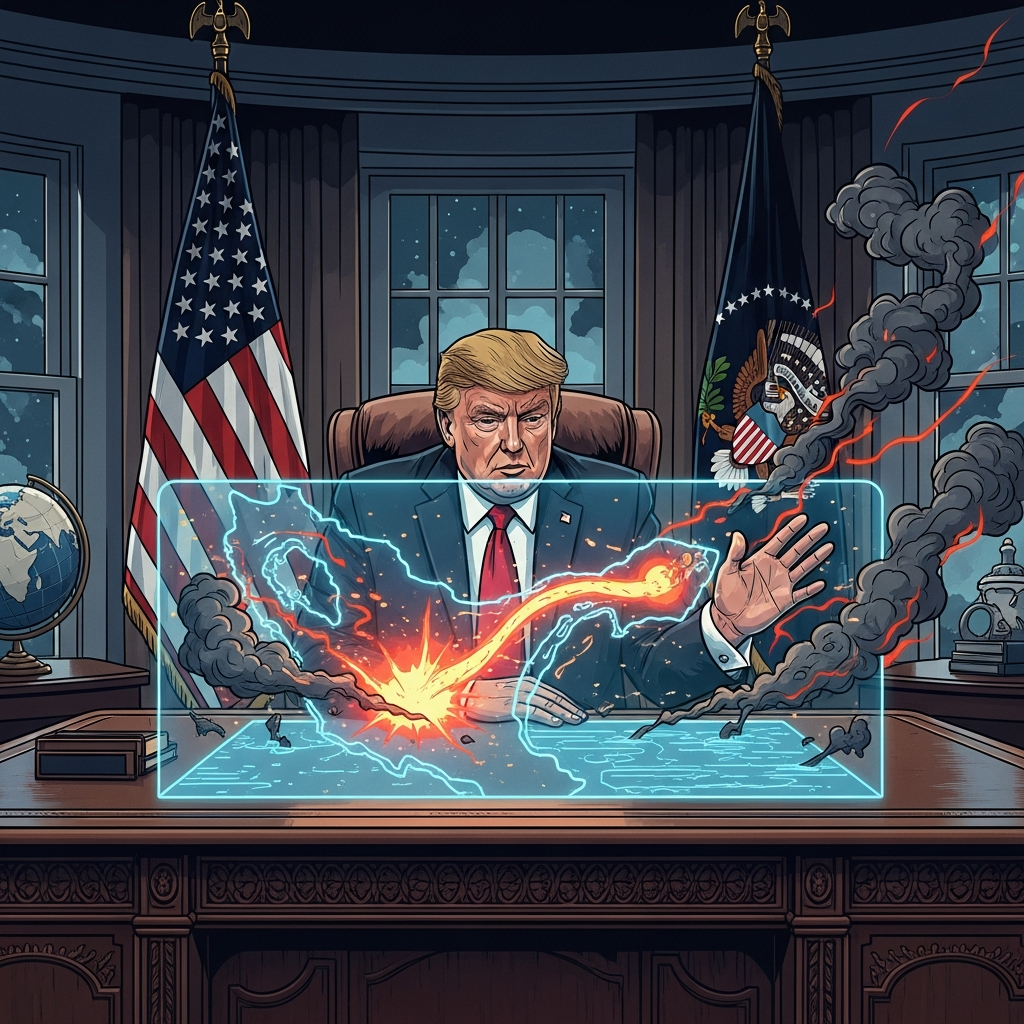
However, these optimistic claims were short-lived. President Trump subsequently declared on social media that the US naval blockade on Iranian ports would “remain in full force and effect” until a “transaction with Iran is 100% complete,” a process he anticipated would be “very quickly.” Tehran swiftly responded by reversing its course on opening the strait, a critical choke point for global oil shipments. Reports from a UK maritime agency indicated that Islamic Revolutionary Guard Corps (IRGC) ships fired at a tanker attempting passage, while Reuters separately confirmed an attack on an Indian-flagged crude oil vessel within the waterway.
The rapid deterioration of relations prompted an urgent White House Situation Room meeting. A senior US official warned that without a breakthrough in peace talks, a “war could reopen within days.” This diplomatic breakdown, according to analysis, stemmed from “mismanaged and premature media announcements” by both the US and Tehran. Iran’s defiant stance included reinstating a complete block on commercial shipping through the strait and declaring it would not export any of its highly enriched uranium stockpile.
The Economic Fallout and Strategic Dilemmas
The ongoing conflict in Iran, which commenced on February 28, 2026, has significant economic repercussions. Nearly a month into the war, gasoline prices have already seen a projected one-dollar increase per gallon. The Pentagon requested an additional $200 billion to sustain military operations. Expert analysts, such as David Brooks and Jonathan Capehart, have critiqued President Trump’s contradictory statements regarding war objectives and exit strategies. His reliance on social media for updates, rather than a formal Oval Office address, has further eroded public trust. Claims of “everything is great” clash sharply with observable realities, including burning tankers and damaged oil infrastructure in Gulf states, which could take years to repair.
Brooks highlighted a critical choice for the administration: commit to a costly, multi-month operation to clear the Strait of Hormuz or negotiate an immediate settlement. He termed the conflict a potential “mother of all mowing the grasses,” aimed at significantly reducing Iran’s regional power. Evidence of success, he suggested, could include the “decapitation of the regime” and destruction of Hamas, Hezbollah, and Iranian weapons capabilities. Despite the economic hardship and the likelihood of an “ugly win,” Brooks argued that reducing Iran’s power for the next generation could benefit the wider region, fostering a “grand coalition against Iran” among Gulf states and Israel. Capehart, however, voiced alarm over the administration’s lack of a clear “day two” plan and the reported disregard for intelligence regarding the strait’s closure, emphasizing the need for a truthful, articulated vision for post-conflict stability.
Domestic Political Landscape and Key Administrative Actions
Beyond the Iran crisis, the Trump administration navigated a complex domestic political landscape and advanced several key policy initiatives. Public sentiment showcased a degree of “buyer’s remorse” among some of Trump’s three-time voters, expressing disappointment over unfulfilled promises regarding new wars and rising prices.
Criticism, Controversies, and Reforms
Democratic Senator Jon Ossoff openly criticized Trump’s optimistic Iran predictions at a campaign rally in Augusta, Georgia. Ossoff, a potential 2028 presidential candidate, condemned the “unprecedented corruption of the president’s family” and argued that military interventions would burden young Americans while cutting essential domestic services. Separately, FBI Director Kash Patel vehemently denied allegations of excessive drinking and being unreachable during his tenure, threatening legal action against a publication that detailed these claims.
On a different front, President Trump announced reforms aimed at accelerating access to psychedelic drug treatments. He signed an executive order directing the Food and Drug Administration (FDA) to expedite the review of drugs like ibogaine. US military veteran groups have advocated for these treatments, citing their potential to help treat post-traumatic stress disorder (PTSD). Data from January to September 2025 also revealed that US Immigration and Customs Enforcement (ICE) deported 174 individuals who were renewing their protections under the Deferred Action for Childhood Arrivals (DACA) program.
Broader Policy Shifts and Judicial Scrutiny
The Trump administration’s influence extended across several other critical areas, including technology regulation, executive power, trade policy, and international relations. Each presented unique challenges and garnered significant attention.
AI, Executive Authority, and Economic Policy
A notable conflict arose between the White House and the AI company Anthropic. President Trump ordered federal agencies to “IMMEDIATELY CEASE” using Anthropic’s AI technology after the company resisted granting the US Department of Defense “unfettered access” to its Claude AI system for mass surveillance or autonomous weapons. Anthropic CEO Dario Amodei defended the company’s “red line,” arguing that AI could “undermine, rather than defend, democratic values” in certain contexts. Trump branded Anthropic an “out-of-control, Radical Left AI company,” asserting that the US would determine its own technological destiny.
Separately, the US Supreme Court signaled its readiness to expand presidential power over independent agencies. The Court heard arguments concerning the legality of Trump’s dismissal of a Democratic member of the Federal Trade Commission (FTC), Rebecca Slaughter, before her term expired. This case could overturn a nearly century-old New Deal-era precedent that protects independent agency heads from presidential removal, potentially ushering in a “historic expansion of executive power.”
Trade Wars and Agricultural Support
In response to the economic strain on American farmers due to his administration’s trade wars and tariffs, particularly with China, President Trump unveiled a $12 billion farm aid package. Announced at a White House roundtable in February 2026, this aid, sourced from tariff revenue, aimed to provide certainty for farmers impacted by reduced sales and increased costs. Over $11 billion was immediately allocated to the Farmer Bridge Assistance program, primarily benefiting row crop farmers, with soybeans and sorghum growers identified as the hardest hit by Chinese trade disputes.
Despite China’s promise to purchase significant volumes of US soybeans, actual purchases lagged, prompting the need for these “bridge payments.” While appreciated, many farmers view the aid as a temporary fix, preferring market profitability over subsidies. Concerns arose about potential industry consolidation, threatening smaller family farms. Trump also addressed record-high beef prices, suggesting more Argentine beef imports and directing investigations into “anti-competitive behavior” across broader food supply chains.
Global Diplomacy and Notable Incidents
Internationally, Trump suggested a “friendly takeover of Cuba” amidst strained US-Cuba relations. Brazilian officials warned of a potential “Vietnam-style” conflict if the US invaded Venezuela, calling Trump’s order to close Venezuelan airspace “an act of war.” US Secretary of State Marco Rubio reportedly directed Middle East ambassadors to avoid public comments that could worsen tensions, aiming to support Trump’s strategy for pressuring Iran on nuclear weapons.
Further controversies included former President Bill Clinton’s House testimony regarding his connections to Jeffrey Epstein, denying knowledge of Epstein’s crimes. Similarly, scrutiny intensified over US Commerce Secretary Howard Lutnick’s ties to Epstein. Defense Secretary Pete Hegseth faced criticism for contradictory statements on the military’s obligation to refuse “unlawful” orders. Finally, Trump voiced concerns about competition issues regarding Netflix’s proposed $83 billion acquisition of Warner Brothers, indicating his involvement in the government’s approval decision.
Frequently Asked Questions
What is the core issue with the Strait of Hormuz and the Iran conflict?
The central issue revolves around Iran’s closure of the Strait of Hormuz, a critical global oil shipping lane, in defiance of US naval blockades on Iranian ports. President Trump initially claimed a diplomatic breakthrough with Iran to keep the strait open, but quickly reversed course by reiterating the blockade. This led to Iran reclosing the waterway and reports of IRGC ships firing on tankers. The escalating tensions stem from conflicting US and Iranian demands, raising fears of a broader conflict and significant economic repercussions, including rising gas prices.
What action did President Trump take regarding psychedelic drug treatments?
President Trump signed an executive order directing the federal Food and Drug Administration (FDA) to expedite the review process for psychedelic drugs, such as ibogaine. This initiative aims to accelerate access to medical research and treatment based on these substances. The move was particularly championed by US military veteran groups, who advocate for psychedelic therapies as a potential aid in treating post-traumatic stress disorder (PTSD), highlighting a focus on alternative mental health solutions within the administration.
How have US farmers been impacted by trade policies, and what support has the administration offered?
US farmers have been significantly impacted by the Trump administration’s trade war and tariffs, particularly with China, leading to reduced sales and increased costs. Soybeans and sorghum farmers were especially hard hit due to diminished exports to China. In response, President Trump announced a $12 billion farm aid package, with over $11 billion allocated to the Farmer Bridge Assistance program. This aid, funded by tariff revenue, provides one-time payments to help farmers manage financial losses, although many prefer market profitability over government subsidies.
Conclusion
The Trump administration continues to navigate a complex array of challenges, with the Iran crisis and the closure of the Strait of Hormuz at the forefront of global concerns. The delicate balance between aggressive policy stances and diplomatic efforts defines its approach to international relations. Domestically, the administration has pushed forward with reforms in areas like psychedelic drug access while facing ongoing scrutiny over issues ranging from executive power to AI regulation and immigration policy. The cumulative effect of these actions underscores a period of significant geopolitical and domestic flux, with the implications of each decision continuing to unfold across the US and the world.