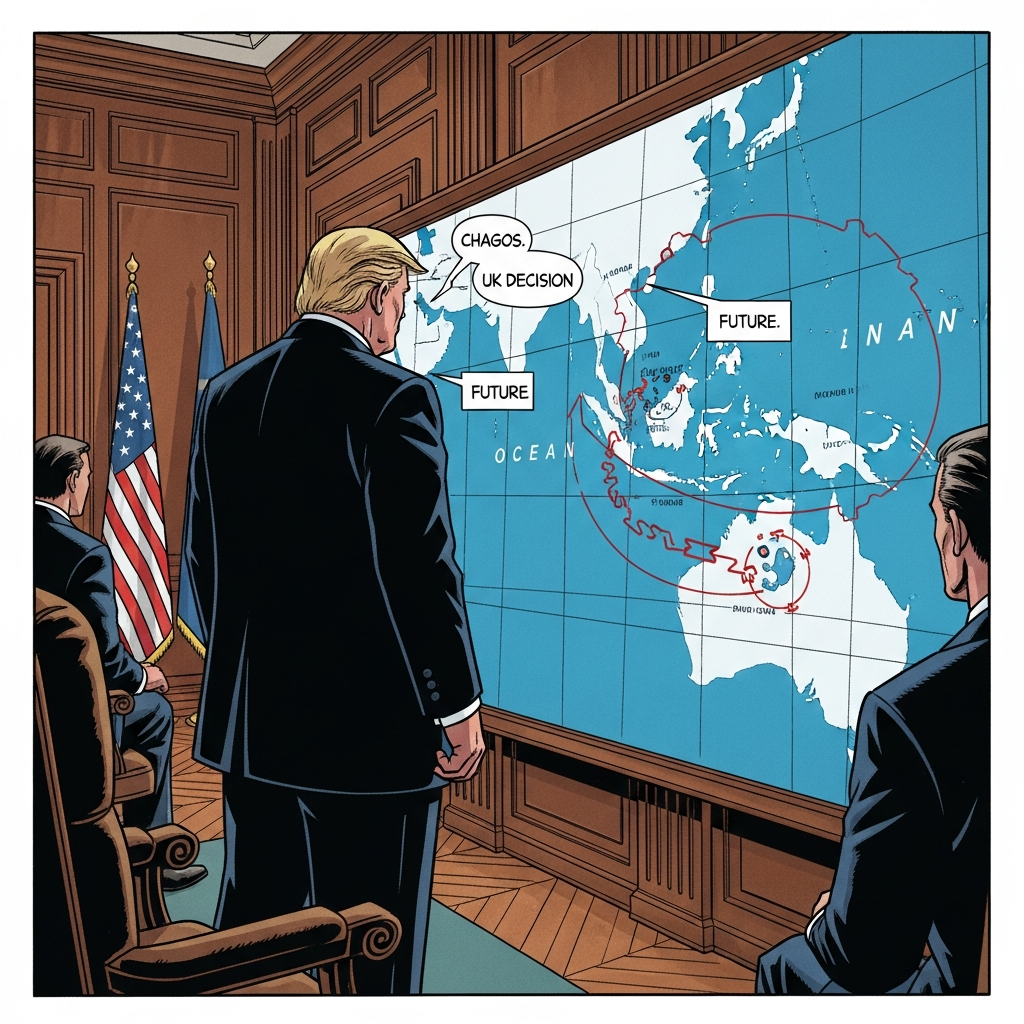
The United Kingdom has indefinitely suspended its plans to transfer sovereignty of the Chagos Islands to Mauritius. This significant decision follows strong opposition and a withdrawal of support from the U.S. administration, led by President Donald Trump. The archipelago, home to the vital joint U.S.-U.K. military base on Diego Garcia, now faces an uncertain future. This halt underscores complex geopolitical tensions, diplomatic challenges, and deep-seated historical grievances.
The Strategic Heart: Diego Garcia and the Chagos Islands
The Chagos Islands, a remote archipelago of over 60 islands, lie strategically in the Indian Ocean, south of the Maldives and off India’s tip. Britain has controlled these islands since 1814, historically as the British Indian Ocean Territory (BIOT). Its largest island, Diego Garcia, hosts a crucial joint U.S.-U.K. military base. This facility has been instrumental in numerous U.S. military operations. It served as a launchpad for campaigns in Vietnam, Iraq, and Afghanistan. More recently, it supported American bombers during the U.S.-Israeli conflict with Iran. The base’s enduring operational security remains a paramount concern for both Washington and London.
For years, the U.K. government under Prime Minister Keir Starmer sought to resolve a long-standing dispute with Mauritius. Mauritius claims sovereignty over the islands. The United Nations and its top court have also urged Britain to return the territory. To safeguard the military base from international legal challenges, Starmer’s government negotiated a deal. This agreement proposed Britain would hand over sovereignty but lease back the Diego Garcia base for a minimum of 99 years. The U.K. also offered £3.4 billion over a century to Mauritius to secure continued access.
Trump’s Sudden Reversal: A Diplomatic Freeze
Initially, President Trump’s administration had supported the handover agreement. However, his stance abruptly reversed in January. Trump publicly denounced the proposed transfer as “an act of GREAT STUPIDITY” on social media. This sudden policy shift sent shockwaves through London. Trump had previously warned Prime Minister Starmer in February that he was “making a big mistake” by giving over the island. “This land should not be taken away from the U.K.,” Trump declared. He added, “if it is allowed to be, it will be a blight on our Great Ally.”
The withdrawal of U.S. backing left the U.K. government in a difficult position. British officials confirmed that legislation underpinning the deal would not be included in the King’s Speech next month. This effectively stalled the parliamentary process. Simon McDonald, former head of Britain’s Foreign Office, noted that the U.K. government “had no other choice” but to put the deal “into the deep freeze” given Trump’s overt hostility. The British government conceded that the bill lacked sufficient time to pass before the current parliamentary session concluded. It is not expected for reintroduction in the next session starting May 13.
UK’s Complex Motivations and Domestic Backlash
The Starmer government’s pursuit of the deal stemmed from a desire to avoid a potentially painful and expensive legal dispute with Mauritius. Yet, the decision to pause the agreement highlights the crucial need for U.S. support. A U.K. government spokesperson stated, “We continue to believe the agreement is the best way to protect the long-term future of the base, but we have always said we would only proceed with the deal if it has U.S. support.” Despite frustrations with the U.S. turnaround, British officials express hope for the deal’s eventual revival. Engagements with both the U.S. and Mauritius are ongoing.
Domestically, the agreement also faced significant opposition within the U.K. Prime Minister Starmer reportedly harbored concerns about potential political backlash from his own Members of Parliament. This concern related to the annual cost of the deal, particularly amidst welfare payment cuts. Opposition parties, including Britain’s Conservative Party and Reform U.K., vehemently opposed relinquishing the islands. They argued that such a move would expose them to potential interference from China and Russia. These parties actively lobbied the Trump administration to revoke its support for the deal, successfully influencing the outcome.
Geopolitical Chessboard: China, Iran, and Military Preparedness
The strategic importance of Diego Garcia extends beyond the U.S.-U.K. alliance. The base has played a critical role in recent geopolitical events. During the Middle East conflict, Iran targeted the Diego Garcia base. Iranian forces fired two ballistic missiles unsuccessfully at the Indian Ocean islands. This incident underscored the base’s vulnerability and its direct relevance in regional conflicts. Prime Minister Starmer had initially restricted American planes from using British air bases for attacks on Iran. He later permitted their use, including Diego Garcia, for strikes specifically targeting Iran’s missile sites.
Concerns about the deal’s irreversible nature also weighed heavily. Once sovereignty transfers, Mauritius could potentially strengthen its alliance with China. This raises fears of Chinese encroachment on other islands within the Chagos Archipelago. China has a track record, particularly in the South China Sea, of developing seemingly “civilian” islands. These often transform into military installations. Mauritius and China already share a Free Trade Agreement. The Chinese community in Mauritius holds significant parliamentary representation. The current Mauritian Prime Minister, Navin Ramgoolam, maintains a much closer relationship with China than his predecessor. Recent pledges from the new Chinese Ambassador to enhance Mauritius-Chinese relations further fuel these concerns.
Recent activity on Diego Garcia further emphasizes its enduring military significance. The airfield showed substantial activity with B-52 bombers and F-15 fighter jets visible. The F-15 fighters provide local defense in light of Iranian threats. This confirmed need for local defense reinforces the perception for forward radar sites on the northern Chagos Islands.
The Unheard Voices: Chagossian People’s Rights
Adding a crucial humanitarian layer to this complex issue are the Chagossian people. These indigenous inhabitants were forcibly displaced from Diego Garcia in the 1960s and 1970s. Their removal facilitated the construction of the military base. An estimated 10,000 displaced Chagossians and their descendants now reside primarily in Britain, Mauritius, and the Seychelles. Critically, these communities reportedly were not consulted on the proposed deal.
Critics also highlight a perceived double standard concerning the transfer of Chagossian citizenship to Mauritius. They draw parallels to the Falkland Islanders, whose right to choose whether to remain British was staunchly defended by the U.K. The Chagossians fear the agreement could further impede their long-standing, but unsuccessful, legal efforts in U.K. courts to return to their ancestral homes. Their desire to return to their homeland remains a central, unresolved aspect of this ongoing dispute. Mauritius, after Trump’s intervention last month, has indicated it is exploring legal tools against London. This suggests a potentially painful and expensive legal dispute looms for the U.K.
Frequently Asked Questions
Why did the UK halt the Chagos Islands handover?
The UK halted the Chagos Islands handover primarily due to opposition from U.S. President Donald Trump’s administration. Trump initially supported the deal but reversed his stance, publicly calling it a “big mistake.” This withdrawal of crucial U.S. backing left the UK government with “no other choice” but to pause the legislation. Domestically, there were also concerns about the deal’s annual cost and opposition from Conservative and Reform U.K. parties who feared potential Chinese and Russian influence.
What is the strategic importance of Diego Garcia?
Diego Garcia, the largest island in the Chagos archipelago, hosts a vital joint U.S.-U.K. military base. Its strategic location in the Indian Ocean makes it crucial for projecting power across the Middle East, Africa, and Asia. The base has supported U.S. military operations in Vietnam, Iraq, and Afghanistan. More recently, it was used for strikes against Iranian missile sites. Its operational security is paramount for both nations. There are emerging needs for local defense and forward radar sites due to evolving geopolitical threats.
How does the Chagos Islands decision impact the Chagossian people?
The decision to pause the handover brings further uncertainty for the Chagossian people. They were forcibly displaced from Diego Garcia in the 1960s and 1970s to make way for the military base. These indigenous inhabitants, estimated at over 10,000 descendants, were reportedly not consulted on the deal. They fear that the agreement, even if revived, could further hinder their long-standing legal efforts and aspirations to return to their ancestral homes. The lack of consultation and transfer of citizenship without their input remains a significant humanitarian concern.
The Unfolding Narrative: An Uncertain Future
The Chagos Islands handover deal, designed to reconcile strategic military interests with international legal obligations and historical grievances, currently remains stalled. Its future is highly uncertain. It hinges on potential shifts in U.S. policy and the ability of the U.K. and Mauritius to navigate this complex geopolitical landscape. The broader implications for U.S.-U.K. relations, regional stability, and the rights of the Chagossian people will continue to unfold. This saga exemplifies the intricate interplay between global power dynamics, national security, and international law.