Major League Baseball veteran umpire C.B. Bucknor endured a dramatic exit from Wednesday’s Brewers-Rays game in Milwaukee, suffering a direct hit to his facemask from a scorching foul tip. The incident, which caused a significant delay and forced Bucknor’s early departure, marks the culmination of a particularly challenging week for the seasoned official, highlighting the intense pressures facing umpires in the modern MLB era, especially with the league’s new Automated Ball-Strike (ABS) challenge system. This in-depth report details the foul ball incident, its immediate aftermath, and the broader context of Bucknor’s recent struggles, offering valuable insight into the evolving landscape of baseball officiating.
Foul Ball Sends Veteran MLB Umpire C.B. Bucknor Off Field
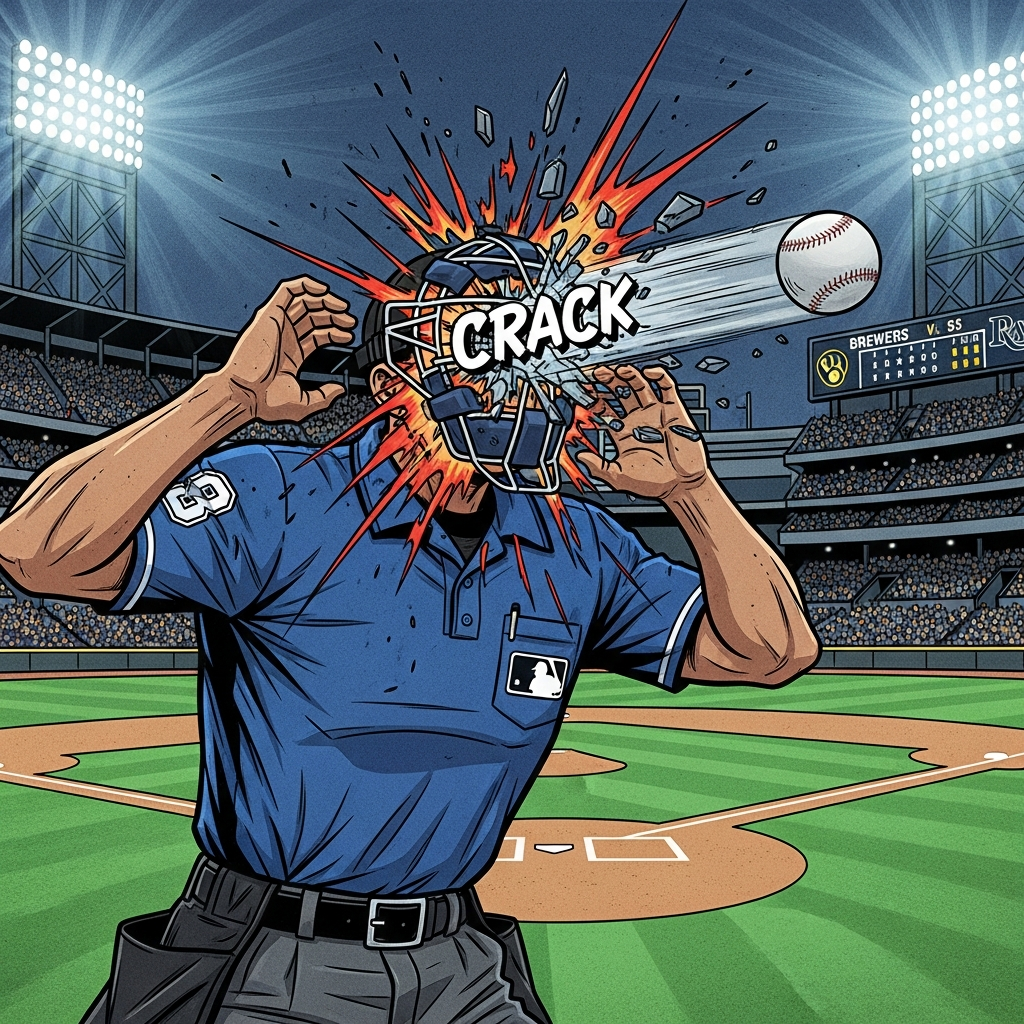
The pivotal moment unfolded in the top of the second inning during the April 1, 2026, contest between the Milwaukee Brewers and the Tampa Bay Rays. Home plate umpire C.B. Bucknor, a familiar face in MLB for decades, was positioned behind Brewers catcher William Contreras as Rays batter Nick Fortes stepped to the plate. Brewers flamethrower Jacob Misiorowski unleashed a 100.2 mph fastball, which Fortes managed to foul tip. The ball rocketed backward, striking Bucknor’s facemask with immense force.
The impact was immediate and jarring. Bucknor, 63, instantly stumbled and dropped to his knees behind home plate. Both Fortes and Contreras quickly recognized the severity, with Contreras being the first to check on the umpire. Brewers training staff swiftly rushed onto the field to attend to Bucknor, who was visibly shaken. After a brief consultation and assessment, it became clear he could not continue. Assisted by the training staff, Bucknor exited the field, walking under his own power but with evident discomfort.
Game Interrupted: The Aftermath of the Umpire Injury
Bucknor’s unexpected departure brought the game to a halt for approximately 13 minutes. This delay allowed for the necessary transition in the umpiring crew. Chad Fairchild, who had initially been working at first base, seamlessly moved to take over duties behind home plate. The game then resumed with a three-man umpiring crew for the remainder of the contest, a common adjustment when an umpire is incapacitated.
Interestingly, despite the disruption, Brewers pitcher Jacob Misiorowski had started the game strongly, striking out four of the first five batters he faced. However, after the lengthy delay, Fortes, the player who hit the foul ball, singled for the Rays’ first baserunner. The Brewers ultimately secured an 8-2 victory, their fifth win in the first six games of the season, but the primary takeaway for many was the dramatic exit of the veteran MLB umpire. This incident wasn’t Bucknor’s first such injury; he had previously been forced to leave a game in 2013 due to a similar foul tip.
C.B. Bucknor’s Challenging Week: Navigating Controversies and the ABS System
The foul ball incident, while a direct physical blow, was merely the apex of what has been described as a “terrible, horrible, no good, very bad week” for C.B. Bucknor. His on-field injury followed a series of controversial calls and intense scrutiny, positioning him as an early-season focal point in the debate surrounding MLB’s new Automated Ball-Strike (ABS) challenge system. This period highlights the immense pressure and rapid adjustments umpires are currently facing.
Just the day before, on Tuesday, while umpiring first base in Milwaukee, Bucknor made what many deemed an “egregious call.” He ruled Brewers first baseman Jake Bauers out for reportedly missing the bag after a line drive. Replays, however, clearly showed Bauers’ cleat making contact with the base. The Brewers successfully challenged the call, which was overturned, a sequence that reportedly “elicited laughter” from both team managers. This public reversal added to the scrutiny on Bucknor’s decision-making.
The ABS Challenge System: A New Era of Umpire Scrutiny
The controversies surrounding Bucknor actually began even earlier in the week. Over the weekend, while serving as home-plate umpire in Cincinnati, six of his eight ball/strike calls that were challenged by the Reds and Red Sox were overturned by the ABS system. Back-to-back successful challenges by Reds slugger Eugenio Suárez drew loud cheers from the crowd, further amplifying the umpire’s struggles. Later in that same game, Bucknor called Trevor Story of the Red Sox out on a check swing. With no challenges left, Story argued, leading to the ejection of Red Sox manager Alex Cora, who later acknowledged Bucknor’s difficult day, stating, “He has one job to do, it’s (to) call balls and strikes. It wasn’t his best day. That’s what the system does. It’s out there, everybody sees it, and he’ll be the first one to accept it.”
The introduction of the ABS challenge system has fundamentally altered the game for umpires. Former umpires have voiced concerns about the system’s precise nature, which can overturn pitches by “a tenth of an inch,” even as they question the system’s own inherent exactness. This microscopic level of precision has left active umpires feeling caught between their human judgment and “what the machine is going to call a strike.” Umpires are now primarily focused on “not to get overturned,” acknowledging that “being close doesn’t really help” when accuracy is measured in such minute fractions. This new environment means that being wrong no longer just means a manager’s rebuke, but can lead to public humiliation amplified on stadium videoboards and social media.
The Future of Umpiring: Safety, Technology, and Human Element
C.B. Bucknor’s incident underscores perennial concerns about umpire safety in MLB. Despite protective gear like facemasks, the sheer velocity of modern baseballs, especially foul tips, poses a constant threat. Umpires are positioned directly in the line of fire, and while injuries are relatively rare, when they occur, they can be severe. This latest incident serves as a stark reminder of the physical risks involved in the job, even for veteran officials.
Beyond immediate safety, Bucknor’s challenging week also ignites conversations about the evolving role of the human umpire. As one of the two longest-tenured umpires in the majors, Bucknor has officiated in significant MLB events, including All-Star Games and Division Series, and has been on the field for two no-hitters. His extensive career highlights a wealth of experience, yet even he is struggling to adapt to the new technological demands. The blend of human judgment, which allows for nuance and game management, versus the absolute precision of technology, remains a central debate in baseball. The league’s “groundbreaking season” for robot umpire calls suggests that these discussions will only intensify as MLB continues to explore how best to integrate technology while preserving the integrity and human element of the game. It remains uncertain whether C.B. Bucknor will miss additional time following his early exit from Wednesday’s game.
Frequently Asked Questions
What exactly happened to MLB Umpire C.B. Bucknor during the Brewers-Rays game?
During the second inning of the Milwaukee Brewers vs. Tampa Bay Rays game on April 1, 2026, veteran home plate umpire C.B. Bucknor was hit directly in his facemask by a 100.2 mph foul tip. The ball came off the bat of Rays hitter Nick Fortes after a pitch from Brewers pitcher Jacob Misiorowski. The impact was severe, forcing Bucknor to drop to his knees. After being attended to by training staff, he was unable to continue umpiring and left the game, which caused a 13-minute delay.
How has MLB’s new Automated Ball-Strike (ABS) challenge system impacted umpires like C.B. Bucknor?
MLB’s new Automated Ball-Strike (ABS) challenge system has introduced a new layer of scrutiny and difficulty for umpires. For C.B. Bucknor, this system has contributed to a challenging week, with several of his ball/strike calls being overturned by replay earlier in the season. The system’s ability to measure pitches with extreme precision (e.g., “a tenth of an inch”) places immense pressure on umpires to align their calls with the “machine,” leading to public reversals and increased criticism. Many umpires are struggling to adapt to this unforgiving precision and the public humiliation of overturned calls.
What are the implications of umpire injuries and the ABS system for the future of MLB umpiring?
Umpire injuries like C.B. Bucknor’s highlight ongoing safety concerns in MLB, underscoring the need for robust protective gear and quick response protocols. The introduction of the ABS challenge system, meanwhile, suggests a future where the human element of umpiring, particularly regarding ball/strike calls, may be significantly diminished or redefined. This could lead to a shift in umpires’ roles, potentially focusing more on base calls and game management, while technology handles the strike zone. The debate continues on how to balance tradition, technology, and umpire well-being in the sport.
The foul ball incident involving MLB umpire C.B. Bucknor serves as a potent reminder of the inherent dangers on the baseball field and the human element within a game increasingly shaped by advanced technology. While the immediate focus is on Bucknor’s recovery, this event, coupled with his recent challenges under the new ABS system, sparks broader discussions about umpire safety, the evolving role of officiating, and the ongoing quest for perfection in America’s pastime. As MLB continues to experiment with technology, the human stories behind the plate, like Bucknor’s, remain a critical part of the game’s compelling narrative.