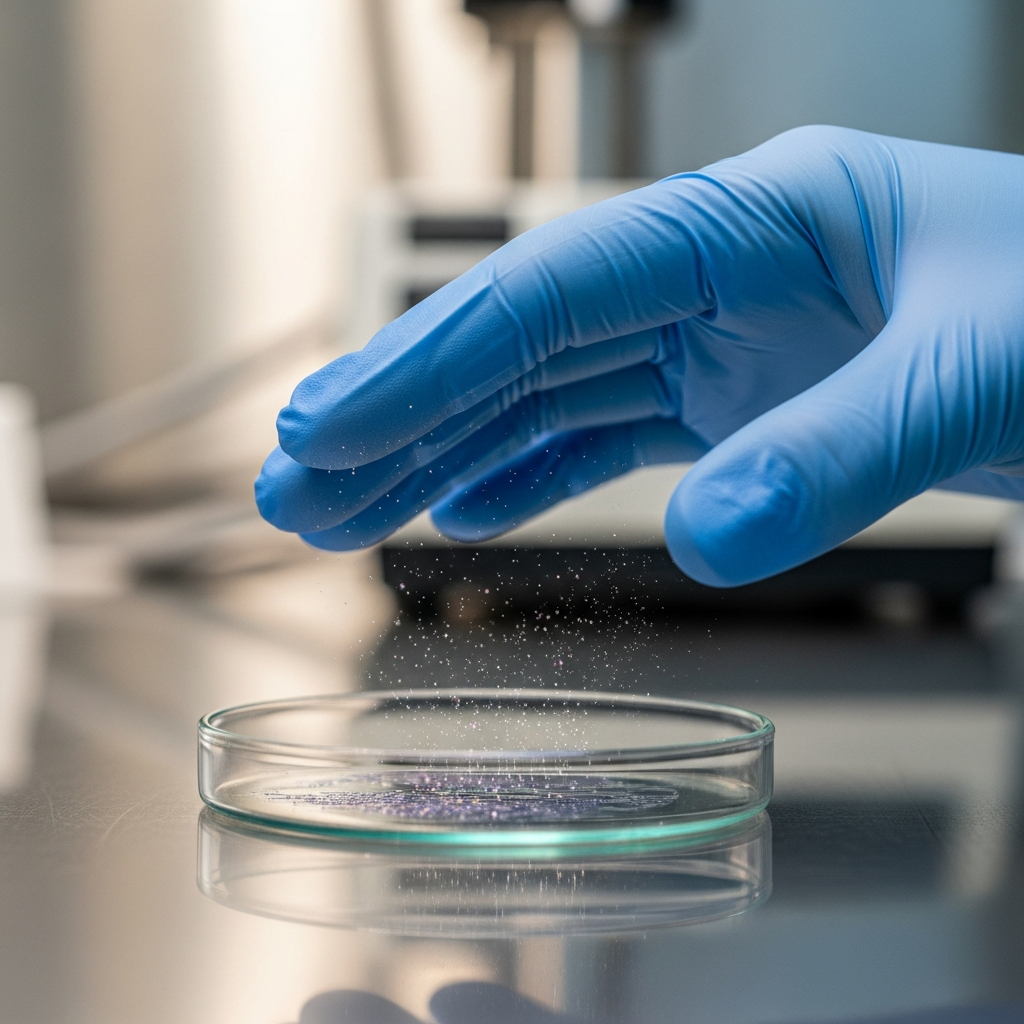
The pervasive issue of plastic pollution is a defining challenge of our era, with microplastics – tiny plastic particles – detected everywhere from the deepest oceans to the air we breathe and even within human tissues. Yet, a groundbreaking study by University of Michigan chemists reveals a critical oversight that may have led to a significant overestimation of microplastic abundance in scientific research: common laboratory gloves. This unexpected source of contamination suggests that our understanding of microplastic levels could be skewed, demanding a re-evaluation of current research methodologies and findings across the scientific community.
The Elusive Nature of Microplastic Detection
Identifying and quantifying microplastics presents immense challenges for scientists. These minuscule particles can range dramatically in size, from visible fragments down to dimensions smaller than a red blood cell. Their ubiquitous presence in our environment means that unintentional sample contamination is an ever-present risk during laboratory analysis. Researchers often go to extreme lengths, employing specialized cleanrooms and non-plastic attire, to prevent outside interference. Despite such rigorous protocols, the latest findings indicate a surprising source of “false positives” that has profound implications for environmental science and policy.
An Unexpected Anomaly in Air Sampling
The journey to this discovery began with a team of chemists at the University of Michigan, including Professor Anne McNeil and Ph.D. candidate Madeline Clough. Their initial goal was to assess the amount of atmospheric microplastics Michiganders were inhaling daily. Following all standard, rigorous contamination prevention measures – avoiding plastic equipment, wearing non-plastic clothing, and utilizing a specialized chamber to filter lab air – their preliminary results were astonishing. The air samples revealed microplastic counts more than 1,000 times greater than any previously reported levels. These anomalous figures immediately raised a red flag, prompting the team to embark on an exhaustive investigation to pinpoint the source of this inexplicable contamination.
Unmasking the Hidden Culprit: Lab Gloves
After an extensive “wild goose chase,” the researchers ultimately identified an everyday lab staple as the primary offender: laboratory gloves. Ironically, these gloves are widely recommended as a best practice in scientific research for sample handling and personal protection. The problem, as the Michigan team uncovered, lies not with the plastic material of the gloves themselves, but with a specific chemical additive.
Stearate Salts: The Invisible Imposters
The contaminating particles were identified as stearate salts. These soap-like molecules serve a crucial role in glove manufacturing, acting as a lubricant to help gloves cleanly release from their molds. When scientists wear these gloves to handle delicate laboratory equipment or samples – such as the small metal sheets used to collect air particulates in the Michigan study – these stearate salts are unknowingly transferred. While harmless in small environmental quantities and distinct from microplastics, these salts pose a significant analytical problem.
The Mimicry Problem: Deceiving Scientific Instruments
The core issue stems from the structural similarity between stearate salts and common plastics, particularly polyethylene, which is one of the most frequently found microplastics in the environment. Scientists typically rely on vibrational spectroscopy to identify microplastics. This technique analyzes how a particle interacts with light, generating a unique “chemical fingerprint.” However, because polyethylene and stearate salts share remarkably similar molecular structures, they produce very similar chemical fingerprints when subjected to spectroscopic analysis.
This structural mimicry means that, often, the stearate particles transferred from lab gloves are incorrectly identified as genuine microplastics. The challenge is exacerbated by the increasing reliance on automated analysis methods in research, which, while boosting efficiency, can also accelerate the rate of these misidentifications. This leads to higher reported microplastic counts than what truly exists in the environment, creating a distorted picture of pollution levels.
Quantifying the Contamination’s Scale
To gauge the extent of this contamination, the research team conducted controlled experiments with seven different types of gloves, simulating typical lab handling. Their findings were alarming: gloves could contribute over 7,000 particles per square millimeter that were falsely attributed to microplastics. This highlights a widespread potential for researchers to unknowingly inflate microplastic abundance estimates simply through routine sample handling.
Even more concerning, a significant proportion of these misidentified particles were less than 5 micrometers in size. Microplastics in this ultra-small range are particularly worrisome for human and ecosystem health because they can more easily penetrate cells and biological barriers. By artificially inflating counts within this critical size range, glove-induced contamination could inadvertently compromise studies that inform future environmental policies and health regulations.
Broader Implications: Scrutiny on Microplastics in Human Bodies
The challenges highlighted by the University of Michigan study resonate with growing concerns within the broader scientific community regarding the reliability of microplastic detection, especially in human tissues. External research summaries indicate that some experts are urging caution, suggesting that reported findings of microplastics in human blood, brains, and other organs might also be subject to overestimation due to similar contamination issues.
Experts like Stephanie Wright and Leon Barron from Imperial College London have questioned the accuracy of various studies, citing the inherent difficulty in isolating minute plastic fragments from biological samples. Natural fatty tissues, composed of carbon and hydrogen, can produce signals akin to plastics, making differentiation exceptionally challenging. Sample contamination during testing is an “ever-present issue,” as noted by Kevin Thomas, director of the Queensland Alliance for Environmental Health Sciences. A “forensic approach” employing multiple methodologies for cross-verification is now being advocated to enhance confidence in research findings concerning microplastics in the human body.
Redefining Research Protocols: Moving Forward Accurately
The Michigan team’s discovery underscores the iterative nature of science, where new research areas often introduce unforeseen challenges. To mitigate this pervasive source of error, the researchers propose several actionable recommendations for the scientific community:
Avoid Glove Use When Possible: For microplastic research that doesn’t involve biological samples requiring personal protection, scientists should consider avoiding gloves entirely during sample preparation.
Opt for Stearate-Free Alternatives: If glove use is unavoidable (e.g., for biological samples), researchers should seek out gloves manufactured without stearate coatings, such as those designed for electronics manufacturing or specialized cleanroom gloves. While these may be more expensive or less readily available, their use is crucial for data integrity.
- Utilize New Differentiation Methods: The University of Michigan team has already developed refined analytical methods to help differentiate the chemical fingerprints of stearate salts from genuine microplastics. Implementing such techniques can aid in re-evaluating older, potentially contaminated datasets and ensure greater accuracy in future analyses.
- theconversation.com
- www.futurity.org
- bioengineer.org
- www.discovermagazine.com
- www.theguardian.com
Despite the setback of having to discard their initial dataset, the researchers emphasize the vital importance of sharing their findings to prevent similar issues across the global scientific community. They plan to continue their research on Michigan’s atmospheric microplastic contamination, this time without the unintended interference of lab gloves.
Beyond the Numbers: The Persistent Threat of Microplastics
It is crucial to stress that this discovery of potential overestimation does not diminish the gravity of microplastic pollution. Senior author Anne McNeil aptly states, “We may be overestimating microplastics, but there should be none. There’s still a lot out there, and that’s the problem.” Even if the actual abundance of microplastics in the environment is lower than previously reported, any amount remains a significant concern given their documented negative effects on human health and ecosystems.
Beyond the physical particles, the “cocktail of potentially harmful chemicals” contained within plastics poses additional risks, linked to various health issues in humans and animals, including heart disease, cancer, and reproductive problems. The call for more accurate scientific methods is not to downplay the problem but to ensure that policies and public understanding are based on robust, reliable data, allowing for targeted and effective solutions to this pressing environmental crisis. This study serves as a powerful reminder of the meticulous scrutiny required in all scientific endeavors, particularly in emerging and complex fields like microplastics research.
Frequently Asked Questions
How do laboratory gloves cause microplastic overestimation in scientific studies?
Laboratory gloves, particularly common nitrile and latex types, can introduce non-plastic contaminants called stearate salts into samples. These salts are used in glove manufacturing to help them release from molds. When researchers handle samples or equipment with these gloves, stearate particles transfer to the surface. Structurally, stearate salts are very similar to common plastics like polyethylene, causing scientific instruments (such as those using vibrational spectroscopy) to misidentify them as microplastics, leading to artificially inflated counts in environmental samples.
What practical steps can researchers take to prevent microplastic contamination from lab gloves?
To prevent contamination from lab gloves, researchers have several options. Firstly, they can avoid using gloves entirely when handling samples, provided there are no biological safety requirements. Secondly, if gloves are necessary, scientists should opt for stearate-free alternatives, such as specialized cleanroom gloves designed for “ultrapure” applications, which are manufactured without these soap-like coatings. Lastly, the University of Michigan team has developed new analytical methods capable of chemically differentiating stearate salts from genuine microplastics, which can be implemented to ensure greater accuracy in analyses and potentially recover older, contaminated datasets.
Does the potential overestimation of microplastics mean we should be less concerned about plastic pollution?
No, the potential overestimation of microplastics does not diminish the overall concern about plastic pollution. While this discovery highlights critical methodological challenges in accurately quantifying microplastics, any amount of these particles in the environment remains a significant issue. Microplastics have documented negative impacts on human health and ecosystems. Furthermore, plastics contain a range of potentially harmful chemicals that pose additional health risks. The findings underscore the need for rigorous scientific methods to accurately understand the scale of the problem, allowing for more effective and targeted interventions, but the fundamental problem of pervasive plastic pollution persists.