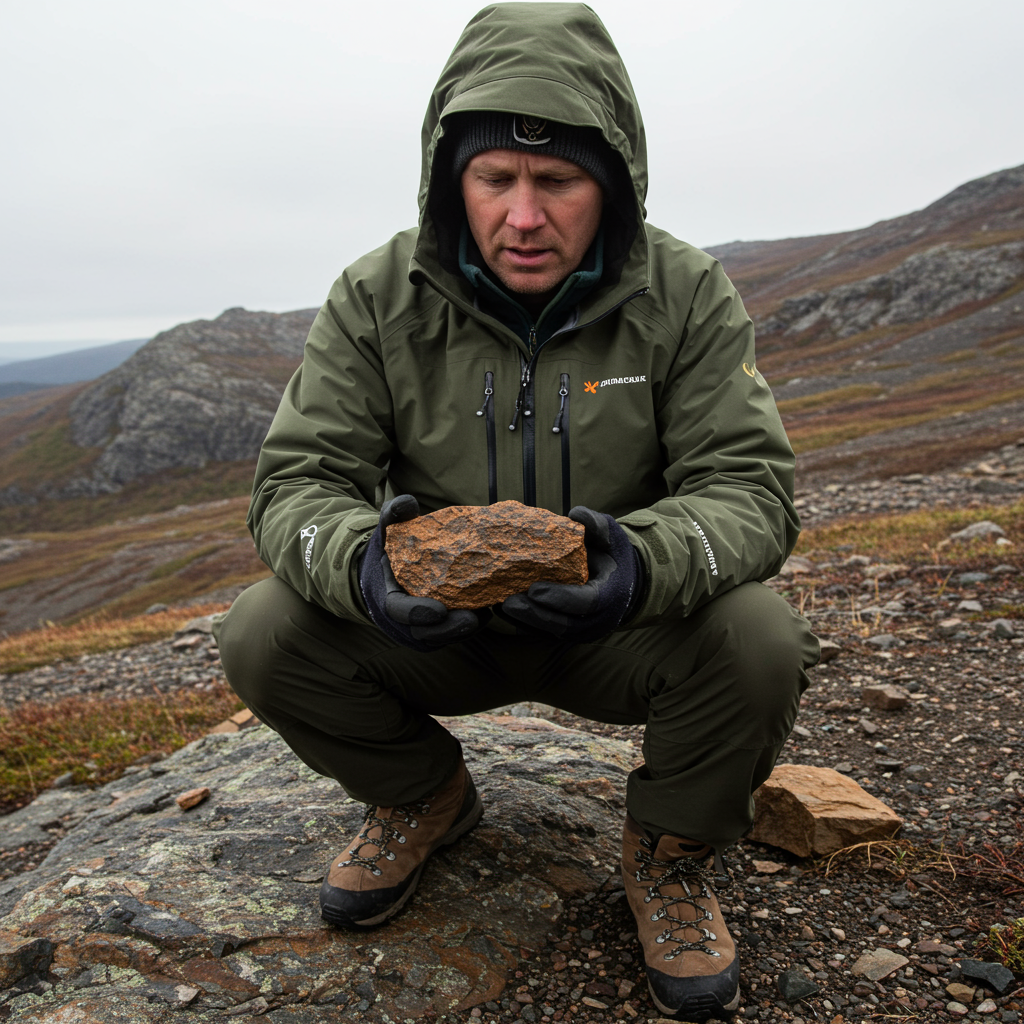
Imagine touching a piece of rock that formed almost at the very birth of our planet. Scientists now believe such a relic exists. Hidden deep within the rugged landscape of northeastern Canada lies what researchers propose is a genuine fragment of Earth’s original crust. Dating back an astonishing 4.16 billion years, these rocks offer an unprecedented window into our planet’s chaotic infancy, known as the Hadean eon. Unearthing and confirming the age of this ancient treasure wasn’t easy. It involved a scientific journey filled with controversy and cutting-edge geological techniques.
Uncovering Earth’s Deepest Past
Our planet Earth formed about 4.57 billion years ago. Its early years, the Hadean eon (roughly 4.6 to 4 billion years ago), were incredibly violent. Picture a molten world constantly bombarded by asteroids. These impacts shattered rock, melted surfaces, and triggered volcanic eruptions. Over unimaginable stretches of time, Earth began to cool. Solid rock started to form, creating the very first crust.
Finding remnants of this primordial crust is incredibly rare. Plate tectonics, the process of Earth’s outer shell constantly shifting, has been a powerful force for billions of years. This activity recycles old crust back into the planet’s interior through subduction. Erosion by wind and water further erased traces of the earliest surface. Most ancient rocks discovered previously dated to around 3.8 billion years ago, placing them in the subsequent Archean eon. Geologists long wondered if any true Hadean crust survived.
The Search for Primordial Rock
For years, the oldest known rocks were meteorites or lunar samples, some dating back over 4.5 billion years. But finding a piece of Earth’s own original skin proved elusive. While tiny zircon crystals found embedded within younger Australian rocks were successfully dated to over 4 billion years, these were just mineral grains, not entire rock formations from the first crust.
Geologist Jonathan O’Neil at the University of Ottawa in Canada was convinced older crust existed. In 2008, O’Neil and his team published a controversial study. They claimed rocks in the Nuvvuagittuq Greenstone Belt (NGB) in remote northeastern Canada were around 4.3 billion years old. This bold assertion challenged prevailing scientific understanding. Other researchers argued the NGB rocks were much younger, closer to 3.8 billion years, similar to the nearby Acasta gneiss, which was previously considered the oldest rock formation.
Solving the Ancient Dating Puzzle
Dating rocks billions of years old requires sophisticated techniques. Geologists often rely on radioactive decay, like studying how elements change over time. Zircon is typically preferred because it’s incredibly stable. However, the volcanic rocks in the NGB lack zircon, forcing scientists to use other methods. O’Neil’s team focused on samarium-neodymium (Sm-Nd) isotopic dating.
This method examines the decay of samarium isotopes into neodymium isotopes. Samarium-147 decays into neodymium-143 over a very long half-life (trillions of years). Samarium-146, however, decays into neodymium-142 with a much shorter half-life (around 96 million years). In their initial 2008 study, the two decay pathways in the NGB rocks seemed to yield different age estimates, fueling the skepticism. One challenge is that subsequent geological events, like “cooking” or metamorphic changes after 4 billion years ago, can potentially ‘reset’ the longer-lived Sm-147/Nd-143 clock, making the rocks appear younger than they are. The shorter-lived Sm-146/Nd-142 system is less susceptible to this kind of resetting.
Confirmation Through Consistency
To address the controversy and strengthen their findings, O’Neil’s team conducted a new analysis. Published recently in the journal Science, their latest study focused on specific sections within the NGB. They examined areas where younger magma from Earth’s mantle had intruded into the surrounding, older crust. The key insight was that these intrusions must be younger than the rocks they pushed into, providing a critical check on the ages.
Crucially, within these particular intrusion samples, both the shorter-lived (Sm-146 to Nd-142) and longer-lived (Sm-147 to Nd-143) samarium-neodymium decay systems yielded the same age: 4.16 billion years. This consistency across two different isotopic clocks provides compelling evidence. As O’Neil and his colleagues stated, “The age agreement between both extant and extinct radiogenic systems… is compelling evidence for preservation of Hadean rocks in the Nuvvuagittuq Greenstone Belt.”
A Window into Early Earth
Confirming rocks of this age opens a rare window into Earth’s earliest times. The Nuvvuagittuq Greenstone Belt is located in northeastern Canada, part of a stable craton relatively untouched by intense tectonic activity for billions of years, unlike areas experiencing active subduction today. This geological stability helped preserve the ancient crust.
Studying these rocks offers vital insights into the Hadean eon’s conditions. Some NGB rocks appear to have formed from precipitation out of ancient seawater. This provides geologists clues about the composition, temperature, and atmosphere of Earth’s first oceans. Understanding the environment of early Earth is critical for grasping how life might have first emerged. It also has implications for the field of astrobiology, guiding the search for evidence of past or present life on other planets, such as Mars, which may have had liquid water early in its history.
Beyond Earth: Lunar Connections?
The discovery also raises intriguing questions about what else might be hidden. There could be more ancient crust awaiting discovery beneath Earth’s surface. It is even speculated that some of Earth’s oldest rocks might reside on the Moon. Around 4.4 billion years ago, not long after Earth formed, a giant impact is thought to have shattered a portion of our planet, creating the Moon. Future missions, like NASA’s Artemis program, could potentially recover Earth rock fragments from the lunar surface, offering another perspective on our planet’s turbulent youth.
Frequently Asked Questions
What are the oldest rocks found on Earth and where are they located?
The oldest known rocks on Earth are believed to be located in the Nuvvuagittuq Greenstone Belt (NGB) in northeastern Canada, near Hudson Bay. Recent studies indicate these rocks date back about 4.16 billion years, placing them firmly within the Hadean eon, Earth’s earliest geological period. This site contains remnants of our planet’s very first crust.
How did scientists determine the age of these ancient rocks?
Scientists used a method called samarium-neodymium (Sm-Nd) isotopic dating. This technique measures the ratios of different isotopes of samarium and neodymium. By analyzing how samarium isotopes have radioactively decayed into neodymium isotopes over billions of years, particularly focusing on two different decay pathways (Sm-146 to Nd-142 and Sm-147 to Nd-143), researchers could calculate the age of the rocks. A recent study provided strong evidence by finding consistent ages (4.16 billion years) from both decay systems in specific rock sections.
Why is finding such old crust so rare and important?
Finding rocks from Earth’s original crust is incredibly rare because processes like intense asteroid bombardment, melting, erosion, and especially plate tectonics have destroyed and recycled most of the planet’s early surface over billions of years. Discovering a piece of Hadean crust is important because it provides a direct window into the conditions of early Earth. It helps scientists understand the environment, oceans, and atmosphere when life may have first begun, and sheds light on how terrestrial planets form and evolve.
Conclusion
The confirmation of 4.16-billion-year-old rocks in Canada’s Nuvvuagittuq Greenstone Belt is a landmark achievement in geology. It validates years of persistent research and overcomes significant scientific debate regarding the age of this unique formation. This ancient rock offers tangible evidence of the turbulent Hadean eon and provides invaluable data for understanding not only how Earth formed but also the conditions that might have paved the way for life’s emergence. As geologists continue to study this remarkable site, it promises to reveal even more secrets buried deep within our planet’s long and complex history.