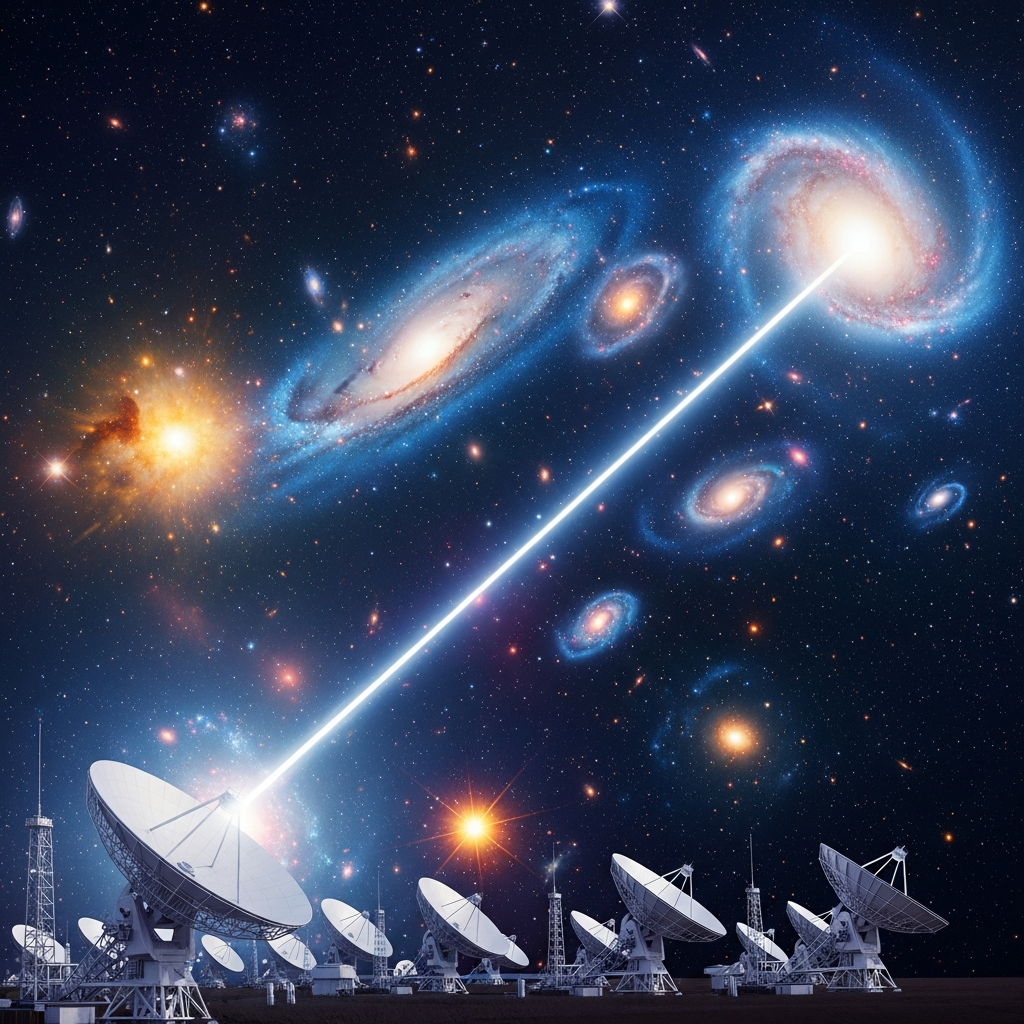
Astronomers have made an astonishing deep-space discovery: an extraordinarily powerful radio signal, likened to a “cosmic laser,” originating from a galaxy an incredible 8 billion light-years away. This persistent beacon, a gravitationally lensed hydroxyl megamaser, was captured by the sensitive MeerKAT radio telescope and offers an unprecedented window into the violent galactic events of the early universe. Its sheer strength means it remains detectable on Earth, challenging our understanding of cosmic phenomena.
Unveiling Nkalakatha: A “Mega-Laser” from the Ancient Universe
Imagine a laser so powerful it spans billions of light-years, beaming its energy directly towards Earth. That’s precisely what scientists have observed. This isn’t science fiction; it’s a natural astronomical phenomenon detected in the vast expanse of space. Researchers, including Dr. Thato Manamela from the University of Pretoria, describe this event as the cosmic equivalent of a laser, operating on a galactic scale. The discovery began with the identification of an exceptionally thin and clear line within the radio spectrum, a signal that stood out despite the immense cosmic distances involved.
Typically, radio emissions from such remote corners of the universe are largely absorbed or scattered, fading into the background noise. Yet, this particular emission remained remarkably distinct and measurable. This clarity immediately suggested that an unusual physical process was actively amplifying the radiation along its epic journey. Named “Nkalakatha”—a Zulu word meaning “big boss”—this powerful megamaser underscores the cutting-edge capabilities of modern radio astronomy.
MeerKAT’s Breakthrough Detection
The groundbreaking detection was made by the MeerKAT radio telescope, a state-of-the-art facility located in South Africa. Comprising 64 interconnected antennas, MeerKAT is designed to capture incredibly faint signals from the deepest reaches of the cosmos. What makes this particular discovery even more astounding, as highlighted by Dr. Marcin Glowacki from the International Center for Radio Astronomy Research, is that the Nkalakatha megamaser was detected on the very first night of a planned 3,000-hour observation period. This speaks volumes about the MeerKAT radio telescope’s unparalleled sensitivity and the sheer power of the cosmic laser signal itself.
Researchers meticulously traced the origin of this potent emission to a specific galactic system, cataloged as HATLAS J142935.3–002836. This system had previously been noted for its distorted and elongated appearance, a characteristic often indicative of strong gravitational forces at play in distant galaxies. Further calculations confirmed its extraordinary distance, corresponding to a redshift of z = 1.027. This means the radio waves we are now receiving began their journey over 8 billion light-years ago, long before our solar system or even Earth itself had formed, when the universe was considerably younger and more tumultuous.
What is a Hydroxyl Megamaser?
The key to understanding Nkalakatha lies in its signature wavelength: 18 centimeters. This specific wavelength is uniquely associated with the hydroxyl molecule (OH), which is formed from oxygen and hydrogen atoms. These molecules exist in vast clouds of gas scattered throughout galaxies. Under particular physical conditions—such as those found in extremely energetic environments—hydroxyl molecules can amplify radiation at precise radio frequencies through a process known as maser (Microwave Amplification by Stimulated Emission of Radiation).
A maser operates on the same fundamental principles as a laser, but at microwave (radio) wavelengths rather than visible light. When this amplification occurs on a galactic scale, generating immense power, it’s aptly termed a “hydroxyl megamaser.” The intensity of the signal detected from HATLAS J142935.3–002836 suggests it belongs to an exceptionally energetic category of megamasers, truly earning its “mega-laser” moniker. This process requires a specific, highly energized environment to create such a colossal cosmic beacon.
Galaxy Mergers: The Engine of Cosmic Lasers
The ideal conditions for generating such powerful hydroxyl megamasers are found in violently merging galaxies. The galactic system HATLAS J142935.3–002836 is precisely this type of environment. During these spectacular cosmic collisions, enormous quantities of gas are violently compressed and agitated. This chaotic process forms dense, turbulent regions where hydroxyl molecules accumulate in vast numbers, creating the perfect conditions for amplifying radio emissions.
Previous studies of this system had already indicated a high rate of star formation, a characteristic consistent with merging galaxies that are rapidly converting their massive gas reserves into new stars. This intense star formation further fuels the energetic environment needed for the hydroxyl megamaser to operate at such a powerful level, making the signal detectable across billions of light-years. Dr. Manamela emphasizes that galactic fusion creates an energized environment where hydroxyl effectively amplifies radio emission, much like a laser works on a cosmic scale.
Gravitational Lensing: Nature’s Cosmic Magnifying Glass
Even with the intrinsic intensity of the hydroxyl megamaser, the signal’s strength as observed on Earth is significantly boosted by an additional natural phenomenon: strong gravitational lensing. Between our planet and the merging galaxy, another massive galaxy lies almost perfectly in the line of sight. The immense gravitational field of this foreground galaxy curves spacetime, acting as a natural lens. This cosmic lens bends and focuses the radiation emitted from the more distant source directly towards our telescopes.
This lensing effect doesn’t create new light; rather, it redirects more of the existing radiation, significantly increasing the apparent brightness of the observed source. Gravitational lensing also explains why distant objects like HATLAS J142935.3–002836 often appear distorted or elongated in astronomical images, sometimes even forming luminous rings known as Einstein rings. This natural amplification is a crucial factor in why Nkalakatha remains so clearly detectable after traveling for 8 billion years.
Terrestrial Lasers: Humanity’s Tools for Cosmic Understanding
While Nkalakatha is a natural cosmic laser, humanity has also harnessed the power of lasers for profound scientific discovery, even simulating conditions found in the deep cosmos. Facilities like the National Ignition Facility (NIF) at Lawrence Livermore National Laboratory (LLNL) in California and the OMEGA laser are the world’s largest and most unique research tools. These immense facilities, housed in buildings the size of multiple football fields, utilize 192 powerful laser beams to converge on a tiny target, generating extreme conditions found inside stars and giant planets.
For instance, NIF can create temperatures reaching 180 million degrees Fahrenheit and pressures 100 billion times that of Earth’s atmosphere. These conditions allow scientists to explore nuclear fusion, simulate stellar interiors, study supernova shock waves, and even investigate the incredibly dense cores of giant planets like Jupiter and Saturn. Experiments at NIF have revealed “bizarre” material behaviors under extreme pressure, such as nickel becoming an insulator or hydrogen turning into a “metallic fluid.” These terrestrial laser systems, initially designed for nuclear fusion research, are now invaluable for advancing our understanding of how planets form, evolve, and potentially harbor life, by peering “under the hood” of exoplanet interiors. This highlights a fascinating parallel: just as natural cosmic lasers reveal secrets of the universe, human-made lasers unveil the fundamental physics of cosmic phenomena.
Implications for the Early Universe
The rapid detection of the Nkalakatha megamaser by MeerKAT after just a few hours of observation is highly significant. It demonstrates that broader astronomical surveys could reveal even more similar systems, potentially further away, offering deeper insights into the universe’s history. The data also recorded an additional absorption signal associated with neutral hydrogen, an important marker for gas in galaxies. The simultaneous presence of hydroxyl emission and neutral hydrogen absorption suggests that HATLAS J142935.3–002836 contains multiple, complex layers of gas.
These features are vital for scientists seeking to reconstruct how gas-rich galactic mergers functioned during this ancient period of cosmic history. By studying signals from such immense distances, astronomers are essentially looking back in time, observing the universe as it was when it was significantly younger. The Nkalakatha discovery provides crucial data on the precise mechanisms and outcomes when galaxies collide, offering an unprecedented view into the evolution of the universe over billions of years. This groundbreaking find pushes the boundaries of our understanding, paving the way for future discoveries about the universe’s most dynamic and energetic events.
Frequently Asked Questions
What is a hydroxyl megamaser, and how does it differ from a terrestrial laser?
A hydroxyl megamaser is a powerful, naturally occurring cosmic phenomenon where hydroxyl molecules (OH) in vast gas clouds within galaxies amplify radio waves at specific frequencies. It operates on the same principle as a laser (light amplification by stimulated emission of radiation) but at microwave (radio) wavelengths, rather than visible light. The “mega” prefix signifies its galactic scale and immense power, often generated during energetic events like galaxy mergers. Terrestrial lasers, in contrast, are human-made devices that produce concentrated beams of light, used in applications from optical fibers to scientific research, like simulating planetary cores at facilities such as the National Ignition Facility.
How does the MeerKAT radio telescope detect such distant cosmic signals?
The MeerKAT radio telescope, located in South Africa, is an array of 64 interconnected antennas working in unison. This advanced design allows it to act as a single, highly sensitive instrument capable of detecting extremely faint radio signals from billions of light-years away. Its powerful data processing capabilities can discern subtle spectral lines, like the 18-centimeter signature of hydroxyl, from background cosmic noise. Furthermore, the detection of the Nkalakatha megamaser was significantly aided by strong gravitational lensing, where an intermediate galaxy magnified the distant signal, making it clearer for MeerKAT to capture.
What does the detection of this cosmic laser signal tell us about the early universe?
The detection of the Nkalakatha cosmic laser signal from 8 billion light-years away provides invaluable insights into the early universe. Because light travels at a finite speed, observing such distant objects means we are seeing them as they were billions of years ago, when the universe was much younger. This signal indicates that massive, gas-rich galaxy mergers were occurring violently during that epoch, creating the energized environments necessary for hydroxyl megamasers to form. It helps astronomers reconstruct the processes of galaxy evolution, star formation rates, and the distribution of gas and dust in a younger cosmos, offering a direct observational glimpse into its dynamic past.
The Nkalakatha discovery serves as a beacon, guiding scientists to a deeper appreciation of the universe’s complexity and the extraordinary power of its natural phenomena. As telescopes like MeerKAT continue to probe the cosmic depths, we can anticipate even more breathtaking revelations about our universe’s past, present, and future.