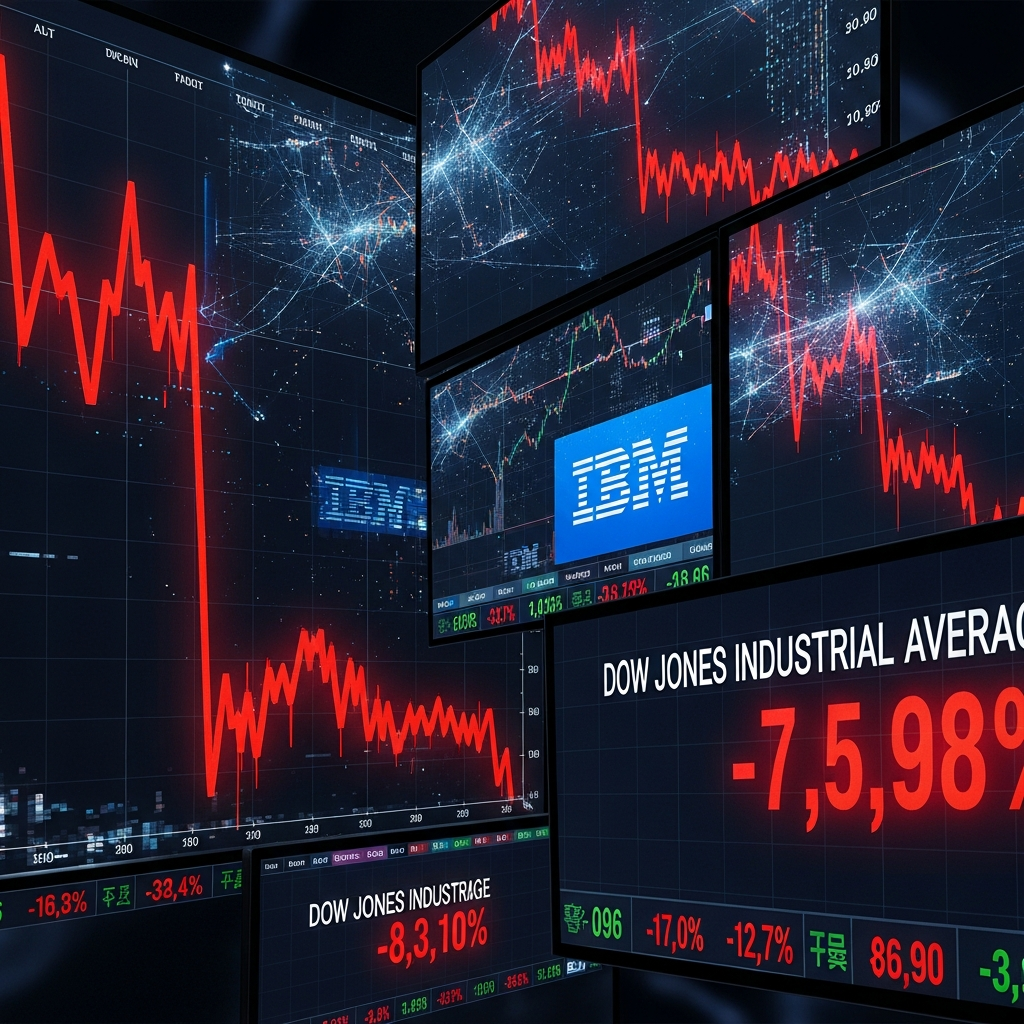
The financial markets recently experienced a significant tremor, with a potent mix of artificial intelligence disruption fears and escalating global tariffs sending major indices sharply downward. On Monday, February 23, 2026, the Dow Jones Industrial Average plunged an alarming 821 points, marking its steepest decline in over a month. Both the Nasdaq and S&P 500 mirrored this sharp fall, while the Cboe Volatility Index (VIX) surged above 21, signaling a pronounced surge in investor anxiety and market uncertainty. This turbulent day was largely defined by what analysts quickly dubbed an “AI scare trade,” fueled by new technological advancements and stark economic warnings.
The Double Whammy: AI Disruption Meets Global Tariffs
The market’s dramatic downturn wasn’t attributable to a single factor but a convergence of powerful headwinds. Firstly, the specter of AI disruption loomed large, amplified by new developments that sparked intense fear among investors. Secondly, President Trump’s surprising decision to hike global tariffs to 15% introduced significant economic instability, further shaking investor confidence. This dual assault created a perfect storm, prompting widespread sell-offs across various sectors and asset classes. The swift reaction underscored the market’s sensitivity to both technological paradigm shifts and geopolitical trade tensions.
AI Scare Trade: Anthropic, Citrini, and IBM’s Historic Drop
At the heart of the “AI scare trade” was Anthropic’s announcement of groundbreaking new programming capabilities for its Claude Code product. This development immediately put immense pressure on major software stocks. International Business Machines Corp (IBM) bore the brunt of this panic, plummeting a staggering 13.15%—its most significant single-day drop since the year 2000. The sharp decline in IBM’s valuation was specifically linked to the perceived threat that Anthropic’s sophisticated AI tool poses to the modernization of legacy programming languages, such as COBOL, which are critical to many older, established systems.
Adding fuel to the fire, Citrini Research issued a sobering warning, suggesting that rapid advancements in artificial intelligence could potentially lead to a 10% unemployment rate. This dire prediction resonated deeply with anxious investors, exacerbating market panic and drawing parallels to historical market bubbles that burst after periods of irrational exuberance. The combination of tangible technological threats and grim economic forecasts created a fertile ground for an emotionally driven sell-off, where fear outweighed fundamental analysis for many.
Tariffs Add to Market Jitters: A Global Impact
Beyond the AI-driven anxieties, President Trump’s tariff policy played an equally crucial role in the market’s turmoil. Following recent legal battles over a Supreme Court tariff ruling, Trump’s subsequent decision to increase global tariffs to 15% sent shockwaves through the global economic outlook. This unexpected hike introduced substantial uncertainty, impacting various markets far beyond traditional equities. The immediate fallout included a significant drop in cryptocurrency valuations, with Bitcoin (BTC) falling below the $65,000 mark.
The tariff concerns also rippled through commodity markets, prompting investors to seek safe havens. Gold, a traditional store of value during economic instability, surged to its highest level in three weeks. April-dated gold futures climbed by 2.8%, settling at an impressive $5,225.60 per ounce, as capital flowed out of riskier assets. Oil prices, however, showed a more muted reaction, settling near breakeven. March-dated West Texas Intermediate (WTI) crude saw a marginal rise of just 1 cent, reaching $66.49 a barrel. Oil’s performance was influenced by a complex interplay of ongoing U.S. and Iran nuclear talks, alongside doubts about global economic growth and fuel demand stemming directly from the new tariffs.
IBM’s Pain: A Symbol of AI’s Disruptive Power
IBM’s dramatic 13.15% stock plunge was more than just a single company’s misfortune; it became a symbol of the market’s profound fear regarding AI’s disruptive potential. For a tech giant with IBM’s long history and established client base, such a sudden and steep decline highlighted how quickly perceived technological obsolescence can impact valuation. Investors seemed to be pricing in the possibility that Anthropic’s Claude Code could accelerate the demise or require costly overhauls of the very systems IBM helps maintain. This fear-driven reaction underscored the transformative, and sometimes brutal, power of cutting-edge AI on established industries and business models.
The “AI scare trade” reflects a market grappling with the pace of technological change. While AI promises immense productivity gains and new opportunities, it also threatens existing infrastructures and jobs. This dichotomy creates a volatile investment landscape, where groundbreaking announcements can trigger both excitement and panic. Understanding these dynamics is crucial for investors navigating the rapidly evolving tech sector.
Beyond the Panic: Long-Term AI Investment Still Strong
Despite the immediate market reaction and the “AI scare trade,” it’s important to contextualize the broader long-term commitment to artificial intelligence. While short-term disruption causes volatility, major players continue to pour vast sums into AI development and infrastructure. A prime example is Amazon.com (AMZN), which announced plans to invest a substantial $12 billion in new AI data centers located in Louisiana. This commitment is part of an even larger trend, with CNBC reporting that Amazon’s total AI spending could reach an astounding $200 billion this year alone.
This contrast highlights a critical distinction: the market’s short-term reaction to perceived AI threats versus the strategic, long-term investment by industry leaders. While some stocks may suffer from the fear of disruption, others are actively building the future of AI. This robust investment indicates a strong underlying belief in AI’s enduring potential to drive innovation and create new value, even as its immediate disruptive impacts cause market jitters. Investors must weigh the short-term anxieties against the long-term growth prospects inherent in this transformative technology.
Frequently Asked Questions
What exactly triggered the “AI scare trade” and IBM’s significant stock drop on February 23, 2026?
The “AI scare trade” was primarily ignited by Anthropic’s announcement of new programming capabilities for its Claude Code product, which was perceived as a direct threat to the modernization of older programming languages like COBOL. This perception led to IBM’s stock plummeting 13.15%, its steepest decline since 2000. Further exacerbating fears, Citrini Research warned of a potential 10% unemployment rate due to AI advancements, collectively creating a panic-driven sell-off in software stocks and broader market uncertainty.
How did the dual concerns of AI and global tariffs impact different market segments?
The confluence of AI disruption fears and President Trump’s 15% global tariff hike led to a broad market downturn. The Dow Jones Industrial Average dropped 821 points, with the Nasdaq and S&P 500 also falling sharply. In commodity markets, gold surged to a three-week high at $5,225.60 per ounce as investors sought a safe haven. Conversely, Bitcoin fell below $65,000 due to the increased economic uncertainty from tariffs. Oil prices, influenced by geopolitical talks and doubts about global growth, remained largely stagnant.
What broader market sentiment emerged from this “AI scare trade,” and what does it suggest for future AI investments?
The “AI scare trade” created a sentiment of heightened uncertainty and fear, with analysts drawing parallels to historical market bubbles. It highlighted the market’s susceptibility to emotionally driven reactions to rapid technological shifts. However, despite the short-term panic, significant long-term investment in AI continues, exemplified by Amazon’s commitment of $12 billion to AI data centers in Louisiana and an estimated $200 billion in total AI spending this year. This suggests that while market volatility around AI’s disruptive potential will persist, strategic investment in the sector remains robust.