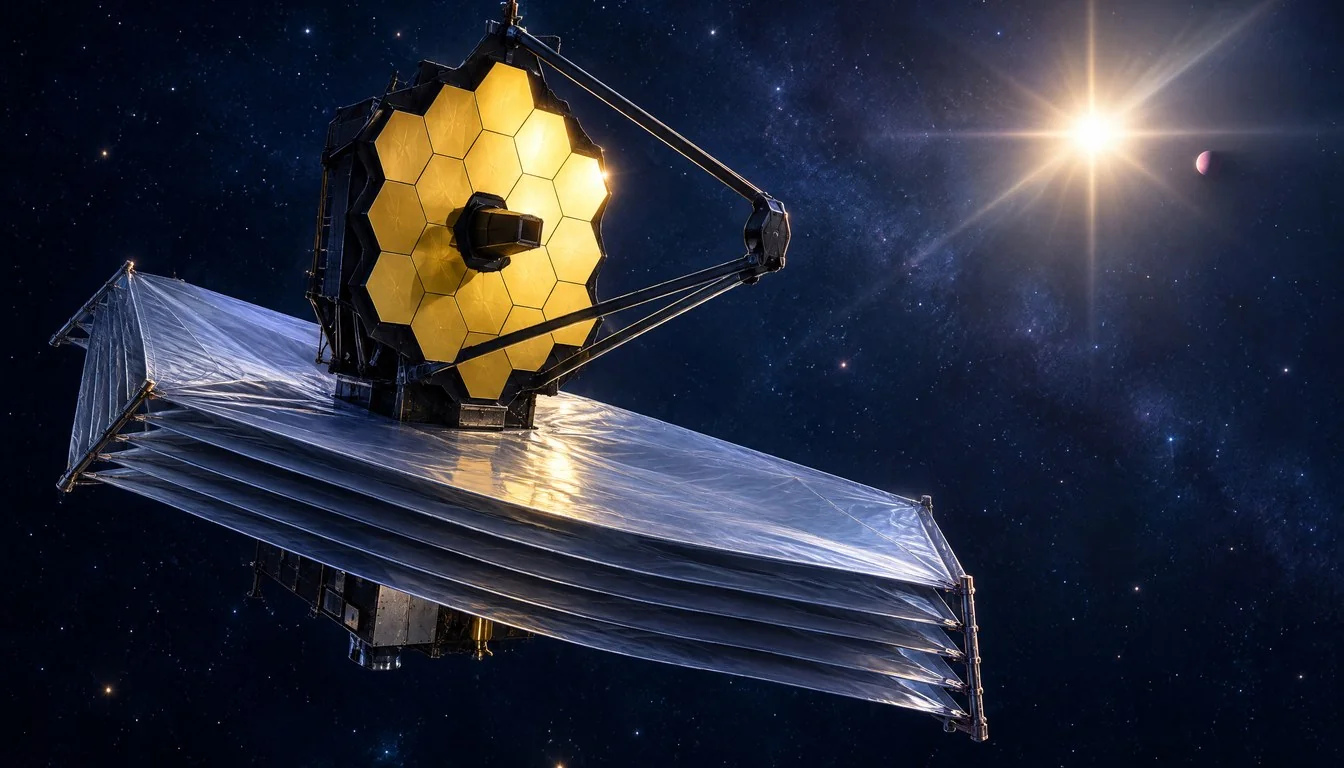
Advancements in JWST exoplanet imaging have reached a new milestone with the development of a software package that allows researchers to extract significantly clearer data from existing observations of distant worlds.
Key Takeaways
- Enhanced Sensitivity: The new FLIP software can increase the sensitivity of exoplanet detection by a factor of 2 to 15, depending on the target.
- Hybrid Methodology: FLIP (Physics-based Learning for Imaging Planets) combines traditional physical modeling with machine learning techniques like gradient descent.
- Archival Discoveries: The software successfully identified the planet 51 Eridani b within existing, previously analyzed JWST data.
- Optimized Hardware Modeling: The tool utilizes a complex 106-parameter model of the telescope‘s Near Infrared Camera (NIRCam) to reduce noise.
- Scientific Efficiency: By improving the signal-to-noise ratio of current data, the software increases the scientific return of the James Webb space telescope without requiring new hardware or launches.
- Empirical Observation: Using a known target to derive a mathematical description of the PSF. While effective, this method is limited because the telescope’s hardware behavior changes over time, and the PSF varies depending on the wavelength of light being observed.
- Hardware Modeling: Attempting to create a mathematical model of the telescope’s physical components to predict the PSF. However, modern instruments like the JWST are incredibly complex, and the number of variables required to make such a model accurate often makes it computationally impossible to solve.
- General Sensitivity Gain: A 2x to 15x improvement over standard imaging techniques.
- Maximum Gain: The target TYC 5899, which is known for high variability, saw a sensitivity boost of 15x.
- Atmospheric Detection: At wavelengths specifically useful for detecting carbon dioxide (CO2), the software allowed researchers to spot one of the planets in the Webb data for the first time.
- Parameter Transparency: A verified, granular list of what each of the 106 parameters represents has not been publicly released, which is a hurdle for independent verification.
- Commercial and Organizational Access: It is currently unclear who owns the FLIP software or if it will be made available as a standardized tool for the broader scientific community or if it will remain restricted to specific research groups.
- Scalability: While the software works well on current GPUs, the computational requirements for processing massive datasets from future missions (like the Nancy Grace Roman Space Telescope) will need to be carefully managed.
- Replication: Will competing research groups be able to replicate the 15x sensitivity gain reported for targets like TYC 5899?
- Atmospheric Characterization: Will the improved signal-to-noise ratio lead to the first definitive, high-confidence measurements of carbon dioxide in the atmospheres of smaller, Earth-like exoplanets?
- shattered.io
- arstechnica.com
A New Frontier in JWST Exoplanet Imaging
Recent research published in the journal Nature and reported by Ars Technica has detailed the emergence of a sophisticated software tool that is fundamentally changing how astronomers approach JWST exoplanet imaging. The tool, known as FLIP (Physics-based Learning for Imaging Planets), addresses one of the most persistent hurdles in observational astronomy: the overwhelming glare of host stars that obscures the much fainter signals of orbiting planets.
While the James Webb Space Telescope (JWST) is equipped with advanced hardware like coronagraphs—devices designed to block out starlight—these physical components are not perfect. Subtle variations in the telescope’s configuration, pointing accuracy, and hardware behavior over time create “noise” that can hide a planet’s signature or mimic its appearance.
According to the research, the FLIP software mitigates these issues by optimizing a highly detailed physical model of the telescope’s Near Infrared Camera (NIRCam). By using this model to predict and subtract the expected pattern of stellar light, researchers can reveal planets that were previously buried in the noise. Testing conducted on three different star systems demonstrated that the software provides a significant boost to observational clarity, with sensitivity gains reaching as high as 15 times for certain targets.

The Physics of the Point Spread Function
To understand why FLIP is necessary, one must understand the concept of the point spread function (PSF). In an ideal universe, a telescope imaging a single, distant point of light would produce a perfect, infinitesimal dot. In reality, due to the physical limitations of telescope hardware and the difficulty of maintaining perfect pointing stability, that point of light appears as a blurry, spread-out pattern.
The PSF is essentially the mathematical description of how a telescope distorts light. For astronomers attempting JWST exoplanet imaging, the PSF of a bright star is the primary obstacle. The star’s light spreads out in a pattern that can easily drown out the light reflecting off or passing through the atmosphere of a nearby planet.
Historically, scientists have used two primary methods to manage the PSF:
FLIP bridges this gap by treating the telescope not as a “black box,” but as a known physical system that can be fine-tuned through computation.
How FLIP Works: Merging Physics and Machine Learning
What sets FLIP apart from previous software-based correction methods is its hybrid approach. It does not rely solely on data-driven machine learning—which can sometimes “hallucinate” or create patterns that aren’t actually there—nor does it rely solely on rigid physical models that may fail to account for real-world drift.
Instead, the FLIP process utilizes a physical model of the NIRCam instrument containing 106 possible parameters. These parameters account for a wide range of physical effects, from the precise optical alignment of the mirrors to the specific behavior of the detectors.
To solve for these 106 variables, the researchers adapted a technique central to modern artificial intelligence: gradient descent. This is the same mathematical optimization process used to train massive neural networks by adjusting billions of parameters to minimize error. In the context of FLIP, the software starts with a simulated PSF and then uses gradient descent to optimize its performance against actual data from a star.
According to the study, this optimization process is remarkably efficient. When run on a modern GPU, the software can optimize the 106 parameters in just over half an hour. Once the model is optimized for a specific star, the researchers then fine-tune the results against the actual scientific image to account for any last-minute variables that may have occurred during the specific observation window.
Proven Performance and Key Discoveries
The efficacy of the FLIP software has been validated through tests on three specific star systems: HIP 65426, 51 Eridani, and TYC 5899. These targets were chosen because they represent different observational challenges, including young stars with massive, warm planets and stars known for high variability between observations.
Breakthroughs in Sensitivity and Signal-to-Noise
The results of these tests were significant across the board. The research reported that FLIP boosted the signal-to-noise ratio (SNR) by a factor of 1.5 to 2 depending on the specific observation. More importantly, the software provided a massive increase in sensitivity:

Uncovering Hidden Worlds in Archival Data
Perhaps the most impactful result of the FLIP testing was its ability to extract new information from data that had already been collected. The software successfully revealed the presence of the planet 51 Eridani b within existing archival JWST data.
This capability suggests that many high-value scientific discoveries may already exist within the JWST archives, simply waiting for more sophisticated software pipelines to pull them out of the noise. This “second life” for existing data provides an immense amount of value to the scientific community, as it allows for new discoveries without the need for additional telescope time.
Comparative Analysis of Imaging Approaches
To better understand where FLIP fits into the current astronomical landscape, the following table compares the software to other common methodologies used in the field.
| Approach | Strengths | Weaknesses | Evidence in Study |
|---|---|---|---|
| Standard Subtraction | Mature and widely understood; standard baseline. | Highly dependent on how well reference stars match the target; prone to structured noise. | Served as the baseline that FLIP outperformed. |
| FLIP (Physics-Based) | Uses known instrument behavior; tunes to specific data; reduces “hallucinations.” | Requires a highly validated and complex instrument model (106 parameters). | Demonstrated 2x–15x sensitivity and 1.5x–2x SNR gains. |
| Purely Data-Driven | Flexible; requires no instrument model; highly adaptable. | Can mistake artifacts for real objects (hallucinations/false positives). | Not tested/used in this specific reporting. |
| New Hardware | Adds fresh photons to the system; provides direct physical blocking. | Extremely costly and slow; requires new launches and years of planning. | FLIP achieves similar goals using existing hardware. |
What It Means for the Scientific Community
The development of FLIP represents a shift in how space missions are valued. It reinforces the concept of “software-as-instrument,” where the computational tools used to process data are considered as vital to the mission’s success as the physical mirrors and sensors themselves.
For Research Scientists and Astronomers
For those studying exoplanets, FLIP offers a way to see dimmer, older, or lower-mass planets that were previously undetectable. By lowering the noise floor, the software expands the catalog of observable worlds. Furthermore, the ability to detect signals at wavelengths conducive to studying carbon dioxide means that FLIP can play a crucial role in the search for atmospheric signatures that might indicate habitability.
For Mission Planners and Funding Agencies
JWST time is an incredibly scarce and expensive resource. Every hour of observation costs significant taxpayer and institutional funding. By increasing the “scientific return” of every hour of telescope time, FLIP provides a massive economic advantage. It allows agencies to get more science out of the same hardware, effectively extending the scientific life of the mission without the multi-billion dollar price tag of a new launch.
For Research Engineers
The success of FLIP provides a roadmap for future mission design. It suggests that the development of highly detailed, high-parameter calibration models should begin much earlier in the design phase of a telescope. If the software can be trained on a model of the instrument before it even launches, the potential for post-launch discovery increases exponentially.

Counterpoints and Open Questions
Despite the impressive results, the use of hybrid physics-machine learning models is not without its risks. One of the primary concerns in the field of AI-assisted science is the risk of “hallucinations.” While the researchers note that FLIP uses physics to constrain the possible answers—thereby reducing the likelihood of the software creating a planet where none exists—the complexity of a 106-parameter model still presents challenges in verifying that every detected signal is a genuine physical object.
There are also several unanswered questions regarding the implementation of this technology:
What Happens Next
The immediate future of JWST exoplanet imaging will likely involve a massive wave of archive reprocessing. As research teams gain access to FLIP and similar physics-based pipelines, they will begin rerunning old observations to see if planets like 51 Eridani b were missed in previous years.
In the coming months, the scientific community will be watching for two key signals:
Frequently Asked Questions
How does FLIP software actually work?
FLIP works by creating a highly detailed mathematical model of the James Webb Space Telescope’s NIRCam instrument. This model includes 106 different parameters that describe how the telescope behaves, including how it points and how its hardware reacts to light. Using a technique called gradient descent, the software adjusts these 106 parameters to match the actual data from a star. Once the model perfectly describes the “noise” or glare produced by the star, the software can subtract that glare from the image, leaving behind the much fainter light of any orbiting planets.
What is the difference between SNR and sensitivity?
In the context of this study, the signal-to-noise ratio (SNR) refers to the clarity of the signal compared to the background interference; FLIP improved this by 1.5x to 2x. Sensitivity, however, refers to the smallest or dimmest object the telescope can detect. Because FLIP can more effectively clear away the “noise” of the star, it allows astronomers to see much fainter planets that were previously invisible. This is why the sensitivity gain (up to 15x) is much higher than the SNR gain.
Can this software be used on other telescopes besides JWST?
While the specific model used by FLIP was built for the JWST’s NIRCam, the methodology is universal. The concept of using a physics-based model combined with gradient descent to optimize a point spread function can be applied to any high-precision telescope. Future software tools will likely be developed for the hubble space telescope, the upcoming Roman Space Telescope, and even ground-based extremely large telescopes.
Is FLIP a new type of telescope hardware?
No, FLIP is entirely software-based. It does not require any changes to the James Webb Space Telescope’s physical structure, its mirrors, or its sensors. It is a computational tool that processes the data that the telescope has already sent back to Earth, making it a highly cost-effective way to improve scientific results.
Conclusion
The development of FLIP marks a significant evolution in the field of astronomy, proving that the next great discoveries in JWST exoplanet imaging may not come from larger mirrors, but from smarter algorithms. By successfully identifying planets in archival data and dramatically increasing sensitivity to stellar signals, this hybrid approach to modeling ensures that the James Webb Space Telescope will continue to reveal the secrets of the cosmos long after its initial observations have been processed.
References
Featured image: Shattered — via Shattered