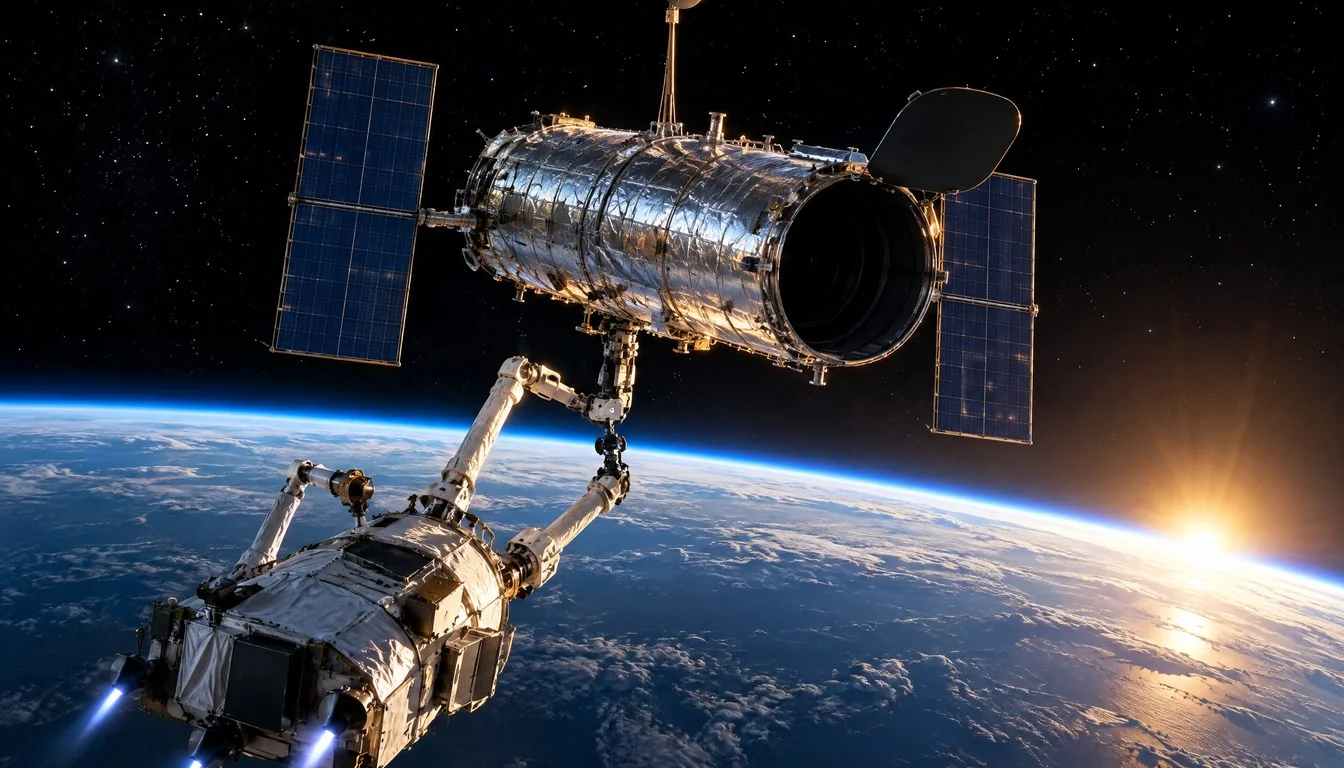
The hubble space Telescope rescue has become a formal priority for NASA as the agency turns to the commercial space industry to prevent the legendary observatory from falling out of orbit and burning up in Earth’s atmosphere.
Key Takeaways
- NASA’s RFI: On October 29, 2026, NASA issued a Request for Information (RFI) to explore private-sector solutions for Hubble’s survival or controlled disposal.
- Orbital Decay: The 36-year-old telescope is losing altitude at an average rate of approximately 4.7 km per year due to atmospheric drag.
- Three mission Paths: NASA is considering three options: capturing and boosting the telescope to 600 km, performing a hardware service mission, or executing a controlled reentry.
- Critical Deadline: Industry responses to the RFI are due by November 30, 2026, at 3:00 p.m. EST, with a target mission completion date in 2032.
- Scientific Gap: Without intervention, Hubble’s reentry in the early-to-mid 2030s could leave a significant observational gap before the Habitable Worlds Observatory arrives in the 2040s.
- For the Scientific Community: A successful mission means continued access to one of the most productive astronomical tools ever built, preventing a gap in data that could last until the 2040s.
- For Space Industry Investors: This RFI serves as a major market validation. It signals that on-orbit servicing and satellite life extension are no longer theoretical concepts but are becoming legitimate, high-value commercial procurement categories.
- For Taxpayers: The agency’s focus on “cost-effective” solutions reflects the pressure to manage a shrinking federal budget while still maintaining scientific leadership. The success of this initiative will demonstrate whether the private sector can provide better value than traditional government-led missions.
- shattered.io
- gizmodo.com
What Happened
On October 29, 2026, NASA officially released a Request for Information (RFI) aimed at the growing commercial space sector. The agency is seeking proposals from private companies that possess the technical capability to either extend the operational life of the Hubble Space Telescope or safely manage its eventual decommissioning.
According to the RFI, NASA is interested in identifying cost-effective methods to elevate the observatory to a higher altitude of at least 373 miles (600 km) or to provide a “performance enhancing tune-up” to its aging hardware. If a life-extension mission is deemed unfeasible, the agency is also open to proposals for a controlled reentry to ensure the telescope does not become uncontrolled debris that poses a risk to other spacecraft or ground populations.
Interested parties must submit their detailed proposals by the deadline of November 30, 2026, at 3:00 p.m. EST. Any mission intended to save the telescope would be targeted for completion in 2032. NASA has clarified that it has not yet allocated a specific budget for this effort and is currently using the RFI as a market probe to gauge technical readiness and cost estimates.
Why It Matters
Since its launch in 1990, the Hubble Space Telescope has served as one of the most significant achievements in the history of science, providing unparalleled views of the cosmos that have reshaped our understanding of the universe. However, the very environment that allows it to observe the stars is also causing its gradual demise.
As the telescope orbits in low-Earth orbit, it experiences atmospheric drag, which slowly saps its orbital velocity and causes it to lose altitude. This decay is not merely a technical hurdle; it is a race against time. If Hubble is not boosted back to a higher altitude, it is predicted to reenter the atmosphere in a fiery blaze sometime in the early-to-mid 2030s.
This potential loss of the observatory creates a looming scientific crisis. The next major successor, the Habitable Worlds Observatory, is not expected to launch until the 2040s. A failure to extend Hubble’s life could result in a decade-long gap in high-resolution, space-based astronomical observation, potentially stalling progress in fields ranging from exoplanet research to deep-space cosmology.
The Physics of Hubble’s Orbital Decay
To understand the urgency of the Hubble Space Telescope rescue, one must look at the specific mechanics of its descent. Gravity and atmospheric drag work in tandem to pull the telescope toward Earth. While the atmosphere is incredibly thin at Hubble’s altitude, it is not non-existent, and the cumulative effect of these tiny collisions with gas molecules is significant.
Data indicates that Hubble’s altitude has been steadily declining for decades. In 2002, during a servicing mission involving the Space Shuttle, the observatory was at an altitude of approximately 583 km. By 2026, that altitude has dropped to approximately 470 km. This represents a total altitude loss of roughly 113 km over a 24-year period.
Orbital Statistics at a Glance
| Metric | Value |
|---|---|
| Current Age | 36 years |
| Average Decay Rate | ~4.7 km per year |
| 2002 Altitude | ~583 km |
| 2026 Altitude | ~470 km |
| Target Reboost Altitude | $ge$ 600 km |
| Required Altitude Gain | ~130 km |
If a successful reboost mission can return Hubble to an altitude of 600 km or higher, estimates suggest the observatory could gain approximately 25 additional years of scientific utility.
The Three Proposed Mission Paths
NASA has requested that commercial respondents focus their proposals on one of three distinct strategic paths. Each path carries its own set of technical requirements and inherent risks.
1. Capture and Boost
This path involves using either a robotic tug or a crewed vehicle to physically rendezvous with Hubble, capture it, and use propulsion to lift it to a higher orbit.
The Challenge: Hubble was not designed with modern docking ports or standardized capture interfaces. Because it is a 36-year-old spacecraft, any attempt at physical contact carries the risk of damaging delicate external components or the solar arrays.
Primary Risk: Physical contact with a non-docking-ready, aging spacecraft.
2. Service and Upgrade
Rather than just moving the telescope, this mission would focus on upgrading its internal or external hardware to improve performance or extend the life of its electronics and instruments.
The Challenge: Servicing a spacecraft that is no longer accessible via the Space Shuttle requires highly sophisticated robotic or human intervention. The complexity of working with 36-year-old, delicate instrumentation cannot be overstated.
Primary Risk: High complexity and potential for instrument failure during servicing.
3. Controlled Reentry
If the cost or risk of saving the telescope is too high, NASA is prepared to explore ways to guide Hubble toward a specific disposal orbit or a controlled descent.
The Challenge: This is a mission of stewardship rather than preservation. The goal is to ensure that when Hubble eventually falls, it does so in a way that minimizes the risk of debris hitting populated areas or active satellite constellations.
Primary Risk: The permanent termination of Hubble’s scientific mission.

Stakeholders and Industry Reactions
The move to involve the private sector marks a significant shift in how NASA manages its legacy assets. Historically, Hubble was maintained by the Space Shuttle fleet, which performed critical servicing missions, including the last major boost in 2002 and the final servicing mission in 2009. With the Space Shuttle fleet now retired, NASA lacks the heavy-lift, human-rated capability required for such complex orbital maneuvers.
NASA Leadership Perspectives
NASA Administrator Jared Isaacman has emphasized the necessity of exploring all avenues to preserve the asset. In a statement on the agency’s website, Isaacman noted, “Hubble still has important science ahead of it, and we should be looking at every reasonable opportunity to keep it delivering for as long as possible.” He further added that if cost-effective ways exist to extend the life of an asset already in orbit, the agency owes it to both the American taxpayer and the scientific community to explore them.
Nicky Fox, Lead of the NASA Science Mission Directorate, has also pointed to the rapid evolution of the commercial space sector. According to Fox, the industry has developed new, highly specialized capabilities for satellite capture and on-orbit servicing that did not exist during the Shuttle era.
The Commercial Landscape
The RFI has caught the attention of several key players in the space economy. Companies like Northrop Grumman, Astroscale, Starfish Space, and Katalyst Space Technologies are recognized as leaders in robotic rendezvous and servicing technology. SpaceX has also been a significant part of the conversation, having previously participated in a 2022 study with NASA regarding a potential private-crew boost mission. Other companies, such as Momentus for in-space transport and ULA (United Launch Alliance) for launch vehicle support, are also central to the potential ecosystem of a rescue mission.
Analysis: Robotic vs. Crewed Missions
A critical debate within the aerospace community concerns whether a rescue mission should be robotic or crewed. Each approach offers a different balance of cost, risk, and flexibility.
The Case for Crewed Missions
Crewed missions offer the highest level of adaptability. Human astronauts can improvise solutions if they encounter unexpected mechanical issues or hardware failures on the 36-year-old telescope. However, the cost of life support, training, and safety protocols makes crewed missions significantly more expensive and introduces the risk of human life.
The Case for Robotic Missions
Robotic missions align more closely with current commercial trends toward autonomous rendezvous and servicing. They are generally lower in cost and eliminate the risk to human life. However, robotic systems are heavily dependent on software and pre-programmed sequences; they lack the ability to handle the “surprises” that often come with working on decades-old, unmaintained hardware.
What It Means for You
The outcome of the Hubble Space Telescope rescue efforts will have implications for several different groups:
Counterpoints and Open Questions
Despite the enthusiasm for a potential rescue, several significant risks and criticisms remain.
One primary concern is the sheer technical difficulty of interacting with a spacecraft that was never intended to be docked with. Unlike modern satellites designed for servicing, Hubble is a “legacy” asset. The physical risks of a robotic tug attempting to grab a non-standardized structure are substantial.
Furthermore, there is the issue of the “launch queue.” Industry analysts have noted a significant shortfall in available launches, with estimates from Quilty suggesting a 150-launch shortfall through 2030. Any mission to save Hubble must compete for a spot on a launch manifest already crowded by commercial satellite constellations and government security missions.
Finally, there is a political dimension to the funding. While NASA seeks cost-effective solutions for Hubble, critics point to the massive, multi-billion-dollar contracts being awarded to private space firms through the Pentagon’s Space Force. This creates a tension between the agency’s need for affordable science-enabling missions and the broader trend of massive commercial space spending.
What Happens Next
The immediate next step is the conclusion of the RFI period on November 30, 2026. Following this deadline, NASA will review the technical proposals and cost estimates provided by the industry.
While NASA has not yet committed to a specific contract or budget, the information gathered will likely inform the agency’s long-term strategy for Hubble. If a viable, cost-effective proposal emerges, the agency may move toward a formal procurement process with a target mission launch in or around 2032.
Frequently Asked Questions
Why is the Hubble Space Telescope falling toward Earth?
Hubble is in low-Earth orbit, where it is subject to atmospheric drag. Even though the atmosphere is very thin at its altitude, the constant friction from gas molecules causes the telescope to lose speed and altitude over time. This process, known as orbital decay, is a natural consequence of gravity and atmospheric interaction.
Can a private company actually save Hubble?
NASA is currently investigating this possibility. By issuing a Request for Information, the agency is looking to see if commercial companies have developed the robotic or crewed technology necessary to capture, service, or move the telescope. While technically challenging due to Hubble’s age and lack of docking ports, the rapid growth in commercial space servicing makes it a possibility.
What happens if Hubble is not rescued?
If no rescue or service mission is successful, Hubble will eventually reenter Earth’s atmosphere. This will likely occur in the early-to-mid 2030s. The telescope will burn up upon reentry, marking the end of its scientific mission and creating a gap in space-based astronomical observations until the next major observatory, the Habitable Worlds Observatory, is launched in the 2040s.
When was the last time Hubble was serviced?
The last time the Hubble Space Telescope received a major servicing mission was in 2009, conducted by the Space Shuttle crew. The last time its orbit was specifically boosted to a higher altitude was in 2002 during a Shuttle mission.
Closing
The fate of the Hubble Space Telescope remains uncertain, but the agency’s move to engage the commercial sector represents a pivotal moment in space exploration
References
Featured image: Shattered — via Shattered