The Trump administration ad ruling issued by a federal judge on Sunday, October 11, 2026, has effectively paralyzed a massive taxpayer-funded media campaign by ordering an immediate halt to all advertisements that portray President Donald Trump in a favorable light.
Key Takeaways
- Immediate Injunction: U.S. District Judge Jennifer Rochon issued a Temporary Restraining Order (TRO) mandating the immediate cessation of all Department of Homeland Security (DHS) advertisements promoting the President.
- legal Basis: The ruling is grounded in the Administrative Procedure Act (APA), following allegations that the administration used government funds for unauthorized political purposes.
- DOJ Non-Defense: In a significant legal development, the U.S. Attorney’s Office for the Southern District of New York declined to defend the legality of the ads in court.
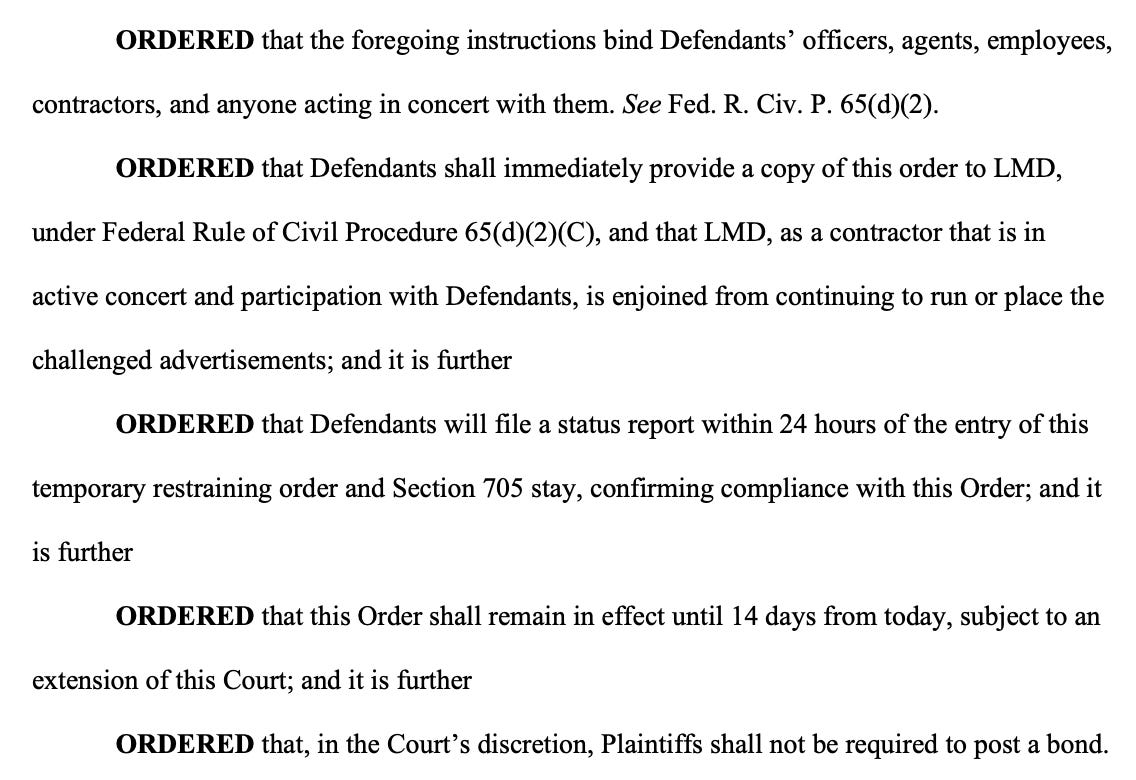
- Mandated Compliance: The administration is required to cancel all existing ad reservations and must file a status report with the court within 24 hours.
- Plaintiffs’ Victory: The lawsuit was spearheaded by the watchdog group Common Cause, along with a Democratic state legislative candidate and a New York labor union.
- For Voters: The ruling aims to ensure that the information you receive from federal agencies is strictly related to agency functions (such as safety, border security, or health) rather than political messaging designed to influence your vote. It seeks to maintain a clear line between official government information and campaign propaganda.
- For Taxpayers: This case is a direct check on how your tax dollars are being utilized. It reinforces the principle that funds appropriated by Congress for specific purposes—like homeland security—must be used for those purposes and not diverted to political campaigning.
- For Political Candidates and Parties: The ruling helps preserve the principle of a level playing field. If the executive branch can use taxpayer funds to run favorable ads, it creates a massive, unearned advantage that traditional campaign finance laws are not designed to counter.
- The Status Report: Within 24 hours of the order, the defendants must file a report detailing their compliance with the judge’s mandate to cancel all ad placements.
- The 14-Day Window: The court will use the next two weeks to evaluate the arguments presented by both sides. During this time, the plaintiffs will likely seek a more permanent injunction.
- Full Litigation: If the court finds that the DHS’s actions were indeed a violation of the APA, the case will move into a more intensive phase of discovery and legal argument, potentially leading to a permanent ban on such advertising practices.
- www.lawdork.com
- www.nbcnews.com
What Happened
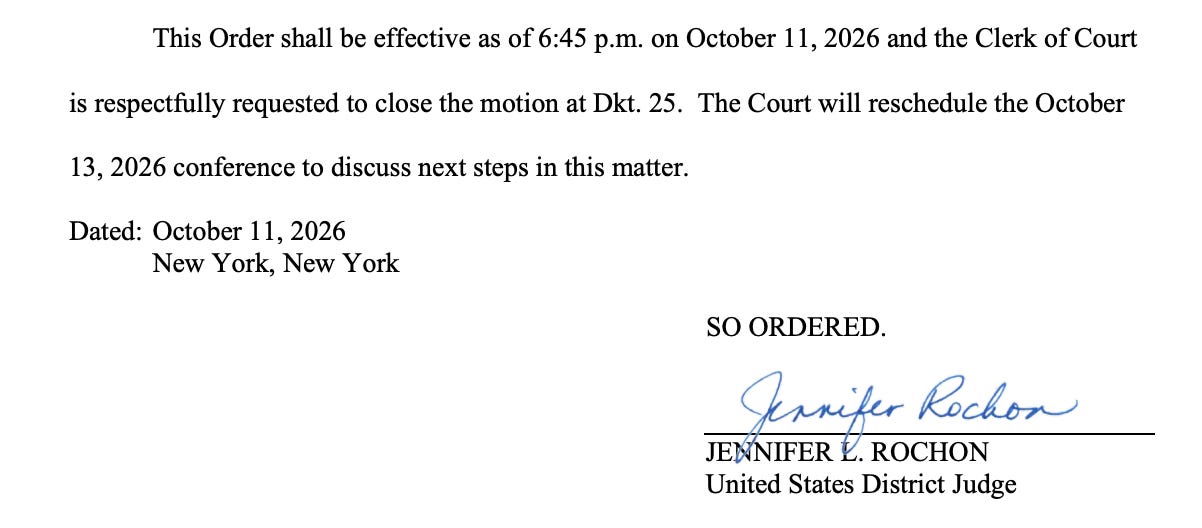
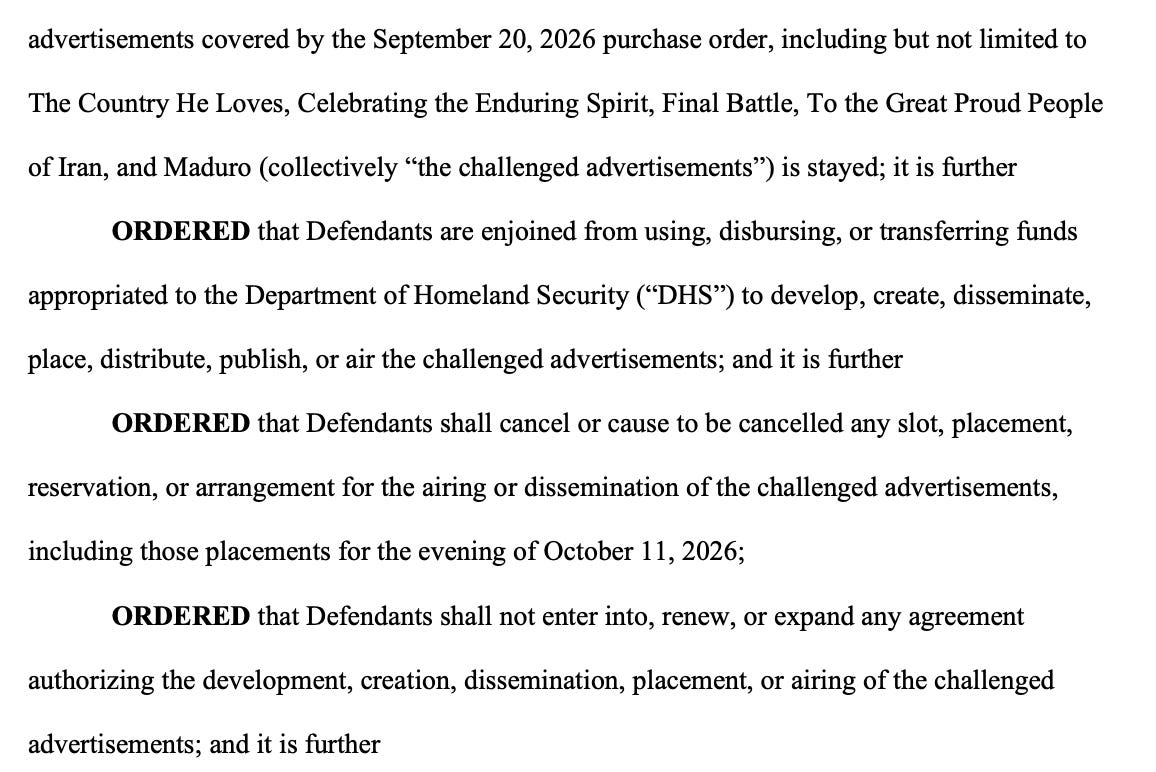
On Sunday, October 11, 2026, the legal battle over federal communication reached a critical turning point when U.S. District Judge Jennifer Rochon of the Southern District of New York issued a Temporary Restraining Order (TRO) against the Trump administration. The order, which went into effect at 6:45 p.m., requires the Department of Homeland Security (DHS) to “cancel or cause to be cancelled” any advertisements, placements, or reservations intended to disseminate pro-Trump messaging.
The litigation was initiated by a coalition of plaintiffs, including the nonpartisan watchdog group Common Cause, Robert Hunter—a Democratic candidate for the Alabama state House—and a New York-based labor union along with its associated political action committee. The plaintiffs argued that the administration was misappropriating funds appropriated by Congress for DHS operations to instead fuel a political propaganda machine.
While the administration had indicated in a Saturday court filing that the DHS, through a third-party vendor, had already instructed agents to stop purchasing new ads after Sunday, Judge Rochon ruled that the administration’s planned cessation was insufficient. She noted that the plaintiffs’ arguments were not moot and that the potential for “irreparable harm” necessitated an immediate and total freeze on all current and upcoming ad dissemination, including those scheduled for Sunday night.
Why It Matters
The implications of this Trump administration ad ruling extend far beyond a single media buy. At its core, the case touches upon the fundamental separation of powers and the integrity of federal agency operations during an election cycle.
First, the ruling addresses the potential for the executive branch to bypass campaign finance laws by using agency-specific budgets—in this case, funds intended for homeland security—to influence public perception of the sitting President. If left unchecked, such actions could set a precedent where every federal agency becomes a potential tool for incumbent political messaging, effectively creating a taxpayer-funded campaign fund for the administration in power.
Second, the case highlights a rare and significant internal tension within the federal government. The fact that the Department of Justice (DOJ), specifically the U.S. Attorney’s Office for the Southern District of New York, declined to defend the legality of the advertisements suggests a deep-seated disagreement regarding the limits of executive authority and the proper use of agency resources.
The Legal Framework: The Administrative Procedure Act
The litigation is primarily built upon the Administrative Procedure Act (APA). The APA is a foundational law that governs how federal agencies propose and establish regulations and how they must conduct themselves when implementing those regulations. It is designed to ensure that agency actions are not “arbitrary, capricious, an abuse of discretion, or otherwise not in accordance with law.”
In this instance, the plaintiffs sought a “stay of agency action” under the APA. This legal mechanism is used when a party believes an agency is acting outside its statutory authority. By requesting a stay, the plaintiffs were asking the court to freeze the DHS’s ability to spend money on these specific advertisements while the full merits of the case are litigated.
Judge Rochon’s decision to grant the TRO indicates that the court found the plaintiffs had a high likelihood of success on the merits. In legal terms, a TRO is a temporary measure intended to preserve the status quo and prevent immediate harm before a full hearing can take place. The 14-day duration of this order provides a window for the court to evaluate the long-term legality of the DHS’s advertising strategy.
A Judicial Mandate: The TRO Details
Judge Rochon’s order was specific and far-reaching. It did not merely ask the administration to stop buying new ads; it commanded the total cancellation of all existing arrangements.
| Mandate Category | Specific Judicial Requirement |
|---|---|
| Immediate Action | Cancel all current, scheduled, and reserved ad placements immediately. |
| Scope of Prohibition | Barred from using DHS funds to develop, create, distribute, or air the challenged ads. |
| Reporting | Defendants must submit a formal status report to the court within 24 hours. |
| Duration | Effective for 14 days, subject to potential extension by the court. |
The DOJ’s Unexpected Silence
Perhaps the most striking aspect of this legal development is the role—or lack thereof—played by the Department of Justice. Typically, when a federal agency like the DHS is sued, the DOJ steps in to defend the agency’s actions in court. However, reports from Law Dork indicate that the U.S. Attorney’s Office for the Southern District of New York declined to defend the legality of the DHS advertisements.
This refusal to defend is a significant blow to the administration’s legal standing. It suggests that even within the government’s own legal apparatus, there is a recognition that the use of DHS funds for political messaging may lack a sound legal basis. This internal rift could signal broader challenges for the administration as it navigates legal battles regarding the boundaries of executive power.
Stakeholders and the Battle for Accountability
The conflict involves a diverse array of stakeholders, each with distinct motivations and concerns regarding the use of federal resources.
The Plaintiffs
For Common Cause, the issue is one of democratic integrity. Virginia Kase Solomón, the organization’s President and CEO, has stated that the fight is about ensuring that no president can “waste and abuse taxpayer funds for propaganda.” The inclusion of Robert Hunter, a candidate for state office, underscores the argument that these ads create an uneven playing field, where incumbents can use the machinery of the state to gain an advantage over challengers.
The Defendants
The White House, DHS, and the Office of Management and Budget (OMB) are all named as defendants. While they have not immediately responded to requests for comment, the administration’s previous stance was that the ads were part of standard agency communication. The administration had also noted that MAGA Inc., a separate entity, would be used to fund such efforts moving forward, suggesting a strategy to bifurcate official government messaging from political campaign activities.
Comparative Overview of Claims
| Feature | Plaintiffs’ Allegation | Administration Position |
|---|---|---|
| Nature of Ads | Blatantly unlawful political propaganda | (No immediate response provided) |
| Funding Source | Misuse of taxpayer funds and DHS appropriations | DHS vendor placed buys through Sunday |
| Legal Justification | No legal precedent or justification exists | (Not explicitly addressed in court filings) |
| Primary Objective | To influence electoral outcomes for the President | (Not explicitly stated in court filings) |
What It Means for You
The outcome of this case and the enforcement of the Trump administration ad ruling will have practical implications for several groups of people:
Counterpoints and Unanswered Questions
Despite the judicial order, several questions and counterarguments remain.
One primary counterpoint is the administration’s argument regarding the timing of the ad cessation. The administration claimed they had already instructed vendors to stop purchases after Sunday. Critics, however, argue that this “planned” stop was a reactive measure to avoid legal scrutiny rather than a proactive adherence to the law.
Furthermore, there is the question of how “political propaganda” is defined. The administration may argue that the ads were intended to inform the public about the successes and activities of the DHS, which they view as a legitimate function of the agency. Distinguishing between “informational government communication” and “political propaganda” is a complex legal challenge that will likely be central to the upcoming litigation.
Finally, the role of private entities like MAGA Inc. remains an open question. If the administration shifts its advertising budget to private, donor-funded organizations, how will the courts distinguish between legitimate political speech and the continued use of government-adjacent influence?
What Happens Next
The legal battle is far from over. The current TRO is a temporary measure, and the next 24 to 48 hours will be critical.
Frequently Asked Questions
Why were the DHS advertisements stopped by a judge?
A federal judge issued a Temporary Restraining Order (TRO) because the plaintiffs, led by Common Cause, successfully argued that the Department of Homeland Security (DHS) was using taxpayer-funded resources to run political advertisements that favored President Trump. The court found that the ads likely constituted unlawful political propaganda and that continuing them would cause “irreparable harm” to the public interest and the electoral process.
Did the Department of Justice support the ads?
No. In a notable turn of events, the U.S. Attorney’s Office for the Southern District of New York, which is part of the Department of Justice (DOJ), declined to defend the legality of the advertisements in court. This means the government’s own legal representatives did not argue in favor of the administration’s right to run the ads, which significantly weakened the administration’s position.
What is the Administrative Procedure Act (APA)?
The Administrative Procedure Act (APA) is a federal law that provides a framework for how government agencies must operate. It ensures that agencies do not act in an arbitrary or capricious manner and that they stay within the legal authority granted to them by Congress. In this case, the plaintiffs used the APA to argue that the DHS was acting outside its legal authority by using its budget for political campaigning.
What happens if the administration ignores the judge’s order?
If the administration fails to comply with the Trump administration ad ruling, they could face significant legal consequences, including contempt of court charges. The judge has already mandated a status report within 24 hours to ensure compliance, indicating that the court intends to maintain strict oversight of the administration’s actions.
Closing
The immediate halt of these taxpayer-funded advertisements marks a significant moment in the ongoing tension between executive authority and judicial oversight. As the court moves toward a more permanent resolution, the focus will remain on whether the line between official government communication and political campaigning can be effectively maintained in a modern electoral landscape.
References
Featured image: Image via lawdork.com