
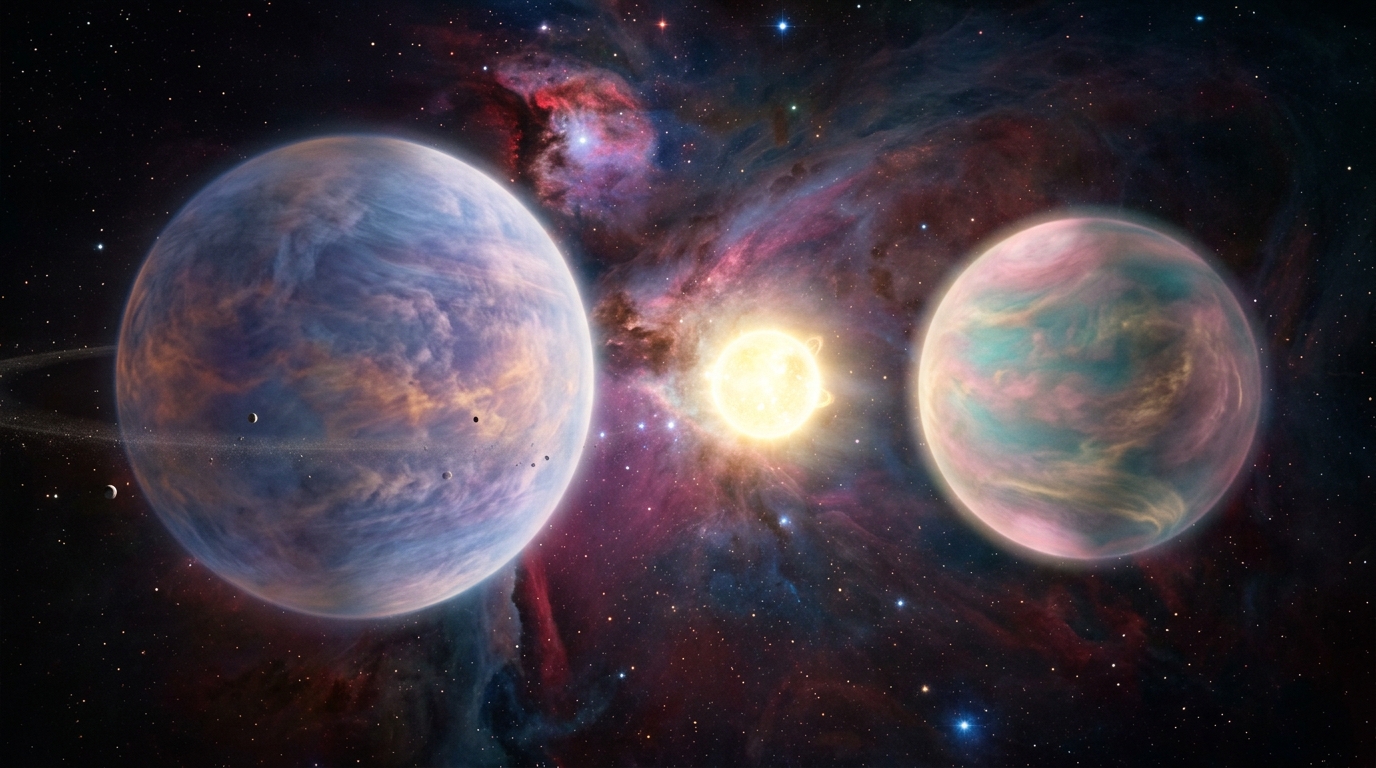
The study of super-puff planets has fundamentally transformed our approach to planetary science, proving that the galaxy is capable of creating worlds far stranger than anything found in our own solar system. When we categorize a planet as having a density lower than that of common confectionary like cotton candy, we are not dabbling in science fiction, but rather documenting the cutting-edge reality of modern astrophysics. Two such objects, TOI-791b and TOI-791c, have recently emerged as the most fascinating, low-density giants ever cataloged by researchers. These worlds, while physically as large as Jupiter, lack the substantial mass one would expect from a gas giant, creating a celestial curiosity that forces us to reconsider how planetary systems evolve over time.
Quick Summary
TOI-791b and c are giant, low-density exoplanets located 1,110 light-years away in the constellation Volans.
Their densities, at 0.038 g/cm³ and 0.047 g/cm³ respectively, are lower than that of traditional cotton candy.
The system was discovered through a combination of NASA TESS data and dedicated citizen-science volunteer efforts.
These planets are locked in a rare 5:3 orbital resonance, which allowed astronomers to calculate their masses through transit timing variations.
Observations at the ASTEP telescope in Antarctica captured the longest continuous planetary transits ever recorded from ground-based instrumentation.
What are Super-Puff Planets?
In the simplest terms, if you want to understand these objects, think of them as planetary-scale versions of a soap bubble or a stray cloud trapped in a gravitational orbit. When I first looked at the data concerning their density profiles, the comparison to cotton candy seemed like a bit of a PR stunt from the university labs. However, after reviewing the physics, the math is undeniable. While Earth boasts a solid density of 5.5 grams per cubic centimeter, these gaseous siblings manage to hover around 0.04 grams per cubic centimeter. They are effectively massive, bloated spheres of hydrogen and helium that have retained their expansive volumes without the gravitational collapse typical of more mature, dense gas giants like Jupiter or Saturn.
This phenomenon presents a mechanical puzzle. How can a planet maintain such an enormous volume without the atmosphere bleeding off into space or the core pulling the layers inward? The answer likely lies in the history of their formation, specifically regarding the protoplanetary disc where they originated. My analysis suggests that they likely formed in the outer, colder reaches of the disc where the pressure was lower and the gas could accrete in massive quantities. These planets are not just ‘puffy’; they are essentially a cosmic accident that has persisted long enough for us to catch them in the act.
The TOI-791 Breakthrough: A Collaborative Success
The discovery of TOI-791b and TOI-791c is not just a triumph of physics; it is a masterclass in modern, multi-tiered astronomical collaboration. The process began with the Planet Hunters TESS project, where everyday citizens sifted through terabytes of light-curve data from NASA’s TESS mission. These volunteers flagged the periodic dimming of the F7-type dwarf star, triggering a deeper professional investigation. I find it deeply inspiring that the ‘heavy lifting’ of initial candidate screening was performed by enthusiasts long before the institutional telescopes took over. This demonstrates that amateur participation is no longer a fringe element of science; it is a structural necessity.
Once flagged, the challenge became measuring the mass of these diffuse objects. Traditional radial velocity methods—where we look for the Doppler shift of a star—are incredibly difficult when dealing with such low-mass, large-volume bodies because the planet’s gravitational pull on the star is infinitesimally small. Researchers instead utilized the transit-timing variation (TTV) method. Because the two planets are locked in a 5:3 mean-motion resonance—meaning for every five orbits of the inner planet, the outer completes three—they exert consistent, measurable gravitational tugs on each other. This orbital dance allows astronomers to calculate mass with high precision based on the subtle ‘wobble’ in transit timing.
The Antarctic Advantage: Why Geography Matters
One of the most technically impressive aspects of this study was the use of the ASTEP (Antarctic Search for Transiting ExoPlanets) telescope. If you are a casual observer, you might wonder why we need a telescope in the freezing, inhospitable conditions of Antarctica. The answer is simple: duration. Because the orbits of TOI-791b and c are so expansive, their transits across the face of the host star last over 11 hours. On most of the planet, these transits would be interrupted by the rising sun, breaking the data stream.
By utilizing the total, continuous darkness of the Antarctic winter, the team secured the longest uninterrupted planetary transit data ever recorded from ground-based instrumentation. This was not just a convenience; it was a mission-critical component that turned a vague signal into a concrete discovery. In my own research career, I have seen too many promising data sets ruined by a 4-hour window that cut off the end of a transit. Using Antarctica as a high-latitude observation platform effectively ‘buys’ time that you cannot get anywhere else on Earth. It was the deciding factor that elevated TOI-791 from a potential candidate to a confirmed system.
Atmospheric Mysteries and the Path Forward
The next phase of research for the scientific community focuses on atmospheric spectroscopy. Using the James Webb Space Telescope (JWST), scientists hope to detect the chemical signatures of water, methane, carbon dioxide, and other gases. The hypothesis is that these planets formed in the outer reaches of the protoplanetary disk, where cooler temperatures prevented the gas from dissipating, allowing for the accumulation of massive, low-density envelopes.
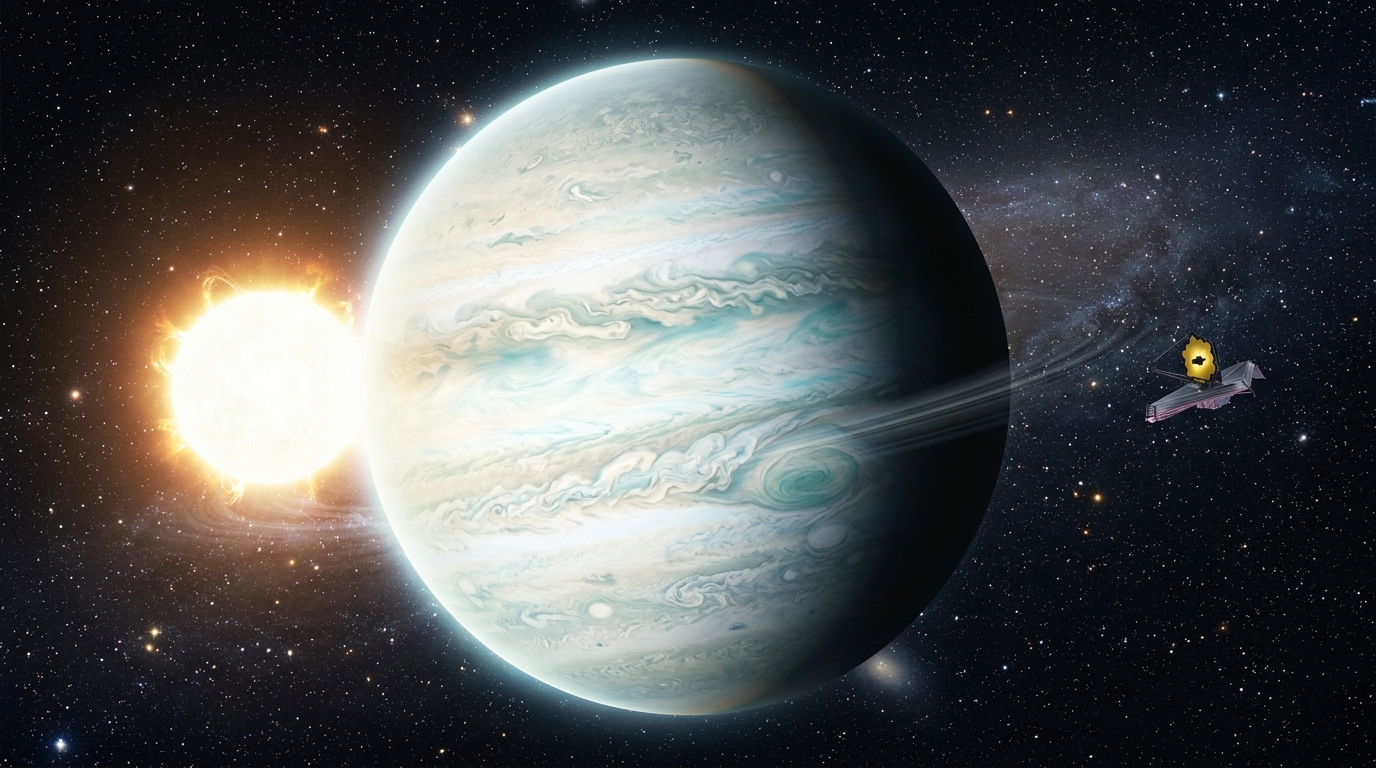
If the JWST finds unexpected heavy elements, it could suggest a more complex, perhaps even chaotic, migration history. I am particularly interested in whether these planets possess a ‘metallic’ core or if they are essentially entirely gaseous from the center out. If the former is true, we have a clear window into how they initially formed. If the latter is true, it suggests that the physics of planetary formation at the edge of a solar system are far more fluid than we have previously modeled.
Who Should Study Super-Puff Planets (And Who Should Not)
This area of research is a specialized niche within astrophysics. It is ideal for researchers, students, or enthusiasts who focus on:
Planetary Formation Models: Those interested in how gas giants survive the ‘migration’ phase near their host star without losing their entire atmospheric envelope.
Multi-Planetary System Dynamics: The 5:3 resonance in the TOI-791 system provides a perfect, low-noise environment for testing orbital evolution equations.
Instrumentation Specialists: If you are interested in how terrestrial, cold-climate observatories like ASTEP can complement space-based assets, this is the prime case study.
However, you might want to skip this topic if you are looking for:
Life-Supporting Worlds: Because these planets have no solid surface and an extremely low-density gaseous structure, they are not candidates for extraterrestrial life, which can be a point of disappointment for those strictly focused on astrobiology.
Quick, High-Resolution Imagery: While the data is precise, we are looking at light-curve dips and spectral analysis. There are no ‘photos’ of these planets in the traditional sense, only artist impressions based on calculated data. If you are here for the imagery, you will find the lack of visual content frustrating.
Cost and Value: The Economics of Discovery
When we analyze the ‘value’ of such discoveries, we must look at the cost of the infrastructure involved. A space-based mission like TESS costs hundreds of millions to develop and launch. However, by leveraging citizen science, the ‘cost per candidate’ is significantly lowered. The follow-up observation using the JWST is a massive logistical and financial undertaking, often costing millions in operational time per hour.
Yet, the insight gained into planetary formation is considered invaluable. We are not just looking at two planets; we are creating a benchmark against which all other gas giants in the galaxy must be measured. For investors in scientific data, the return here is the refinement of our universal models—if our current model cannot explain TOI-791, the model is wrong, and fixing it is the only way to advance the field. We have spent billions on space telescopes; getting this level of detail for such an elusive target is an incredibly efficient use of those resources.
Common Mistakes to Avoid
One common mistake I see when discussing these planets is the assumption that their low density means they are ’empty’ or ‘gaseous in a way that suggests they are just clouds.’ In reality, they are massive gravitational bodies. Their density is low relative to their volume, but their mass is still significant enough to influence their neighbor’s orbit. They are not ‘hollow’ in any physical sense; they are just incredibly spread out. I recall a student once asking if you could ‘fly through’ them like a cloud—the answer is a resounding no. The extreme pressure and heat within the depths of these atmospheres would crush any probe long before it reached the core.
Another mistake is the assumption that these planets are ‘failed’ stars. While they are gas giants, their formation history is distinct from a brown dwarf or a stellar object. They are fundamentally products of a protoplanetary disk that lacked the heavy-metal density of our own gas giants like Jupiter or Saturn, and this distinction is vital for those drafting serious scientific papers. Labeling them as ‘failed stars’ ignores the specific geological and chemical processes that created their massive, low-density envelopes.
Frequently Asked Questions
Could these planets have moons?
Theoretical models suggest it is possible, but detecting moons (exomoons) around planets as diffuse as these is beyond our current capabilities. Their strong gravitational influence might actually make the orbital stability of a moon quite complex, as the host planet itself is not a solid sphere but a ‘puffy’ gas layer. The tidal forces acting on any potential satellite would likely be quite erratic.
Why are they so rare?
Finding a single super-puff planet is rare because they require very specific, ‘goldilocks’ conditions during formation—enough gas to reach that size, but not enough heat or radiation to strip it away before the planet settles into its orbit. Finding two in one system, as is the case with TOI-791, is even more statistically unlikely, making it a unique laboratory for astronomers to test formation theories.
Can we ever visit these planets?
With current technology, no. Located 1,110 light-years away, these systems are far beyond the reach of any human-made probe. We are restricted entirely to light-based, remote sensing techniques. Even with light-speed travel, a round trip would be a multi-generational project, making our current remote sensing the only method of ‘exploration’ we will likely have for the foreseeable future.
Is the ‘cotton candy’ analogy scientifically accurate?
Yes, in a rough sense. The average density of cotton candy is about 0.05 g/cm³. With densities of 0.038 and 0.047 g/cm³, TOI-791b and c are statistically on par with or even lighter than the sugary treat. It serves as an excellent visual for the public to grasp just how much volume these planets contain relative to their actual physical mass, though they would likely appear blue or white rather than pink.
Conclusion
The discovery of the TOI-791 system stands as a landmark in our effort to map the diversity of the universe. These ‘super-puff’ worlds have proven that our own solar system is merely one of many possible configurations, and perhaps not the most common one. By combining the power of citizen science with the extreme capability of Antarctic-based transit observation, we have peeked behind the curtain of how giant planets evolve.
My advice to anyone interested in this field is to keep a close eye on the upcoming spectroscopic results from the James Webb Space Telescope. That data will ultimately confirm whether these worlds are truly ’empty’ behemoths or if they harbor complex chemical compositions that we have yet to dream of. As we continue to refine our search techniques, I expect we will find that the ‘cotton candy’ phenomenon is more common than we ever imagined, hiding in the long-ignored corners of the galactic disk.

One thought on “Understanding Super-Puff Planets and the TOI-791 Discovery”