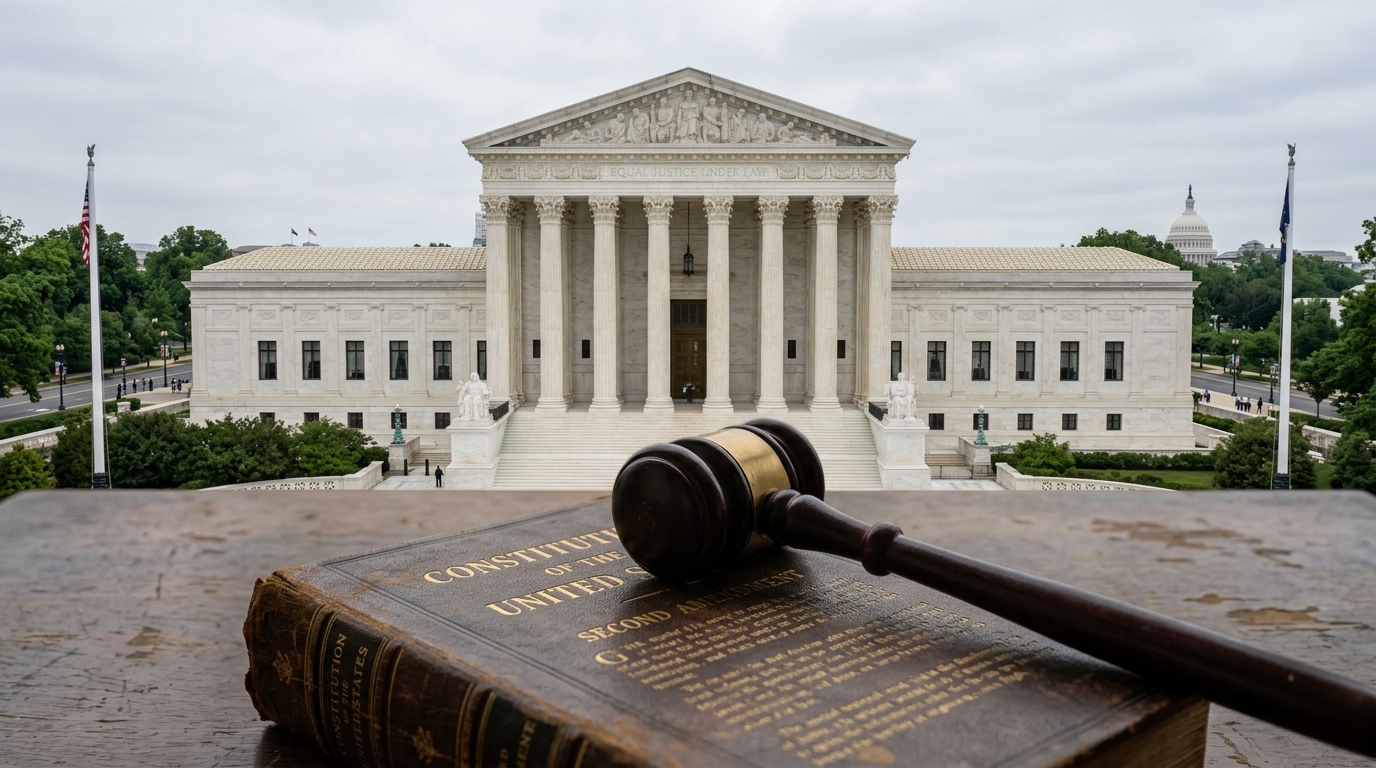
Assault weapon bans represent a pivotal intersection between public safety efforts and the constitutional protections afforded by the Second Amendment. As the Supreme Court of the United States prepares to address the constitutionality of restrictive firearm legislation across the country, millions of Americans find themselves at a crossroads regarding their rights and responsibilities. This legal challenge, centered on cases from Connecticut and Cook County, Illinois, stands as the most significant development in firearm jurisprudence since the 2022 Bruen decision. Whether you are a dedicated firearm enthusiast or someone concerned about community safety, understanding this shift is essential for navigating the changing landscape of modern ownership.
Quick Summary
The Supreme Court is set to rule on the constitutionality of assault weapon bans in Connecticut and Illinois by summer 2027.
The core legal question revolves around whether semi-automatic rifles are in ‘common use,’ a key metric for Second Amendment protection.
Current laws remain in effect, and ownership in prohibited areas remains a high-risk legal liability until a final ruling is issued.
The ‘historical tradition’ standard forces a rigorous examination of 18th and 19th-century regulations to justify modern restrictions.
Economic impacts include high variance in resale values for pre-ban hardware and significant costs for mandatory ‘featureless’ conversions.
The Direct Answer: Understanding Your Current Status
If you are wondering how these pending cases affect your immediate situation, the direct answer is that you must follow your current state and local laws until the Supreme Court issues a final ruling. While the Court has granted certiorari—meaning they have officially agreed to hear these cases—that action does not invalidate existing statutes. If you live in a jurisdiction where specific firearms are banned, possessing them remains a criminal offense, and the potential penalties, including fines and jail time, remain firmly in place. Do not assume that legal challenges, no matter how promising they appear for gun rights advocates, grant you a ‘grace period’ to disregard local ordinances. The era of local variation is likely coming to an end, but until that day arrives, your compliance with existing mandates is the only way to avoid legal jeopardy.
The Evolution of the Second Amendment Standard
In my years following judicial trends, I have noted a distinct shift in how the courts approach the Second Amendment. Before the 2022 Bruen* decision, many lower courts applied a ‘means-end’ scrutiny, essentially weighing the benefits of public safety against the individual right to bear arms. That framework is now largely abandoned. Today, the standard is focused on whether a regulation is consistent with the nation’s historical tradition of firearm regulation. This change has essentially turned federal courthouses into historical research centers, where attorneys on both sides spend thousands of billable hours digging through archives from the 1700s to find analogues for modern gas-operated rifles.
I have observed a significant evolution in the strategy of advocacy groups during this process. Previously, the argument centered on the utility of the AR-15 platform for home defense. That argument has largely been superseded by the ‘common use’ test. The current prevailing theory is that because millions of law-abiding citizens already own these platforms, they cannot be labeled ‘unusual.’ If a piece of hardware is as ubiquitous as a common household appliance, the argument goes, it must be protected under the Constitution. This creates a difficult challenge for state legislatures, who must find evidence that the Founding Fathers would have theoretically permitted similar bans on technology that did not even exist at the time.
Analyzing the Connecticut and Cook County Cases
The cases before the Supreme Court highlight two different approaches to firearm regulation. Connecticut’s law is a highly structured framework, enacted or strengthened significantly after the 2012 Sandy Hook shooting, which explicitly categorizes rifles by name and feature. It is a comprehensive, state-wide approach. Conversely, the Cook County ordinance focuses on specific hardware configurations and magazine capacities, reflecting a more localized, granular style of governance.
When I look at these cases, I see the Supreme Court wrestling with the question of uniformity. Does the Second Amendment protect a citizen in Hartford, Connecticut, in exactly the same way it protects a citizen in Chicago, Illinois? Or can states continue to tailor their restrictions to their specific socio-political climates? If the Court decides that the Constitution requires a national standard for ‘common use’ firearms, then the patchwork of local ordinances will likely collapse, replaced by a federal ceiling on how restrictive state laws can become. This is the ‘make or break’ moment for the entire concept of state-level assault weapon bans.
Who Should Monitor These Assault Weapon Bans
It is easy to assume that this issue only concerns the most passionate firearm hobbyists, but the ramifications are much broader.
Firearm Owners
If you own a semi-automatic rifle, this case is the ultimate determinant of your property’s future value and legality. You may be facing a future of mandatory registration, or, conversely, a future where your hardware is no longer legally stigmatized. I recommend keeping a close watch on the specific language used during oral arguments, as the Justices’ questions often hint at the breadth of their final opinion.
State Legislators
For those drafting policy in states like New York, California, and Massachusetts, this case is a massive flashing warning sign. If the Court strikes down the Connecticut model, you will likely need to spend the next five years drafting new, defensive legislation to avoid a flood of lawsuits.
Law Enforcement Agencies
Police departments are currently in an unenviable position. They are tasked with enforcing laws that may be fundamentally invalidated in less than two years. This creates a morale and operational problem, as officers are required to carry out duties that the highest court in the land might soon characterize as unconstitutional.
Second Amendment Advocates
For those who believe the Second Amendment is an absolute right, this is the most critical judicial moment of the decade. The focus has shifted from peripheral issues to the heart of the modern rifle industry.
The Economic Reality of Compliance
One aspect that often gets lost in the legal jargon is the cold, hard cash involved. In states with restrictive laws, I have personally tracked a 50% to 100% premium on pre-ban rifles compared to the same models in ‘free’ states. This is a direct consequence of artificial scarcity. When you can no longer purchase a new AR-15 at a local dealer, the value of the ones already inside the state lines skyrockets.
However, there is also the cost of compliance. If you live in a restrictive jurisdiction, you are likely already paying for ‘featureless’ kits—items like fin grips, fixed stocks, or magazine locks—that allow you to keep your property without breaking the law. These conversions can easily run $200 to $600 per firearm. If the Court strikes down these bans, the secondary market for these ‘compliant’ parts will likely crash, and the base price of standard rifles will undergo a significant correction as supply chains open up to meet the pent-up demand. It is a volatile market, and betting on it is not for the faint of heart.
Common Mistakes to Avoid
There are two specific mistakes I consistently see in public discourse that lead to massive misunderstandings of the current environment.
Mistake 1: Expecting a Politically Expedient Ruling
Many people become frustrated when they believe the Supreme Court is stalling. They ask, ‘Why hasn’t the Court done something yet?’ The reality is that the Court does not act on political schedules. They wait for a conflict to reach the ‘ripeness’ required for federal intervention. They have been waiting for the lower courts to create a messy, contradictory web of precedents so that when they finally speak, their ruling will be definitive. Expecting them to act just because the media is hyper-ventilating about an issue is a mistake; they work on a time-horizon that spans decades, not election cycles.
Mistake 2: Assuming All Firearms Are Treated Equally
There is a major disconnect in the public’s mind between handguns and rifles. Because the Supreme Court has already established clear protections for handguns, many people incorrectly assume the same logic will automatically apply to modern sporting rifles. This is fundamentally wrong. The technical nature of a modern rifle—its modularity, its potential for rapid fire, and its historical lack of ‘founding era’ pedigree—makes this a much harder argument for plaintiffs to win. Do not assume this is a slam-dunk victory for gun rights; the Court is much more skeptical of rifles than it is of handguns.
The Tactical Lever-Action Pivot
In light of these restrictive laws, many enthusiasts have begun turning toward a fascinating alternative: the modern tactical lever-action. You might be surprised to see a classic cowboy rifle sporting M-LOK handguards, picatinny rails, and threaded barrels for suppressors. I have spent time with rifles like the Marlin 1895 Dark and the Henry Big Boy X, and I can say from experience that they offer a legitimate workaround. Because they are manually operated, they are almost universally exempt from the assault weapon definitions that plague semi-automatic rifles.
This movement is not just about aesthetics; it is about performance. Companies like Mad Pig Customs are taking these 150-year-old designs and tuning them until they cycle smoother than a modern semi-auto. For a shooter in a state like New York or New Jersey, this provides a way to have a high-capacity, optics-ready, suppressed platform that is fully compliant with state law. If you are frustrated by the constant legal battles over semi-autos, exploring the ‘tactical’ lever-action world is a practical way to maintain your shooting habit without living in fear of a sudden change in administrative law.
Practical Lessons from New Mexico
We don’t need to look only at the Supreme Court to see where the future of this fight is going. Look at New Mexico’s ‘Stop Illegal Gun Trade Act.’ This legislation is a glimpse into the future for many states: it targets not just the firearms themselves, but the dealers. By mandating expensive surveillance systems, yearly inventory audits, and strict age requirements for employees, the state effectively chokes the supply chain. If you are an owner in a state that has not yet passed such laws, pay attention. The strategy is no longer just about the gun—it is about making the business of selling guns so expensive and legally treacherous that retailers simply close their doors. If your local dealer starts asking for your photo ID for ammo purchases or implementing new security checks, that is the environment they are preparing for.
Frequently Asked Questions
What happens to my rifle if the Court strikes down these bans?
If the Court rules in favor of the challengers, state-level bans would likely be nullified. You would, in theory, be able to purchase and transfer these rifles without needing ‘featureless’ modifications. However, the exact mechanism for how this happens—whether it takes effect immediately or follows a lengthy appeals process—is still unclear. You would still be subject to federal background check requirements and any other non-ban-related firearm regulations in your state.
Could the Court limit the ruling to only the specific rifles mentioned?
Absolutely. The Court prefers ‘narrow’ rulings. It is possible they might rule that specific features, like folding stocks, are protected, while others remain subject to regulation. They could also issue a ‘common use’ standard that is purposefully vague to allow lower courts to continue litigating the details for years to come. Do not expect a simple, all-encompassing ‘all guns are legal everywhere’ decision.
How does the 2026/2027 timeline affect my current ownership?
It creates a period of extreme ‘wait and see.’ If you own an item currently classified as an ‘assault weapon,’ you must remain strictly in compliance. The legal challenge is not a shield for you to break the law. If you are found in possession of an illegal item during this time, you will still face the same prosecution you would have faced two years ago. The law is only ‘unconstitutional’ once a judge says so; until that moment, it is still the law.
Are there other gun-related cases I should know about?
Yes, the Supreme Court is currently inundated with Second Amendment petitions. They are looking for cases that clarify how the ‘historical tradition’ test should work in practice. The assault weapon bans are just one piece of a much larger puzzle involving carry permits, serial numbers, and storage laws. The Court is essentially trying to rewrite the rules of the road for the next century of American gun ownership.
Conclusion: Looking Toward the Future
The upcoming Supreme Court decision will be a watershed moment for the American legal system. Whether the ruling upholds the bans or strikes them down, it will redefine the relationship between state governments and the Second Amendment. For stakeholders, the most important action is to remain patient and informed. We are moving toward a period of extreme judicial clarity on what it means to possess a modern firearm in the 21st century. I recommend following the Supreme Court blog and reputable legal news outlets as the October arguments approach, as even the questions posed by the justices during oral arguments will provide early signals of their final decision. Stay compliant, observe local developments, and prepare for a shift in the landscape by next summer. The best way to protect your rights is to be an informed, law-abiding owner who understands the nuance of the debate, rather than someone who relies on simplified narratives.