Escalating tensions between the United States and Iran have reached a critical point following the US Navy’s seizure of an Iranian-flagged cargo vessel, the Touska, near the Strait of Hormuz. This bold military action has cast a shadow over impending peace talks in Pakistan, with Iran swiftly rejecting further negotiations amidst accusations of “armed piracy” and calls for retaliation. The incident underscores a rapidly deteriorating diplomatic situation, highlighting the strategic volatility of a region vital to global energy supplies.
US Navy Seizes Iranian Ship After Hormuz Blockade Attempt
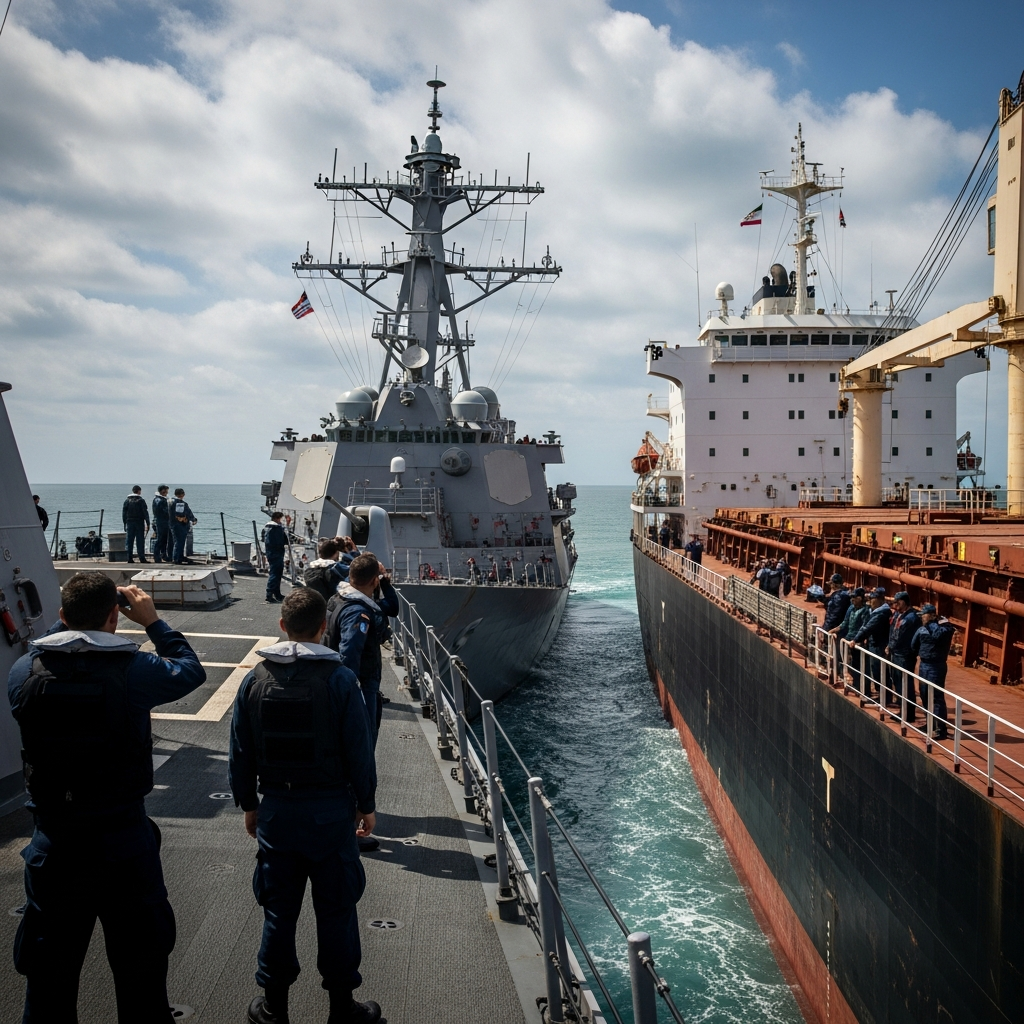
On Sunday, US President Donald Trump announced that United States forces intercepted and seized the Iranian-flagged cargo ship Touska. This decisive action occurred in the Gulf of Oman, close to the crucial Strait of Hormuz, after the vessel reportedly attempted to bypass a standing US naval blockade on Iranian ports. The Touska, a nearly 900-foot-long container ship, was already under US Treasury sanctions for alleged prior illegal activities, according to presidential statements.
Reports from the US Central Command detail the sequence of events: the USS Spruance, a US Navy guided missile destroyer, repeatedly warned the Touska to stop over a six-hour period as it sailed toward the Iranian port of Bandar Abbas. When the Iranian crew refused to comply, US forces took more drastic measures. Marines, deployed by helicopter from the USS Tripoli assault ship, rappelled onto the Touska. Before boarding, the US Navy fired upon the vessel, “blowing a hole in the engine room” to disable it. Video evidence released by the US defense department corroborated these events, showing warning shots and subsequent disabling fire after crews were advised to vacate the engine room. US personnel now hold full custody of the ship, with inspections underway to determine its cargo.
Iran Condemns Seizure as “Armed Piracy” and Vows Retaliation
Tehran’s response was immediate and furious. A spokesperson for Khatam al-Anbiya, Iran’s top joint military command, vehemently condemned the US action. They labeled it a “violation of the ceasefire” and an “act of armed piracy” by the US military. Iran accused the US of opening fire on a commercial vessel, disabling its navigation systems, and illegally boarding it.
Iranian state media, including the Isna news agency, reported that Tehran views the incident as a direct breach of the fragile ceasefire established earlier in the month. Iran has warned of “swift Iranian retaliation” and vowed to “soon respond to and retaliate” for what it perceives as an egregious act. There were even unconfirmed reports in Iranian media of drones attacking US ships, though no damage from these alleged strikes was confirmed by US sources. This direct confrontation exacerbates already high US-Iran tensions in the region.
Peace Talks Collapse Amid Escalating US-Iran Tensions
The dramatic ship seizure has effectively derailed scheduled diplomatic efforts aimed at de-escalating the ongoing conflict. US officials had planned to send a delegation to Islamabad, Pakistan, for a second round of peace talks with Iran, with the goal of resolving the “US-Israel war on Iran.” Vice-President JD Vance was slated to lead the US delegation, which included Middle East Envoy Steve Witkoff and son-in-law Jared Kushner, for discussions planned for Monday evening.
However, Iran quickly announced its decision to decline the proposed talks. An Iranian foreign ministry spokesman, Esmail Baghaei, stated, “As of now… we have no plans for the next round of negotiation, and no decision has been made in this regard.” Iranian state media, including IRNA, cited several reasons for their refusal: the “continuation of the so-called naval blockade, violation of the ceasefire and threatening US rhetoric,” as well as “Washington’s excessive demands, unrealistic expectations, constant shifts in stance, and repeated contradictions.” Pakistan, acting as a mediator, had seen its Prime Minister Shehbaz Sharif speak with Iranian President Masoud Pezeshkian, but official statements made no mention of the stalled US-Iran talks.
Trump’s “No More Mr. Nice Guy!” Threat
Adding to the diplomatic deadlock, President Trump issued a stark warning if Iran refused a deal. He threatened that the United States would “knock out every single Power Plant, and every single Bridge, in Iran,” declaring, “NO MORE MR. NICE GUY!” This rhetoric, coupled with the Iran ship seizure, underscores the severe risks involved and the dwindling prospects for a peaceful resolution as the fragile ceasefire, initially set to expire on Wednesday, faces unprecedented strain. Trump also lauded the US blockade, claiming it saved the US money while costing Iran significantly.
The Critical Role of the Strait of Hormuz
At the heart of these escalating US-Iran tensions lies the Strait of Hormuz, a narrow yet profoundly strategic waterway. Approximately one-fifth of the world’s crude oil and liquefied natural gas (LNG) normally transits through this crucial chokepoint. The US has maintained a naval blockade on ships traveling to and from Iranian ports since April 13, significantly impacting Iran’s economy and its access to international trade routes.
Iran views the blockade as a direct violation of the ceasefire and a challenge to its sovereignty. Mohammad Bagher Qalibaf, Iran’s chief negotiator, publicly declared on state television, “It is impossible for others to pass through the Strait of Hormuz while we cannot.” This assertion signals Iran’s determination to control traffic through the strait as long as the US blockade persists. The Strait of Hormuz briefly reopened after a short truce between Israel and Hezbollah, but Iran swiftly reversed this decision when President Trump affirmed the US blockade would remain “in full force.” The continued closure and threats of further naval action have led to a significant reduction in ship traffic, contributing to soaring global energy prices and leaving over 20,000 seafarers stranded.
Broader Regional Instability and Ceasefire Challenges
The Iran ship seizure and the subsequent collapse of talks are not isolated incidents but part of a wider pattern of regional instability. The initial ceasefire between the US and Iran followed a five-week conflict sparked by US and Israeli strikes across Iran in late February. Even during the brief reopening of the Strait of Hormuz, several incidents were reported:
India confirmed a “serious incident of firing on merchant ships” involving two Indian-flagged vessels.
The UK’s Maritime Trade Operations Centre reported Iranian Revolutionary Guard gunboats firing on an unspecified tanker.
President Trump accused Iran of attacking a French ship and a UK freighter, though the UK denied any attacks on its vessels.
These events highlight the precarious nature of any truce in the Middle East. Beyond the US-Iran conflict, a separate ceasefire between Israel and the Lebanese group Hezbollah is also under severe pressure. Casualties have been reported, including a French peacekeeper and Israeli soldiers, while the conflict in Lebanon has claimed over 2,000 lives and displaced over a million people. The regional landscape remains highly volatile, with the current escalation between the US and Iran threatening to ignite renewed fighting across multiple fronts.
The implications of this incident are severe, jeopardizing the delicate regional ceasefire and significantly diminishing any prospects for diplomatic resolution. The confrontation threatens to intensify the global energy crisis and risks a wider, more devastating conflict in an already unstable region. As both sides dig in, the immediate future appears fraught with uncertainty and the potential for further escalation.
—
Frequently Asked Questions
What prompted the US to seize the Iranian cargo ship Touska?
The US Navy seized the Iranian-flagged cargo ship Touska after it reportedly attempted to bypass a US naval blockade in the Strait of Hormuz. According to President Trump and US Central Command, the vessel, already under US Treasury sanctions, ignored multiple warnings over six hours to stop. This non-compliance led to US forces disabling the ship by firing into its engine room and subsequently boarding it with Marines. The US maintained it was a “deliberate, professional, and proportional manner” to enforce the blockade.
Where were the proposed US-Iran peace talks scheduled to take place?
The proposed second round of peace talks between the United States and Iran was scheduled to take place in Islamabad, Pakistan. Pakistan had been mediating the conflict, and a US delegation led by Vice-President JD Vance, along with advisors Steve Witkoff and Jared Kushner, was expected to arrive in Pakistan for discussions planned for Monday evening. However, Iran ultimately refused to attend these talks following the US seizure of the Touska*.
How does the Strait of Hormuz closure impact global oil prices and trade?
The closure of the Strait of Hormuz significantly impacts global oil prices and trade because it is a vital international waterway through which approximately 20% of the world’s crude oil and liquefied natural gas (LNG) normally passes. Iran’s decision to close the strait, asserting it would remain so as long as the US naval blockade on Iranian ports continued, drastically reduces ship traffic. This disruption to a critical supply route directly contributes to soaring global energy prices and creates significant instability in international shipping and commodity markets.
—