Understanding the Ebola Outbreak DRC
Navigating the current Ebola outbreak DRC requires a deep understanding of how viral dynamics intersect with one of the most complex geopolitical landscapes on the planet. I have tracked health emergencies in the Congo for years, and this specific 2026 event is arguably one of the most challenging due to the convergence of regional insecurity and the specific biological characteristics of the Bundibugyo virus. When you look at the news, it is easy to focus only on the case numbers, but the real story is found in the logistics of the ‘last mile’—the point where medicine meets the challenging terrain of the Ituri province.
Quick Summary
The 2026 outbreak is driven by the Bundibugyo strain, which currently lacks a licensed, widely available vaccine.
Over 1,300 cases have been identified, with international agencies emphasizing that confirmed numbers often lag behind the reality on the ground.
Primary response pillars include regional surveillance, safe and dignified burial practices, and the implementation of standardized clinical management guidelines.
The crisis is complicated by persistent regional conflict in the eastern provinces, which often prevents life-saving aid from reaching the most vulnerable populations.
Strict international travel protocols, including mandatory 21-day monitoring periods, are now in effect for travelers arriving from affected zones.
Direct Response to the Crisis
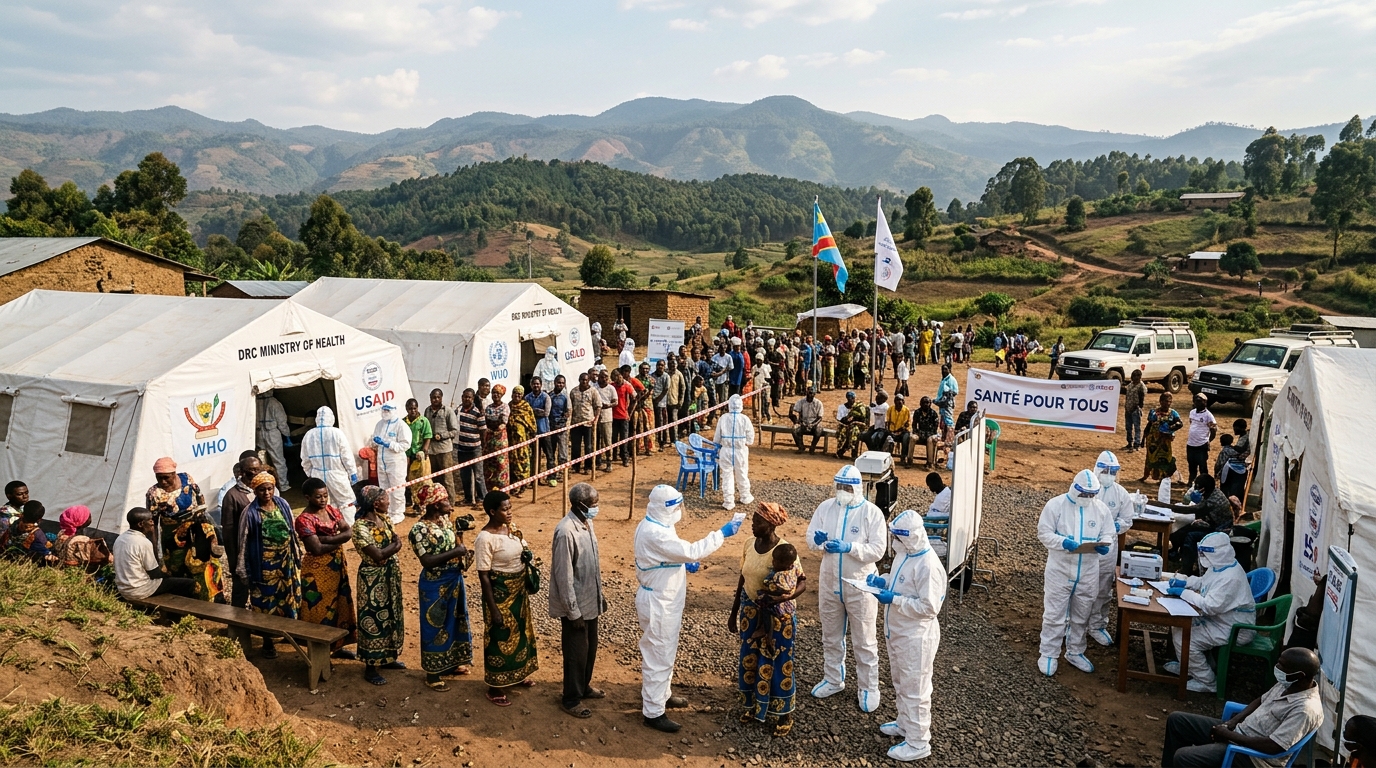
If you are wondering what the immediate priority is for anyone involved—whether as an NGO partner or a concerned observer—it is the stabilization of local health infrastructure. We are not just fighting a virus; we are fighting the systemic distrust that arises when global actors descend on a community that has historically been neglected by its own government. My experience in field operations taught me that you cannot force containment. If you show up in full bio-hazard gear without explaining to community elders why burial rites must change, you will be met with resistance. The most effective way to help right now is to support local health networks, such as community-based water initiatives and mobile screening units, which act as the first line of defense before the patient ever reaches a treatment center.
The Logistics of Containment in Fragile States
When I first analyzed the movement patterns in this outbreak, I was struck by how effectively the virus exploits the cracks in infrastructure. Managing an Ebola outbreak DRC is, at its heart, a logistical puzzle. You are moving sensitive biological samples, vaccines, and high-tech equipment across roads that disappear during the rainy season. This is why the $319 million national response budget is so critical. It isn’t just for medical staff; it is for the fleet of motorcycles, the solar-powered cold chain freezers, and the satellite internet access that allows field teams to report data in real-time.
Mobility is the enemy of containment. In the Ituri province, population displacement due to armed conflict means that the ‘containment zone’ is a moving target. I have seen how quickly a localized cluster in a rural village can turn into a regional crisis because a single infected individual decided to travel to a major market center like Bunia. This is exactly why the national ban on mass gatherings was implemented. It is a blunt instrument, but it is necessary to reduce the reproduction rate (R-number) while the surveillance teams catch up to the infection chains.
The Human Element: Addressing Distrust
One of the most persistent issues I have witnessed in my time studying these events is the ‘distrust factor.’ It is far too easy for Western observers to look at the destruction of a treatment center by a mob and label it as irrational fear. That is a mistake. It is, instead, a rational response to a history of being treated as subjects of an experiment rather than partners in health. When health authorities intervene in traditional funeral rites—which are essential to local identity—they are often seen as violating a sacred trust.
We must treat communication as a clinical tool. If we cannot explain the ‘why’ behind the quarantine, we have failed the patient. Transparency in this regard means admitting what we do not know. When we don’t have a vaccine for the Bundibugyo strain, we must be honest about that. Pretending that the medical response is foolproof only creates a vacuum that misinformation quickly fills. I have seen programs succeed only when they hire local influencers and community leaders to lead the conversations, rather than relying solely on external experts.
Clinical Management and Evidence-Based Care
With the release of the 2026 WHO clinical management guidelines, the standard of care for filovirus diseases has finally entered a new era of scientific rigor. We have moved past the days of just ‘isolating and observing.’ The new protocols emphasize aggressive, proactive supportive care. The shift to using balanced crystalloids like Ringer’s lactate instead of normal saline is a major upgrade. It may seem like a minor detail, but preventing hyperchloremic acidosis can be the difference between life and death for a patient already suffering from severe shock.
Furthermore, the management of vasopressors is now clearly defined. Using norepinephrine as the first-line treatment for shock is a massive leap forward from the older, less effective approaches that relied on dopamine. For a clinician on the ground, these protocols provide a lifeline. They reduce the burden of decision-making under extreme stress and ensure that whether a patient is in a sophisticated hospital in Kinshasa or a field unit in the Ituri province, they are receiving the best possible evidence-based treatment.
The Importance of Long-Term Survivorship
We often ignore the ‘post-outbreak’ phase, but it is a massive oversight. Ebola does not just end when the patient tests negative. We know that the virus can hide in ‘sanctuary sites’—the eyes, the brain, and the testes—leading to long-term health complications that are only just being recognized. The 2026 guidelines rightly call for structured, long-term follow-up care for survivors. If we don’t provide this, we are abandoning survivors to chronic physical pain and profound mental health issues, including depression, which affects about 75% of survivors. Providing this care is not just a moral duty; it is a vital part of containing the virus by managing the risk of future transmission through these hidden reservoirs.
Who Should Engage With This Crisis (And Who Should Not)
Deciding how to contribute to the response effort is a decision that requires brutal honesty about your capabilities.
This is ideal for: Licensed medical professionals with experience in tropical medicine, logistics experts specializing in supply chain management in conflict zones, and anthropologists or community organizers who speak local dialects fluently.
- You should skip this if: You are a generalist without field experience, or if your primary motivation is ‘voluntourism.’ Misdirected well-wishers often become a burden on the system, requiring security, water, and food that is already in short supply.
- Ignoring the Mobility Variable: Many analysts make the mistake of viewing the DRC’s provinces as static, isolated entities. They are not. The mobility between provinces is constant, fluid, and often happens through unofficial routes. Any modeling that fails to account for how people move from hotspots to agricultural centers will consistently underestimate the virus’s speed of spread. I remember watching an early model fail completely because it treated the Ituri province like an island, forgetting that its borders were porous and the population was highly migratory.
- Confusing Political Friction with Health Resistance: It is a dangerous fallacy to assume that all resistance to medical intervention is born of ‘ignorance’ or political animosity. Much of it is a logical response to a lack of security. If a mother in a conflict-ridden zone fears that sending her child to an isolation center means that child will be lost in a war zone, her resistance is not about the virus—it is about maternal survival. Conflating these two things leads to disastrous communication strategies that fail to build the necessary rapport for contact tracing and vaccination.
- www.cdc.gov
- www.cdc.gov
- news.un.org
- globalbiodefense.com
- www.bbc.com
- www.concern.net
My advice: if you aren’t a specialist, support the organizations that are already there. The goal is to maximize the efficiency of the professional response units, not to add to the logistical strain of managing civilian presence in a red zone.
Financial and Strategic Realities: The Cost of Containment
Comparing the $319 million response plan to previous outbreaks shows a marked shift in government strategy. We are seeing a move away from ‘reactive spending’ toward ‘overwhelming force’—at least in financial terms. The cost of a fully equipped treatment center, including staff, specialized waste management, and security, can easily exceed $50,000 per week, and that is before accounting for the massive costs of air-lifting supplies into remote areas.
However, the economic ripple effect is the true hidden cost. When the government restricts travel and trade in the eastern provinces, it is essentially choking off the region’s economic engine to save its people. This is a painful trade-off. It creates a short-term humanitarian strain as families lose their income sources, but it is the only way to prevent the much higher long-term cost of a nationwide epidemic. If the outbreak were to reach a major metropolis like Kinshasa, the economic damage would be measured in billions, not millions.
Common Mistakes to Avoid
When we analyze the Ebola outbreak DRC, we frequently fall into two common traps that derail our understanding of the situation.
Frequently Asked Questions
How is the fatality rate calculated for the current outbreak?
The Case Fatality Rate (CFR) is calculated by dividing confirmed deaths by confirmed cases. While this provides a snapshot, it is often skewed in the early days of an outbreak because it fails to capture the true number of infections in remote or conflict-affected regions. We must always read these numbers with the understanding that they likely underestimate the true scale of the crisis. Early intervention within the first 48 hours of symptoms is the single most effective way to lower this rate, as it allows for the administration of supportive therapies before the body is overwhelmed by the viral load.
Why are public gatherings banned even in non-epicenter provinces?
The government is utilizing a ‘prevention of seeding’ strategy. Viruses are opportunistic; they look for the path of least resistance. By limiting gatherings in urban centers that are currently unaffected, they are creating a firebreak. If the virus reaches a crowded, high-density city, it will spread exponentially faster than it does in the rural eastern provinces. This policy is intentionally disruptive to daily life to prevent the far more devastating catastrophe of an uncontrolled urban outbreak.
What makes contact tracing so difficult in the current environment?
Contact tracing requires stable, trusting relationships with the people being tracked. In the Ituri province, the constant displacement caused by military operations creates a nightmare for tracing. When an individual is forced to flee their home due to gunfire, the tracers lose that link in the chain. Furthermore, there is the issue of fear. If individuals suspect that being identified as a ‘contact’ will result in forced separation from their families or time in an isolation unit that they do not trust, they will simply disappear into the population, effectively breaking the chain of surveillance and allowing the virus to propagate in secret.
Is there a clear timeline for the end of the outbreak?
No. The end of an outbreak is not determined by a calendar date, but by the biology of the virus. We look for a period of 42 days (two full incubation periods) without a new confirmed case. This timeline is entirely dependent on the ability of our field teams to maintain the 81.3% contact follow-up rate. If that number slips, the clock effectively resets because the hidden transmission vectors remain active. The focus must be on granular, day-to-day control rather than searching for an end date.
Conclusion
The path forward for the DRC is one of extreme diligence. We must synthesize local knowledge with international medical standards, ensuring that our technical responses do not ignore the human, emotional, and political realities of the communities they serve. While the financial investment is significant, the true measure of success will be found in the contact tracing statistics and the long-term rebuilding of trust in the healthcare system.
The Ebola outbreak DRC is a stark reminder that in our modern, interconnected era, health security is a shared burden. We cannot simply wall off these regions; we must invest in the infrastructure that makes them resilient. Moving forward, the priority must be to transition from an ’emergency-only’ mindset toward sustainable health system investments that can catch these threats before they escalate into global crises. By following the new clinical management guidelines and prioritizing human dignity alongside viral containment, we have the best chance to extinguish the flames of this current outbreak and prepare for whatever comes next.