Formula 1’s highly anticipated return to action in Miami faces a significant threat of severe disruption as ominous weather forecasts predict heavy thunderstorms for Sunday’s main Grand Prix race. As round four of the 2026 season draws near, teams, drivers, and fans are bracing for potentially chaotic track conditions that could dramatically impact the outcome. This isn’t just about the weather; it’s a pivotal moment shaped by new regulations, intense driver rivalries, and major team upgrades, all converging on the vibrant “Magic City.”
Thunderstorm Threat Looms Over Sunday’s Miami Grand Prix
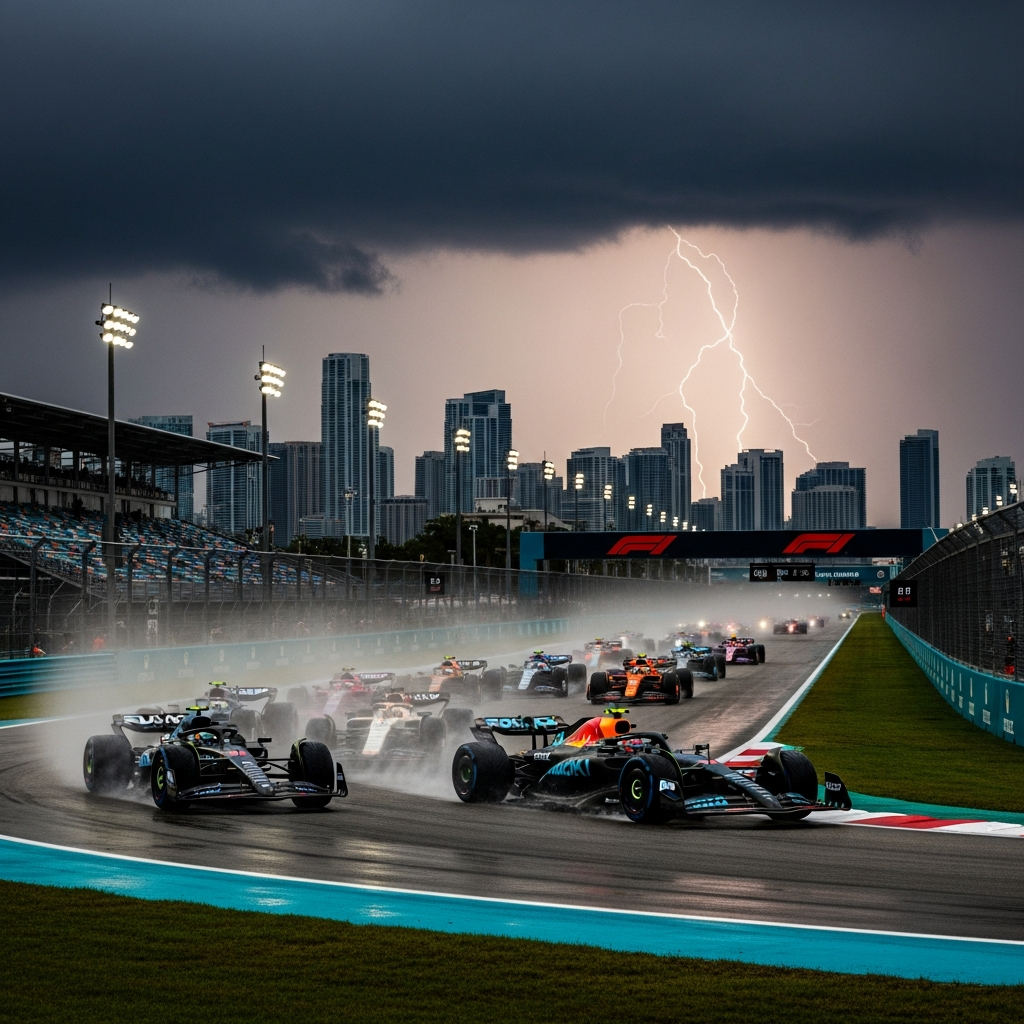
The focus for the 2026 Miami Grand Prix has shifted dramatically to the skies. Weather forecasts issued on Wednesday, April 29th, at 0600 ET/1100 BST, indicate a high probability of intense thunderstorms sweeping through the city. These cells are expected to develop on Sunday morning and persist throughout the afternoon, directly threatening the scheduled 16:00 local time start of the 57-lap race. Predictions suggest a 37 percent chance of thunderstorms on race day, alongside temperatures around 32°C, 100 percent cloud cover, and rising humidity at 39%.
The path of this disruptive weather system is extensive. Originating earlier in the week in the Rocky Mountains near Denver, Colorado, it will traverse much of the eastern seaboard of the United States. Forecasters track its movement across the southern states of Alabama, Louisiana, and Mississippi on Friday and Saturday. It will then pass over the Florida panhandle during Saturday night and Sunday morning, setting a direct course for Miami by race time. These conditions mark the first significant rainfall at the Miami Autodrome since a light drizzle impacted its debut event in 2022.
Historical Precedent: The 2025 Sprint Chaos
Adding to the apprehension is the memory of the 2025 Miami Sprint race. That event was also significantly affected by thunderstorms, leading to a delayed start under red flag conditions. A notable incident saw Charles Leclerc aquaplane and crash on the lap to the grid before the race even officially began. However, history offers a glimmer of hope: once the rain ceased in 2025, the track dried rapidly, allowing drivers to switch to slick tires by the race’s conclusion. This quick-drying characteristic could prove crucial for strategic decisions if similar conditions arise this year.
In stark contrast to the Sunday forecast, the preceding sessions of the Grand Prix weekend are expected to remain clear and warm. Practice, Sprint Qualifying, the Sprint race itself, and the main Qualifying session are all predicted to be rain-free. Temperatures are anticipated to be comfortably warm, ranging in the low to mid-30 degrees Celsius region, ensuring dry running for crucial setup and competitive action before the potential Sunday deluge.
Navigating the New Era of Formula 1: Rules and Rivalries
Beyond the immediate weather concerns, the 2026 Miami Grand Prix is set against a backdrop of sweeping changes and escalating tensions within Formula 1. The season has already seen the introduction of the sport’s most significant rule changes in history, bringing both excitement and controversy. Teams are also rolling out substantial upgrades, and championship battles are heating up, making Miami a truly pivotal race.
The Controversial 2026 Engine Regulations
The 2026 season ushered in revolutionary engine regulations, mandating a 50-50 split between internal combustion and electrical power. This shift introduced new ‘overtake’ and ‘boost’ modes, replacing the traditional DRS. While ‘overtake’ provides a temporary electrical energy boost for a driver within one second of a rival, ‘boost’ allows maximum electrical energy on demand. The result has been dubbed “yo-yo racing,” where cars repeatedly pass and re-pass as energy advantages fluctuate.
This new dynamic has drawn strong criticism from some quarters. Four-time world champion Max Verstappen famously called the new F1 “a joke” and likened it to the video game “Mario Kart,” labeling the racing “anti-driving.” Conversely, Lewis Hamilton described a recent battle with Charles Leclerc as his “best battle” in over a decade, representing “how racing should be.” Yet, even Hamilton, like many other drivers, expressed misgivings about how the new engines diminish pure driver skill. Lando Norris acknowledged the appeal for viewers but noted the feeling of becoming a “complete passenger” once the battery is depleted after an overtake.
The Diminished Art of Qualifying
The impact of the new regulations extends significantly to qualifying. There is near-unanimous agreement among drivers that the challenge of a flat-out qualifying lap has been compromised by the necessity of energy management. Drivers now often treat challenging corners as “charging zones” and employ ‘lift and coast’ techniques to optimize electrical recovery, rather than pushing to the absolute limit.
The Suzuka circuit, known for its demanding layout, served as a stark example. Sections like the Esses were designated “zero kilowatt zones,” where engines operated at roughly half power. Drivers like Norris and Leclerc expressed intense frustration, with Norris stating it “hurts the soul” to lose significant speed. Leclerc swore over the radio, lamenting that consistency now pays off more than bravery, making qualifying less challenging. Oscar Piastri described the required actions as “counter-intuitive.” The FIA and teams acknowledge this is an ongoing issue they are actively working to resolve, though Mercedes engine boss Hywel Thomas admitted “a simple solution does not exist” due to the rules’ complexity.
Rising Safety Concerns
A more grave consequence of the new regulations has been an increase in safety concerns, particularly regarding significant speed differentials during races. Oliver Bearman’s 191mph crash at Suzuka starkly highlighted this danger. The electrical part of the engine provides substantial power, but the battery drains quickly, necessitating frequent recharging. This leads to nearly 500bhp offsets in engine power when one car is deploying energy and another is recovering. Such differences can create massive closing speeds, as seen when Bearman encountered Franco Colapinto’s Alpine going over 30mph slower.
The Grand Prix Drivers’ Association (GPDA), including prominent figures like Carlos Sainz, has repeatedly warned the FIA about these dangers. There is growing concern about the lack of attention to racing safety while focusing on qualifying, especially for street circuits like Baku, Singapore, or Las Vegas, where such high-speed differentials near walls could have catastrophic consequences. While F1 bosses are seeking solutions, the fundamental 50-50 power split remains a core, politically charged issue.
Championship Dynamics and Team Intrigues in Miami
The Miami Grand Prix also arrives amid a flurry of intriguing team and driver storylines, adding layers of excitement to an already action-packed weekend. From an escalating internal battle at Mercedes to McLaren’s anticipated performance leap, the stakes are exceptionally high.
Mercedes’ Internal Battle: Antonelli vs. Russell
The Mercedes-AMG Petronas F1 Team is grappling with intense internal tension as the rivalry between its two drivers, George Russell and the young sensation Kimi Antonelli, heats up early in the 2026 season. Mercedes has swept every Sunday race so far, with Russell taking victory in Australia and a sprint win in Shanghai, while the 19-year-old Antonelli has claimed two Sunday victories in China and Japan, giving him a nine-point lead over his teammate heading into Miami.
Team principal Toto Wolff openly addressed this inherent paradox of F1, stating that teammates are also the biggest competitors. He emphasized Mercedes’ decade-long experience in managing such situations, forged through difficult experiences like the “explosive” Rosberg-Hamilton rivalry of 2016. Wolff’s guiding principle is clear: “The team is always more important than the drivers.” He conveyed a direct message to both Russell and Antonelli: no individual driver is bigger than the team badge. Despite Antonelli’s rapid ascent, Wolff believes his young prodigy is still in a development phase and not expected to perform “miracles all year,” yet he continues to deliver standout performances.
McLaren’s “Significant Step” and Wider Upgrades
In other team news, McLaren is poised to make a “significant step” forward in performance at the Miami Grand Prix. This anticipated improvement stems from the team successfully solving a complex issue related to its Mercedes F1 power unit. Earlier in the season, McLaren encountered “early teething troubles” and struggled to fully comprehend the Mercedes HPP unit, evidenced by pre-race electrical glitches that prevented both Lando Norris and Oscar Piastri from starting the Chinese Grand Prix.
Crucially, every team on the grid is expected to introduce “huge upgrades” at the American circuit. This widespread development could potentially “reset” the championship standings and create a significant shift in the competitive order, making Miami a crucial barometer for the rest of the season.
Calendar Adjustments and Driver Market Buzz
The Miami Grand Prix’s return to action follows an unusual five-week break in the F1 calendar. This hiatus was a direct consequence of the cancellations of the Bahrain and Saudi Arabian Grands Prix from their original April schedule due to conflict in the Middle East. In a remarkable show of support, Silverstone, the venue for the British Grand Prix, has volunteered to host a second Grand Prix this year to help compensate for the lost events.
Meanwhile, the driver market continues to generate speculation. Respected F1 commentator Martin Brundle issued a “closed doors warning” concerning Max Verstappen’s future. Brundle suggested that Verstappen’s options for potentially leaving Red Bull might be severely limited, given that the three leading F1 teams already have established driver line-ups. While acknowledging Red Bull’s challenge in retaining Verstappen amidst struggles with the RB22 car, Brundle’s analysis implies a lack of viable top-tier alternatives for the four-time champion. Former F1 champion Nigel Mansell has also added his voice to the conversation, lambasting the current F1 technical regulations for creating “totally false” overtakes and causing fan “grumpiness.”
The 2026 Miami Grand Prix is shaping up to be far more than just another race on the calendar. With a significant weather threat looming, coupled with a revolutionary set of regulations, high-stakes team development, and intense driver battles, this event promises drama both on and off the track. The unpredictable conditions and the underlying tensions of a rapidly evolving Formula 1 season mean that Miami could indeed be a pivotal, and potentially chaotic, moment in the championship narrative.
Frequently Asked Questions
What is the primary weather concern for the 2026 Miami Grand Prix race day?
The main concern for the 2026 Miami Grand Prix is the high likelihood of heavy thunderstorms on Sunday, April 29th, specifically threatening the 16:00 local time start of the main race. Forecasts issued on Wednesday, April 29th, predict these storms will move across the eastern US, hitting Miami after crossing the Florida panhandle. There’s a 37% chance of thunderstorms, with temperatures around 32°C and high humidity. While practice and qualifying sessions are expected to be dry, the main event faces a significant risk of disruption.
How have the new 2026 F1 engine regulations impacted qualifying performance?
The new 2026 F1 engine regulations, featuring a 50-50 split between internal combustion and electrical power, have significantly altered qualifying. Drivers now prioritize energy management over flat-out speed, using ‘lift and coast’ techniques and treating corners as “charging zones” to recover electrical energy. This has led to a diminished challenge for a qualifying lap, with drivers expressing frustration over reduced speeds and the need to manage power, as exemplified by “zero kilowatt zones” at Suzuka. Critics argue it makes qualifying less about driver bravery and more about consistent energy management.
What key team and driver storylines are unfolding at the Miami Grand Prix?
The Miami Grand Prix is a hotbed of storylines, including an intense rivalry within Mercedes between George Russell and Kimi Antonelli, where Antonelli holds a nine-point championship lead. Mercedes has adopted a “team over driver” philosophy to manage this. McLaren is expected to introduce a “significant step” in performance after resolving power unit issues, and all teams are bringing “huge upgrades” that could reset the championship. Additionally, the race follows a five-week break due due to calendar changes, and speculation continues around Max Verstappen’s future and Nigel Mansell’s criticism of the new rules.