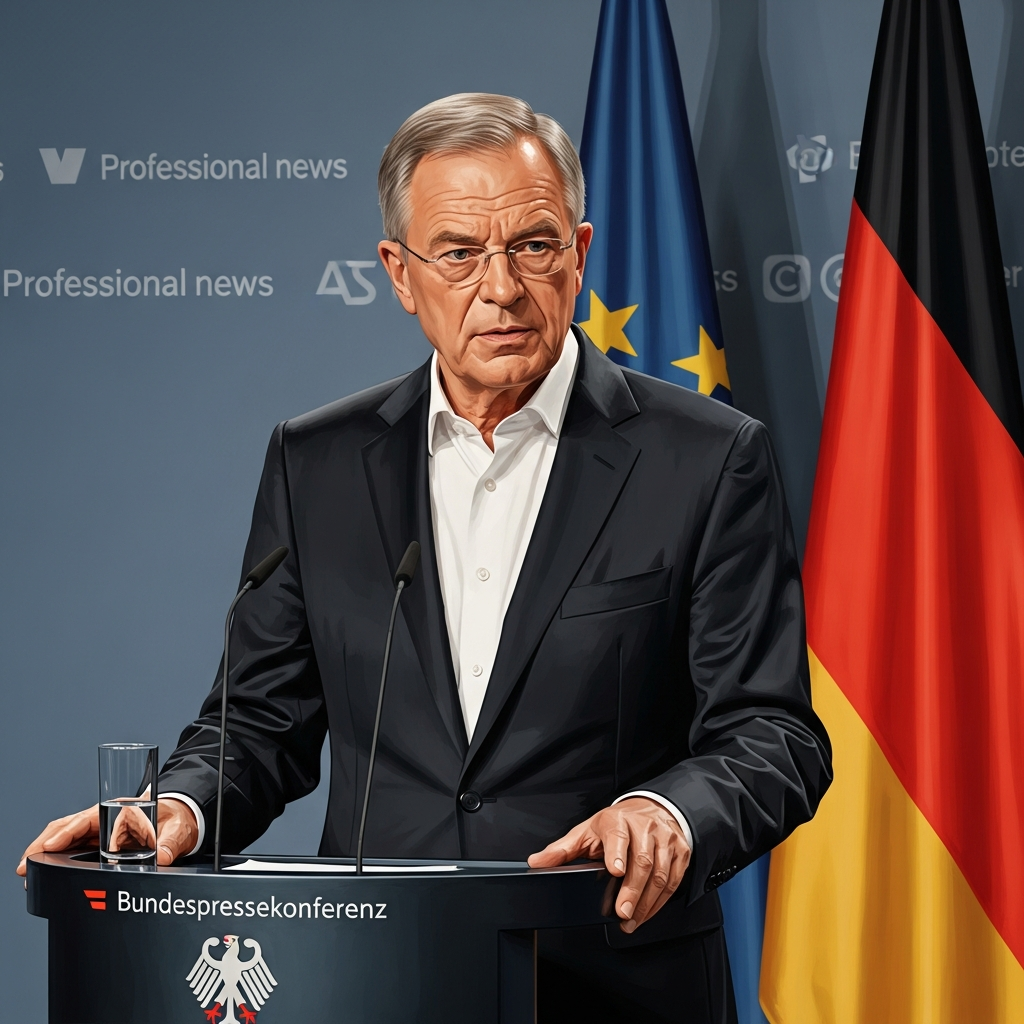
German Chancellor Friedrich Merz has delivered a stark assessment of current US-Iran relations, asserting that the United States is being “humiliated” by Tehran’s leadership. This candid declaration suggests the Trump administration is being significantly outmaneuvered at the diplomatic table, exposing a profound lack of strategic foresight in Washington’s approach to the complex Middle East conflict. Such a trenchant critique from a key NATO ally underscores the severe transatlantic rift and raises critical questions about the future of global diplomacy with Iran.
German Chancellor Merz Accuses US of Strategic Blunders
Speaking to students in Marsberg, Chancellor Merz did not mince words, characterizing the US engagement with Iran as entering a conflict “without a coherent strategy.” He highlighted the enduring challenge with such interventions: “The problem with conflicts like this is always you don’t just have to get in – you have to get out again.” Drawing sobering parallels to the prolonged US withdrawals from Afghanistan and Iraq, Merz emphasized the painful lessons of disengagement without clear strategic foresight.
Merz’s critique extends specifically to the stalled US-Iranian talks. He pointed to repeated instances where American negotiators traveled to Islamabad for indirect discussions, only to depart without progress. Vice-President JD Vance led a delegation two weeks prior that yielded no results, and a subsequent trip was outright canceled. The Chancellor suggested that Iran’s leadership, particularly the Revolutionary Guards, possesses a “very skillful” approach to negotiation, or rather, a mastery of “not negotiating,” effectively outwitting US diplomats. This, he concluded, constitutes a “humiliation” of an entire nation by the Iranian leadership.
Trump’s Optimism vs. Merz’s Stark Reality
Chancellor Merz’s assessment directly contradicts President Trump’s efforts to cast the diplomatic limbo in a positive light. Just a day prior, Trump confidently told Fox News, “We have all the cards,” adding that if Tehran desired talks, “they can come to us, or they can call us.” Merz, however, implied it was Trump’s team being outplayed, suggesting that Iranian resilience in an “existential battle” allows them to absorb a much higher price than anticipated. This strategic miscalculation, according to experts like Ali Vaez of the International Crisis Group, has left Washington struggling for leverage.
Iran’s “Hormuz First” Proposal and Its Rejection
Amidst this diplomatic stalemate, Iran put forward a new ceasefire proposal focusing on the immediate opening of the Strait of Hormuz. Under this “Hormuz first” offer, Iran proposed deferring discussions on critical issues such as nuclear weapons, missile programs, and sanctions to a later stage. A bill being prepared by Iran’s parliament suggested shippers would pay Tehran for “services” involved in passing through the strait, a passage previously free for international navigation. Iranian officials indicated a willingness to discuss the nuclear issue eventually, but only after the US blockade had been lifted, facing significant domestic pressure from the Islamic Revolutionary Guard Corps and public opinion against immediate nuclear discussions.
This proposal, however, met with widespread skepticism. Mediators involved in the talks quickly deemed it unlikely to succeed, primarily because it failed to address Washington’s core war aim: a permanent end to Iran’s nuclear program. As one diplomat familiar with the talks noted, “Hormuz is a byproduct of the war, so how can this be tackled first?” Furthermore, the UN’s International Maritime Organization (IMO) firmly rejected the concept of imposing fees, with Secretary General Arsenio Dominguez stating there was “no legal basis” for such taxes on straits for international navigation.
The Strait of Hormuz: A Lifeline Under Pressure
The Strait of Hormuz remains a critical global artery. Its proposed “services” fees and the ongoing blockades highlight its immense strategic importance. While Iran’s “Hormuz first” offer failed, it signaled a notable shift in Tehran’s diplomatic strategy, previously focused on leveraging its blockade on Gulf exports for broad security guarantees.
US Counter-Blockade Exacerbates Iran’s Economic Crisis
Following the breakdown of the Islamabad talks, the Trump administration imposed a counter-blockade on shipping utilizing Iranian ports. This intensified measure has severely exacerbated Iran’s already deep economic crisis. The International Monetary Fund (IMF) has projected a grim 6.1% contraction in Iran’s gross domestic product (GDP) this year, with year-on-year inflation soaring to nearly 70%. Prices for essential food staples and healthcare are rising at even higher rates, placing immense strain on the Iranian populace.
The blockade has also created a critical shortage of storage capacity for Iran’s oil output. Empty Iranian tankers are prevented from returning to port, limiting storage options. Winding down oil production would inflict long-term, damaging effects on the nation’s vital energy sector, further complicating any potential recovery. These economic pressures, while intended to force concessions, are instead viewed by some experts as hardening Iran’s resolve in what it perceives as an existential struggle.
Russia’s Crucial Role and Germany’s Offer
In a bid to mitigate the crippling effects of the US counter-blockade, Iranian Foreign Minister Abbas Araghchi met with Russian President Vladimir Putin and a high-powered Russian delegation in Moscow. Official Russian media reported Putin’s pledge that Russia would “do everything that serves [Iranian] interests, the interests of all the people of the region, so that peace can be achieved as soon as possible.” Araghchi, for his part, asserted that “the world has now realised Iran’s true power,” emphasizing the Islamic Republic’s stability and strength.
Analysts like Nikita Smagin suggest these talks centered on Russian military and economic support, particularly focusing on transit routes for Iranian trade. Smagin noted that if the US blockade continues, “the Caspian Sea and the land link with Russia will become one of the few remaining routes for connecting Iran with world markets.” However, the vulnerability of these routes was highlighted by an Israeli bombing of Bandar Anzali, an Iranian port on the Caspian, in March. Even before this strike, these alternative pathways fell far short of substituting the Strait of Hormuz, which historically facilitated over 90% of Iran’s pre-war trade.
European Concerns and Germany’s Vision
Chancellor Merz also underscored the significant negative economic repercussions of the complicated Middle East situation on Germany and the broader European Union. He explicitly stated that the “war against Iran” is directly impacting Germany’s economic output and “costing us a great deal of money.” In this context, Merz reiterated Germany’s standing offer to deploy minesweepers to aid in reopening the crucial Strait of Hormuz. However, this assistance is contingent upon a cessation of hostilities, reflecting Europe’s cautious and conditional approach to intervention.
Merz articulated a vision for Germany to assume a more prominent leadership role within the European Union. He suggested that a united EU, with its larger population, could be “at least as strong as the United States of America.” This statement points to a desire for rebalancing international power dynamics, with Europe taking greater responsibility for its own security and foreign policy, potentially reducing reliance on the US in global affairs.
The Nuclear Standoff and Regional Instability
Despite the economic pain, Ali Vaez believes Trump misjudged Iran’s willingness to make concessions on its nuclear program. Iranian resilience, Vaez argues, is rooted in an “existential battle,” prepared to absorb far greater costs by transferring the pain to its population. For Trump, however, domestic political considerations like high petrol prices and inflation, the desire to resolve the crisis before meeting Xi Jinping, and fears of a global jet fuel shortage jeopardizing the World Cup, are all significant pressures.
While a deal to reopen the Strait of Hormuz could allow Trump to declare a victory by pointing to damage inflicted on Iran’s nuclear program, experts warn of substantial risks. Such an agreement would leave Iran with a significant stockpile of highly enriched uranium, theoretically sufficient for a dozen nuclear warheads. Ariane Tabatabai, a former Pentagon policy adviser, cautions that Iran could rapidly reconstitute its military capabilities, given its doctrine of building and deploying “cheap” assets. Simultaneously, Israeli Prime Minister Benjamin Netanyahu raised concerns about threats from Hezbollah’s rockets and drones, hinting at potential fresh Israeli military action in Lebanon, further illustrating the pervasive regional instability fueled by the Iran conflict.
Frequently Asked Questions
What specific concerns did German Chancellor Merz raise about US strategy in the Iran conflict?
German Chancellor Friedrich Merz criticized the United States for entering the “Iran war” without a coherent strategy, making disengagement exceedingly difficult. He highlighted that the Trump administration was being outwitted by Tehran’s skillful “non-negotiating” tactics, leading to US negotiators returning from Islamabad without progress. Merz viewed this as a “humiliation” of the US by Iran’s leadership, particularly the Revolutionary Guards, and pointed to the significant economic impact of the conflict on Germany and Europe.
How did Iran’s “Hormuz First” ceasefire proposal aim to reshape negotiations, and why was it rejected?
Iran proposed a “Hormuz First” ceasefire deal focused on immediately reopening the Strait of Hormuz, with shippers potentially paying fees to Tehran, while deferring discussions on nuclear weapons, missiles, and sanctions to a later stage. Iranian officials were willing to discuss nuclear issues only after the US blockade ended. However, this proposal was rejected by international mediators and the UN’s International Maritime Organization (IMO) because it failed to address Washington’s primary war aim—a permanent end to Iran’s nuclear program—and the IMO found no legal basis for imposing fees on international navigation straits.
What economic pressures is Iran currently facing due to blockades, and how is it seeking support?
Iran is facing a severe economic crisis exacerbated by a US counter-blockade on its shipping. The International Monetary Fund (IMF) forecasts a 6.1% GDP contraction and nearly 70% inflation, with surging prices for food and healthcare. The blockade has also led to a critical shortage of storage for Iran’s oil output. In response, Iranian Foreign Minister Abbas Araghchi met with Russian President Vladimir Putin in Moscow to seek military and economic support, including the establishment of alternative transit routes via the Caspian Sea and land links to mitigate the impact of the sanctions.
Conclusion
Chancellor Friedrich Merz’s blunt assessment serves as a critical wake-up call, highlighting a perceived diplomatic vulnerability for the United States in its ongoing engagement with Iran. The complex interplay of stalled negotiations, Iran’s strategic proposals, severe economic pressures, and the involvement of global powers like Russia paints a volatile picture. While the US seeks to compel concessions through economic pressure, experts suggest Iran’s deep-rooted resilience and regional ambitions may be underestimated. As the situation evolves, the global community will watch closely to see if diplomacy can forge a path forward, or if the “humiliation” Merz describes will deepen, with far-reaching consequences for international stability and the global economy.