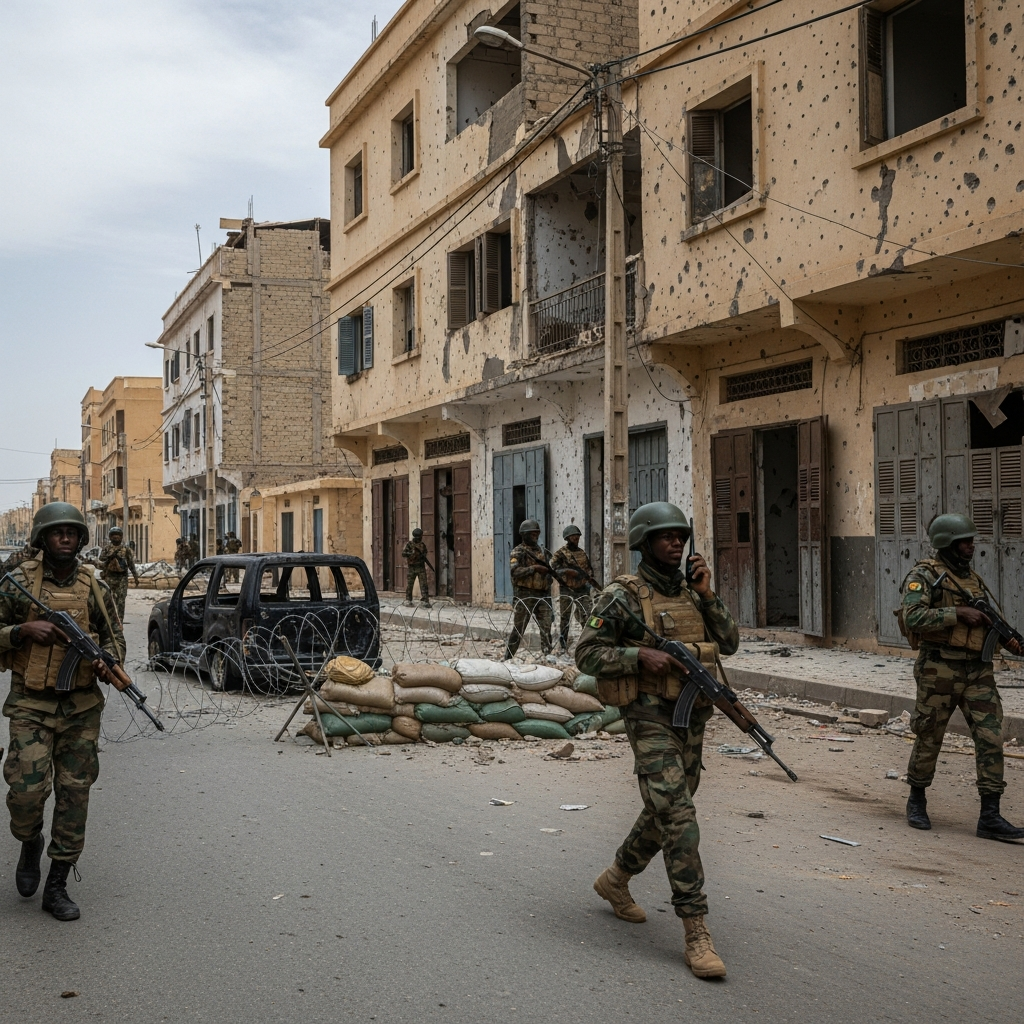
Mali recently faced one of its most significant security challenges in years. On Saturday, April 25, 2026, a series of widespread and coordinated attacks struck strategic locations across the nation. This bold offensive targeted the capital, Bamako, alongside key cities in central and northern Mali. It underscored the severe and escalating insecurity plaguing the West African nation.
The attacks, claimed by the al-Qaida-linked group Jama’at Nusrat al-Islam wal Muslimeen (JNIM), marked a troubling alliance. JNIM stated they acted jointly with the Azawad Liberation Front, a prominent Tuareg-led separatist group. This collaboration reignited fears of a broader, more entrenched conflict. Such coordinated actions highlight the persistent and evolving nature of insurgencies in the Sahel region.
The Scope of the Assault
The widespread nature of these Mali coordinated attacks demonstrated significant planning and operational capability. Targets ranged from the capital’s international airport to military bases and government figures’ residences. Simultaneously, other major cities experienced intense clashes. This multi-front offensive overwhelmed initial security responses.
Targets in the Capital
Bamako, Mali’s capital, became a focal point of the assaults. The Modibo Keïta international airport faced sustained heavy weapons fire and automatic rifle exchanges. An Associated Press journalist and local residents confirmed hearing intense gunfire. Helicopters patrolled nearby neighborhoods, underscoring the severity of the situation. The airport’s proximity to a Malian air force base made it a critical target.
Kati, a town just outside Bamako, also experienced severe disruption. Kati is home to Mali’s main military base and the residence of junta leader Gen. Assimi Goita. Residents reported being woken by gunfire and explosions. Reports indicated the residence of Defense Minister Sadio Camara suffered significant damage. This points to a deliberate targeting of state infrastructure and leadership figures. Social media videos captured militant convoys moving through deserted Kati streets, instilling widespread fear among residents.
Northern and Central Fronts
Beyond the capital, the Mali militant attacks extended deep into the country. Towns like Sévaré and Mopti in central Mali reported gunmen launching assaults. These incidents showcased the militants’ reach and ability to strike simultaneously across vast distances.
Further north, the cities of Kidal and Gao witnessed fierce street battles. Insurgents reportedly entered Kidal, taking control of several neighborhoods. This led to direct exchanges of fire with the Malian army. A spokesperson for the Azawad movement, Mohamed Elmaouloud Ramadane, claimed control of Kidal and parts of Gao on Facebook. While independent verification was difficult, Kidal holds immense symbolic weight. It was a long-standing separatist stronghold, only recaptured by Malian government forces and Russian mercenaries in 2023. Its re-entry by separatists suggests a significant blow to the junta’s recent gains.
Who Is Behind the Attacks?
Understanding the perpetrators is key to grasping the complexity of Mali’s security crisis. The recent events underscore a dangerous resurgence of alliances. These alliances fuel regional instability.
JNIM and Separatist Alliance
The al-Qaida-linked group JNIM quickly claimed responsibility for the Mali coordinated attacks. Their statement on Az-Zallaqa, their website, confirmed the joint operation. It named the Azawad Liberation Front, a Tuareg-led separatist group, as their partner. JNIM, or Jama’at Nusrat al-Islam wal Muslimeen, is a prominent jihadist organization in the Sahel. It aims to establish an Islamic state. The Azawad Liberation Front, conversely, has historically fought for an independent Tuareg state in northern Mali. Their combined effort represents a formidable threat.
A Troubling Precedent
This collaboration between jihadists and Tuareg separatists is not new. Ulf Laessing, head of the Sahel programme at the Konrad Adenauer Foundation, highlighted this concern. He noted the last time these groups teamed up was in 2012. That alliance notoriously overran northern Mali, sparking the region’s initial security crisis. The renewed coordination suggests a strategic shift among the insurgent groups. It poses a significant challenge for the Malian government and its allies. This partnership increases the lethality and reach of militant attacks in Mali.
Mali’s Worsening Security Crisis
The 2026 Mali militant attacks are part of a broader, deteriorating security situation across the Sahel. Mali, alongside neighboring Niger and Burkina Faso, faces a protracted battle. Armed groups affiliated with al-Qaida and the Islamic State group continue to sow chaos.
Geopolitical Shifts and Regional Instability
Recent years have seen military coups in Mali, Niger, and Burkina Faso. These new juntas have notably shifted their alliances. They moved away from traditional Western partners to embrace Russia for security assistance. However, this strategic pivot has not improved stability. Analysts suggest the security situation has, in fact, worsened. The region now records an unprecedented number of militant attacks. This indicates a potential failure of new security strategies. It also highlights the deep-seated nature of the insurgency.
Impact on Civilians and Government Response
The human cost of this conflict remains high. Residents in affected areas experienced profound fear and displacement. The US embassy in Bamako issued a security alert. It urged American citizens to shelter in place and avoid travel to affected areas. This reflects the immediate danger faced by civilians.
The Malian army issued statements confirming the targeting of barracks and locations by “unidentified armed terrorist groups.” They asserted soldiers were “engaged in eliminating the attackers.” Later, they declared the situation “under control.” However, security forces have also faced accusations. They are sometimes blamed for killing civilians suspected of collaborating with militants. This complicates efforts to build trust and stabilize the region. Coordinated attacks like these strain government resources. They also test the resilience of national security forces.
Implications and Outlook
The recent Mali coordinated attacks represent a critical escalation. They challenge the Malian junta’s claims of improving national security. The symbolic recapture of areas like Kidal, even if temporary, fuels separatist aspirations. It also emboldens jihadist groups. This coordinated approach could signal a new phase in the Sahel conflict. It requires a robust and unified counter-terrorism strategy. Without it, Mali and its neighbors risk deeper instability. The region remains a hotspot for extremist activity. International attention and effective solutions are urgently needed.
Frequently Asked Questions
What militant groups were involved in the April 2026 coordinated attacks across Mali?
The al-Qaida-linked group Jama’at Nusrat al-Islam wal Muslimeen (JNIM) claimed primary responsibility for the widespread attacks. They stated the operations were carried out jointly with the Azawad Liberation Front. This group is a Tuareg-led separatist movement. This collaboration between a global jihadist entity and a local separatist faction marks a significant and concerning development in Mali’s ongoing conflict.
Which key strategic locations were targeted during the Mali attacks?
The attacks targeted multiple critical locations across Mali. In the capital, Bamako, the Modibo Keïta international airport and military facilities in nearby Kati were hit. Other targeted cities included Sévaré and Mopti in central Mali. In the north, the cities of Kidal and Gao experienced significant clashes. These targets demonstrate an intent to disrupt governance, military operations, and critical infrastructure nationwide.
How do the recent Mali attacks reflect the broader security challenges in the Sahel?
These Mali militant attacks underscore the deepening security crisis across the Sahel. They highlight the persistent threat from both jihadist and separatist groups. The coordination between JNIM and Tuareg rebels echoes the 2012 crisis, suggesting a sophisticated, evolving threat. Despite a shift in alliances from Western partners to Russia by the military juntas, security has demonstrably worsened. This indicates that current strategies may not effectively counter the complex, multi-faceted insurgencies plaguing the region.
Conclusion
The coordinated Mali attacks of April 2026 represent a stark reminder of the nation’s fragile security landscape. This widespread assault, orchestrated by a powerful alliance of jihadists and separatists, targeted vital infrastructure and symbolic locations. It demonstrated the insurgents’ growing capability and reach. Mali’s military junta faces immense pressure to stabilize the country. However, the escalating violence, coupled with geopolitical shifts and persistent regional instability, presents an formidable challenge. Addressing this complex threat demands comprehensive, adaptive strategies to secure lasting peace and protect civilian lives.