New scientific discoveries reveal that the Africa splitting apart phenomenon in its eastern region is happening faster than previously understood. Groundbreaking research on the Turkana Rift, a geologically active zone in Eastern Africa, indicates that the Earth’s crust here has thinned dramatically, nearing a critical point of continental breakdown. This accelerated geological process not only reshapes our understanding of Earth’s tectonics but also offers a fresh, compelling explanation for the region’s unparalleled abundance of early human fossils, a key center for studying human evolution.
East Africa’s Looming Continental Split: A Deeper Look
Eastern Africa is a dynamic landscape, known for its intense volcanic activity and a rich fossil record documenting early human history. These dramatic features are driven by the shifting of massive tectonic plates. Scientists recently reported in Nature Communications that the crust beneath the Turkana Rift, a significant part of the larger East African Rift System, is far thinner than previously believed. This finding strongly points to an advanced stage in the long-term continental breakup of Africa.
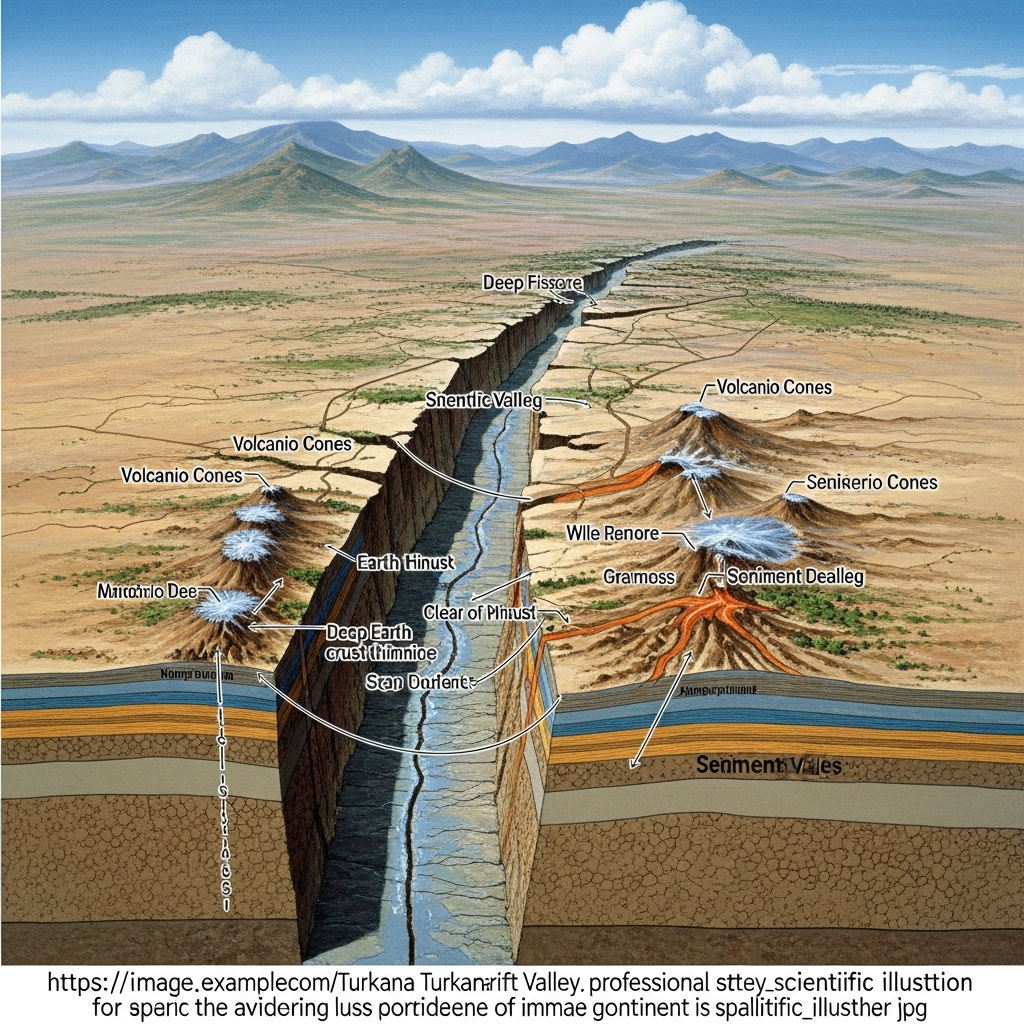
The Turkana Rift spans approximately 500 kilometers across Kenya and Ethiopia. It forms a crucial segment of the vast East African Rift System, which stretches from Ethiopia’s Afar Depression all the way to Mozambique. This immense geological feature is actively separating the African tectonic plate from the Arabian and Somali plates. In the Turkana region, the African and Somali plates are slowly diverging at a rate of about 4.7 millimeters each year. This gradual pulling apart, known as rifting, causes the Earth’s crust to stretch sideways. This strain creates buckling and cracking on the surface, allowing molten rock (magma) from deep within the Earth to rise upwards.
Unveiling the “Necking” Phenomenon: A Critical Discovery
Not all rifts lead to a complete continental split, but the Turkana Rift appears to be on that irreversible path. Christian Rowan, lead author of the study and a Ph.D. student at Columbia University’s Lamont-Doherty Earth Observatory, emphasized the significance of their findings. “We found that rifting in this zone is more advanced, and the crust is thinner, than anyone had recognized,” Rowan stated. He further explained that Eastern Africa has progressed further in the geological rifting process than scientists had previously thought.
The research pinpointed a dramatic difference in crustal thickness across the region. Along the central axis of the rift, the Earth’s crust measures a mere 13 kilometers thick. In contrast, areas farther away from the rift’s center boast a crust exceeding 35 kilometers in depth. This extreme thinning is a hallmark of a process termed “necking.” Imagine pulling a piece of saltwater taffy: it stretches and narrows in the middle. The same happens to the Earth’s crust. As the crust thins, it also becomes significantly weaker, making it easier for the rifting to continue. Anne Bécel, a geophysicist at Lamont and co-author, noted that the crust has reached a “critical threshold” of breakdown, making it highly susceptible to further separation. This weakening promotes continued rifting, eventually leading to a complete break.
How Scientists Confirmed the Accelerated Breakup
To reach these groundbreaking conclusions, Rowan and his team meticulously analyzed a rare dataset of high-quality seismic information. This data was collected through collaborations with industry partners and the Turkana Basin Institute, founded by the late paleoanthropologist Richard Leakey. By examining how sound waves travel through underground layers and integrating these results with other advanced imaging methods, the research team successfully mapped subsurface sediment structures and accurately determined the crust’s depth beneath the rift. This sophisticated analysis provided the irrefutable evidence for the advanced stage of continental rifting.
Geological Timelines and the Road to Oceanization
While the prospect of Africa splitting apart might sound alarming, these changes unfold over immense timescales. The Turkana Rift began its opening journey approximately 45 million years ago. Researchers estimate that the “necking” process, where the crust significantly thins, intensified following widespread volcanic eruptions around 4 million years ago. Even with this accelerated pace, it may still take several million more years before the next major phase, known as oceanization, truly begins. At that distant stage, magma will vigorously rise through the fractures, forming new seafloor. Eventually, water from the Indian Ocean to the north could flood the newly formed basin, creating a vast, new ocean.
The research also unearthed signs of an earlier rifting episode in the region that ultimately did not result in a full continental split. However, this ancient event left the crust thinner and weaker, effectively pre-conditioning the area for its current phase of intense activity. This finding challenges some of the more traditional ideas about how continents typically break apart.
A Unique Window into Earth’s Tectonic Evolution
The Turkana Rift is currently the only known active continental rift undergoing the “necking” process. This makes it an invaluable natural laboratory, offering scientists an unprecedented chance to study this crucial stage of tectonic evolution in real-time. Co-author Folarin Kolawole, also from Lamont, highlighted this unique opportunity: “In essence, we now have a front-row seat to observe a critical rifting phase that had fundamentally shaped all rifted margins across the world.” These ongoing geological processes are intimately linked to other Earth systems, providing researchers with vital clues to reconstruct past landscapes, vegetation, and climate patterns. This knowledge can then be applied to understand future geological and climatic shifts, even over shorter timescales.
Rewriting Human History: The Fossil Preservation Link
Beyond its profound geological implications, these discoveries shed new light on the Turkana Rift’s extraordinary hominin fossil record. Over the past 4 million years, this region has yielded more than 1,200 hominin fossils, accounting for approximately one-third of all such discoveries across Africa. Historically, many scientists viewed this area as a uniquely important center where human ancestors evolved.
However, the new research offers a compelling alternative hypothesis. After the widespread volcanic activity about 4 million years ago, the onset of crustal “necking” caused the land within the rift to subside or sink. This subsidence created ideal conditions for the rapid accumulation of fine-grained sediments, which are exceptionally effective at preserving fossils. Rowan suggests, “The conditions were right to preserve a continuous fossil record.” This new perspective proposes that the Turkana Rift might not have been uniquely significant as a primary site of human evolution itself. Instead, its unique geological conditions simply made it an incredibly fortuitous location for preserving the history of our ancestors.
This groundbreaking idea opens exciting new avenues for research, allowing other scientists to explore how shifting tectonics and climates intertwined to influence the course of human evolution. The research team also included Paul Betka from Western Washington University and John Rowan from the University of Cambridge, with materials provided by the Columbia Climate School.
Frequently Asked Questions
What is “necking” in the context of continental breakup?
“Necking” describes a critical geological process where the Earth’s continental crust stretches and thins dramatically in the middle, similar to how a piece of taffy narrows when pulled. This thinning weakens the crust significantly, making it more susceptible to further stretching and eventual complete rupture. The Turkana Rift in Eastern Africa is the first known active continental rift currently undergoing this “necking” process, bringing it closer to a full continental split and the potential formation of a new ocean.
Where is the Turkana Rift located and why is it important for this research?
The Turkana Rift is a geologically active region spanning roughly 500 kilometers across Kenya and Ethiopia. It is a vital part of the larger East African Rift System, where the African and Somali tectonic plates are slowly pulling apart. Its importance for this research stems from its unique status as the only known active continental rift where scientists can observe the “necking” process firsthand. This provides an unparalleled opportunity to study the critical stages of tectonic evolution that have shaped rifted margins worldwide, offering insights into Earth’s past and future geological systems.
How will the potential breakup of Africa impact human life or future generations?
While the idea of Africa splitting apart might sound profound, it’s crucial to understand that these geological processes unfold over immense timescales—millions of years. This means there will be no immediate impact on human life or current generations. However, for future generations of scientists, this ongoing continental breakup offers invaluable data. The research helps us understand fundamental Earth processes, reconstruct ancient climates, and improve models for predicting long-term geological and environmental changes, ultimately contributing to our broader scientific knowledge about planetary evolution.