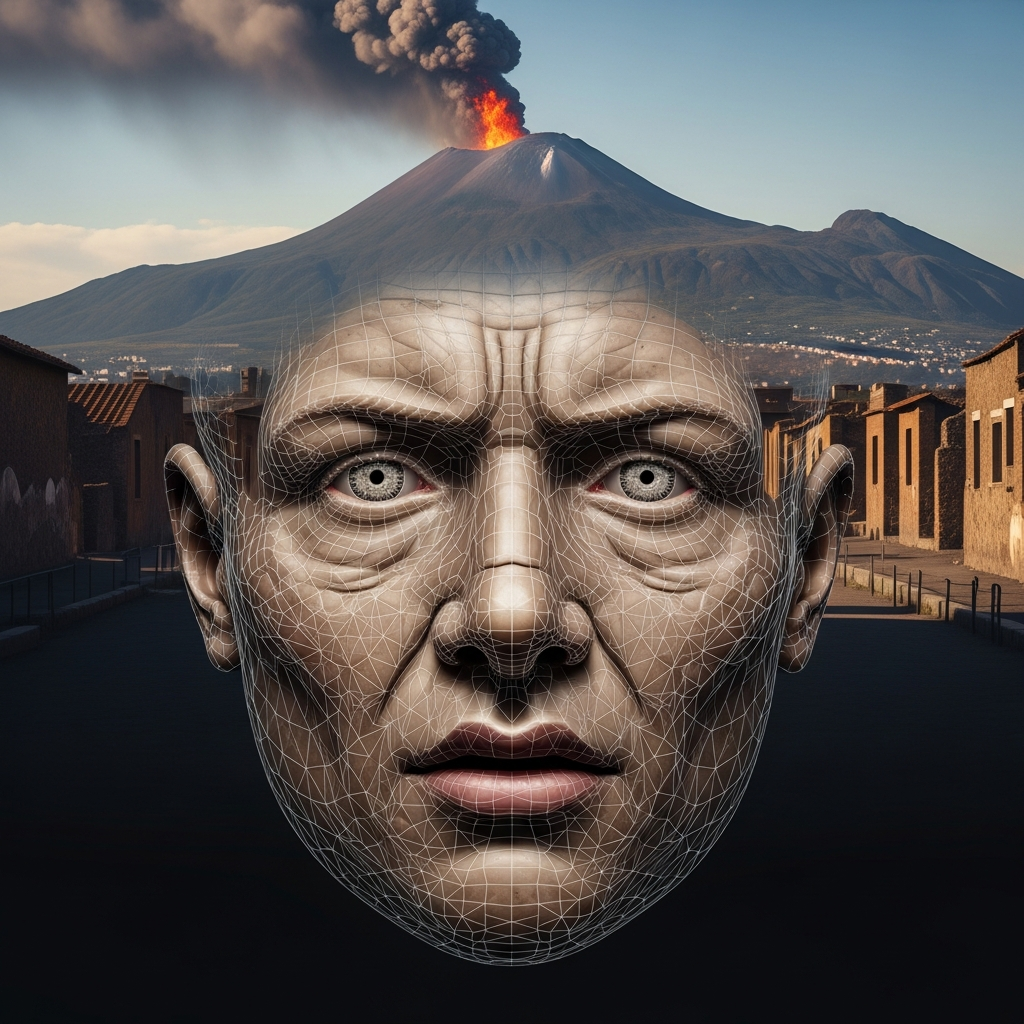
The ancient city of Pompeii, tragically entombed by Mount Vesuvius in AD 79, continues to unveil its haunting secrets. In a groundbreaking leap for archaeology, experts have leveraged artificial intelligence (AI) to digitally reconstruct the face of a victim. This pioneering effort offers an unprecedented, emotionally compelling glimpse into the final moments of an individual trying to flee the catastrophic eruption. It marks a new era in understanding history’s most devastating natural disasters.
For nearly two millennia, the ash and pumice preserved Pompeii, freezing thousands of its inhabitants in remarkable detail. Now, this cutting-edge application of AI brings one of those individuals vividly back to life. This innovative project transforms skeletal and archaeological data into a realistic human likeness, fundamentally changing how we connect with the past.
Unveiling a Face from the Ashes: A Digital Reconstruction
Archaeologists at the Pompeii Archaeological Park, in collaboration with the University of Padua, achieved this significant milestone. They used artificial intelligence for the first time to create a digital portrait of an older man. He was one of two victims discovered near the Porta Stabia necropolis, just outside the ancient city walls. These individuals were desperately attempting to escape towards the coast of what is now Italy.
Researchers believe this man perished early in the disaster. A heavy fall of volcanic debris likely caused his death. The digital reconstruction visualizes him in a ducking posture. He runs along a rough, debris-covered road. A large, shallow terracotta mortar is clutched over his head, an improvised shield against the relentless shower of lapilli. These small volcanic stones rained down during the eruption’s second day. A flaming Mount Vesuvius erupts powerfully in the background of the AI illustration, adding a dramatic context.
A Glimpse into Final Moments and Daily Life
The meticulous archaeological findings provide crucial insights into the victim’s final moments. His posture suggests a desperate attempt to protect himself from the destructive volcanic material. This aligns perfectly with ancient accounts. Roman writer Pliny the Younger described residents using various objects to shield themselves from falling ash and debris. This modern discovery thus provides a poignant connection between ancient texts and scientific evidence.
Beyond his protective mortar, personal items found with the man painted a picture of his existence. He was carrying an oil lamp, a small iron ring, and ten bronze coins. These possessions suggest he was moving quickly, likely striving to reach safety with his valuables. Such details offer a rare look into daily life in Pompeii before the catastrophe. They also underscore the immediate, desperate responses people had to the unfolding disaster.
AI: Revolutionizing Classical Studies and Archaeology
The director of the Pompeii Archaeological Park, Gabriel Zuchtriegel, emphasized AI’s transformative potential. He stated, “The vastness of archaeological data is now such that only with the help of artificial intelligence will we be able to adequately protect and enhance them. If used well, AI can contribute to a renewal of classical studies.” This powerful sentiment highlights AI’s role in managing and interpreting complex excavation data more efficiently.
Italian Culture Minister Alessandro Giuli further affirmed this importance. He noted, “Pompeii is perhaps the most prestigious place in the world for archaeological research where every new discovery illuminates enthusiastically the plot of ancient life.” Giuli added that these innovative methodologies, “used with care, can give us new historical perspectives.” This project aims to make archaeological research both accessible and emotionally engaging for the public. Crucially, it maintains a rigorous scientific foundation. By presenting the human face of a Pompeii victim, researchers hope to foster a deeper connection to this pivotal historical moment.
The Broader Impact of AI in Heritage Preservation
The integration of AI into Pompeii’s research methods represents a significant modern step. It continues to unlock and present ancient secrets. This technological advancement goes beyond mere visualization. It enables experts to process vast amounts of data more effectively. This ensures better protection and enhancement of invaluable archaeological records. As Pompeii attracts 4.3 million visitors annually, these immersive presentations can significantly boost public engagement and understanding.
This AI-powered reconstruction is part of Pompeii’s ongoing significant discoveries. Last year, archaeologists found evidence of reoccupation. Some survivors, unable to relocate, attempted to restart their lives amidst the ruins. Earlier this year, a 2,000-year-old love note and an illustrated gladiator fight scene were also uncovered. These continuous findings consistently enrich our understanding of this remarkably preserved ancient city.
Frequently Asked Questions
How did archaeologists use AI to reconstruct the Pompeii victim’s face?
Archaeologists from the Pompeii Archaeological Park and the University of Padua collaborated on this pioneering project. They used advanced artificial intelligence and photo-editing techniques. These methods translated extensive skeletal and archaeological survey data into a realistic human likeness. The process involved analyzing bone structures and surrounding artifacts to ensure the digital portrait accurately reflects the physical evidence. The AI allowed for a scientifically grounded, yet compelling, visualization of the victim.
What specific details were discovered about the Pompeii victim whose face was reconstructed?
The reconstructed victim was an older man found near the Porta Stabia necropolis, just outside Pompeii’s city walls. He perished early in the AD 79 eruption, likely due to falling volcanic debris. Archaeologists found him clutching a terracotta mortar over his head, interpreted as an improvised shield against lapilli. He also carried an oil lamp, a small iron ring, and ten bronze coins, suggesting an attempt to flee with valuables. His position indicates he was running towards the coast for escape.
Why is the use of AI at Pompeii considered a groundbreaking step for classical studies and archaeology?
The application of AI in reconstructing the victim’s face is groundbreaking because it offers a novel approach to understanding ancient history. It helps manage and interpret the “vastness of archaeological data” more efficiently. AI transforms raw scientific data into emotionally engaging, realistic visuals, making complex research accessible to the public. Experts believe it can contribute to a “renewal of classical studies” by illustrating the ancient world in a more immersive and impactful way.
A New Chapter in Historical Discovery
The digital unveiling of this Pompeii victim’s face marks more than just a technological achievement. It represents a profound shift in how we interact with history. AI breathes life into archaeological findings, transforming ancient remains into relatable human stories. This innovation ensures Pompeii continues to illuminate the human experience, bridging the nearly 2,000-year gap with astonishing clarity. As technology advances, we can anticipate even deeper, more immersive explorations of our shared past.
References
- www.cbsnews.com
- timesofindia.indiatimes.com
- www.nbcdfw.com
- <a href="https://www.newspressnow.com/news/worldnews/archaeologists-at-pompeii-use-artificial-intelligence-to-reveal-the-face-of-one-of-the-victims/articleee2b3338-94d5-5e1e-9493-d8cd7dd60018.html”>www.newspressnow.com
- www.independent.co.uk