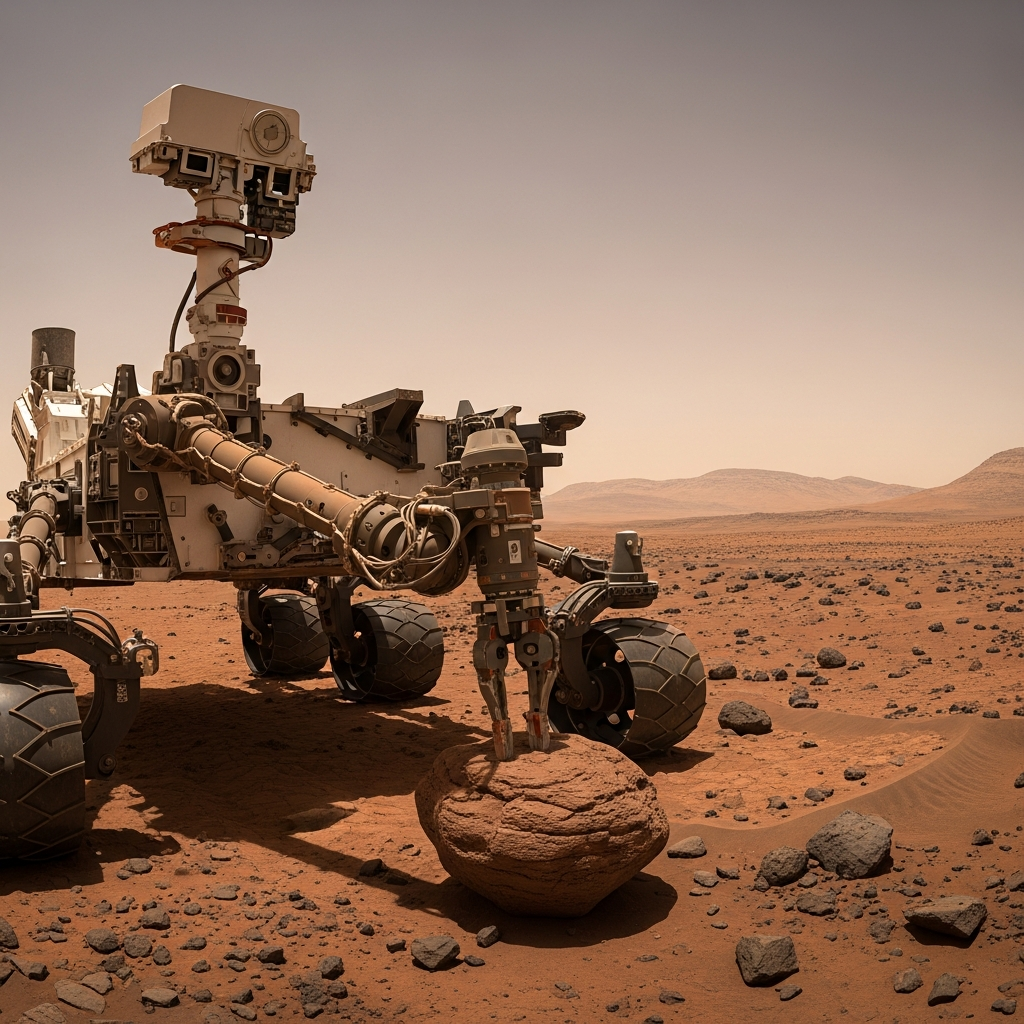
NASA’s intrepid Curiosity rover has made a groundbreaking discovery on the Red Planet, uncovering the most diverse collection of organic molecules ever observed on Mars. This extraordinary finding significantly strengthens the long-held hypothesis that ancient Mars possessed environments perfectly poised to support life. Scientists are particularly excited about seven new carbon-containing compounds, never before detected on the Martian surface, which were unearthed from a rock sample aptly named “Mary Anning 3.”
This pivotal research, recently published in the esteemed journal Nature Communications, details how Curiosity’s sophisticated instruments confirmed the presence of 21 distinct organic molecules within the rock sample. While researchers cannot yet definitively declare these molecules as direct evidence of past life, their sheer diversity and composition hint at a remarkably complex ancient Martian chemistry. This revelation is a massive leap forward in the quest to understand the Red Planet’s potential for habitability billions of years ago.
A Groundbreaking Discovery on Mount Sharp
In 2020, the Curiosity rover, a persistent explorer on Mars since 2012, drilled into a promising rock formation on Mount Sharp. This area was once a vibrant landscape teeming with lakes and streams before Mars gradually dried out. The drilled sample, christened “Mary Anning 3,” honors the pioneering English paleontologist Mary Anning, famed for her aquatic fossil discoveries. This naming choice draws a powerful parallel to the water-rich Martian environment where these crucial organic building blocks were found.
Officials at NASA’s Jet Propulsion Laboratory (JPL), which oversees the Curiosity mission, emphasized that these findings provide “renewed confirmation that ancient Mars had the right chemistry to support life.” The remarkable preservation of these compounds, despite billions of years exposed to Martian radiation that typically degrades such molecules, is a testament to the protective properties of the rock and its ancient environment. This discovery dramatically expands our understanding of Mars’ past chemical richness.
Unpacking the “Mary Anning 3” Sample
The “Mary Anning 3” sample presented scientists with an unprecedented chemical treasure trove. Among the 21 identified carbon-containing molecules, seven were entirely new to Mars research. This diverse spectrum of Martian organics provides invaluable insights into the complex chemical processes that may have unfolded on the planet’s ancient surface. The presence of such intricate compounds signals a far more dynamic and potentially life-friendly past for Mars than previously imagined.
Key Organic Molecules: Nitrogen Heterocycles & Benzothiophene
Two of the newly identified organic molecules stand out for their potential implications for life. One is a nitrogen heterocycle, a unique molecular structure incorporating a ring of carbon atoms with added nitrogen. This type of molecule is considered a crucial precursor to RNA and DNA, the very nucleic acids that carry genetic information in all known life forms. Amy Williams of the University of Florida, lead author of the research paper, highlighted the profound significance of this detection, noting its unprecedented discovery on Mars.
Another exciting find is benzothiophene, a molecule containing both carbon and sulfur. Scientists hypothesize that benzothiophene, also found in numerous meteorites, may have played a vital role in delivering prebiotic chemistry across the early solar system. These significant new findings bolster earlier Curiosity discoveries, which last year identified the largest organic molecules on Mars to date, including long-chain hydrocarbons like decane, undecane, and dodecane.
Why This Discovery Matters for Ancient Mars
The detection of such a diverse array of organic molecules, particularly precursors to RNA and DNA, offers compelling new evidence for the ancient habitability of Mars. It suggests that the Red Planet not only had liquid water but also the necessary chemical ingredients to kickstart biological processes. This moves the scientific conversation beyond simply the presence of water to the complex chemistry that underpins life itself. The findings paint a picture of a warmer, wetter Mars, capable of hosting the fundamental chemistry required for life to emerge.
The Role of Ancient Lakes and Clay Minerals
The location where the “Mary Anning 3” sample was retrieved holds particular significance. This region of Mount Sharp was once an ancient oasis, experiencing multiple cycles of flooding and drying. This dynamic aquatic environment led to the accumulation of clay minerals. Crucially, these clay minerals are exceptionally good at preserving organic compounds over geological timescales. They act like tiny time capsules, shielding delicate molecules from the harsh radiation and destructive forces on Mars. Ashwin Vasavada, the mission’s project scientist at NASA’s Jet Propulsion Laboratory, emphasized that this collection of organic molecules “once again increases the prospect that Mars offered a home for life in the ancient past.”
How Curiosity Uncovers Martian Secrets: The SAM Instrument
Curiosity’s ability to unlock these Martian secrets lies within its sophisticated Sample Analysis at Mars (SAM) instrument. This miniature laboratory, housed within the rover’s body, is a marvel of engineering. The process begins with Curiosity’s robotic arm drilling into a rock, then pulverizing the sample into a fine powder. This powder is then meticulously transferred into SAM’s high-temperature oven. Inside, the sample is heated, releasing gases whose compositions are then precisely measured by SAM’s analytical instruments.
The Power of “Wet Chemistry” with TMAH
SAM’s capabilities extend beyond simple heating. It also performs “wet chemistry,” a technique where samples are mixed with specific solvents to break apart and identify larger, more complex molecules that might otherwise remain undetectable. The “Mary Anning 3” sample was the very first to benefit from tetramethylammonium hydroxide (TMAH), a powerful solvent specifically designed to dismantle organic molecules. Curiosity carries only two small cups of TMAH, underscoring the immense scientific value assigned to the “Mary Anning 3” sample. This advanced chemical analysis capability is a testament to the ingenuity of the mission’s engineers and scientists.
Validating Martian Finds with Earth Meteorites
To ensure the reliability of the TMAH technique on extraterrestrial materials, the research team conducted rigorous validation tests on Earth. They used a fragment of the Murchison meteorite, a carbonaceous meteorite over 4 billion years old and renowned for its rich organic content. When the Murchison sample was exposed to TMAH, it broke down, yielding some of the identical molecules found in “Mary Anning 3,” including benzothiophene. This crucial Earth-based verification confirms that the Martian molecules could indeed have originated from the breakdown of even more complex, life-relevant compounds. This meticulous cross-validation strengthens the scientific confidence in Curiosity’s findings.
Beyond “Mary Anning 3”: The Future of Martian Exploration
The successful operation of SAM, particularly its complex wet chemistry experiments, provides invaluable experience for future missions. NASA Goddard has already contributed components for next-generation instruments, such as the Mars Organic Molecular Analyzer for ESA’s Rosalind Franklin Mars rover and the Dragonfly Mass Spectrometer for NASA’s Dragonfly rotorcraft, which will explore Saturn’s moon Titan. Both these future missions are equipped to perform similar advanced wet chemistry experiments, building directly on Curiosity’s pioneering work. The insights gained from “Mary Anning 3” will undoubtedly accelerate the search for life beyond Earth, refining our strategies for identifying biosignatures in even more challenging environments.
Curiosity recently deployed its second and final cup of TMAH on samples from “weblike boxwork ridges,” geological formations indicative of ancient groundwater activity. The results from this concluding TMAH experiment are eagerly anticipated and will be detailed in future studies, promising even more insights into Mars’ hydrological and chemical past.
Frequently Asked Questions
What exactly are the newly discovered organic molecules on Mars and why are they significant?
NASA’s Curiosity rover identified 21 distinct organic molecules within the “Mary Anning 3” rock sample, with seven being entirely new discoveries on Mars. Among the most significant are a nitrogen heterocycle, which is a chemical precursor to RNA and DNA (the building blocks of genetic information), and benzothiophene, a molecule found in meteorites that may have helped seed prebiotic chemistry in the early solar system. Their presence highlights the complex and potentially life-friendly chemistry that existed on ancient Mars, suggesting conditions ripe for life’s emergence billions of years ago.
How did NASA’s Curiosity rover detect these diverse organic molecules, and what tools were involved?
The detection relied on Curiosity’s sophisticated Sample Analysis at Mars (SAM) instrument. The rover first drilled into the “Mary Anning 3” rock, pulverized it, and transferred the powder into SAM. Inside SAM, the sample was heated in an oven, releasing gases for analysis. Crucially, SAM also employs “wet chemistry,” mixing the sample with a powerful solvent called tetramethylammonium hydroxide (TMAH). This process breaks down larger organic molecules, making them detectable, a technique validated on Earth using the Murchison meteorite.
What do these new findings mean for the possibility of ancient life on Mars and future astrobiology missions?
These discoveries dramatically strengthen the case for ancient Mars having possessed the necessary chemical conditions to support life. The presence of diverse organic molecules, including precursors to genetic material, suggests that ancient Mars had more than just liquid water—it had the complex chemical ingredients essential for life. For future astrobiology missions, this success validates the use of “wet chemistry” techniques with solvents like TMAH, informing the design of instruments for upcoming explorers like ESA’s Rosalind Franklin rover and NASA’s Dragonfly mission to Titan, further advancing the search for extraterrestrial life.
Conclusion
The discovery of the most diverse collection of organic molecules ever seen on Mars by the Curiosity rover marks a monumental step in our ongoing quest to understand the Red Planet’s past habitability. From the ancient lakebeds of Mount Sharp to the cutting-edge “wet chemistry” performed by the SAM instrument, every detail reinforces the idea of a Mars that was once chemically vibrant and potentially teeming with life’s basic ingredients. While the definitive proof of Martian life remains elusive, these findings provide an incredibly rich scientific foundation, propelling us closer to answering one of humanity’s most profound questions: Are we alone in the universe? The insights gleaned from “Mary Anning 3” will undoubtedly guide the next generation of Martian explorers, refining our methods and focusing our search for biosignatures that could finally confirm life beyond Earth.