The competitive race for global satellite internet took a significant leap forward as a United Launch Alliance (ULA) Atlas V rocket successfully launched 29 of Amazon’s Leo internet satellites, making history by tying its own record for the heaviest payload ever carried. This pivotal mission, dubbed Amazon Leo 6, underscores Amazon’s aggressive pursuit to deploy its Project Kuiper broadband constellation, directly challenging established players like SpaceX’s Starlink. Launching from Florida’s Cape Canaveral Space Force Station, the event not only showcased ULA’s exceptional operational efficiency but also marked a crucial step in bringing high-speed internet to underserved communities worldwide.
ULA Atlas V Soars: Tying a Payload Record
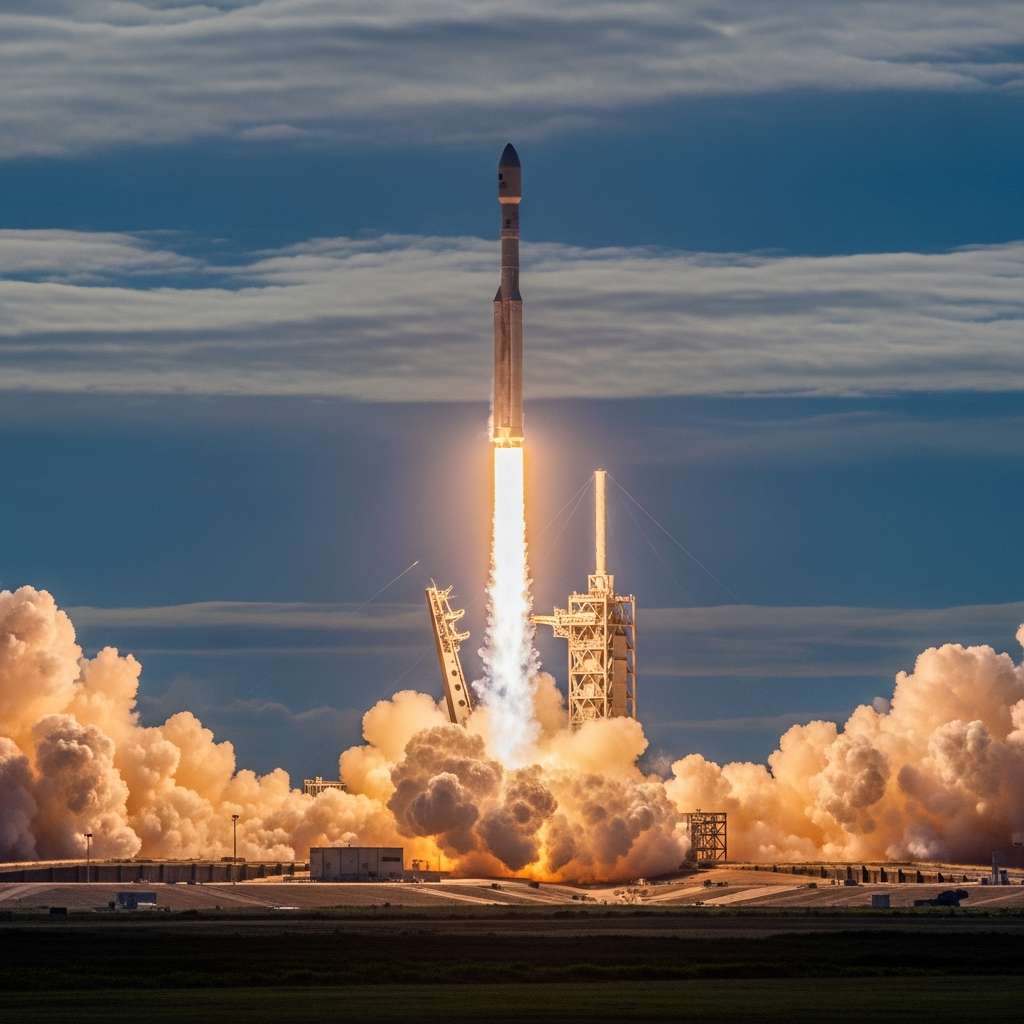
On Monday night, April 27, 2026, at precisely 8:53 p.m. EDT (0053 GMT on April 28), the powerful Atlas V 551 rocket thundered skyward. This particular configuration, known for its five solid rocket boosters, delivered a staggering 18-ton payload to low Earth orbit (LEO). The successful deployment of 29 production-version Amazon Leo satellites during this flight matched a record previously set by the Amazon Leo 5 mission just weeks prior on April 4. This consistent demonstration of heavy-lift capability highlights the Atlas V’s robust design and ULA’s precision in executing complex spaceflight missions for Amazon’s ambitious internet network.
Precision Deployment in Low Earth Orbit
The intricate process of deploying these vital satellites began approximately 21 minutes after liftoff. Over the next 16 minutes, the 29 spacecraft were carefully released across 10 separate deployment events. Each satellite found its designated orbital slot, critical for the seamless formation of Amazon’s expansive broadband constellation. Unlike rockets designed for booster recovery, the Atlas V’s first stage booster followed its planned trajectory, separating and safely splashing down in the Atlantic Ocean for retrieval, an operational norm for this veteran launch vehicle.
ULA’s Record-Breaking Operational Efficiency
This Amazon Leo 6 mission wasn’t just about the satellites; it was a testament to ULA’s enhanced operational capabilities. The launch marked the company’s second Atlas V flight within a single month, demonstrating an impressive turnaround. Specifically, ULA achieved a new fastest pad turnaround at Space Launch Complex 41. The LA-06 mission launched an astonishing 23 days and 19 hours after the preceding Atlas V mission from the very same pad. This significantly shattered ULA’s previous record by nearly three days, showcasing a monumental leap in efficiency.
Streamlined “Roll-to-Launch Flow” Innovation
Achieving such rapid sequencing required innovative changes to ULA’s pre-launch procedures. The team implemented a new, streamlined “roll-to-launch flow.” Traditionally, Atlas V rockets were rolled to the pad a day or more before launch, followed by fuel loading. For the LA-06 mission, the 205-foot-tall rocket was rolled out and reached its “harddown” milestone early Monday morning. ULA strategically divided its personnel into two dedicated shifts: a “Roll and Preps Crew” and a “Tanking and Launch Crew.” This two-shift approach compressed tasks typically spread over two days into a single, expedited timeline. While not a universal strategy for all future launches, this compressed timeline included new planned holds during the countdown, significantly enhancing operational agility. This flight also represented the 108th launch of an Atlas V rocket to date, and a remarkable 100th under ULA’s operational tenure, solidifying its place in spaceflight history.
Amazon Leo: Building a Global Internet Network
The Amazon Leo constellation, formerly known as Project Kuiper, is Amazon’s highly ambitious initiative to provide high-speed, low-latency internet access to customers globally. Designed to be a direct rival to SpaceX’s Starlink internet megaconstellation, Project Kuiper aims for an initial deployment exceeding 3,200 satellites. Achieving this vast network requires a multi-faceted launch strategy, necessitating over 80 launches utilizing a variety of rocket providers.
Progress and the Multi-Provider Approach
With the successful deployment of these 29 satellites, the Amazon Leo constellation now boasts a total of 270 satellites in orbit. This launch was the tenth overall mission contributing to the construction of Amazon’s satellite internet network. ULA’s Atlas V has been a significant contributor, having now completed six dedicated missions for Project Kuiper, including this record-tying flight. Additionally, SpaceX’s Falcon 9 rockets have contributed three launches, and Arianespace’s Ariane 6 rocket has launched one. This diverse approach ensures redundancy and accelerates the deployment timeline, with another Ariane 6 mission for Amazon Leo anticipated soon from French Guiana.
Atlas V’s Enduring Legacy and Future Transition
The Atlas V rocket has been a workhorse for the U.S. space industry for decades, known for its reliability and versatility in launching a wide array of payloads, from scientific missions to national security satellites and, more recently, commercial broadband constellations. This record-tying Amazon Leo mission highlights the Atlas V’s continued relevance even as it approaches its retirement. United Launch Alliance is actively transitioning its focus to the next-generation Vulcan Centaur rocket, which is poised to carry forward ULA’s legacy of heavy-lift capabilities and advanced spaceflight. The final Atlas V missions will mark the end of an era, making each remaining launch, like this one, particularly significant.
East Coast Spectacle: Observing a Rocket Launch
For stargazers and space enthusiasts along the East Coast, particularly in areas like the New York City metropolitan area and the Hudson Valley, Atlas V launches from Cape Canaveral can offer a breathtaking spectacle. The rocket’s north-easterly trajectory over the Atlantic Ocean means that under ideal conditions—clear skies, minimal light pollution, and the rocket’s plume catching sunlight during its ascent—the ascending rocket can be faintly visible. Viewers in New Jersey, for instance, could potentially spot the rocket low on the southern horizon approximately four minutes after liftoff, appearing as a fast-moving point of light. For those unable to witness it in person, ULA provides live streams on platforms like YouTube, ensuring widespread access to these momentous events.
What This Means for Global Connectivity
The relentless pace of Amazon Leo deployment, powered by missions like the Atlas V record-tying launch, signals an intensified competition in the satellite internet sector. As more satellites enter low Earth orbit, the promise of truly global broadband access becomes increasingly tangible. This competition is expected to drive innovation, improve service quality, and potentially reduce costs for consumers worldwide. Amazon’s strategic, multi-launch provider approach, coupled with ULA’s enhanced operational efficiency, is rapidly shaping the future of how people connect to the internet, pushing the boundaries of what’s possible in space exploration and communication.
Frequently Asked Questions
What is Amazon’s Project Kuiper, and how does it compete with Starlink?
Amazon’s Project Kuiper, now often referred to as Amazon Leo, is an ambitious initiative to build a vast constellation of over 3,200 satellites in low Earth orbit (LEO). Its primary goal is to provide high-speed, low-latency broadband internet access globally, especially to unserved and underserved communities. It directly competes with SpaceX’s Starlink, which already has a substantial satellite network in orbit. Both projects aim to revolutionize internet connectivity by bypassing traditional terrestrial infrastructure, offering a new era of global communication.
How many Amazon Leo satellites are currently in orbit after this Atlas V launch?
Following the successful Amazon Leo 6 mission, which deployed 29 satellites, the total number of Amazon Leo satellites in orbit now stands at 270. This specific launch was the tenth overall mission dedicated to building the Amazon Leo constellation, involving various rocket providers. United Launch Alliance’s Atlas V has completed six of these missions, SpaceX’s Falcon 9 has launched three, and Arianespace’s Ariane 6 has contributed one, all working towards the ultimate goal of over 3,200 satellites.
What’s the significance of the Atlas V’s record-tying payload for future space launches?
The Atlas V’s record-tying payload of 18 tons, carrying 29 Amazon Leo satellites, highlights its robust heavy-lift capabilities and ULA’s engineering prowess. This achievement, particularly in a mission that also marked ULA’s fastest pad turnaround at Cape Canaveral, demonstrates an impressive blend of power and efficiency. As the Atlas V nears retirement, with ULA transitioning to the next-generation Vulcan Centaur rocket, these final record-setting missions underscore the legacy of the Atlas V as a reliable workhorse and set a high bar for the capabilities expected from future launch vehicles in the competitive space industry.
The Amazon Leo 6 mission represents more than just another satellite launch; it’s a critical moment in the ongoing space race for global internet dominance. With the Atlas V rocket proving its mettle once again and ULA demonstrating unprecedented operational agility, Amazon’s Project Kuiper is rapidly advancing. The coming years will undoubtedly witness intensified competition and innovation, ultimately shaping the future of internet access for billions around the world.