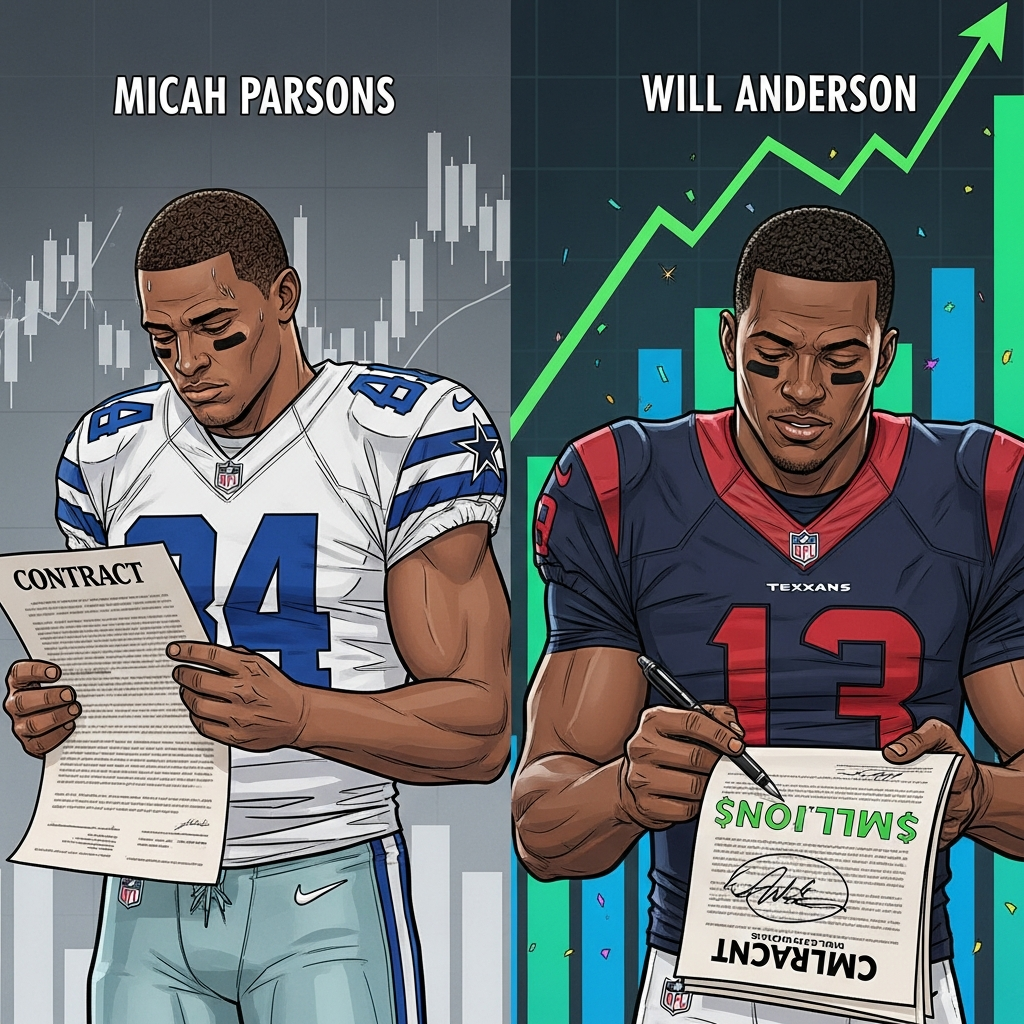
The landscape of elite NFL pass rusher contracts has undergone a seismic shift, directly impacting the ongoing saga surrounding Dallas Cowboys star Micah Parsons. Houston Texans’ formidable pass-rusher Will Anderson recently inked a groundbreaking new three-year deal, reportedly worth an astounding $50 million per year. This significant agreement doesn’t just make Anderson the highest-paid non-quarterback in the league; it resets the financial benchmark, raising the stakes dramatically for any team looking to secure their top defensive talent, especially the Dallas Cowboys as they navigate Micah Parsons’ long-awaited extension.
Anderson’s deal reportedly includes $134 million in guarantees and a coveted no-trade clause, signaling the escalating value of dominant defensive players. This contract now serves as a critical point of comparison for other top-tier defenders, none more prominent than Parsons, whose own contract negotiations with the Cowboys have been a contentious topic for months.
Parsons’ Unmatched Production vs. Anderson’s New Benchmark
While Will Anderson’s new deal sets a staggering financial precedent, a closer look at on-field production reveals why Micah Parsons’ current situation is so compelling. Since entering the league in 2021, Parsons has been an absolute force, averaging an incredible 83.6 pressures per season. This figure stands as the best in the NFL over that span, with only Cleveland Browns’ Myles Garrett coming close at 80.2 pressures annually. In contrast, Anderson has averaged 69 pressures per year over his three seasons.
Parsons’ elite output on his rookie contract has long been considered an exceptional value for the Cowboys. Currently playing on his initial four-year rookie deal, with the Cowboys having exercised his fifth-year option, Parsons is slated to earn $24.007 million in base salary for the 2025 season. This makes his current deal appear to be an absolute “steal” for Dallas, especially when measured against Anderson’s fresh $50 million per year contract, which represents a nearly 8 percent bump over what was previously considered top-tier non-quarterback money. The juxtaposition highlights the Cowboys’ fortunate position with Parsons’ current earnings but also underscores the massive financial jump required for his next deal.
The Cowboys’ Delay and an Exploding Market
Micah Parsons became eligible for a contract extension after his exceptional third NFL season, which concluded in January 2024. He had already solidified his status with a Defensive Rookie of the Year award in 2021 and back-to-back first-team All-Pro selections in 2021 and 2022, becoming the first player in league history to finish top-three in AP Defensive Player of the Year voting for his first three seasons. Despite this unprecedented production, the Cowboys initially prioritized extensions for quarterback Dak Prescott and wide receiver CeeDee Lamb, both of whom were entering their final contract years. Lamb eventually signed a massive four-year, $136 million extension in August 2024, momentarily making him richer than Parsons.
The market for non-quarterback players, particularly pass rushers, exploded in early 2025, adding immense pressure to the Cowboys’ unhurried approach. In March 2025, Maxx Crosby of the Raiders signed a $35.5 million average annual value (AAV) extension. This was swiftly surpassed by Myles Garrett, who broke the $40 million AAV barrier. Ja’Marr Chase then slightly edged Garrett at $40.25 million AAV, and by July 2025, T.J. Watt further reset the market with a $41 million AAV deal. These soaring figures transformed Parsons’ early 2024 sentiment of “I don’t need $40 million” into a warning that the Cowboys’ continued delay would “cost them more.”
Escalating Tensions: A Timeline of Frustration
The relationship between Micah Parsons and the Dallas Cowboys’ front office has been characterized by a noticeable breakdown in communication and trust as contract talks stalled. A key moment occurred in July 2025 when owner Jerry Jones cited Parsons’ high ankle sprain from September 2024, which caused him to miss four games, as a reason to downplay urgency for an extension. Jones stated, “Just because we sign him doesn’t mean we’re going to have him. He was hurt six games last year. Seriously.” This comment was widely perceived as a “dig” at Parsons.
Parsons publicly expressed his growing frustration, highlighting what he called a “lack of communication” from the organization. He felt ownership was “always going to make it drag out, make it more complicated than it has to be.” In July 2025, Parsons initiated a “hold-in,” attending training camp but refraining from participating in team drills. He openly noted that other star players like Watt, Crosby, and Garrett had been “taken care of” by their respective teams. Stephen Jones, the Cowboys’ Executive Vice President, responded by implying Parsons also needed to demonstrate a desire to be paid, stating, “We want to pay Micah too. He’s gotta want to be paid.”
The situation reached a boiling point on August 1, 2025, when Parsons publicly submitted a trade request to Stephen Jones via a lengthy statement on X. He cited the lack of agent involvement in talks, “shots taken” at him for getting injured, and the creation of “narratives” as reasons for his desire to leave, emphatically stating, “I no longer want to be here.” Jerry Jones, however, downplayed the request as mere “negotiation” and advised fans “Don’t lose any sleep over it,” despite admitting he hadn’t spoken to Parsons since.
The Financial Stakes: Guaranteed Money and Future Outlook
The financial implications for both Parsons and the Cowboys are immense. While Will Anderson’s deal reportedly includes $134 million in guarantees, Parsons’ rookie contract provided $123.1 million in true guarantees at signing. His expected extension, however, would far surpass this, likely targeting numbers at or above Anderson’s guarantees, especially considering Parsons’ superior performance statistics. The ongoing delay in reaching an agreement means that every new record-setting contract for an elite pass rusher further inflates the price the Cowboys will ultimately have to pay for Parsons.
The comparison to CeeDee Lamb, who became richer than Parsons after his significant extension, underscores the dynamic nature of NFL player salaries. While Parsons is currently behind Lamb in total career earnings due to Lamb’s new deal and more extensive endorsement portfolio (including deals with Nike, Old Spice, and energy drink companies for Parsons, versus Bose, BODYARMOR, and fashion brands for Lamb), this financial gap is expected to close, or even reverse, once Parsons secures his anticipated long-term deal. The ball is now firmly in the Cowboys’ court to decide how much they are willing to invest to retain their generational talent.
Frequently Asked Questions
What is the current contract status of Micah Parsons with the Dallas Cowboys?
Micah Parsons is currently playing on his rookie contract, which includes a fifth-year option exercised by the Dallas Cowboys. He is slated to earn $24.007 million in base salary for the 2025 season. Despite his eligibility for an extension since early 2024 and his elite performance, a long-term contract has not yet been finalized, leading to ongoing negotiations and public disputes.
How does Will Anderson’s new contract with the Texans influence Micah Parsons’ future negotiations?
Will Anderson’s new three-year, $50 million per year contract, with reported $134 million in guarantees, sets a new financial benchmark for non-quarterback players in the NFL. This deal significantly influences Parsons’ future negotiations by establishing a higher market value for elite pass rushers. Parsons’ representatives will undoubtedly leverage Anderson’s contract to secure a deal that reflects Parsons’ own superior production and market standing.
Why are the Dallas Cowboys delaying a long-term extension for Micah Parsons, despite his elite performance?
The Cowboys have cited various reasons and exhibited a deliberate pace in extending Micah Parsons. Initially, they prioritized extensions for Dak Prescott and CeeDee Lamb. Owner Jerry Jones also mentioned Parsons’ injury history as a factor. Parsons himself has expressed frustration over a “lack of communication” and perceived “shots taken” by the organization, suggesting a strategic delay that he believes will ultimately “cost them more” due to the escalating market for top defensive talent.
Conclusion
The contract situation surrounding Micah Parsons is a microcosm of the intense financial and strategic battles fought in the NFL. With Will Anderson’s record-setting deal now a reality, the urgency for the Dallas Cowboys to secure their generational pass rusher has never been higher. Parsons’ unparalleled production on his current “steal” of a deal, coupled with an exploding market for defensive stars, puts the Cowboys in a precarious position. The ongoing communication breakdown, public frustrations, and even a trade request underscore the high stakes involved. As the league continues to evolve, how the Cowboys navigate this critical negotiation will not only impact their future on the field but also set a precedent for player-team relations in a market constantly redefined by elite talent.