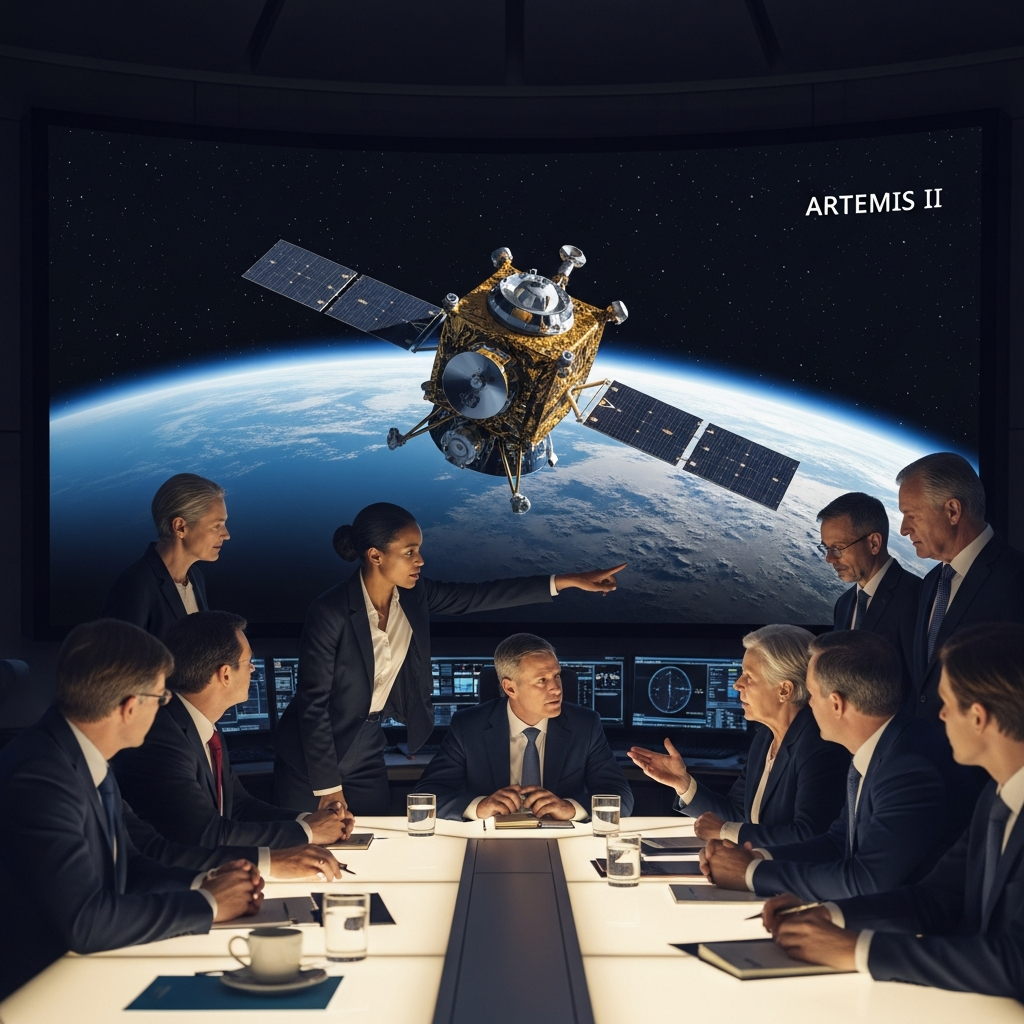
The successful Artemis II mission, marking humanity’s return to lunar orbit, ignited celebrations worldwide. Yet, beneath the triumph, a critical conversation is unfolding about the United States’ long-term role in space. This historic mission, pushing human presence further than ever before, also prompts hard questions about US space leadership, international cooperation, and the very rules governing our cosmic future.
Artemis II: A New Chapter in Human Exploration
Artemis II achieved a monumental feat. It was the first crewed lunar fly-by in over 50 years. This mission pushed the boundaries, traveling the greatest distance yet by humans from our “pale blue dot.” Engineering, scientific, and technical prowess by NASA and its global team ensured the crew’s safe journey there and back.
Beyond the technical marvels, Artemis II delivered powerful symbolic firsts. It carried the first woman and the first person of color to orbit the Moon. As astronaut Victor Glover eloquently stated, “people need to be able to see themselves in the things that they dream about.” This historic journey, launching from Kennedy Space Centre, not only shattered records, reaching 252,756 miles from Earth, but also inspired a new generation.
Geopolitical Ambition Beyond Orbital Milestones
Artemis II is more than a singular exploration. It forms a cornerstone of a broader US program. The ultimate goal is establishing a permanent Moon base by 2030. This isn’t just about scientific curiosity. US Presidents have articulated a vision of asserting “American space superiority.” They aim to establish a “sustained American presence” and cultivate a thriving lunar economy. Echoes of a “manifest destiny to the stars” ideology are undeniable in this grand plan.
The bigger picture reveals an intensifying “space race.” NASA Administrator Jared Isaacman has directly referred to China as a “geopolitical adversary” in this context. China’s Chang’e-6 mission, which in 2024 became the first state to return rock samples from the far side of the Moon, underscores this escalating rivalry. Both nations are vying for preeminence in lunar exploration.
The Prize: Lunar Resources and Global Governance
A significant point of contention in this new space race is access to finite, valuable resources. The lunar south pole, for example, holds critical water ice deposits. These could sustain future human outposts. They also promise to provide rocket fuel for ambitious missions to Mars. More speculative, profit-driven visions also fuel this interest. These include mining helium-3 or extracting resources from asteroids for terrestrial use.
However, existing international space treaties largely date from the 20th-century Cold War era. They offer little guidance on the complex issue of appropriating resources off-Earth. To address this gap, the US has spearheaded the Artemis Accords. These non-binding principles are grounded in the Outer Space Treaty of 1967. They offer a “blueprint” for governing resource activities and other unsettled topics in space.
While some observers see the Artemis Accords as more transparent than China’s International Lunar Research Station, critics argue they undermine multilateral, consensus-based international processes. Sixty-one countries have signed the Accords. However, a slowdown in new signatories has been observed, especially since President Trump’s return. This trend raises questions about the long-term global acceptance of a US-led framework for space governance.
Why Returning to the Moon is Harder Than Ever
Despite immense technological advancements, NASA’s Artemis program faces significantly greater hurdles than the Apollo missions of the past. The scientific and technical challenges are compounded by a transformed global landscape. The program is projected to consume $93 billion by 2025.
One key factor is the changed geopolitical context and funding. The Cold War-era “space race” provided an existential motivation for Apollo. That program received massive government funding, consuming around 4% of the national budget. Today, NASA receives closer to 1%, with numerous other scientific endeavors to fund. This lack of urgent political impetus often leads to inconsistent funding and policy shifts, causing delays.
Furthermore, Artemis is a collaborative international effort, involving Japan, Canada, the UAE, and the European Space Agency. While fostering “soft power,” this cooperation naturally extends timelines and increases costs compared to a solo endeavor. NASA also grapples with the loss of institutional knowledge from the 50-year deep space hiatus. Reusing and retrofitting older technology, like the SLS rocket mandated to incorporate Space Shuttle components, proves more complex and expensive than anticipated. Modern safety standards, far stricter than in the Apollo era, also contribute to the program’s increased cost and duration.
Scrutiny from Earth: A Pattern of Disregard?
The discussion around US space leadership often becomes a binary comparison with China. This limited view, however, can deflect crucial scrutiny. Many observers, including US allies, are raising concerns about America’s recent actions on Earth. As Artemis II captured global attention skyward, the US–Israel conflict with Iran was intensifying. Threats of nuclear strikes and targeting civilian infrastructure, including a school reportedly killing over 150 people, emerged.
This conduct unfolded amid the ongoing crisis and civilian casualties in Gaza. Trump’s “Board of Peace” faced criticism for attempting to function as an “alternative UN.” Moreover, renewed territorial ambitions toward Greenland, Canada, Cuba, and Venezuela were expressed. These aspirations openly linked to acquiring strategic natural resources, including critical minerals and oil. Such actions have alarmed international lawyers and organizations. Even US allies spoke out, drawing Trump’s criticism for not joining the Iran conflict.
Scholars from the Global South, like law professor Antony Anghie, have long argued that the US selectively applies international law to align with its own interests. This pattern, though not new, has become more visible and intense. As Canadian Prime Minister Mark Carney noted at the World Economic Forum, the “rules-based order” appears “partially false.” International law, he suggested, is applied with “varying rigour depending on the identity of the accused or the victim.” This observation, though not about space, casts a long shadow on how the US might act when control over lunar resources becomes a tangible reality.
Artemis II’s Final Frontier: The Perilous Journey Home
While the focus has been on future ambitions, Artemis II still faced its most dangerous phase: Earth re-entry. The crew, including veteran astronauts Reid Wiseman, Victor Glover, Christina Koch, and Canadian Jeremy Hansen, acknowledged the immense jeopardy. Imagine a mini-bus-sized craft, named “Integrity,” enduring 2700°C temperatures at speeds of 25,000 mph. Its three-inch heat shield, made of Avcoat, is designed to burn away in a “controlled fashion” to dissipate heat.
Concerns about the heat shield are not new. During the un-crewed Artemis I mission, the shield suffered damage, cracking and breaking off in chunks. Despite assurances from former NASA astronaut Dr. Danny Olivas, expert Charlie Camarda warned of “serious risk” due to “technical and organisational issues” that mirrored “patterns that preceded past catastrophes.” The Artemis II crew expressed confidence in the implemented solutions and a “new reentry path” to ensure safety. To combat extreme G-forces during re-entry, astronauts used salt tablets and specialized compression suits. Following atmospheric re-entry, 11 parachutes were deployed for a planned landing in the Pacific Ocean off San Diego.
The Road Ahead: Delays and Difficulties
Even before launch, the Artemis II mission encountered its share of setbacks. A helium issue discovered in the Space Launch System (SLS) rocket led to a new delay, announced in February 2026. This required rolling the giant moon rocket back to the Vehicle Assembly Building (VAB), pushing the launch window from March to early April.
This helium interruption, similar to problems observed during the uncrewed Artemis I mission, followed what appeared to be a successful wet dress rehearsal. NASA Administrator Jared Isaacman acknowledged public disappointment but underscored that such challenges are inherent in pioneering space exploration. He drew parallels to the Apollo era, reminding everyone that even Neil Armstrong’s Gemini 8 mission faced setbacks before his historic Moonwalk.
Frequently Asked Questions
What is the main objective of NASA’s Artemis program beyond exploration?
Beyond scientific exploration, NASA’s Artemis program aims to establish a permanent human presence on the Moon by 2030. This initiative is driven by strategic goals to assert “American space superiority,” establish a “sustained American presence” on the lunar surface, and foster a new lunar economy. This includes objectives like securing access to valuable lunar resources such as water ice and potentially helium-3, reinforcing a geopolitical competition in space with rivals like China.
What are the primary concerns regarding the Artemis II mission’s re-entry phase?
The Artemis II mission’s re-entry phase was considered its most dangerous segment, primarily due to concerns about the spacecraft’s heat shield. During the un-crewed Artemis I test, the heat shield experienced unexpected damage, with cracks and chunks breaking off. Expert warnings cited “serious risk” due to technical and organizational issues mirroring past catastrophic patterns. The crew prepared for extreme G-forces and relied on a “new reentry path” to ensure the heat shield’s integrity for their safe return to Earth in the “Integrity” capsule.
Why are international observers questioning US leadership in space despite Artemis II’s success?
Despite Artemis II’s technical triumph, international observers are questioning US leadership in space due to perceived inconsistencies between its global rhetoric and actions on Earth. Critics point to the US’s selective application of international law in recent earthly conflicts and territorial ambitions. This raises concerns about whether the US will adhere to established international rules and principles, including those outlined in its own Artemis Accords, when control over vital lunar resources becomes a concrete issue. Scholars and allies suggest this pattern makes a US-led space future uncertain for equitable global governance.
Conclusion
Artemis II is a powerful testament to human ingenuity and our collective yearning for the stars. It represents a significant step towards humanity’s permanent presence beyond Earth. However, the mission also serves as a potent reminder that the grand ambitions of space exploration are deeply intertwined with Earth-bound geopolitics, legal frameworks, and ethical considerations. The questions about US space leadership, its commitment to multilateral governance, and its adherence to international norms are not peripheral. They are central to shaping a truly inclusive and equitable future among the stars. No superpower should operate without scrutiny, whether on the ground or in the vast expanse of space.