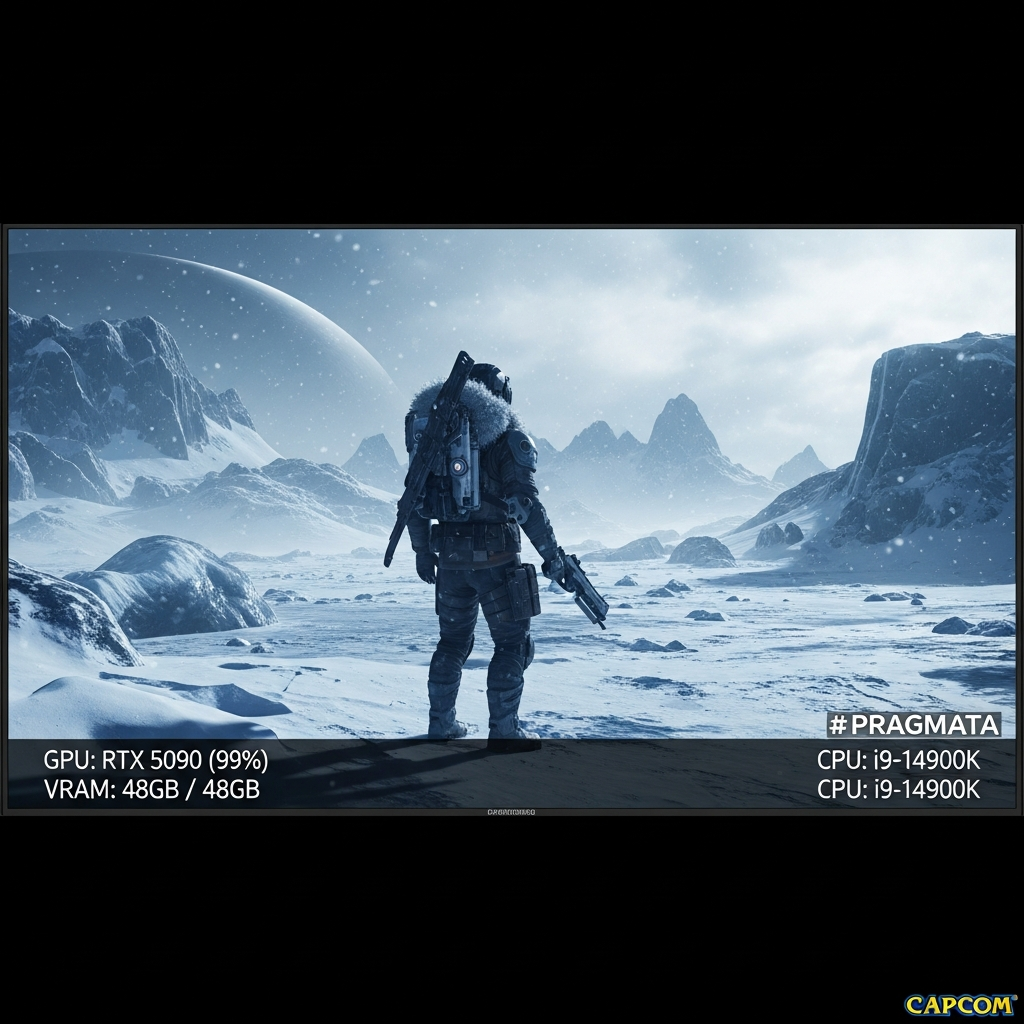
Capcom once again solidifies its reputation as a leading publisher this generation with the arrival of Pragmata. This original intellectual property, built on the robust RE Engine, stands as a testament to technical ambition and polished execution. While the game truly shines across all platforms, the Pragmata PC experience offers a fascinating deep dive into cutting-edge graphics and performance dynamics, from the most powerful GPUs to more accessible mid-range setups. Our comprehensive analysis reveals an impressive visual spectacle, groundbreaking tech, and some critical hardware considerations.
Pragmata: A Fresh Take on Action-Adventure
At its core, Pragmata is an engaging action-adventure game infused with survival horror elements. Players navigate a sprawling space colony, progressively unlocking new areas and objectives in a style familiar to Capcom enthusiasts. Unlike traditional survival horror, however, Pragmata builds tension through dynamic movement and diverse encounters, rather than relying on fixed camera angles or scarce resources.
A standout innovation is the real-time hacking mechanic. This feature centers on Diana, an advanced android who accompanies protagonist Hugh. Initiating a hack in the heat of combat carries a significant risk of enemy attacks. Yet, successful execution rewards players with a substantial weapon power-up. This mechanic demands precise timing and skill. PC players using a mouse and keyboard might find it slightly more intuitive, but gamepad controls remain remarkably well-tuned. Beyond its gameplay impact, the evolving relationship between Diana and Hugh forms the game’s emotional backbone. Their dialogue and compelling interplay are a particular highlight, reminiscent of the cherished dynamic between Mega Man and Roll in Mega Man Legends. This contrasting approach to situations provides a crucial anchor for the narrative.
Unparalleled Visuals: Path Tracing on High-End Pragmata PC
From a graphical standpoint, Pragmata stands out as one of the year’s most visually stunning PC releases. This is especially true when running in its demanding path-traced (PT) mode on high-end hardware. Unlike earlier RE Engine horror titles, where path tracing primarily enhanced subtle shadow details and low-light behavior, Pragmata fully leverages this technology. The game’s intricate environments boast a multitude of reflective surfaces. This design choice, combined with global illumination and physically-accurate reflections, dramatically elevates the overall visual presentation.
At its peak, the image quality of Pragmata PC approaches that of pre-rendered CGI. Expansive open spaces are bathed in incredibly convincing dynamic lighting. The PT mode heavily utilizes Nvidia’s ray reconstruction technology. While this tech isn’t entirely flawless, occasionally exhibiting minor smearing on certain surfaces – a known characteristic of dynamic frame generation technologies as explored in other Digital Foundry analyses – it still delivers a significant boost to overall image fidelity. For those fortunate enough to game on a top-spec RTX 5090 PC, Pragmata runs exceptionally well, even with all settings maxed out. This showcases the RE Engine’s prowess and the incredible power of high-end GPUs.
Mid-Range Performance and the VRAM Challenge
Even on more modest mid-range systems, Pragmata delivers an attractive experience. Our test setup, featuring an RTX 4060 and Ryzen 5 3600, maintained a consistent frame rate above 50fps across the initial two levels. This was achieved at 1440p using DLSS balanced mode and optimized settings, adapted from the technically similar Resident Evil 9. Performance can occasionally dip into the 40s or 50s during cutscenes that heavily feature Diana’s highly detailed, strand-based hair. However, with a Variable Refresh Rate (VRR) display, this still feels perfectly acceptable. While disabling the fancier strand-based hair system and ray tracing could boost performance, these visual elements are integral to the game’s unique aesthetic.
Despite its impressive scalability, the Pragmata PC experience isn’t without its frustrations, particularly concerning VRAM. A noticeable and “egregious stutter” was encountered upon entering a specific control center area. This issue miraculously disappeared after disabling the shadow cache option, effectively freeing up memory. This highlights a critical problem: users often struggle to distinguish between a genuine lack of GPU horsepower and hitting VRAM limits. Compounding this, the in-game graphics settings menu, while providing an estimate of VRAM consumption, was found to be inaccurate based on real-time monitoring.
This situation underscores a broader industry challenge. While 60-class graphics cards ideally need to move beyond 8GB framebuffers, this is a significant ask in the current hardware market. Capcom, and indeed all PC game developers, should acknowledge the vast installed base of 8GB GPUs. Providing clearer guidance to users or, more importantly, implementing improved VRAM optimization is crucial for a smoother experience across a wider range of hardware. Such proactive measures, potentially including more dynamic texture streaming or sophisticated memory management, would significantly enhance player satisfaction.
Capcom’s Triumph and the Path Forward
Overall, Pragmata emerges as a highly recommended title. It’s a rare original AAA project that blends inventive mechanics, fascinating characters, and cutting-edge rendering technology from its bespoke RE Engine. On high-end PCs, it’s an almost unqualified success, offering an uncompromised visual feast with its path tracing mode. Even on lower-end CPUs, players can enjoy a smooth 60fps and a visually appealing gameplay experience. The VRAM-related performance hiccups, while notable, don’t completely detract from Capcom’s triumph.
This release further solidifies Capcom’s standing as one of the best publishers of this generation. Few other companies consistently deliver such a quantity, quality, and variety of innovative titles. For PC game developers, addressing the 8GB VRAM challenge should remain a top priority, ensuring that stunning games like Pragmata are accessible and perform optimally for the broadest possible audience.
Frequently Asked Questions
What is Pragmata’s core gameplay loop and innovative mechanics?
Pragmata is an action-adventure game with survival horror undertones, set in a vast space colony. Players explore new regions, guided by objectives, while engaging in fluid combat. A key innovation is the real-time hacking mechanic, where protagonist Hugh, aided by the android Diana, risks enemy attacks to gain powerful weapon upgrades. The emotional interplay and dialogue between Hugh and Diana are also central to the game’s narrative and character development.
How does Pragmata perform on mid-range PC hardware like an RTX 4060?
On mid-range PCs, such as one equipped with an RTX 4060 and Ryzen 5 3600, Pragmata generally maintains over 50 frames per second (fps) at 1440p using DLSS balanced mode and optimized settings. While certain cutscenes with detailed hair can cause dips into the 40s or 50s, the experience is acceptable, especially with a VRR display. However, the game can encounter “egregious stutter” due to VRAM limitations, particularly with 8GB GPUs, which might require users to disable shadow cache or other demanding settings for smoother performance.
Is Pragmata PC worth playing despite potential VRAM limitations?
Yes, Pragmata PC is highly recommended and well worth playing. Despite the VRAM challenges faced by some 8GB GPUs, the game offers inventive mechanics, compelling characters, and cutting-edge visuals powered by the RE Engine. On high-end systems, the path-traced mode delivers an exceptional visual experience. Even on mid-range hardware, a smooth and attractive gameplay experience is achievable with optimized settings. The VRAM issue is a notable point for developers to address, but it doesn’t diminish Pragmata‘s overall quality as a rare and exciting original AAA project.