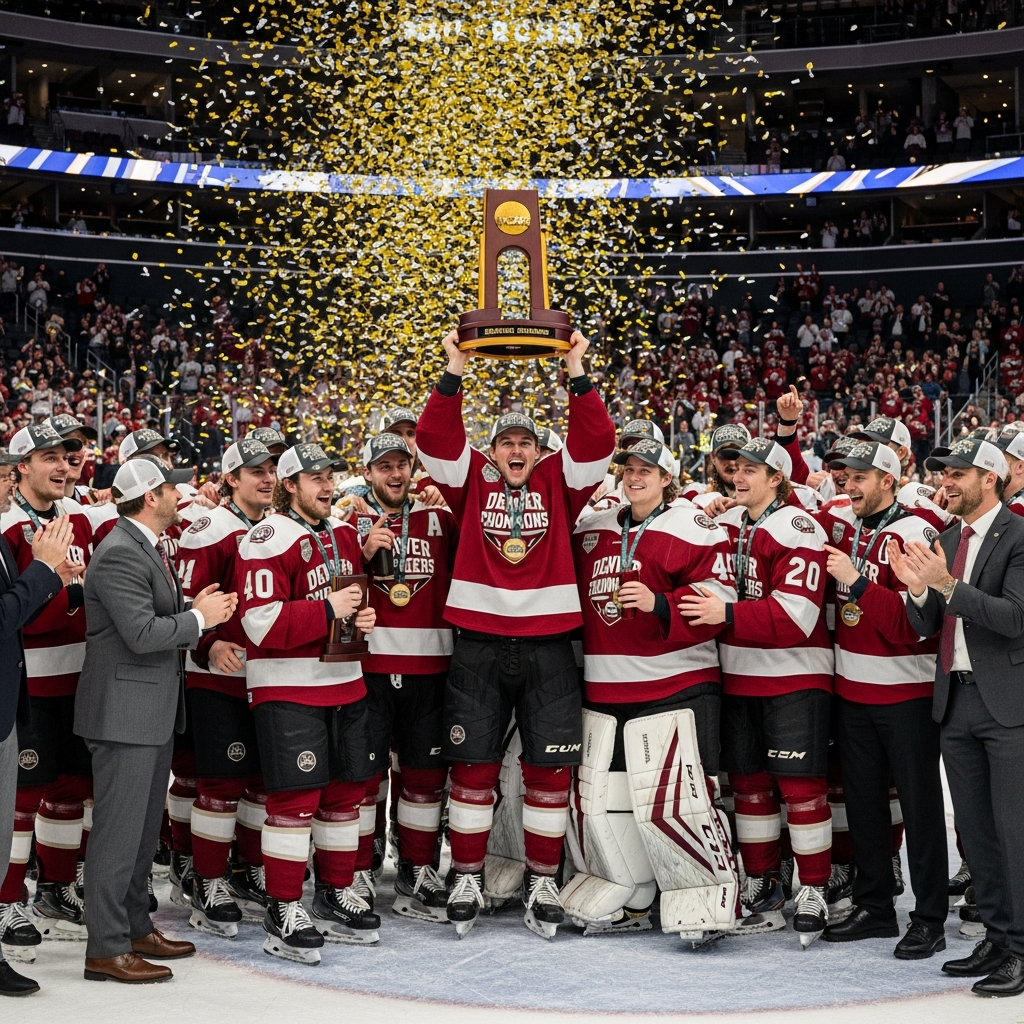
The University of Denver Pioneers have etched their name deeper into college hockey history, securing their record-extending 11th NCAA National Championship. In a thrilling Frozen Four finale in Las Vegas, the Pioneers mounted a dramatic third-period comeback to defeat the Wisconsin Badgers 2-1. This victory marks Denver’s third national title in just five seasons, solidifying their status as the sport’s pre-eminent program and underscoring a remarkable era of dominance for Denver hockey.
A Gritty Battle: Wisconsin’s Early Domination
The championship game, held at T-Mobile Arena on April 11, unfolded as a true test of endurance. For much of the contest, the Wisconsin Badgers appeared to have the upper hand. Their relentless forecheck and superior puck control stifled Denver’s offense, creating a lopsided shot count early on. Wisconsin outshot the Pioneers 10-2 in the first period, a championship game record low for Denver. By the end of the second period, the shot differential had ballooned to 21-5 in Wisconsin’s favor.
Adding to Denver’s challenges, key players faced early setbacks. First-line center and New Jersey Devils prospect Samu Salminen left the ice with a suspected shoulder injury. Shortly after, sophomore Jake Fisher also departed after taking a high hit to the face, leaving the Pioneers without two key centers for a period. Despite these obstacles, Denver remained resilient, a trait that would ultimately define their historic win.
The Unbreakable Wall: Johnny Hicks’ Masterclass in Net
Wisconsin capitalized on its early pressure when Buffalo Sabres prospect Vasily Zelenov ripped a wrist shot past Denver defenseman Eric Pohlkamp and over the right shoulder of freshman goaltender Johnny Hicks. This early goal put the Badgers ahead 1-0, continuing their tournament trend of scoring first. However, that would be the only puck to elude Hicks all night.
Despite the Badgers’ constant barrage, Hicks stood tall, making 29 saves on 30 shots. His performance was nothing short of heroic, earning him the Frozen Four’s Most Outstanding Performer award. Hicks, who finished his freshman season with an incredible 16-0-1 record, showcased exceptional vision and positioning. Coach David Carle lauded his young netminder, stating Hicks kept Denver “within striking distance” throughout Wisconsin’s early dominance. His ability to track the puck through heavy traffic, despite not being the tallest goalie, proved critical.
The Turning Tide: Denver’s Third Period Surge
As the game entered the final frame, the momentum shifted dramatically. Nearly 48 minutes into the contest, with Denver still trailing, alternate captain and Minnesota Wild prospect Rieger Lorenz found the equalizer. Lorenz, playing with renewed energy, buried a rebound for only Denver’s second “grade-A” scoring chance of the game. His crucial tally knotted the score at 1-1, breathing new life into the Pioneers.
Just six minutes later, Denver Pioneers hockey completed its stunning comeback. Junior defenseman Boston Buckberger, who himself had battled through a skate cut to his hand in the semifinal, fired a shot towards the net. Kyle Chyzowski expertly tipped it in, giving Denver a 2-1 lead. This crucial goal came during an extended offensive zone possession for Denver, notably after Wisconsin goaltender Daniel Hauser had lost his stick, making defense incredibly difficult. Wisconsin captain Ben Dexheimer nearly tied it late, hitting the crossbar, but Denver held on for the hard-fought victory.
A Dynasty Cemented: David Carle’s Coaching Legacy
At just 36 years old, head coach David Carle has solidified his place as a college hockey great. Under his leadership, the NCAA Hockey Championship has become a familiar destination for the Pioneers. Carle’s philosophy emphasizes commitment and investment over sheer size, proving that a “smaller institution” can build a winning program. “You don’t have to be big in hockey to be good. You have to invest,” Carle remarked, highlighting Denver’s dedication. This win extends Denver’s lead over Michigan (nine titles) for the most national titles in NCAA hockey history.
Wisconsin’s Resurgence: A Program on the Rise
While the championship slipped away, the Wisconsin Badgers under coach Mike Hastings demonstrated an incredible turnaround. Just one year prior, the Badgers won only 13 games and finished sixth in the Big Ten. Their path to the Frozen Four was unexpected, overcoming a six-game losing streak in January and a decisive 7-1 conference tournament loss. They secured their spot in Las Vegas with dramatic wins, including a 4-3 overtime victory against Michigan State in the regional final. Hastings, leveraging advice from legendary coach Jerry York, inspired his team to play their best hockey on the biggest stage.
Player Spotlights and Future Prospects
Several players on both sides made significant impacts and now face critical decisions about their futures.
Eric Pohlkamp: A Hobey Finalist’s Grit
Denver junior defenseman Eric Pohlkamp, a Hobey Baker finalist, played a pivotal role despite battling hand and foot injuries. Carle praised Pohlkamp’s “abrasive” style and competitive nature, noting his significant defensive growth this season. A San Jose Sharks prospect, Pohlkamp faces a decision about turning pro, a move Carle believes he is ready for due to his improved two-way play.
Rieger Lorenz: The Clutch Scorer
Rieger Lorenz delivered the tying goal, a career highlight in a season where he recorded a personal-best 17 goals. The Minnesota Wild prospect plans to sign with the NHL club after the Frozen Four, signaling a bright professional future following his impactful collegiate career.
Blake Montgomery: Wisconsin’s Rising Star
For Wisconsin, Ottawa Senators prospect Blake Montgomery showcased his potential. The 6-foot-4 freshman, a Memorial Cup winner the previous year, nearly became the first player in the new eligibility era to win both CHL and NCAA titles. His speed and ability to create offensive entries were noticeable throughout the tournament, hinting at a promising career ahead.
The Road to Las Vegas: Semifinal Drama
Both teams endured arduous paths to the final. Denver navigated a grueling double-overtime semifinal against the top-seeded Michigan Wolverines, winning 3-2 after 92 minutes and 35 seconds of play. Wisconsin’s journey was equally impressive, as they delivered a “masterclass in defense, special teams, and goaltending” to shut out North Dakota 2-1 in their semifinal clash, setting the stage for the highly anticipated championship matchup.
Pre-Game Insights and Accolades
Leading up to the championship, individual accolades were announced. Max Plante of Minnesota Duluth earned the Hobey Baker Memorial Award as the nation’s top player, while Michigan State’s Trey Augustine received the Mike Richter Award for top goaltender. The final game itself featured a remarkable 19 NHL prospects across both rosters, highlighting the elite talent on display. Wisconsin coach Mike Hastings also incorporated advice from coaching legend Jerry York into his final practice, emphasizing energy and leadership.
Frequently Asked Questions
What made Denver’s 11th NCAA Championship victory historic?
Denver’s 2-1 win over Wisconsin secured their record-extending 11th NCAA Men’s Ice Hockey National Championship, surpassing Michigan’s nine titles. This victory also marked their third national title in just five seasons, a testament to their consistent excellence and solidified their status as a dominant force in college hockey. The dramatic third-period comeback added another layer to this historic achievement.
How did Denver’s goaltender, Johnny Hicks, contribute to the championship win?
Freshman goaltender Johnny Hicks was pivotal, earning the Most Outstanding Performer award for his heroic efforts. He stopped 29 of 30 shots in the final, keeping Denver within striking distance despite Wisconsin’s early offensive onslaught. Hicks concluded his freshman season with an undefeated 16-0-1 record, making critical saves throughout the game, particularly during Wisconsin’s periods of heavy pressure, proving to be the backbone of Denver’s defense.
What does this championship mean for Coach David Carle and the Denver hockey program?
At 36, Coach David Carle has further cemented his legacy as a college hockey great, leading Denver to its 11th national title. He views Denver’s success as “proof of concept” that smaller institutions can achieve elite status through commitment and investment in their hockey program. This sustained success under Carle establishes Denver as the pre-eminent program in the nation, setting a high standard for collegiate hockey excellence and potentially signaling a prolonged dynasty.
Conclusion
The 2026 NCAA Hockey Championship was a testament to resilience, strategic coaching, and individual brilliance. The University of Denver Pioneers, led by the unflappable Johnny Hicks and the visionary David Carle, showcased their championship pedigree by overcoming adversity and mounting a thrilling comeback. Their 11th national title not only extends their record but also firmly establishes a modern college hockey dynasty. While Wisconsin’s remarkable journey ended in heartbreak, their dramatic turnaround under Mike Hastings signals a program firmly on the rise. This Frozen Four finale will be remembered as a classic, highlighting the enduring passion and competitive spirit of collegiate ice hockey.