Washington D.C. is no stranger to monumental architecture, but a newly unveiled proposal by President Trump for a colossal triumphal arch has ignited a storm of debate. The ambitious design, intended to stand at 250 feet, promises to reshape a significant portion of the National Mall while simultaneously drawing fire from veterans, preservationists, and legal experts. As America prepares to celebrate its 250th birthday, this project emerges as a central, albeit contentious, feature of the administration’s “Freedom 250” commemorative plans, challenging established norms of federal construction and historic preservation.
The Grand Vision: Unveiling D.C.’s Proposed Triumphal Arch
Official architectural renderings released on April 11, 2026, by the U.S. Commission of Fine Arts have provided the first detailed look at President Trump’s proposed D.C. triumphal arch. These plans, consistent with a 3D model previously showcased at a White House fundraising dinner, depict a structure designed for unparalleled grandeur and symbolic weight. The vision aims to cement a lasting architectural legacy, though its path is fraught with legal and ethical challenges.
A Monumental Design: Taller Than Paris’s Icon
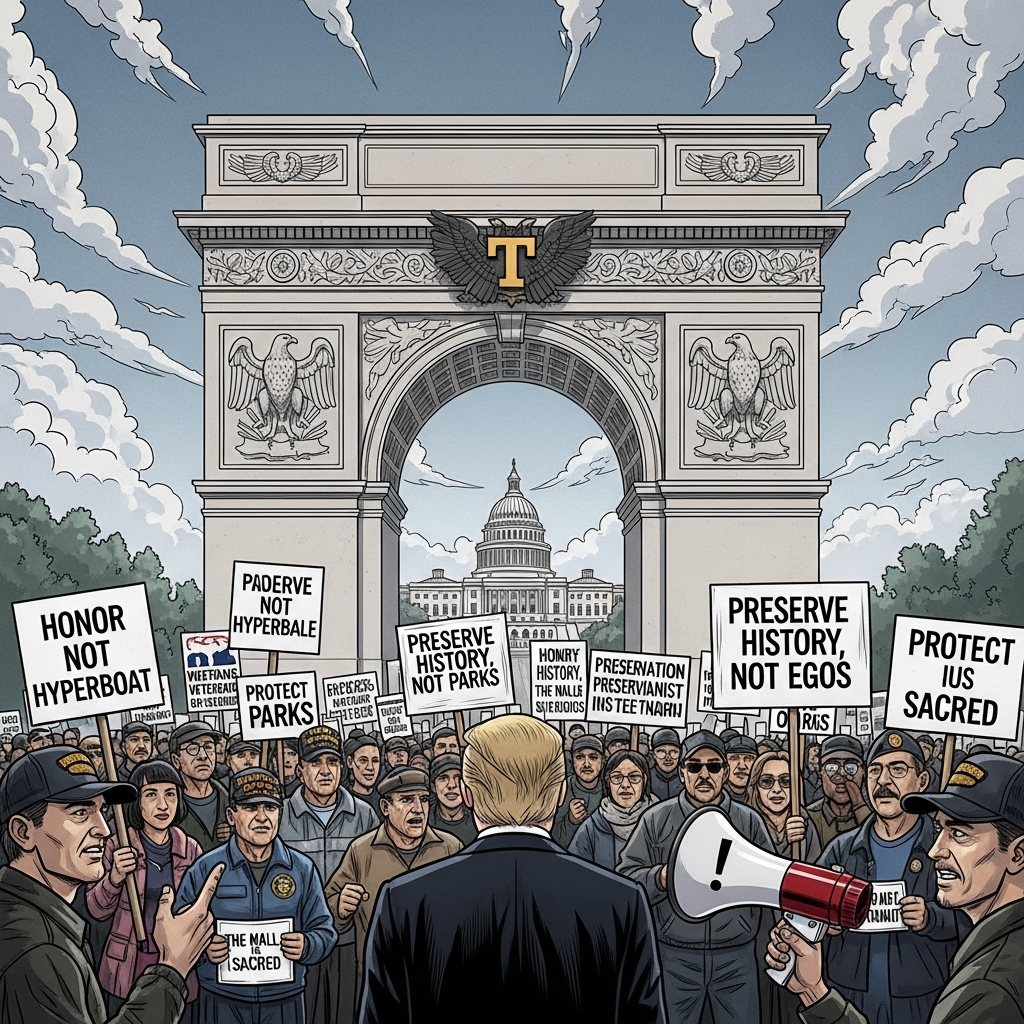
The proposed arch is a striking, white and gilded edifice that immediately brings to mind Paris’s iconic Arc de Triomphe. However, Trump’s vision dwarfs its French inspiration, standing almost 100 feet taller at a formidable 250 feet. This immense height is, according to a White House email to NPR, “a fitting recognition of America’s 250th birthday,” making it a dominant feature in the nation’s capital. The design incorporates distinctive American symbols, including two golden eagles perched atop the structure and a winged, crowned figure that evokes the revered Statue of Liberty. Inscriptions on its facades are planned to feature patriotic phrases: “One nation under God” on one side and “Liberty and justice for all” on the other, intended to reflect core American values.
Location and Symbolic Placement
The strategic placement of the triumphal arch is intended to maximize its visual impact and symbolic resonance. It is proposed for one end of the Arlington Memorial Bridge, directly adjacent to the solemn grounds of Arlington National Cemetery and near the Potomac River. This location would make it a focal point for visitors, significantly impacting the visual landscape of the National Mall. Notably, at 250 feet, it would stand at more than twice the height of the nearby Lincoln Memorial, physically dominating one of America’s most cherished landmarks and altering the traditional sightlines that have defined this historic area for generations. White House spokesperson Davis Ingle touted the arch as an iconic landmark that would “enhance the visitor experience at Arlington National Cemetery for veterans, the families of the fallen, and all Americans alike.”
Controversy and Conflicting Narratives
Despite the White House’s celebratory rhetoric, the D.C. triumphal arch project has been mired in controversy since its inception. The project highlights a significant tension between a president’s desire for a personal legacy and public expectations for national monuments. The debate centers on its true purpose, its legality, and the very spirit of monumental art in a democratic society.
“Me” vs. “America’s 250th”: A Disputed Purpose
The stated purpose of the arch, as articulated by the White House, is to honor America’s 250th birthday and the sacrifices of veterans. Spokesperson Ingle emphasized it would serve as a “visual reminder of the noble sacrifices borne by so many American heroes.” However, this narrative starkly contrasts with President Trump’s own candid remarks. When initially questioned in October 2025 about whom the monument would honor, Trump famously responded, “Me,” an exchange captured in a widely circulated social media video. This direct admission fueled skepticism and criticism, suggesting a personal rather than purely national motivation behind the colossal undertaking. This perceived self-aggrandizement has become a central point of contention for opponents, raising questions about the appropriate use of public space and resources.
Legal Battles and Preservationist Concerns
The project faces significant legal hurdles and strong opposition from various groups. A lawsuit was filed in February by a group of Vietnam War veterans seeking to block the arch’s construction. Their core argument hinges on federal statutes that mandate explicit congressional authorization for any commemorative works or structures erected on federal park grounds in Washington D.C. This legal challenge underscores a fundamental aspect of federal land use and democratic oversight. Beyond the legalities, Sue Mobley, director of research at Monument Lab, a Philadelphia-based nonprofit, characterized the arch as “textbook Trump.” She interpreted its emphasis on immense size and personal prominence as an “authoritarian impulse” and expressed strong doubts about the project’s eventual realization, predicting it would “likely get tied up in court.”
The Road to Approval: Hurdles and Influence
The White House insists it will “follow all legal requirements” in the construction of the D.C. triumphal arch. However, the process itself has become a point of contention, raising questions about the independence of federal review agencies and the potential for executive influence.
Federal Oversight and Appointment Controversies
Key to the approval process are federal bodies like the U.S. Commission of Fine Arts and the National Capital Planning Commission. The National Park Service has requested to present potential designs to the Commission of Fine Arts, which is scheduled to review the plans. A critical factor in this review is the composition of the Commission: in October 2025, President Trump took the unusual step of dismissing six sitting members, subsequently appointing an entirely new commission predominantly composed of his own selections. This move has led to concerns about the impartiality and independence of the body responsible for overseeing design and aesthetics in the nation’s capital. The National Capital Planning Commission, a central planning agency, is also expected to weigh in, adding another layer of review to this high-profile project.
Project Costs and Funding Challenges
The estimated cost of the triumphal arch remains a significant unknown. The White House anticipates a blend of public and private funds will be used for its construction, but Harrison Design, the architecture firm behind the plans, has not yet released specific pricing information. Monumental projects of this scale typically involve substantial financial commitments, and the lack of transparent cost estimates further fuels public scrutiny, particularly given the ongoing legal challenges and the need for public accountability for projects impacting federal lands.
Broader Architectural Ambitions: A D.C. Makeover
The D.C. triumphal arch is not an isolated proposal but rather part of a broader pattern of architectural interventions championed by the Trump administration in and around Washington D.C. These projects reflect a consistent preference for classical or traditional styles, mandated by an August executive order for federal buildings with budgets over $50 million. This series of initiatives aims to dramatically reshape the capital’s aesthetic, sparking both admiration and fervent opposition.
The White House Ballroom: A Secure Bunker Underneath?
One of the most dramatic interventions is the push for a $400 million (originally $300 million) neoclassical ballroom at the White House. This project has faced its own legal battles, with a federal appeals court temporarily allowing construction to proceed on April 11, 2026, despite a lower court ruling that it lacked congressional approval. The historic East Wing has already been demolished to make way for the new structure. President Trump has defended the construction not just for hosting events but also by citing national security, revealing in March that a “secure, upgraded FDR-era bunker” with “high-grade bulletproof glass” is being built directly underneath the ballroom, which he claimed “essentially becomes a shed for what’s being built under.” This disclosure adds a complex layer of utility and controversy to an already contested project.
Other Major Renovation Plans
Beyond the White House ballroom and the D.C. triumphal arch, the administration has pursued several other architectural changes in the capital. These include:
Rose Garden Redesign: The White House Rose Garden was notably converted into a stone-covered patio, a move that drew criticism from horticulturalists and preservationists.
Kennedy Center Renovation: Plans to shut down The Kennedy Center for two years for a major renovation have been met with a lawsuit from a coalition of preservation groups, including the National Trust for Historic Preservation and the American Institute of Architects.
- Dulles Airport Overhaul: The Department of Transportation launched an initiative to overhaul Washington Dulles International Airport, attracting proposals from prominent firms like Zaha Hadid Architects.
- www.npr.org
- www.npr.org
- www.cbsnews.com
- abcnews.com
- www.dailysabah.com
These projects collectively illustrate a significant and controversial effort to redefine the architectural landscape of the nation’s capital under the Trump administration.
Frequently Asked Questions
What is the proposed Trump D.C. Triumphal Arch and its features?
The proposed Trump D.C. Triumphal Arch is a 250-foot-tall monumental structure designed to be erected in Washington D.C. Its design, inspired by Paris’s Arc de Triomphe but nearly 100 feet taller, includes two golden eagles atop the arch and a winged, crowned figure resembling the Statue of Liberty. Inscriptions “One nation under God” and “Liberty and justice for all” are planned for its facades. The White House states its purpose is to recognize America’s 250th birthday and honor veterans, though President Trump also publicly indicated it would honor himself.
Where would the proposed Trump D.C. Triumphal Arch be located?
The D.C. triumphal arch is planned for a prominent location on the National Mall. Specifically, it would stand at one end of the Arlington Memorial Bridge, immediately adjacent to the Arlington National Cemetery and near the Potomac River. This placement would position it to significantly overshadow the nearby Lincoln Memorial, standing at more than twice its height, and dramatically alter the visual landscape of a historically significant area in the nation’s capital.
What are the main controversies surrounding the Trump D.C. Triumphal Arch project?
The project faces several significant controversies. First, its true purpose is disputed; while the White House cites America’s 250th birthday and veterans, President Trump stated it would honor him, leading to accusations of self-aggrandizement. Second, a lawsuit by Vietnam War veterans claims the project violates federal statutes requiring explicit congressional authorization for monuments on federal park grounds. Third, critics like Monument Lab view its immense size as an “authoritarian impulse.” Finally, the composition of the U.S. Commission of Fine Arts, now entirely Trump appointees after a mass dismissal, raises concerns about the impartiality of its review process.
The Future of D.C.’s Skyline
The proposal for a D.C. triumphal arch represents a pivotal moment in the ongoing conversation about presidential legacy, national memory, and the physical transformation of Washington D.C. While presented as a grand gesture to honor America’s 250th anniversary and its heroes, the project is entangled in debates over its true intent, legal legitimacy, and impact on the capital’s historic landscape. As legal battles continue and federal commissions deliberate, the future of this colossal monument remains uncertain, poised to either become a defining symbol of a contentious era or another unbuilt architectural dream. This project, along with other White House-backed renovations, underscores a clear shift in the aesthetic vision for the nation’s capital, prompting citizens and policymakers alike to consider the enduring questions of what monuments truly represent and who they ultimately serve.