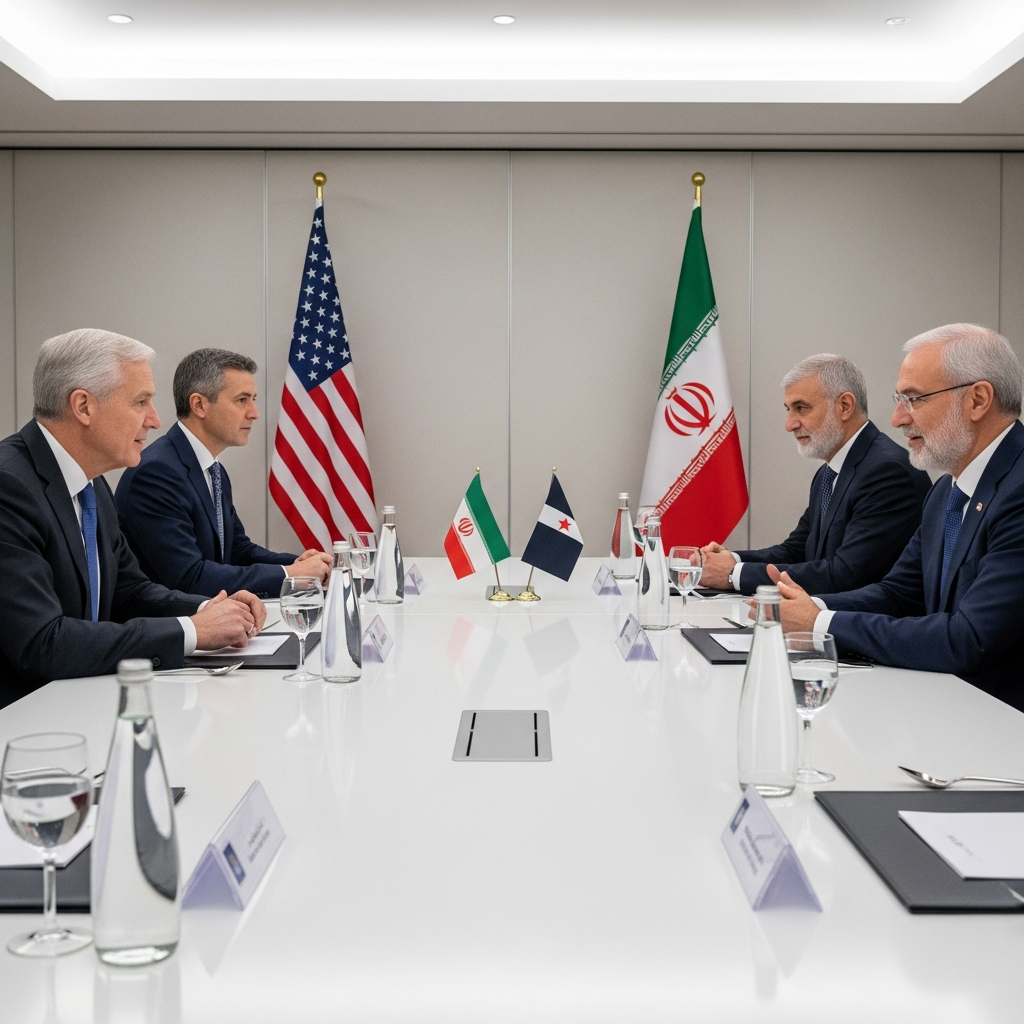
The geopolitical landscape of the Middle East remains volatile, with critical US-Iran ceasefire negotiations unfolding in Islamabad. As an Iranian delegation arrived on April 10, 2026, ahead of pivotal talks, the region grappled with escalating military engagements, a deepening economic crisis in Iran, and persistent disputes over vital maritime routes like the Strait of Hormuz. These complex discussions, aimed at de-escalation, are navigating a minefield of differing interpretations, internal power struggles within Iran, and ongoing regional conflicts that threaten to undermine any fragile peace.
High-Stakes Ceasefire Talks: A Fragile Path in Islamabad
Diplomatic efforts intensified in Islamabad as US Vice President JD Vance, operating under strict guidance from President Donald Trump, joined a US negotiating team including Jared Kushner, Special Envoy Steve Witkoff, and officials from the Pentagon, National Security Council, and State Department. Their counterparts, an Iranian delegation led by Parliament Speaker Mohammad Bagher Ghalibaf and Foreign Affairs Minister Abbas Araghchi, arrived with their own set of demands and internal divisions. Optimism remains cautious, even as early reports from a Pakistani source suggest “everything is on track,” citing de-escalation in Lebanon as a positive sign.
The Challenge of Undocumented Ceasefire Terms
A major hurdle to upholding any peace is the absence of mutually agreed-upon, public ceasefire documents. This ambiguity allows Iranian officials to frame the United States and its allies as aggressors, attempting to collapse a peace framework whose terms are, by design, unclear to outsiders. Iranian negotiators insist on the inclusion of Lebanon in any ceasefire and assert Iran’s right to restrict shipping in the Strait of Hormuz. Iranian Parliament Speaker Ghalibaf even declared on April 10 that a Lebanon ceasefire and the release of blocked Iranian assets must precede negotiations – demands for which no public evidence of mutual agreement exists. This lack of transparency extends to other areas, such as Iraq, raising questions about the ceasefire’s true scope.
Iran’s Fragmented Negotiation Front
Adding another layer of complexity, the Iranian negotiating team is far from unified. It operates as a de facto committee of competing political, military, and security factions. These internal rivalries manifest in mixed signals and unclear lines of authority, particularly between diplomatic institutions, the Islamic Revolutionary Guards Corps (IRGC), and the Supreme National Security Council (SNSC).
Abbas Araghchi, representing the diplomatic wing, supports engagement but faces hostility from hardline elements, including protests outside his ministry.
Mohammad Bagher Ghalibaf, the Parliament Speaker, has surprisingly emerged as the lead negotiator, a role typically reserved for the president or foreign minister. Despite his strong ties to conservative networks, he appears to lack direct command over the IRGC.
Major General Ahmad Vahidi, the senior-most IRGC commander, wields significant influence despite not being a formal negotiator. His past as a Quds Force commander and a key figure in Hezbollah’s establishment suggests a firm stance on Lebanon and may constrain diplomatic maneuverability. Vahidi reportedly pushed for SNSC Secretary General Mohammad Bagher Zolghadr to join the team, a request met with resistance from Ghalibaf and Araghchi due to Zolghadr’s lack of diplomatic experience.
Mohammad Bagher Zolghadr, SNSC Secretary General, a hardline IRGC veteran, oversees coordination among Iran’s security bodies. Despite his critical role in shaping national security policy, he is not reportedly part of the delegation, further obscuring the SNSC’s current influence.
Notably absent from visible mediation is Supreme Leader Mojtaba Khamenei, whose traditional role as an internal arbiter could otherwise help harmonize these divergent positions. This internal division within Iran makes assessing credibility and reaching enforceable agreements significantly more challenging for the US.
Strait of Hormuz: A Flashpoint for Regional Influence
The Strait of Hormuz, a critical choke point for global oil supplies, has emerged as a central and contentious issue. US President Trump publicly warned on April 10 that Iran is engaging in “short-term extortion” in the Strait, asserting that Iranian leadership is negotiating from a position of weakness. US intelligence reportedly assesses that the IRGC is exploiting the current two-week ceasefire to solidify control over maritime traffic in this vital waterway.
Iranian parliamentarians are reportedly preparing to vote on a strategic plan for the Strait of Hormuz. This plan would prohibit “hostile” shipping (targeting US, Israeli, and other vessels), mandate transit fees in Iranian rials, and require the use of the term “Persian Gulf.” Such measures would force countries to negotiate for safe passage, introducing unpredictability and potentially keeping global energy prices high. While some shipping firms are resisting these “tolls” as violations of freedom of navigation, Iran understands its ability to coerce other powers by threatening shipping through the Strait. US Vice President Vance affirmed the US team would not allow Iran to “play them” on this critical issue.
Escalating Military Engagements Across the Region
Amidst diplomatic efforts, military confrontations continue to punctuate the Middle East, highlighting the ongoing regional instability.
Drone Warfare Intensifies in Kuwait and Iraq
On April 10, Kuwaiti armed forces detected and engaged seven Iranian drones in their airspace, reporting attacks on National Guard facilities that injured several personnel. The IRGC, however, denied involvement in drone or missile attacks in Gulf states.
Meanwhile, Iranian-backed Iraqi militias likely used advanced first-person view (FPV) drones to ambush US Embassy personnel near Baghdad International Airport on April 8. While US officials confirmed the attack and lack of casualties, the precision required for such an ambush points to FPV drone use, a technology demonstrated by these militias. The arrest of an IRGC officer and three Iraqis connected to these airport attacks further suggests IRGC guidance and support. The potential transfer of FPV drone technology, especially fiber-optic versions that are difficult to jam, from actors like Russia to Iran and its proxies, poses a significant and evolving threat to US interests.
Intense Israel-Hezbollah Confrontations
Hezbollah claimed an unprecedented 49 attacks targeting Israeli forces in southern Lebanon between April 9-10, marking its highest number since March 29. These included 25 attacks in the Bint Jbeil district, an area of strategic and symbolic importance where the IDF has reportedly engaged Hezbollah fighters. Separately, Hezbollah claimed 43 attacks on Israeli infrastructure and communities in northern and southern Israel, including a missile fired at the Ashdod Naval Base, intercepted by Israeli air defenses.
The IDF, in turn, reported extensive counter-operations:
Over 1,400 Hezbollah operatives killed since March 2, including Radwan Force members and rocket operators.
Over 200 rocket launchers and 1,300 launch tubes destroyed.
120 Hezbollah targets struck on April 10 alone.
Ground operations by the 162nd and 36th Armored Divisions have destroyed over 2,700 Hezbollah sites and seized 250 weapons.
The 401st Armored Brigade located and destroyed two Hezbollah tunnels.
An IDF strike killed a Hezbollah Nasr Unit rocket artillery commander, a unit crucial to attacks against Israel.
Despite the intensity, an Israeli official hinted at “scaling down” operations in Lebanon ahead of direct negotiations between Israel and Lebanon, slated for next week in Washington, D.C. US President Trump reportedly urged Israel to reduce its strikes. However, Lebanese officials insist a ceasefire is a precondition for such talks, while Hezbollah Secretary General Naim Qassem declared his group would continue fighting “until the last breath.” Simultaneously, the Lebanese government continued efforts to disarm Hezbollah, with the Lebanese Armed Forces deploying units to enforce state monopoly over weapons in Beirut.
US and Israeli Air Campaign Details
New satellite imagery reveals significant damage to several Iranian facilities from pre-ceasefire combined force strikes:
The Besat Research Complex in Shiraz, Fars Province (April 6 strike).
The IRGC Navy base in Gheshm Island, Hormozgan Province (heavy damage to warehouses).
- Six buildings at the 26th Salman Missile Group near Borazjan, Bushehr Province.
An Israeli journalist also reported smoke from storage tanks at the oil terminal on Lavan Island, Hormozgan Province, on April 10, following explosions on April 9 after the ceasefire took effect. The perpetrator remains unclear, with both Israel and the United States denying involvement. The IDF reported conducting over 8,500 operational sorties and 1,000 air missions in Iran since the war began, employing over 18,000 munitions against more than 4,000 targets.
Iran’s Domestic Challenges and Nuclear Posture
Beyond the immediate conflict, Iran faces severe internal pressures that could significantly influence its strategic decisions.
Economic Instability: Iran’s “Achilles Heel”
Iran’s economy is reportedly in a precarious state. Iranian Parliament Budget Committee member Mehrdad Lahouti warned on April 10 that banks are in poor condition, risking crisis or bankruptcy. Production has “practically” stalled, exporters have halted activity, and businesses struggle to pay wages, leading to closures like Tehran hotels. Political insiders close to the Iranian establishment reportedly view the economy as Iran’s “Achilles heel,” fearing deterioration could threaten the regime’s ability to govern. A nationwide internet blackout, now exceeding 42 days, has compounded this economic strain, disrupting financial transactions and costing the economy an estimated $37 million USD per day. Any comprehensive peace agreement, insiders suggest, would need to lift sanctions and release frozen assets for Iran to meet payroll and repair infrastructure.
Nuclear Ambitions and Defensive Measures
The Institute for Science and International Security reported on April 9 that Iran is actively restricting access to the tunnel complex at the Esfahan Nuclear Technology Center (ENTC) in Esfahan Province. New makeshift roadblocks and backfilled tunnel entrances, coupled with additional barriers, suggest an aim to delay or complicate any ground operation to reach or seize highly enriched uranium stored there. Earlier reports indicated a large convoy transporting potentially nuclear-related material into the ENTC ahead of the June 2025 Israel-Iran War.
Further underscoring the nuclear dimension, Kamal Kharrazi, Strategic Council on Foreign Relations Chairman, died on April 9 from injuries sustained in a combined force strike on April 1. Kharrazi, a senior figure in the former Supreme Leader Ali Khamenei’s inner circle, notably stated in May 2024 that Iran had the capability to build a nuclear bomb and would change its doctrine if its existence was threatened. His death removes a key figure in Iran’s strategic thinking on nuclear matters.
The Broader Regional Implications
The interwoven events of April 10, 2026, paint a picture of profound regional instability. The Islamabad talks, while offering a glimmer of hope, are hampered by internal Iranian disunity and fundamental disagreements over ceasefire terms. The Strait of Hormuz issue threatens global energy markets, while proxy conflicts involving FPV drones and extensive Israeli-Hezbollah engagements highlight continuous military escalation. Combined with Iran’s severe economic distress and defensive maneuvers around its nuclear sites, the situation underscores how tightly intertwined diplomatic, economic, and military pressures are. The casualties suffered by the Popular Mobilization Forces (PMF) from combined force strikes further demonstrate the broad impact of the conflict on regional actors tied to Iran’s “Axis of Resistance.” This dynamic environment demands careful monitoring, as even small shifts could have far-reaching consequences for international security.
Frequently Asked Questions
What are the primary obstacles in the ongoing US-Iran ceasefire negotiations?
The negotiations face significant hurdles, including the absence of mutually agreed-upon, publicly documented ceasefire terms, allowing for conflicting interpretations and demands. Iran’s negotiating team itself is fragmented, composed of competing political, military, and security factions with divergent views and unclear lines of authority, making it difficult to assess their true mandate. Core sticking points from previous talks—nuclear enrichment limits, missile programs, sanctions, and access to frozen assets—are now compounded by new disputes over shipping in the Strait of Hormuz.
How is the Strait of Hormuz impacting regional tensions and global shipping?
The Strait of Hormuz is a critical flashpoint. Iran is reportedly considering a plan to restrict “hostile” shipping, levy transit fees in rials, and impose specific terminology, which the US views as “extortion.” US intelligence suggests the IRGC is using the current ceasefire to assert control over maritime traffic. Such actions could introduce significant unpredictability for international shipping, potentially driving up global energy prices and exacerbating regional tensions, as freedom of navigation is a key international principle.
What are the current economic challenges facing Iran, and how might they influence its foreign policy?
Iran is grappling with a severe economic crisis. Banks are reportedly near bankruptcy, production has stalled, and many businesses cannot pay wages. Political insiders view the economy as Iran’s “Achilles heel,” fearing its deterioration could threaten the regime’s ability to govern. An extended internet blackout further exacerbates financial strain. This economic fragility places immense pressure on Iranian leaders, potentially making them more insistent on sanctions relief and the unfreezing of assets as part of any peace deal, thereby directly influencing their foreign policy objectives and negotiation tactics.