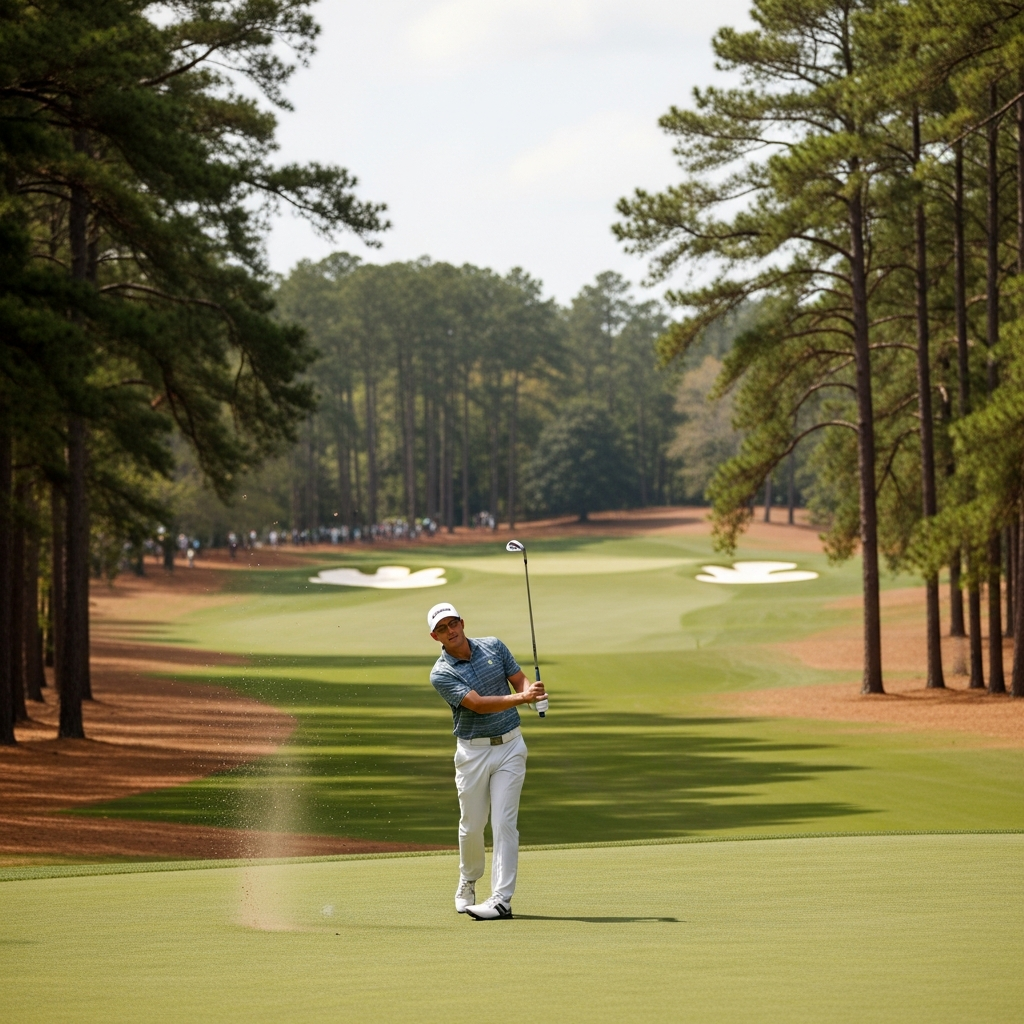
The Masters Tournament at Augusta National is legendary for its beauty and tradition, but this year, it has quickly earned a reputation for its extraordinarily challenging course conditions. After years of rain often softening the hallowed grounds, a relentless stretch of sunny, hot, and windy weather has transformed Augusta into a formidable adversary. This unique confluence of circumstances is creating an unprecedented tactical test, pushing even the world’s elite golfers to their absolute limits. Fans and players alike are witnessing a Masters unlike any other, where razor-thin margins dictate destiny and only the most precise shots find their reward.
The Unprecedented Challenge at Augusta National
For three full days leading up to the opening round, Augusta National was “on broil.” With a forecast promising continued sunshine and gusts, the course managers have the ideal canvas to dial up the difficulty. This sustained dry spell marks a significant shift from the previous seven Masters, where rain frequently intervened, preventing the course from reaching its peak firmness. Now, the verdant fairways and greens are rapidly transitioning to a state of extreme speed and rigidity, setting the stage for a dramatic contest.
Veteran Australian golfer Jason Day, with 13 PGA Tour wins and currently ranked 41st globally, offered a telling observation during his practice round. “You start seeing the purple,” Day noted, referencing the subtle discoloration of the grass. “When you start seeing that tinge of purple, that’s when you know it’s starting to get firm and fast.” This visual cue signals a major change, where the slightest miscalculation can lead to significant consequences. Day’s experience underscores how intimately players must understand the course’s evolving character.
A Historical Turn: No Rain, Pure Test
The absence of rain this Masters week is a game-changer. Historically, even a single day of precipitation could prevent Augusta from “baking out,” leaving greens and fairways more receptive to approach shots. Last year, for instance, a Monday practice round washout softened the course, preventing it from ever reaching truly firm conditions. This year, Mother Nature has stepped aside, allowing the iconic venue to present its most exacting challenge in recent memory.
“I think this could be the toughest Masters we’ve played in a while,” stated Shane Lowry, who managed an impressive opening-round 69. Lowry’s comment highlights the belief among players that the “green jackets” – the tournament committee – are now able to sculpt the course to their desired specifications, pushing the boundaries of difficulty. This deliberate firming up transforms the tournament from a battle against fellow competitors into a profound strategic chess match against Augusta itself.
Early Rounds Reveal the Gauntlet: Scoring Soars
The immediate impact of these demanding conditions was starkly evident during Thursday’s opening round. The world-class field collectively played to a staggering stroke average of nearly 74.7. This figure speaks volumes about the sheer difficulty presented, as low scores were exceptionally rare. Only three holes on the entire course – the par-5 2nd, the par-5 8th, and the par-5 13th – played under par for the day, showcasing the brutal nature of the par-4s and par-3s.
The most notorious challenge emerged at the seemingly innocuous par-4 seventh hole. This hole played to an average of 4.418, yielding a paltry two birdies throughout the entire round. This statistic made it the hardest hole of the day, surpassing its own historical average for an entire tournament week (4.402 in 1972). Such data points underscore that every hole at Augusta, under these conditions, demands unwavering respect and precise execution. The firm greens mean approaches bounce harder and roll out further, penalizing shots that are even slightly off target.
Veteran Insights: Patience and Precision are Paramount
Players who have experienced Augusta National in its firmest guise understand the unique demands. Patrick Reed, the 2018 Masters champion, notably won in the last tournament week without any precipitation. He mirrored Lowry’s 3-under effort in the opening round and vividly illustrated the course’s firmness: he broke his tee attempting to repair a ball mark on the 17th green.
Reed’s advice for navigating the firm conditions emphasizes a blend of mental fortitude and technical excellence. “You know it’s going to get fast, and it’s going to take a lot of patience,” he explained. “You’re going to have to hit the ball solid and put the ball in the right spots. When you do, be patient and try to minimize errors.” This focus on error minimization and strategic placement becomes critical when there’s no soft landing for errant shots.
Even defending champion Rory McIlroy, who carded an exceptional 5-under 67 to share the early lead, acknowledged the course’s stern test. McIlroy estimated his overall play should have yielded a score closer to 2-under, indicating he maximized every scoring opportunity. Far from being intimidated, McIlroy relishes the challenge. “When the greens do get firm like this, it makes it a much more tactical test,” he said. “You really have to think about things. As you guys know, I’ve said for the last few years, I’ve started to really relish that type of golf.” McIlroy’s strategic prowess and ball-striking consistency position him well for such demanding conditions, where calculated risks trump aggressive gambles.
Razor-Thin Margins: When Inches Make All the Difference
Exacting conditions at Augusta National translate directly to razor-thin margins for error. On Thursday, the fine line separating a brilliant shot from a potential disaster was often a matter of mere feet, or even inches. This unforgiving dynamic saw many players, even the most seasoned, fall victim to the course’s relentless pressure. The elevated expectations and unforgiving nature of the firm surfaces create immense psychological and physical strain.
The pressure was particularly acute for the 22 first-timers in the field. These debutants, likely unfamiliar with Augusta under such severe conditions, struggled to adapt. Only Jacob Bridgeman managed to finish in red figures, chipping in from behind the 18th green to secure a 1-under 71. His performance highlighted the invaluable role of past experience at Augusta National, particularly when the course stiffens up. Understanding the subtle contours, the prevailing winds, and the precise landing areas becomes crucial for success.
Even legends found themselves humbled by the course’s unforgiving nature. Fred Couples and José María Olazábal, boasting a combined 78 Masters appearances and three green jackets, both faced short wedge shots on the par-5 15th, looking to set up birdies after hours of admirable play. Yet, both found the water from short range – Olazábal once for a double bogey, Couples twice for a quadruple bogey. Olazábal’s reflection perfectly captured the course’s capriciousness: “I felt I didn’t mis-hit the shot, to be honest. I think a couple more yards, it would have been perfect. But it’s one of those things. I mean, Augusta is like that. Five feet can make a huge difference.” These dramatic moments underscore the constant tension and the premium on perfect execution.
What to Expect: The Course’s Evolution Towards Sunday
As the Masters progresses, the course will only become firmer and faster. The “folks in the green jackets” are master strategists themselves, expertly manipulating conditions to ensure the ultimate test. By Sunday, expect Augusta National to be “very, very crusty,” as Shane Lowry predicted. This means even more unpredictable bounces, faster roll-outs, and greens that resemble glass, making holding approach shots incredibly difficult.
This “once-a-decade confluence of circumstances” promises compelling viewing. Spectators will witness a dramatic unfolding where only the truly exceptional shots will be rewarded, while those marginally off target will be repelled without prejudice. It will be a grueling, shot-by-shot battle for the competitors, but an exhilarating spectacle for fans worldwide. The strategic demands, the mental resilience required, and the precision needed make this Masters a true showcase of golf at its most challenging. Understanding these unique conditions is key to appreciating the incredible performances that will undoubtedly unfold over the weekend.
Frequently Asked Questions
Why are Augusta National’s course conditions so challenging this year?
Augusta National’s conditions are exceptionally challenging due to a sustained period of dry, sunny, hot, and windy weather. This contrasts sharply with the last seven Masters, which frequently saw rain. The lack of precipitation has allowed the course to become “firm and fast,” with fairways and greens drying out significantly. This makes the course a “tactical test,” as noted by players like Rory McIlroy, requiring precise ball striking and strategic course management.
Which holes proved most difficult during the Masters’ opening rounds?
During the opening rounds, the par-4 seventh hole stood out as the most difficult. It played to an average of 4.418 strokes and yielded only two birdies throughout Thursday. This average even surpassed its historical highest for an entire tournament week. Additionally, most of the par-4s and par-3s posed significant challenges, with only the par-5s (Nos. 2, 8, and 13) playing under par for the field.
How do firm Masters conditions impact player strategy and scoring?
Firm Masters conditions dramatically impact player strategy and lead to higher scoring. Players must prioritize patience, solid ball striking, and precise shot placement, as emphasized by Patrick Reed. Greens become less receptive, causing approach shots to bounce higher and roll out further, demanding excellent distance control and spin management. The margin for error shrinks to mere feet, often turning potential birdies into bogeys, forcing a more tactical, conservative approach to avoid costly mistakes.
Ultimately, this Masters is shaping up to be an unforgettable chapter in tournament history. The combination of Augusta National’s inherent design and the unusually firm and fast conditions creates a battleground where mental toughness, strategic brilliance, and flawless execution will define the champion. As the tournament progresses, expect the challenge to intensify, making every shot a critical decision in the quest for the coveted green jacket.