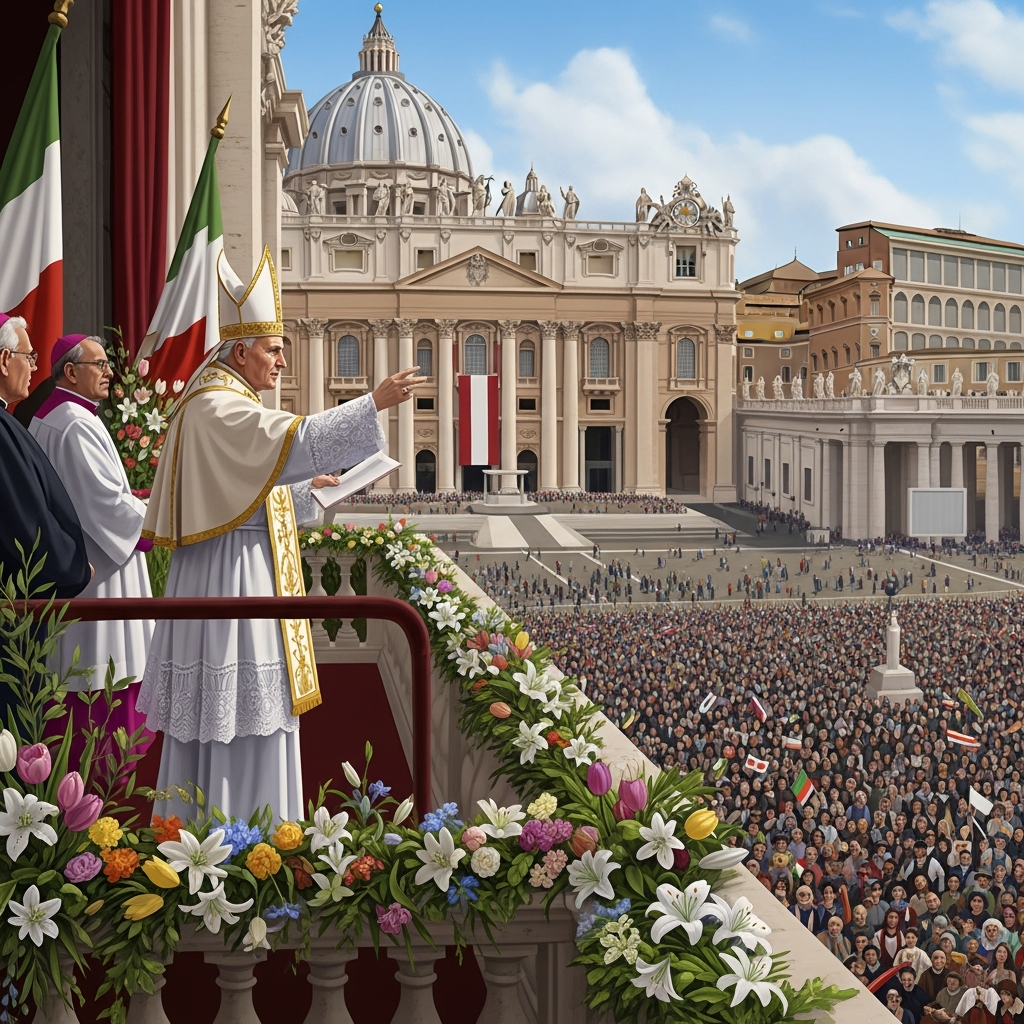
Pope Leo XIV delivered a powerful and urgent call for global peace during his inaugural Easter Mass as pontiff on Sunday, April 5, 2026. Addressing an estimated 50,000 faithful gathered in a flower-adorned St. Peter’s Square, the Pope implored world leaders and individuals to prioritize dialogue over domination, emphasizing that genuine peace cannot be imposed by force. His first Easter Urbi et Orbi (to the city and the world) blessing departed from recent tradition by focusing broadly on hope and nonviolence, rather than a specific litany of global conflicts, while still implicitly referencing ongoing struggles like the U.S.-Israeli war on Iran and Russia’s campaign in Ukraine.
A New Papacy’s Defining Moment: The Call for Nonviolent Peace
The 70-year-old Pope Leo XIV, the first U.S.-born pontiff, used this pivotal occasion to frame Christ’s resurrection as the ultimate triumph over death and a blueprint for achieving peace through nonviolent means. “Let those who have weapons lay them down! Let those who have the power to unleash wars choose peace! Not a peace imposed by force, but through dialogue! Not with the desire to dominate others, but to encounter them!” the Pope declared passionately. This direct and unequivocal statement underscored his vision for a world built on mutual respect and shared purpose.
His Easter message was a powerful spiritual counterpoint to the pervasive “death” he identified in contemporary society. This included not only physical demise but also abuses crushing the weakest, the idolatry of profit, and the violence of war. Pope Leo XIV asserted that Easter opens humanity to “a hope that never fails, to a light that never fades. Death has been conquered forever,” offering a new beginning for humanity stronger than hatred and despair.
Confronting the “Globalization of Indifference”
A central theme in Pope Leo XIV’s address was a stark warning against what he called an “ever-increasing ‘globalization of indifference’.” This concept, borrowed from his predecessor, Pope Francis, describes a societal desensitization to violence and suffering. The Pope lamented that people are “growing accustomed to violence, resigning ourselves to it, and becoming indifferent” to the deaths of thousands, the repercussions of hatred, and the severe economic and social consequences of conflict. He warned that this indifference fosters an acceptance of injustice, oppression, and destruction.
This powerful caution came as the U.S.-Israeli war on Iran entered its second month, alongside Russia’s ongoing conflict in Ukraine. While Pope Leo XIV chose not to explicitly name these wars in his Urbi et Orbi blessing, a departure from his own Christmas address and previous papal practice, his message resonated deeply with the current geopolitical landscape. His implicit acknowledgment underscored the urgency of his plea for leaders to foster respectful relationships and collaborate for the common good, rather than pursuing private interests through force.
Shifting Traditions: Pope Leo XIV’s Distinct Papal Style
Pope Leo XIV’s first Easter also showcased several notable shifts in papal tradition, signaling a distinct style for his pontificate since his election on May 8, 2025. He revived the practice of greeting the global faithful in 10 languages, including Arabic, Chinese, and Latin—a custom Pope Francis had let lapse. This linguistic outreach underscored his commitment to connecting with a diverse global Catholic community.
During Holy Week, Pope Leo XIV also reclaimed the tradition of washing priests’ feet on Holy Thursday. This gesture, intended to encourage clergy, contrasted with Pope Francis’s more inclusive approach of washing the feet of women, non-Christians, and prisoners in various settings. Furthermore, the 70-year-old pontiff made history by becoming the first Pope in decades—and only the second after Pope John Paul II—to carry the light wooden cross for the entire 14 stations during the Way of the Cross on Good Friday at Rome’s Colosseum. These traditional rediscoveries highlight a pontificate rooted in established ceremonial practices, while still delivering a forward-looking message of peace.
Easter’s Echoes: Celebrations Amidst Global Conflict
Beyond the Vatican, Easter celebrations in 2026 provided a poignant illustration of the global tensions Pope Leo XIV addressed. In Jerusalem, traditional ceremonies at the revered Church of the Holy Sepulchre were significantly scaled back. An agreement with Israeli police limited public gatherings due to ongoing missile attacks, leading to deserted historical alleyways in the Old City. These restrictions, which also impacted recent Muslim and Jewish holidays like Ramadan, Eid al-Fitr, and Passover, reportedly strained relations between Israeli authorities and Christian leaders. Access was heavily controlled, limiting worshippers.
Conversely, in Gaza City, the small Palestinian Christian community experienced “great joy” and relief during their Easter Mass at the Holy Family church. A recent ceasefire, after nearly three years of suffering, brought a sense of stability and normalcy, allowing residents like George Anton to feel “somewhat relieved.”
Meanwhile, in Tehran, Iran, Armenian Christians observed Easter at St. Sarkis Cathedral amidst daily airstrikes, striving to maintain a semblance of normalcy. Families exchanged painted eggs, with English teacher Juanita Arakel, 40, noting that children “just need to feel normal” despite the conflict. Iran, home to some 300,000 Christians, predominantly Armenians, saw Archbishop Sepuh Sargsyan of the Armenian Diocese of Tehran express collective prayers for an end to the U.S.-Israeli war. These varied experiences underscored the deep impact of global conflicts on communities of faith.
Looking Ahead: A Sustained Commitment to Peace
Pope Leo XIV’s Easter message was not merely a ceremonial address but a foundational statement for his papacy. He announced a prayer vigil for peace to be held on April 11 in St. Peter’s Basilica, signaling a sustained commitment to his Easter message and a continued call for global reflection and action. His consistent plea for peace, evident throughout Holy Week where he condemned war-wagers and called for an “off-ramp” in the Iran conflict, places the Catholic Church’s highest authority squarely behind the choice of dialogue over force. The Vatican, adorned with 75,000 flowers from the Netherlands, stood as a vibrant backdrop to this profound appeal for hope and nonviolence for the world’s 1.4 billion Catholics.
Frequently Asked Questions
What was Pope Leo XIV’s central message during his first Easter Urbi et Orbi blessing?
Pope Leo XIV’s central message during his first Easter Urbi et Orbi blessing on April 5, 2026, was an urgent and fervent call for global peace through dialogue, not force. He implored leaders and individuals to “lay down arms” and “choose peace,” warning against a “globalization of indifference” to human suffering and the destructive consequences of conflict. The Pontiff emphasized Easter’s message of hope and Jesus’ resurrection as a triumph over death, advocating for nonviolent power as the true strength that brings peace.
How did Pope Leo XIV’s Easter traditions differ from his predecessor, Pope Francis?
Pope Leo XIV introduced several notable shifts during his first Holy Week as pontiff. He revived the tradition of greeting the global faithful in 10 languages, a practice Pope Francis had discontinued. Additionally, he reclaimed the custom of washing priests’ feet on Holy Thursday, contrasting with Pope Francis’s more inclusive approach of washing the feet of women, non-Christians, and prisoners. Furthermore, Pope Leo XIV became the first Pope in decades to carry the light wooden cross for all 14 stations during the Way of the Cross on Good Friday.
What impact did global conflicts have on Easter celebrations in regions like Jerusalem, Gaza, and Tehran in 2026?
Global conflicts significantly impacted Easter celebrations in 2026. In Jerusalem, traditional ceremonies at the Church of the Holy Sepulchre were heavily scaled back due to missile attacks and Israeli restrictions on public gatherings, straining relations between authorities and Christian leaders. Conversely, Gaza City’s Christian community experienced “great joy” and relief due to a recent ceasefire. In Tehran, Iranian Armenian Christians observed Easter amidst daily airstrikes, striving to maintain a sense of normalcy, with community leaders expressing prayers for the ongoing war to end.