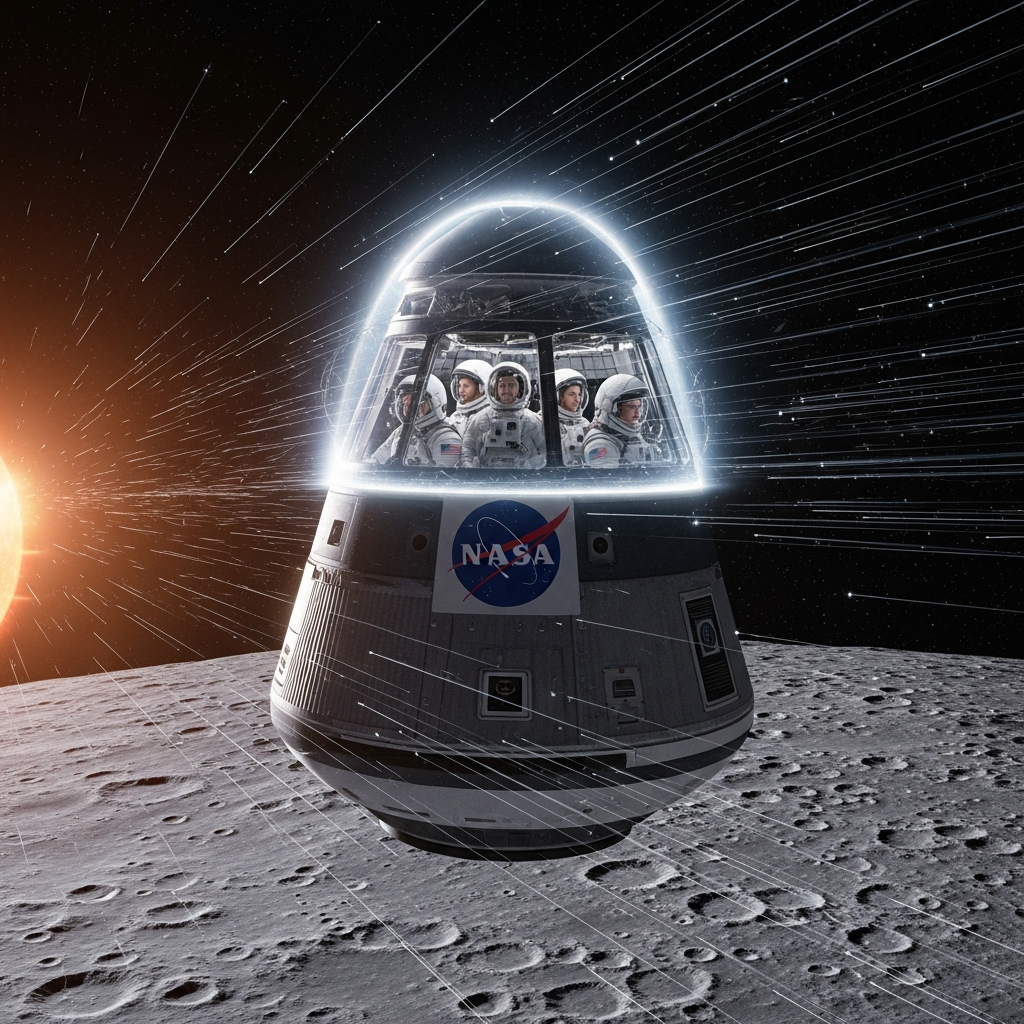
As humanity prepares for its bold return to the Moon with the Artemis II mission, an exciting journey awaits. Four astronauts will venture beyond Earth’s protective embrace, embarking on a critical test flight around our celestial neighbor. This groundbreaking mission, however, carries inherent risks, none more formidable than the invisible threat of space radiation, particularly from unpredictable solar storms. NASA has engineered a robust, multi-layered strategy to safeguard the crew, demonstrating an unparalleled commitment to astronaut safety in deep space.
The Invisible Threat: Decoding Space Radiation
Venturing beyond Earth’s atmosphere and magnetic field exposes astronauts to a relentless barrage of radiation. Unlike the relatively shielded environment of low-Earth orbit, lunar missions encounter three primary types of hazardous space radiation. Galactic cosmic rays (GCRs) originate from distant supernovae and black holes. These high-energy particles are constant, incredibly difficult to shield against, and behave almost like daily X-rays, as noted by space plasma physicist Patricia Reiff.
Then there are the protons and electrons trapped within the Van Allen Belts, which encircle Earth. While predictable, these belts present a significant but transient radiation hazard during transit. Most critical and unpredictable are solar energetic particles (SEPs), which erupt from the Sun during powerful events like solar flares and coronal mass ejections (CMEs). These highly energetic particles travel rapidly and pose an immediate, intense threat to astronauts’ DNA and cellular health. The Sun’s activity follows an 11-year cycle, currently near its peak, or “solar maximum,” making vigilance paramount.
Orion’s Robust Defense: More Than Just a Ride
The Orion spacecraft, carrying the Artemis II crew, isn’t just a transport vessel; it’s a sophisticated fortress. Its design incorporates significantly enhanced shielding against space radiation, far surpassing that of previous lunar missions like Apollo. The compact and dense nature of the crew module provides substantial inherent protection. Data from the uncrewed Artemis I mission, which used over 5,600 radiation sensors and instrumented manikins, validated Orion’s effectiveness, confirming it as an excellent vehicle during a radiation storm.
Unlike Apollo-era missions, which avoided major solar mishaps largely due to luck, modern spacecraft like Orion integrate cutting-edge materials and design. Astrophysicist Azita Valinia highlights the considerable advancements in spacecraft shielding since the 1970s. This inherent protection forms the first line of defense, mitigating a broad spectrum of radiation exposure for the four-person crew: Reid Wiseman, Victor Glover, Christina Koch, and Jeremy Hansen.
Vigilance is Key: Monitoring the Sun and Radiation Levels
Artemis II astronauts won’t just be flying blind; they’ll be highly vigilant. The crew will actively monitor radiation detectors, listen for caution and warning alarms, and wear active dosimeters. These personal devices continuously measure and track their individual exposure to various radiation types, including X-rays and gamma rays. This real-time data is crucial for informed decision-making.
Beyond the crew, NASA employs an expansive network of sun-monitoring spacecraft and advanced computer simulations. NOAA’s Space Weather Prediction Center, along with instruments like the Mars Perseverance rover and the new SOLAR-1 spacecraft, provide critical situational awareness. These assets offer a vastly superior understanding of space weather compared to the Apollo era. Inside Orion, six Hybrid Electronic Radiation Assessors (HERA) sensors are strategically placed, complemented by four updated M-42 EXT sensors from the German Space Agency DLR, offering six times more resolution than previous versions to differentiate energy types. This comprehensive system ensures NASA and the crew receive timely warnings.
The “Storm Shelter” Protocol: Orion’s Emergency Safe Zone
When facing a particularly worrisome solar event, Artemis flight rules dictate a specific, rapid response: the creation of a “radiation storm shelter.” This contingency plan allows the crew to establish a lower-dose region within the capsule. Within 30 minutes, astronauts can convert central stowage bays into a temporary shelter. They empty the contents from these bays, which are then strategically moved to a known “hot spot” within Orion. These relocated items, often bulky equipment, are positioned along the capsule’s least-protected walls. This ingenious use of onboard materials significantly reduces the overall dose rate exposure for the crew.
Experts confirm that in severe events, specific areas within the capsule, such as storage bays and even the space near the toilet, offer enhanced shielding due to their structural density or surrounding equipment. A dry run of this shelter-building procedure is a planned activity during the mission, ensuring the crew’s proficiency. This dynamic adaptation of the spacecraft interior demonstrates NASA’s commitment to proactive risk mitigation.
Navigating Solar Maximum: A Nuanced Risk Assessment
The question often arises: “Why launch Artemis II during the sun’s peak activity?” Patricia Reiff provides a nuanced perspective. While solar maximum increases the frequency of intense, short-lived solar flares, a stronger solar wind during this period actually helps push away the more insidious galactic cosmic rays (GCRs). GCRs are difficult to shield against and represent a constant background radiation. Thus, launching during solar maximum might offer a net reduction in overall GCR exposure, despite the increased risk of transient solar flare events.
Solar flares, though powerful, are relatively short-lived, typically lasting only a few hours. This allows astronauts to seek immediate protection in the storm shelter. While solar energetic particles offer little advance warning, their brief duration makes prompt action effective. NASA maintains constant vigilance, monitoring sunspot groups and the sun’s magnetic field to predict potential energy releases. Despite a recent strong X-class solar flare observed just days before a projected launch window, NASA officials confirmed it was not anticipated to impact the Artemis II mission. This underscores the effectiveness of their monitoring and prediction capabilities.
Lessons Learned and Future Frontiers
The uncrewed Artemis I mission was instrumental in validating NASA’s radiation models. It carried not only sensors but also human body phantoms, Helga and Zohar, outfitted with internal radiation detectors. This provided invaluable data on how radiation penetrates the spacecraft and affects internal organs, confirming the effectiveness of protective measures.
The lessons learned from Artemis II will extend far beyond this specific mission. While Artemis III will remain in Earth orbit, the Artemis IV mission in 2028 aims to land humans on the Moon. This presents an even greater challenge, as astronauts on the lunar surface will lack Orion’s shielding, relying primarily on their space suits. This necessitates further innovation in lunar habitat design and surface-based radiation protection. The mission also continues to study radiation’s impact on astronaut health, adhering to strict annual and lifetime maximum dose limits for spaceflight participants.
NASA’s comprehensive approach to radiation safety for Artemis II reflects decades of scientific research, technological advancement, and rigorous planning. From advanced spacecraft shielding and extensive real-time monitoring to dynamic onboard shelters and expert guidance, every measure is in place to ensure the crew’s well-being. This meticulous preparation is not just about survival; it’s about pushing the boundaries of human exploration safely and successfully, paving the way for future deep space endeavors.
Frequently Asked Questions
What types of radiation will Artemis II astronauts face in deep space?
Artemis II astronauts will encounter three main types of space radiation beyond Earth’s protective layers. These include highly energetic galactic cosmic rays (GCRs) from outside our solar system, protons and electrons trapped in Earth’s Van Allen Belts, and unpredictable solar energetic particles (SEPs) from solar flares and coronal mass ejections. Each type presents unique challenges for shielding and mitigation.
How will the Orion spacecraft protect its crew from a severe solar storm?
In the event of a severe solar storm, the Orion spacecraft will activate its “radiation storm shelter” protocol. This involves the crew quickly emptying central stowage bays and relocating the contents to less-shielded areas of the capsule. The emptied bays, along with other dense areas like specific storage compartments or even the area around the toilet, become a designated “lower-dose region,” providing significantly enhanced protection against incoming radiation.
Why is NASA launching Artemis II during the sun’s period of peak activity?
Launching Artemis II during solar maximum, a period of increased solar activity, is a calculated decision. While it increases the frequency of intense solar flares (which are short-lived), a stronger solar wind during this time actually helps to push away the more constant and difficult-to-shield galactic cosmic rays (GCRs). Experts like Patricia Reiff suggest this trade-off may result in a net reduction in overall GCR exposure, making solar maximum potentially safer for long-term deep space missions.