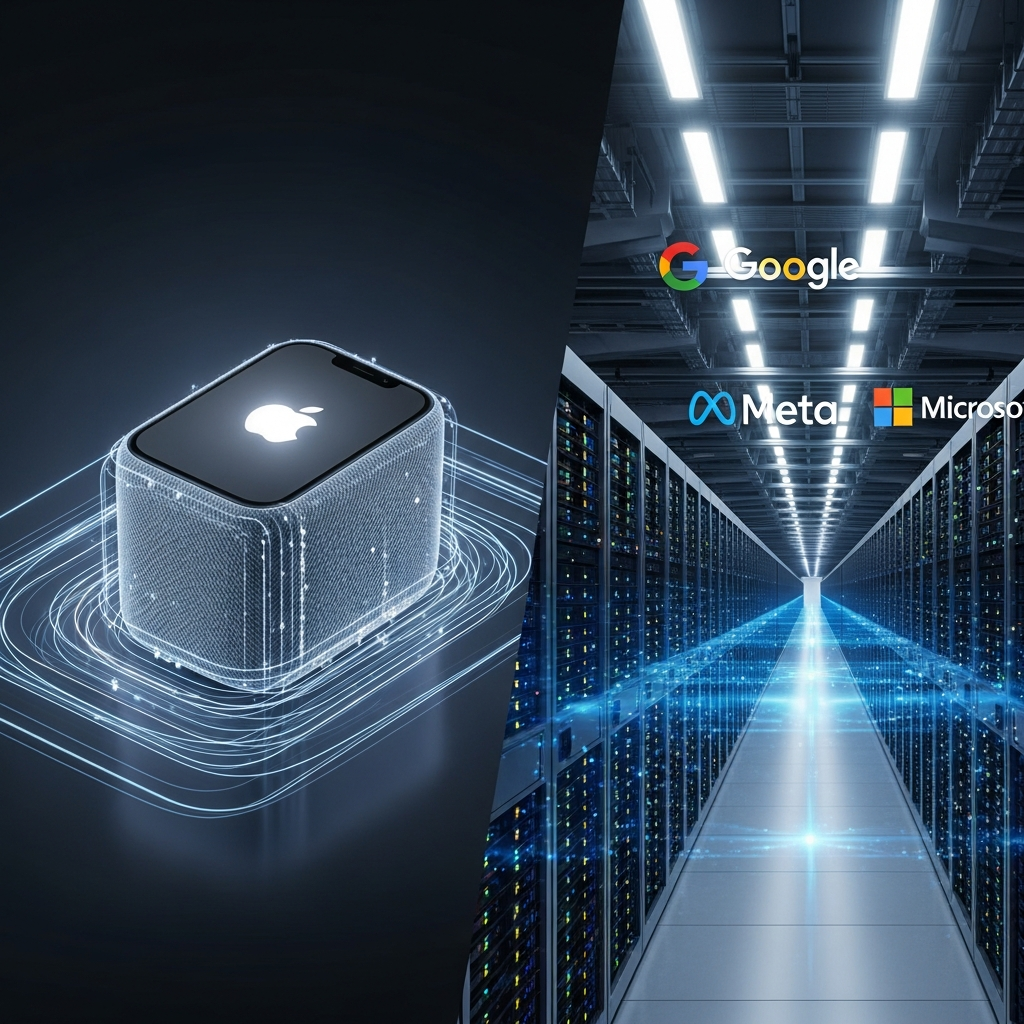
In an era dominated by a fervent artificial intelligence (AI) arms race, where tech giants pour hundreds of billions into infrastructure and model development, Apple has seemingly opted for a different, more subdued path. This seemingly “lazy” approach, characterized by lower capital expenditure and strategic partnerships, is now being hailed by some as a stroke of genius. While competitors like Google, Meta, and Microsoft aggressively build vast AI empires, Apple’s focus on refinement, on-device intelligence, and user experience could offer a sustainable, high-margin alternative, reshaping the future of personal AI.
The High-Stakes AI Arms Race and Its Heavy Toll
The landscape of frontier AI development is marked by unprecedented investment and rapid innovation. Companies like Google, Meta, and Microsoft are locked in a fierce battle, committing colossal sums to data centers, specialized chips, and foundational model research. These hyperscalers are projected to collectively spend over $700 billion on capital expenditures for AI infrastructure in 2026 alone.
Consider Meta Platforms, a prime example of the intense pressure. Its ambitious next-generation AI model, codenamed Avocado, faced a significant delay, pushing its launch from Q1 to at least May or June 2026. Internal tests revealed Avocado lagged significantly behind rivals like Google’s Gemini 3.0 and Anthropic’s Claude in critical areas such as reasoning, coding, and writing. This setback led to a strategic pivot from open-source to a proprietary, closed-source model, aiming for higher profit margins and deeper product integration. However, Meta’s investment remains staggering, with projected capital expenditures for 2026 ranging from $115 billion to $135 billion, a figure that evokes “uncomfortable memories” of its costly metaverse push.
Similarly, Google (Alphabet) is making an unhedged bet on AI, with planned capital expenditure for 2026 projected at a staggering $175 billion to $185 billion. This massive investment underscores its commitment to maintaining leadership in data infrastructure and model quality, epitomized by its Gemini app, which already serves over 750 million monthly active users and processes over 10 billion tokens per minute. The prevailing sentiment among these tech giants is that only immense investment can secure a dominant position in this “winner-take-most market.”
Apple’s Distinctive “Capital-Light” AI Playbook
Against this backdrop of escalating spending, Apple’s strategy appears remarkably restrained. While its rivals collectively plan to spend hundreds of billions, Apple’s projected capital expenditure for AI infrastructure in 2026 is a comparatively modest $14 billion. This stark difference has led many to perceive Apple as lagging in the AI race, yet this perception overlooks a calculated, strategic foresight.
Apple’s approach centers on outsourcing the heavy lifting of foundational AI model development. Instead of building massive, costly server farms, Apple leverages strategic partnerships with industry leaders. It initially collaborated with OpenAI and later shifted to integrating Google’s Gemini model to enhance Siri, prioritizing best-in-class performance and privacy for its users. This flexible model allows Apple to integrate leading third-party technologies and switch providers as AI capabilities evolve, avoiding the immense risks and costs associated with rapidly depreciating proprietary systems. Its rivals, by contrast, face escalating costs in maintaining server farms where expensive GPUs can lose half their value in just 18 months.
Furthermore, Apple emphasizes on-device AI processing through its powerful M-series chips. This hybrid model combines privacy-focused AI running directly on the user’s device with the ability to offload more complex tasks to external, cloud-based partners. This dual approach not only enhances user privacy by processing sensitive data locally but also reduces the company’s reliance on expensive, centralized data centers for every AI query. Apple’s strategy focuses its considerable resources on user experience, seamless integration across its vast ecosystem of devices and services, and the “last mile” of AI delivery—making AI genuinely personal and intuitive for its users.
Why Apple’s Strategy Could Be a Genius Move
Apple’s unconventional AI strategy, often dubbed a “tortoise-and-the-hare” approach, presents several compelling advantages that could yield long-term profitability and market leadership.
Avoiding the Depreciation Trap and Preserving Cash
The rapid pace of AI innovation means that today’s cutting-edge hardware can quickly become obsolete. Investing heavily in proprietary AI infrastructure forces companies into a constant cycle of expensive upgrades. By primarily renting cloud capacity and partnering for foundational models, Apple sidesteps this “depreciation trap.” This financial prudence allows Apple to conserve its substantial cash reserves, reportedly over $130 billion. While rivals drain capital, Apple can return value to shareholders, having distributed $106.1 billion in the last fiscal year, or deploy its cash for strategic acquisitions or further R&D in other areas. This asset-light model echoes historical booms where companies avoiding massive fixed costs often generated superior returns.
Owning the “Personal AI” Layer
The CEO of Intelligent Alpha identifies “personal AI” as the dominant investment theme for 2026 – an AI that knows the user, lives on their device, and acts as an operating layer between them and everything else. Apple possesses a unique and formidable advantage in this domain: ownership of the device layer closest to the user. With an installed base of over 2.5 billion active devices, Apple has an unmatched distribution moat. While Apple Intelligence is still in its early stages, the company’s proven ability to integrate technology seamlessly into its ecosystem, combined with its robust Services segment (which hit an all-time high of $30.01 billion in the same quarter as iPhone’s best-ever performance), positions it strongly to monetize personal AI.
Google, with its superior data infrastructure and model quality (Gemini’s scale), is seen as owning the intelligence layer. However, Apple holds the crucial device layer, which is far harder for Google to replicate. This makes Apple exceptionally well-positioned to “own the layer closest to you,” ultimately determining who wins the personal AI race.
Betting on AI Model Commoditization
A core tenet of Apple’s strategy is the long-term bet that foundational AI models will eventually become interchangeable commodities rather than proprietary competitive moats. If this prediction holds true, then owning vast, expensive infrastructure for model development offers little lasting advantage. Instead, the real value will lie in how these models are integrated, personalized, and delivered to users—areas where Apple excels. By strategically curating external AI models and wrapping them in its renowned privacy, design, and user experience ecosystem, Apple aims for higher margins and a more sustainable business model, avoiding the pitfalls of an overbuilt and potentially commoditized AI infrastructure market.
The Broader AI Ecosystem: Unseen Beneficiaries
While Apple and Google battle for supremacy in personal AI, the massive buildout required for the AI revolution benefits other, less visible players. Infrastructure companies are quietly securing significant long-term contracts. For instance, Vistra has secured a 20-year nuclear Power Purchase Agreement (PPA) with AWS for 1,200 MW and a separate deal with Meta covering over 2,600 MW. Similarly, GE Aerospace reported substantial revenue and a massive backlog, indicating its crucial role. These “contracted cash flows tied directly to the AI buildout” represent a less speculative, yet vital, facet of the smart money’s investment focus, underpinning the entire AI ecosystem.
Risks and Opportunities Ahead
Apple’s strategy isn’t without its risks. A perceived lag in cutting-edge AI features could temporarily impact investor confidence or cede mindshare to faster-moving rivals. Its reliance on external partners for foundational models could also create a dependency, though Apple’s track record suggests it maintains strong negotiating power and can switch partners as needed.
However, the opportunities are substantial. By prioritizing long-term relevance, product quality, and financial prudence over immediate speed, Apple aims to build a deeply integrated, privacy-centric AI experience that resonates with its loyal user base. Its focus on on-device processing via M-series chips promises efficiency and data security, further enhancing user trust. If Apple’s bet on AI model commoditization proves correct, its lean, flexible approach could indeed crush the competition by delivering superior margins and a more sustainable competitive advantage in the burgeoning personal AI market.
Frequently Asked Questions
What defines Apple’s unique AI strategy compared to other tech giants?
Apple’s strategy is notably “capital-light” and focuses on outsourcing the most expensive aspects of foundational AI model development. Unlike rivals like Google and Meta, which invest hundreds of billions in building vast proprietary AI infrastructures, Apple commits a comparatively modest $14 billion in capital expenditure for AI in 2026. Instead, it relies on strategic partnerships (e.g., Google Gemini for Siri) and leverages its powerful M-series chips for efficient, privacy-focused on-device AI processing. This approach prioritizes user experience, seamless integration, and financial prudence over massive direct investment in raw computing power.
How does Apple’s lower AI investment potentially give it a competitive advantage?
Apple’s strategy offers several key advantages. First, it avoids the “depreciation trap” of rapidly obsolete AI hardware, preserving its substantial cash reserves (over $130 billion). This financial flexibility allows Apple to maintain high margins and return value to shareholders. Second, by focusing on integrating best-of-breed external AI models and enhancing on-device intelligence, Apple can concentrate its resources on the user experience and its unmatched distribution moat of 2.5 billion active devices. This positions Apple to “own the layer closest to the user” in the burgeoning “personal AI” market, which some experts believe is the ultimate prize in the AI race.
What is “Personal AI” and how is Apple positioned to lead this segment?
“Personal AI” is defined as an artificial intelligence that deeply knows its user, resides on their device, and acts as an intelligent operating layer between the user and all their digital interactions. It’s envisioned as “the Siri we all wish we had.” Apple is uniquely positioned to lead this segment due to its unparalleled ownership of the device layer and a massive installed base of over 2.5 billion active devices. While Google may lead in underlying data infrastructure and model quality, Apple’s ability to seamlessly integrate AI into its hardware and software ecosystem, prioritizing privacy and user experience, gives it a distinct advantage in delivering a truly personal and intuitive AI experience directly to the consumer.
Conclusion
Apple’s path in the AI revolution may appear understated, but its deliberate, capital-light strategy holds the potential for profound long-term success. By sidestepping the massive capital expenditure arms race and focusing on smart partnerships, on-device innovation, and an unparalleled distribution network, Apple is playing a sophisticated game. This “tortoise-and-the-hare” approach, prioritizing quality and strategic positioning over sheer speed, could ultimately enable Apple to achieve higher margins, stronger user trust, and a more sustainable leadership position in the deeply personal, AI-powered future. Its quiet confidence in curating the best of external AI, integrated flawlessly within its ecosystem, may indeed prove to be a stroke of pure genius.