Golf legend Tiger Woods faces renewed scrutiny after his recent arrest on suspicion of driving under the influence (DUI) following a multi-vehicle rollover crash in Jupiter Island, Florida. The incident, which occurred in late March 2026, has ignited fresh concerns about Woods’s personal well-being and his ongoing pattern of driving-related controversies. Crucially, while Woods registered a 0.00 breathalyzer reading, authorities suspect impairment from medication or another substance, adding a complex layer to the charges. This latest development casts a long shadow over his potential return to competitive golf and reignites discussions about the sport’s unwavering loyalty to its troubled icon.
The Jupiter Island Incident: A Detailed Account of the Crash
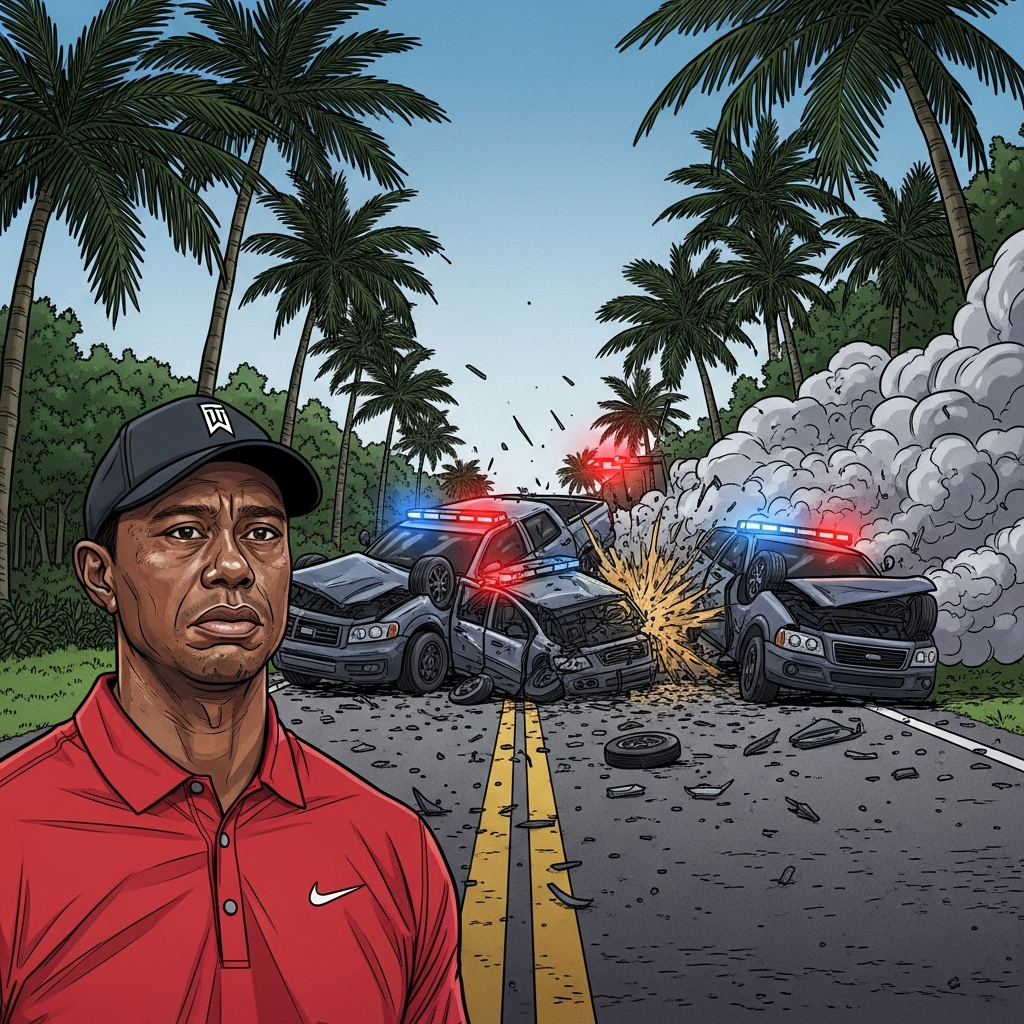
On Friday, March 27, 2026, just before 2 p.m. ET, emergency services responded to a two-car rollover crash on South Beach Road in Jupiter Island, Florida, mere miles from Tiger Woods’s residence. Woods, driving a Land Rover, was involved in a collision with a pickup truck that was pulling a pressure cleaner trailer. According to Martin County Sheriff John Budensiek, the pickup driver observed Woods’s Land Rover “overtaking him at high speeds” from behind. The speed limit on this narrow, two-lane road is 30 mph.
As the pickup attempted to turn into a driveway, moving to the side to avoid a collision, Woods’s Land Rover swerved at the last moment. It clipped the rear end of the trailer, an impact that caused Woods’s vehicle to roll over onto its side. Fortunately, Woods, who was alone in his car, managed to crawl out of the passenger side door. Neither he nor the driver of the pickup truck sustained any injuries, a fact Sheriff Budensiek highlighted, stating the outcome “could have been a lot worse” given the potential for oncoming traffic.
Suspected Impairment and Refusal of Urinalysis
Upon arrival, Jupiter Island police and Martin County deputies noted that Woods exhibited “signs of impairment” and appeared “lethargic” during field tests. Despite these observations, a breathalyzer test administered at the scene registered “triple zeroes,” definitively indicating the absence of alcohol in his system. This immediately shifted the focus of the investigation.
Police quickly suspected impairment from “some kind of medication or drug,” a belief reinforced by a Drug Recognition Expert (DRE) present at the scene. When asked to submit a urine sample for further testing at the Martin County Jail, Woods refused. This refusal is a critical element of the charges, leading to an additional misdemeanor count. Authorities confirmed that no drugs or medication were found inside Woods’s vehicle at the crash site. Woods remained cooperative throughout the process but was reportedly guarded in his statements, choosing not to “incriminate himself.” After spending the standard eight hours in custody for a DUI arrest, he was released on bail later that night.
A Pattern of Peril: Tiger Woods’s Troubling History Behind the Wheel
This recent Jupiter Island crash is not an isolated incident but rather another entry in a concerning sequence of driving-related controversies for the golf icon. The narrative of Tiger Woods’s personal life often features significant car accidents preceding major public revelations or professional setbacks.
His history includes:
May 2017 DUI Arrest (Jupiter, Florida): Woods was found asleep at the wheel of his Mercedes-Benz, partially in the road. A toxicology report later revealed five different prescription medications in his system, including Vicodin, Xanax, Ambien, and THC. He attributed the incident to an “unexpected reaction to prescribed medication.” Ultimately, he pleaded guilty to reckless driving, paid a fine, and entered a diversion program that included DUI school.
February 2021 Rollover Crash (Los Angeles County, California): This severe single-car accident resulted in Woods suffering multiple fractures to his right leg, requiring extensive surgery and the insertion of a rod, screws, and pins. Law enforcement indicated he was traveling at nearly twice the 45 mph speed limit. Despite the severity, no drug tests were administered at the scene, nor was he issued a traffic citation. Woods later offered no “adequate explanation” for the crash, stating it was “all been answered” in the police report.
- November 2009 Fire Hydrant Crash (Orlando Area, Florida): This incident, where his SUV struck a fire hydrant and a tree near his home, notoriously preceded the public unraveling of his personal life. Reports of multiple extramarital affairs soon surfaced, leading to his divorce and a temporary withdrawal from golf.
- www.theguardian.com
- www.usatoday.com
- www.wptv.com
- defector.com
- sports.yahoo.com
These incidents paint a picture of a recurring pattern of vehicle-related mishaps, often coupled with questions of impairment and a lack of clear explanation from Woods himself. The contrast between his 2010 televised mea culpa and his more recent evasiveness has been noted by critics.
Beyond the Green: Golf’s Enduring Allegiance and Its Cost
The latest Tiger Woods DUI arrest comes at a time when the golf world continues to grapple with his waning competitive relevance while paradoxically still placing him “front and centre” in critical roles. The sport’s governing bodies, particularly the PGA of America and the PGA Tour, have faced criticism for their continued allegiance to Woods despite his repeated personal crises and fading presence on the course since his 2021 crash.
Commentators argue that “the post-Tiger world scares the sport’s office bearers,” leading them to grant him undue influence. Despite Woods’s last official PGA Tour event being in July 2024 and his ongoing recovery from multiple injuries—including a ruptured Achilles tendon in March 2025 and lumbar disc replacement surgery in October 2025—he was rumored for the 2026 Masters. He also recently made an appearance at a TGL indoor simulator event, bizarrely billed as a Masters test run.
The PGA of America is reportedly “desperate” for Woods to captain the US Ryder Cup team for a second time, and the PGA Tour has placed him on its board and as chairman of a committee tasked with reshaping its schedule. Critics, however, question his “credentials whatsoever” for leadership roles, citing his individualistic nature as a player and his “dithering” over commitments. There’s a growing sentiment that a network of “yes-men and umbrella holders” around Woods may enable his “depressing” decline, preventing a necessary re-evaluation of golf’s relationship with its troubled idol. This dynamic highlights the complex interplay between sports celebrity, personal struggles, and the commercial interests of an entire industry.
Legal Ramifications and What’s Next for the Golf Icon
Tiger Woods’s refusal to submit to a urine test carries significant legal consequences under Florida law. Under “Trenton’s Law,” effective October 1, 2025, a first refusal to submit to a urine test during a DUI arrest is classified as a second-degree misdemeanor. This offense is punishable by up to 60 days in jail and an automatic driver’s license suspension.
For the DUI charge itself, a first conviction in Florida can lead to imprisonment for up to six months and a fine of up to $1,000, in addition to license suspension. While the 0.00 breathalyzer result might initially seem to weaken the DUI case, the suspicion of impairment from medication or other drugs, coupled with the DRE’s assessment, means prosecutors can still pursue the charge. The legal battle will likely hinge on the evidence of impairment collected at the scene, including field sobriety tests and officer observations, in the absence of a urine test.
Beyond the courtroom, this latest incident casts doubt on Woods’s immediate professional future. His potential participation in the 2026 Masters was already uncertain due to his recent surgeries and lack of competitive play. This new legal entanglement further complicates any comeback plans, potentially impacting his training, focus, and public image. The persistent nature of his off-course issues continues to overshadow his legendary career, fueling discussions about his need for support and accountability for his actions, which risk not only his own health but also the safety of others.
Frequently Asked Questions
What were the specific circumstances of Tiger Woods’ recent DUI arrest in Florida?
Tiger Woods was arrested on March 27, 2026, in Jupiter Island, Florida, following a two-car rollover crash. Driving a Land Rover, Woods attempted to overtake a pickup truck pulling a trailer at high speed, clipping the truck and causing his vehicle to roll onto its side. Authorities noted he showed signs of impairment and was lethargic. While a breathalyzer registered 0.00, indicating no alcohol, police suspected impairment from medication or another drug. Woods was subsequently charged with DUI with property damage and refusal to submit to a lawful urine test.
How does Tiger Woods’ latest incident compare to his previous car-related controversies?
Woods’s March 2026 Florida crash marks his third significant vehicle incident. It follows a severe rollover crash in February 2021 in Los Angeles, which resulted in major leg injuries and was suspected to involve high speed, and a May 2017 DUI arrest in Jupiter where he was found asleep at the wheel with five prescription drugs in his system. His first publicly known crash in November 2009 preceded the revelation of his personal scandal. All incidents raise questions about impairment, vehicle control, and a pattern of behavior that has drawn public concern and scrutiny.
What are the potential legal and professional consequences for Tiger Woods following his refusal of a urine test?
Under Florida’s “Trenton’s Law,” Woods’s refusal to provide a urine sample during a DUI arrest is a second-degree misdemeanor, which can lead to up to 60 days in jail and an automatic driver’s license suspension. For the DUI charge itself, a first conviction carries potential penalties of up to six months in jail and a $1,000 fine, alongside further license suspension. Professionally, this latest legal issue, coupled with his ongoing injury recovery, significantly complicates any plans for a competitive return, including potential Masters participation, and further impacts his public image and the golf world’s perception of his leadership roles.
Conclusion
The latest Tiger Woods DUI arrest in Florida represents a sobering chapter in the life of a golf icon, underscoring a persistent pattern of personal and legal challenges. While the absence of alcohol complicates the driving under the influence charge, the suspicion of drug-related impairment and the refusal of a urine test open new avenues for legal scrutiny and raise serious questions about his well-being. This incident not only threatens his immediate future in golf, including any hopes for a Masters comeback, but also forces the sport to once again confront its complex and often uncritical relationship with its most celebrated, yet increasingly troubled, star. The road ahead for Tiger Woods appears to be fraught with challenges, both in the courtroom and in the public eye.