April ushers in a new season for stargazers, replacing winter’s familiar constellations with fresh celestial wonders. This month promises dazzling displays, from the historic Lyrid meteor shower to potentially bright comets and the brilliant return of Venus. Whether you’re a seasoned astronomer or a casual sky-watcher, prepare to be captivated by the cosmic spectacles unfolding in the April night sky. Our comprehensive guide ensures you won’t miss a single highlight, offering expert tips and key dates for an unforgettable stargazing experience.
Planetary Highlights: A Shifting Skyward Dance
While the full planetary ensemble of winter has retreated, April still offers compelling views of our solar system neighbors. Venus, the brightest planet, makes a spectacular return, beaming low in the western sky shortly after sunset. This “Evening Star” commands attention, shining brilliantly about 20-40 minutes post-sunset and remaining visible through September.
Higher in the southwest, Jupiter holds its ground, providing another prominent target. Together, these two gas giants dominate the early evening show.
For those in mid-northern latitudes, Mars, Saturn, and Mercury present a challenge. They appear in the morning sky, often obscured by the sun’s glare. Catching a glimpse requires precise timing and a clear eastern horizon. Binoculars can certainly aid in spotting these elusive morning planets.
Stellar Storylines: Constellations and Bright Stars
As spring progresses, the celestial tapestry evolves. Orion the Hunter, a winter favorite, gracefully dips westward, preparing its exit from the evening sky by May. Taking center stage is Leo the Lion, now standing high in the southern sky as darkness falls. Its distinct sickle shape is easy to identify.
In the northeast, Vega, the radiant leader of the Summer Triangle asterism, makes its annual debut around 10 p.m. local time. While still low in the April sky, its light often appears to twinkle vigorously. This atmospheric phenomenon occurs as Vega’s light battles through the thicker, turbulent air near the horizon, causing it to shimmer and dance.
Featuring Canes Venatici: The Hunting Dogs
Our featured constellation for April is Canes Venatici (pronounced KAY-nees veh-NAT-uh-see), the Hunting Dogs. This relatively modern constellation, established by Polish astronomer Johannes Hevelius in 1687, forms a unique part of the northern sky. It’s often depicted as a pair of leashed greyhounds, playfully jumping and snapping at Ursa Major, the Great Bear, yet held in check by the neighboring constellation Boötes the Herdsman.
Finding Canes Venatici is straightforward. Look for it just below the end of the Big Dipper’s handle. Comprising only two bright stars, Cor Caroli and Chara, it’s a modest yet charming addition to the April night sky. Binoculars can help resolve Cor Caroli, a beautiful double star.
The Lyrid Meteor Shower: An Ancient Spectacle
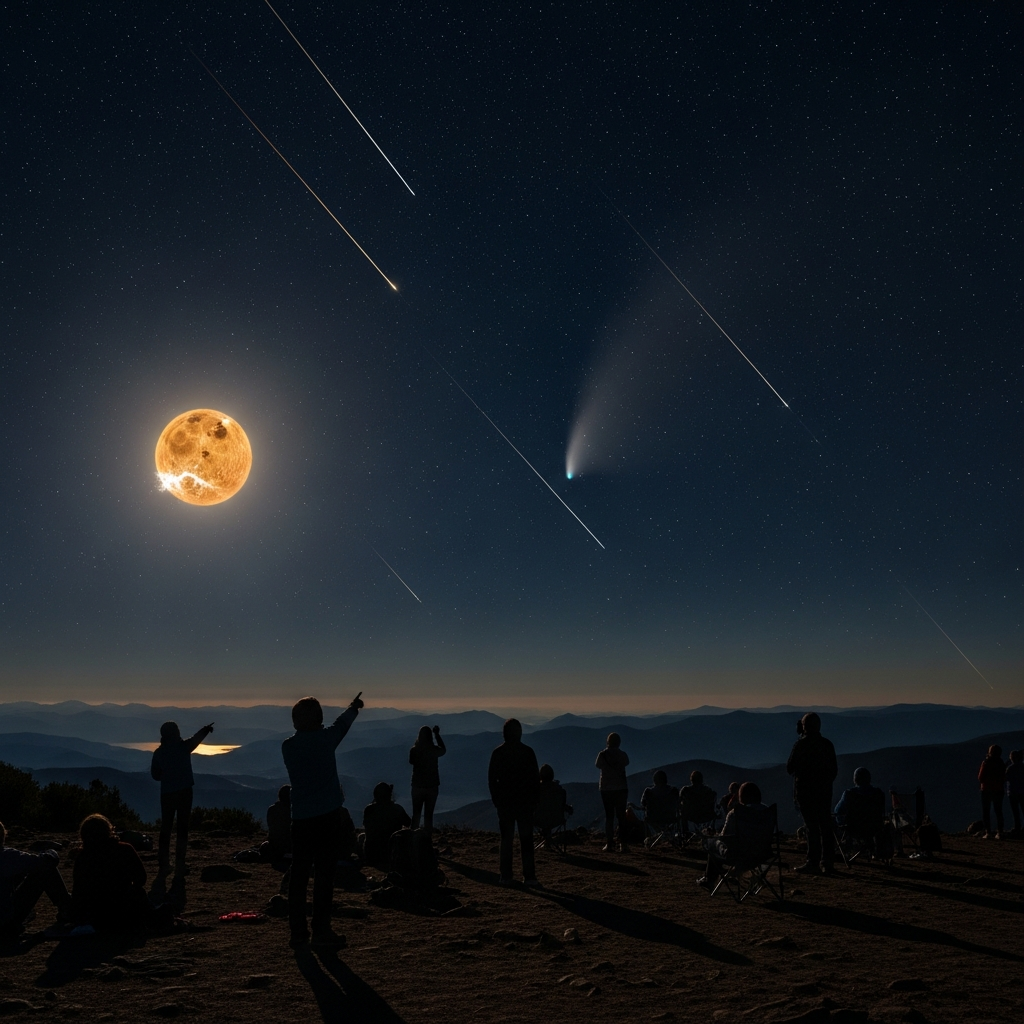
April brings the annual Lyrid meteor shower, a celestial event with a rich history stretching back over 2,700 years. Ancient Chinese astronomers recorded “stars fell like rain” in 687 BC, marking the Lyrids as the oldest continuously observed meteor shower. This year, the Lyrids promise an excellent show, peaking on the mornings of April 22 and 23.
The shower’s radiant point lies just west of the bright star Vega, in the constellation Lyra the Harp. Under dark, moonless conditions, observers can expect to see 15-20 meteors per hour. A significant advantage for 2026 is the dark sky during peak viewing hours, as the first quarter moon falls on April 24, minimizing interference. While typically a modest shower, the Lyrids are known for rare “outbursts,” occasionally producing up to 100 meteors per hour, though a rate of one every five minutes is more common. The next major outburst isn’t anticipated until 2042.
Maximizing Your Lyrid Viewing Experience
To make the most of this historic event:
Optimal Time: The best viewing window is between 1 a.m. and 4 a.m. local time on April 22 and 23. During these hours, Vega and the radiant will be highest in the southeastern sky.
Dark Skies: Seek a location far from city lights. Light pollution severely diminishes meteor visibility.
Comfort is Key: Dress warmly, bring a blanket, and use a reclining lounge chair. Staring straight up can be tiring.
Wide Field of View: No special equipment is needed. Your naked eye provides the widest field of view. Look generally towards the southeast or north, keeping Vega in your peripheral vision.
Identifying Lyrids: Trace meteor trails backward; true Lyrids will appear to originate from near Vega.
Unique Characteristics: Look for persistent trains, glowing trails that can linger for a few seconds, and exceptionally bright fireballs – both hallmarks of Lyrid activity.
These meteors are tiny fragments of Comet Thatcher (C/1861 G1), which Earth intersects annually. Discovered in 1861, Comet Thatcher has an orbital period of about 415 years, meaning its next return won’t be until around 2276. The yearly Lyrid shower is our spectacular consolation prize.
Comets Gracing Our Skies: Two Potential Wonders
April also presents an exciting opportunity to spot two potentially bright comets. Comets are notoriously unpredictable, so vigilance and up-to-date information are key.
Comet MAPS (C/2026 A1)
Comet MAPS could become a naked-eye object, displaying a long, bright tail if it successfully survives its perilous close solar passage on April 4. While southern hemisphere observers might have the best views, those in mid-northern latitudes can look for it low in the western sky about 20-30 minutes after sunset. The prime viewing window is approximately April 6-10. Even if visible to the unaided eye, binoculars are highly recommended for a clearer view.
Comet PanSTARRS (C/2025 R3)
Named after the automated telescopic survey that discovered it, Comet PanSTARRS (C/2025 R3) will be visible low in the eastern sky near the Great Square of Pegasus. Look for it at the start of dawn, from approximately April 10-19. Like Comet MAPS, PanSTARRS might be a naked-eye object, but binoculars will significantly enhance the experience, revealing more detail.
April’s Celestial Calendar: Don’t Miss These Dates!
Beyond the Lyrids and comets, the April night sky is packed with other captivating events. Mark your calendar for these key dates:
April 1: Full Pink Moon. Named for the moss pink flower (mountain phlox), this full moon rises around sunset and illuminates the entire night.
April 3-11: China’s Tiangong Space Station passes across the southern sky during evening twilight. It appears like a bright star, though generally fainter than the ISS. Use resources like Heavens-Above.com to find specific flyover times for your location.
April 9: Last Quarter Moon. Rises around 1 a.m., reaching its highest point in the south at sunrise.
April 17: New Moon. The moon is near the sun and not visible, offering ideal dark skies for deep-sky observations.
April 18: Silver Crescent Moon with Venus. Look low in the northwestern sky at dusk to see a slender lunar crescent shining to the right of brilliant Venus.
April 19-30: International Space Station (ISS) Flyovers. The ISS makes morning twilight passes. NASA’s Spot the Station app or Heavens-Above.com provides accurate local schedules.
April 22: Moon and Jupiter Conjunction. A waxing lunar crescent stands directly above Jupiter. Gemini’s brightest stars, Castor and Pollux, also appear above the moon, creating a beautiful tableau.
April 23: Half-Moon near the Beehive Cluster. The half-moon shines a few degrees right (west) of the Beehive star cluster (Messier 44) in the constellation Cancer. Binoculars will bring both into the same field of view.
April 23-25: Venus and the Pleiades. Over these three nights, Venus inches within a few degrees of the stunning Pleiades star cluster. This pairing creates an eye-catching sight low in the northwestern sky at dusk, especially through binoculars.
April 25: Moon Occults Regulus. A very close conjunction of the waxing gibbous moon and Regulus, Leo’s brightest star. From many Eastern Time Zone locations, the moon will actually cover (occult) the star. For specific timings in Universal Time (UT), consult specialized lunar occultation prediction sites, remembering to adjust for your local time zone.
April 30: Moon and Spica. A nearly full moon shines just to the right of Spica, Virgo’s brightest star.
Essential Stargazing Tools & Resources
To enhance your exploration of the April night sky, consider these valuable resources:
Mobile Apps: Download the free Stellarium Mobile app for Android and iPhone. It acts as a portable planetarium, helping you identify planets, stars, and constellations. Remember to use its night mode (red screen) to preserve your night vision.
Online Sky Maps: For a free, printable sky map and calendar, visit reputable astronomy websites.
Space Station Trackers: Use Heavens-Above.com or NASA’s “Spot the Station” app for precise flyover times for the Tiangong and ISS.
- Expert Updates: Follow trusted astronomy communicators for the latest news on comet activity and other breaking celestial events.
- www.duluthnewstribune.com
- www.duluthnewstribune.com
- www.duluthnewstribune.com
- earthsky.org
- www.brainerddispatch.com
Frequently Asked Questions
What makes the Lyrid meteor shower special this April?
The Lyrid meteor shower, peaking on April 22-23, 2026, holds historical significance as the oldest continuously recorded meteor shower, with observations dating back over 2,700 years. This April offers exceptional viewing conditions due to a dark, moonless sky during peak hours. Expect to see 15-20 meteors per hour from dark locations, with the possibility of bright fireballs and lingering “persistent trains.” The shower is caused by debris from Comet Thatcher, which Earth passes through annually.
Where can I find reliable tools and maps for April stargazing?
Several excellent resources are available to help you navigate the April night sky. For interactive guidance, download the free Stellarium Mobile app for Android and iPhone; it acts as a portable planetarium. Websites like Heavens-Above.com offer precise schedules for space station flyovers specific to your location. For general sky maps and calendars, search for reputable astronomy sites that provide free downloads. These tools are invaluable for identifying planets, constellations, and tracking celestial events.
What equipment is recommended for viewing April’s celestial events?
While many events in the April night sky, such as the Lyrid meteor shower and bright planets like Venus and Jupiter, are visible with the naked eye, binoculars are highly recommended. Binoculars can enhance views of comets (MAPS and PanSTARRS), reveal details in the moon’s surface, and bring fainter star clusters like the Beehive into focus. For pinpointing objects and preserving night vision, consider using a red-light headlamp. Most importantly, seek out a dark sky location away from light pollution for the best experience.
Embrace the Sparkle of April Nights
April truly lives up to its promise of adding sparkle to our nights. From the consistent brilliance of Venus and Jupiter to the ancient spectacle of the Lyrid meteor shower and the intriguing possibility of bright comets, there’s an abundance of wonder awaiting your gaze. Take advantage of the clear, dark skies, especially during the Lyrid peak. Step outside, look up, and connect with the vast, mesmerizing beauty of the cosmos. The April night sky offers a perfect opportunity to explore the universe from your own backyard.