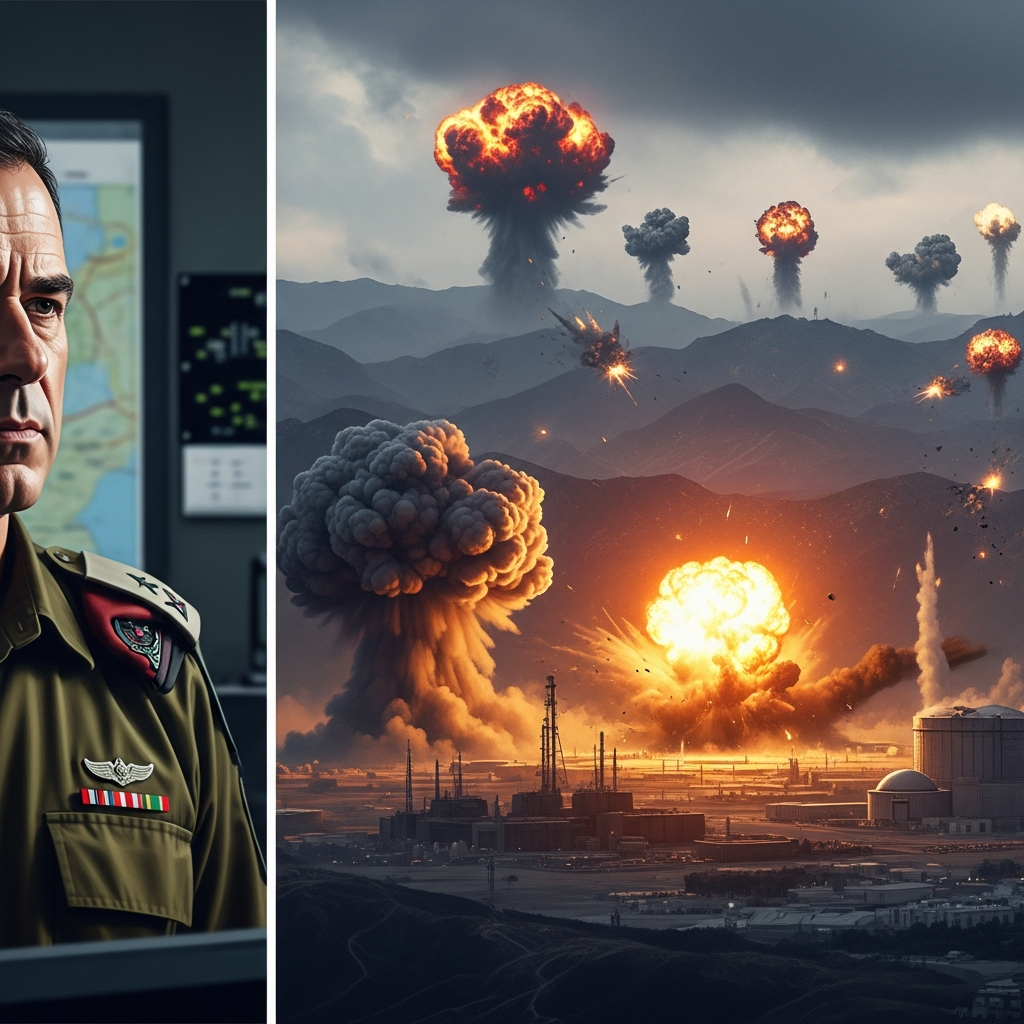
The Middle East is gripped by a significant escalation as Israel launches a wave of decisive military strikes against both Iran and its proxy, Hezbollah. These operations, explicitly approved by IDF Chief of Staff Lt.-Gen. Eyal Zamir, mark a critical moment in the ongoing regional conflict. Recent Israeli military strikes have targeted key Iranian strategic assets, including facilities linked to nuclear weapons development in Tehran, alongside extensive operations against Hezbollah in Lebanon. This aggressive response follows a period of intense Iranian ballistic missile attacks that inflicted substantial civilian casualties within Israel.
The current escalation paints a stark picture of a multi-front war, underscoring Israel’s commitment to protecting its citizens and neutralizing threats. With explicit backing from the United States, these actions signal a broader strategy aimed at degrading hostile capabilities and reasserting regional deterrence.
Immediate Retaliation: Targeting Tehran’s Nuclear Ambitions
In a highly strategic move, the Israel Air Force (IAF) executed a precise strike on a critical research and development (R&D) facility in Tehran. This facility, located within the Malek-Ashtar University, was identified as being used by the Iranian regime to develop both nuclear weapons components and ballistic missiles. The operation, carried out on Saturday, March 21, 2026, directly addresses Israel’s long-standing concerns regarding Iran’s nuclear program and missile capabilities. This precision strike underscores Israel’s resolve to prevent Iran from acquiring or advancing its strategic weapons technology. Such a high-value target in Tehran signals Israel’s deep intelligence capabilities and its willingness to directly confront threats at their source.
The Triggers: Iranian Aggression and Civilian Casualties
The catalyst for this latest wave of Israeli military strikes was a series of recent, devastating Iranian ballistic missile attacks on southern Israeli cities. These attacks caused widespread injury and fear among the civilian population. Specifically, Iranian missiles struck Arad and Dimona, leading to significant casualties. At least 84 individuals were wounded in Arad, while an additional 78 sustained injuries across multiple impact sites in Dimona. The severity of these bombardments is highlighted by imagery from March 21, 2026, showing the aftermath of a missile hitting an apartment building in Arad. This direct targeting of civilian areas by Iran prompted Israel’s swift and comprehensive retaliatory measures.
Beyond Tehran: Crippling Iran’s Repression and Ballistic Capabilities
The scope of Israel’s response extends far beyond the strike in Tehran, encompassing a wider campaign against Iran’s internal security and military infrastructure. As part of “Operation Roaring Lion,” initiated on February 28, Israel, with U.S. support under “Operation Epic Fury,” has focused on dismantling elements of Iran’s internal security forces. These forces, including the Basij militia, have been responsible for years of “terror activities” and “brutal repression” of internal protests.
In Ilam province, a western region of Iran known for anti-regime demonstrations, Israeli Air Force jets struck numerous targets. These included:
Local headquarters of Tehran’s internal security forces.
Barracks of a special forces unit.
An office of the regime’s Intelligence Ministry.
An IRGC command center for protest suppression battalions.
- Various Basij and IRGC infrastructures vital for regime control.
- www.jpost.com
- www.jpost.com
- www.ynetnews.com
- www.jns.org
- www.ynetnews.com
The goal is to degrade Tehran’s ability to use “severe violence, mass arrests, and force against civilian demonstrators.” The IDF also reported eliminating Iranian operatives in western Iran preparing to launch suicide UAVs towards Israeli territory, alongside ongoing efforts to dismantle ballistic missile infrastructure. This joint Israeli-U.S. effort has been framed as a “historic war for liberty” against the “tyrants of Tehran,” aiming to create conditions for the Iranian people to “grasp their destiny.”
Hezbollah in the Crosshairs: Strikes in Lebanon
Simultaneously, Israeli military strikes have intensified significantly against Hezbollah targets in Lebanon. The IDF has conducted extensive raids on Hezbollah hideouts in southern Lebanon, resulting in the elimination of terrorists and the seizure of weapons, including rockets. Notably, a wave of strikes targeted Hezbollah infrastructure in Beirut’s Dahieh district, a known stronghold for the group. Reports indicate at least one strike hit a building near the Lebanese government headquarters.
These operations have dramatically impacted the Lebanese civilian population, with the Lebanese Health Ministry reporting 687 fatalities in Israeli strikes since March 2. Amidst these intensified operations, the IDF issued an immediate evacuation order for all areas in southern Lebanon south of the Zahrani River, leading to widespread displacement and massive traffic jams as residents fled. Lieutenant General Zamir confirmed the elimination of the commander of the Imam Hussein Division, his deputy, and many staff officers, signifying a major blow to Hezbollah’s leadership.
A War for Regime Change? The Broader Context
The current military escalation is framed within a much larger and more ambitious strategic context. Operations “Roaring Lion” and “Epic Fury” were reportedly launched with the stated aim of creating conditions for “regime change” in Iran. This objective is underscored by significant internal developments within Iran, including the reported death of Ayatollah Ali Khamenei, Iran’s defense minister, and several IRGC generals in a Tehran bunker during a major Israeli aerial attack on February 28. Furthermore, the elimination of Ali Larijani, described as Iran’s “de facto leader,” has reportedly created a leadership vacuum within Iran.
In an unprecedented shift, Israel’s security forces, the IDF and Mossad, have received directives authorizing them to eliminate senior figures in Iran or Hezbollah without prior approval from the prime minister or defense minister. This reflects a need for immediate action in a rapidly evolving intelligence environment. U.S. President Donald Trump’s administration has explicitly backed these efforts, reportedly “deepening their involvement” in the conflict.
Regional and International Repercussions
The far-reaching implications of this conflict extend across the region and beyond. Saudi Arabia has escalated diplomatically, expelling an Iranian military attaché and warning that continued Iranian attacks would lead to “further escalation” with “significant consequences.” The Strait of Hormuz remains a critical flashpoint, with former U.S. President Donald Trump issuing a severe ultimatum to Iran, threatening to “obliterate” its power plants if the strait is not “FULLY OPEN, WITHOUT THREAT.”
Earlier, a Patriot missile reportedly exploded over homes in Bahrain, injuring 32 people, including children, an incident both Bahrain and Washington attributed to an Iranian drone attack. These events highlight the potential for wider regional destabilization and underscore the high stakes involved for international shipping and energy markets.
Navigating a Prolonged Conflict
IDF Chief of Staff Lt.-Gen. Eyal Zamir has made it clear that this “campaign will not be short.” He has committed to reinforcing the northern sector with additional forces and capabilities, vowing to continue operations with “great force.” Zamir characterized the ongoing situation as a “multi-front war” against Iran and its proxies, emphasizing that “Every blow to Iran weakens all of its proxies,” and that the war against Hezbollah is a “main arena, not a secondary one.”
Despite the intensity, Zamir highlighted the success of Israeli defenses, noting that out of hundreds of rockets fired in a recent barrage, only two struck Israeli territory. He also publicly took responsibility for any communication missteps with residents following previous rocket attacks, reaffirming the IDF’s commitment to citizen safety. The conflict is projected to continue for “several more weeks,” with continuous efforts to defend Israeli citizens from all threats.
Frequently Asked Questions
What sparked the latest wave of Israeli military strikes against Iran and Hezbollah?
The recent wave of Israeli military strikes was directly triggered by a series of Iranian ballistic missile attacks on southern Israeli cities, including Arad and Dimona, which resulted in nearly 200 civilian casualties. This aggressive act prompted Israel’s comprehensive retaliatory response, alongside ongoing efforts to degrade Iran’s nuclear and ballistic missile programs and counter Hezbollah’s aggression from Lebanon.
Where specifically have Israel’s recent military operations targeted in Iran and Lebanon?
In Iran, Israel strikes Iran focused on a crucial R&D facility in Tehran (Malek-Ashtar University) linked to nuclear weapons components, and various internal security and military infrastructure targets in Ilam province as part of “Operation Roaring Lion.” In Lebanon, operations have targeted Hezbollah hideouts in the south, extensive terror infrastructure in Beirut’s Dahieh district, and key commanders within the organization.
What are the potential broader implications of this escalating conflict for regional stability?
This escalating conflict carries significant regional and international implications. With the explicit goal of “regime change” in Iran stated by Israeli and U.S. officials, and direct strikes on sovereign territories, the potential for wider destabilization is high. The involvement of the U.S., Saudi Arabia’s diplomatic warnings, and threats regarding the Strait of Hormuz indicate a heightened risk of broader regional conflict affecting international trade, energy markets, and alliances. The conflict is projected to continue for “several more weeks,” maintaining high tension across the Middle East.
Conclusion
The current surge in Israeli military strikes against Iran and Hezbollah represents a dramatic and potentially transformative phase in the ongoing regional conflict. Fueled by Iranian aggression and the desire to dismantle strategic threats, Israel’s actions, supported by the U.S., target critical infrastructure and leadership figures. As the IDF Chief of Staff indicates, this “multi-front war” is far from over, signaling a prolonged period of heightened tension and military engagement. The world watches closely as the strategic landscape of the Middle East continues to be reshaped by these profound and impactful developments.