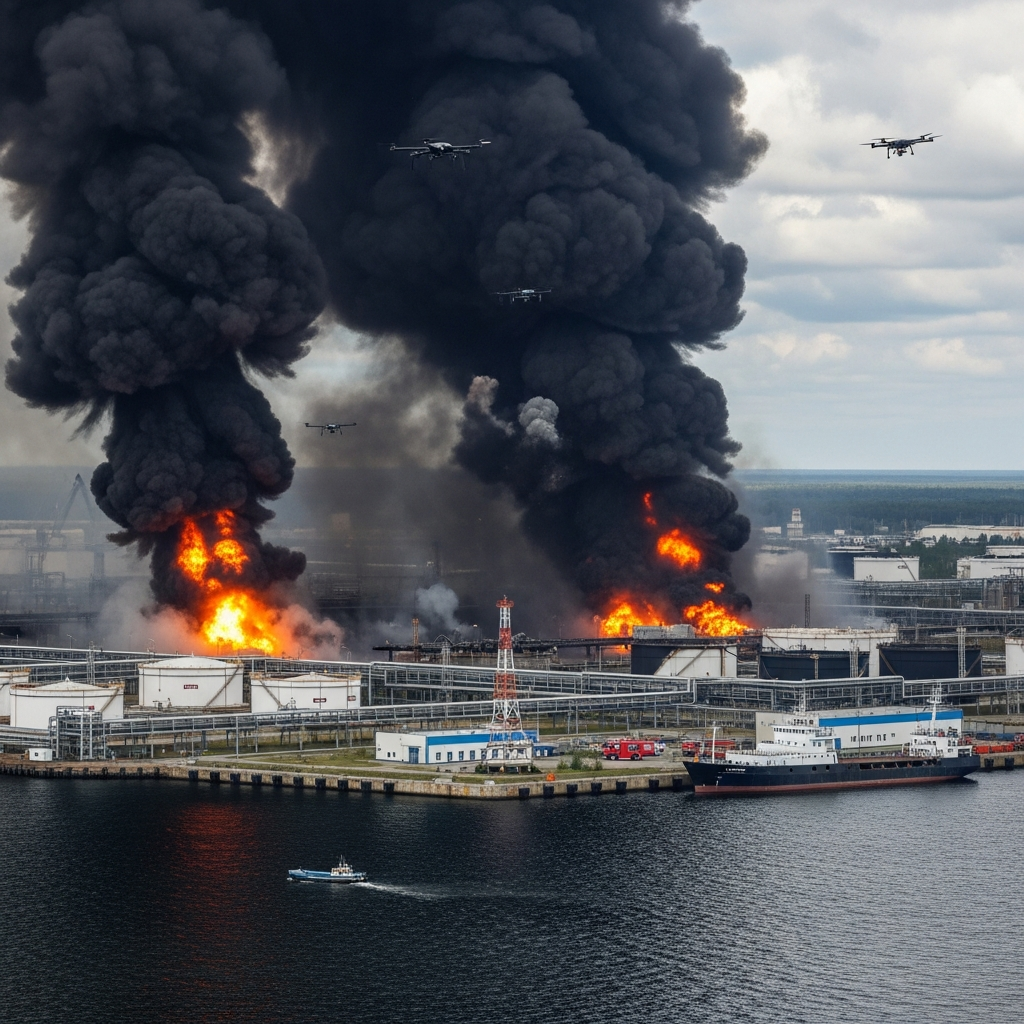
Ukraine has significantly escalated its economic warfare against Russia, launching a series of sophisticated drone attacks on critical oil infrastructure in Russia’s Leningrad region. These calculated strikes, primarily targeting vital Baltic Sea ports like Primorsk and Ust-Luga, aim to undermine Moscow’s ability to fund its ongoing war efforts. Kyiv’s strategy, while potent, navigates a complex geopolitical landscape, balancing direct hits to Russia’s finances with potential diplomatic friction among Western allies. This high-stakes campaign marks a critical evolution in Ukraine’s defensive posture, seeking to impose substantial financial costs on the Kremlin.
Ukraine’s Bold Strategy: Striking Russia’s Oil Lifeline
In recent weeks, Ukrainian forces have unleashed a barrage of long-range drone attacks deep within Russian territory. These assaults primarily focused on key oil export terminals situated along the Baltic Sea. The targets, including the vital Primorsk and Ust-Luga ports, represent a direct challenge to Russia’s economic stability. Satellite imagery and local reports confirm significant damage, with some facilities burning for days after the strikes.
The port of Primorsk, Russia’s largest oil export hub on the Baltic Sea, handles a staggering 60 million tons of oil annually. A March 23 strike, confirmed by Ukraine’s General Staff, hit a Transneft oil terminal there, causing a fire and damaging both a fuel tank and oil-loading infrastructure. Reports indicated at least four tanks were ablaze. Similarly, the Ust-Luga port, another major terminal, also suffered damage. These facilities, located over 1,000 kilometers from Ukrainian borders, underscore Kyiv’s rapidly advancing drone capabilities and willingness to strike far beyond conventional front lines.
A Strategic Shift in Economic Warfare
Experts highlight these recent drone operations as a deliberate strategic pivot by Ukraine. Initially, Ukrainian drone attacks focused on targets closer to the border and within the Black Sea region. The primary goal was often to disrupt domestic fuel production. However, the new focus on major export terminals signifies a crucial shift. Will Kingston-Cox, a Russia specialist, notes that these strikes now target “the routes through which Russia monetizes its hydrocarbons internationally.” This means directly impacting Russia’s foreign currency earnings, a vital source for its war chest.
Huseyn Aliyev, an expert on the war in Ukraine, explains this evolution as a “natural progression” of Ukraine’s strategy. As drone technology improved in capacity and range over the past six months, Kyiv gained the ability to strike deeper. This tactical change aims to inflict maximum financial pain where Russia is most vulnerable: its oil export revenues, which account for roughly 30% of its overall oil exports through these Baltic terminals alone.
Global Geopolitics and Russia’s Vulnerability
The timing of Ukraine’s intensified strikes is no accident; it coincides with a volatile global energy market. The ongoing conflict in the Middle East, particularly the instability around the Strait of Hormuz, has significantly boosted global oil demand and prices. This situation ironically presented an opportunity for Russia. Despite international sanctions, a 30-day waiver issued by the United States allowed Moscow to capitalize on the higher prices. Agata Loskot-Strachota, a European energy specialist, explains this development as “completely contrary to Ukraine’s interests.”
Facing a situation where external economic pressure on Russia was weakening, Ukraine opted to create its own military-economic leverage. By using relatively low-cost drones, Kyiv can inflict high-value damage on Russia’s critical energy infrastructure. This “economically intelligent” approach, as Kingston-Cox describes it, hits the Kremlin directly in its wallet. It demonstrates Ukraine’s resolve to continue fighting Russia on all fronts, including the economic one, even when geopolitical currents seem to favor Moscow.
Russia’s Exposed Energy Hubs
The concentration of Russia’s crucial oil infrastructure in its western European part is a legacy of the Soviet era. At that time, Western Europe served as Russia’s primary market for energy supplies. Jeff Hawn, a Russia specialist at the London School of Economics, points out that this historical distribution makes these facilities particularly sensitive and vulnerable today. The Primorsk and Ust-Luga ports became main terminals due to this inherited infrastructure. Russia has become heavily reliant on its oil industry to sustain its ongoing military campaign. Targeting these established, critical export channels directly threatens this crucial funding source.
Navigating the Diplomatic Minefield
Ukraine’s aggressive targeting of Russian oil infrastructure, while strategically sound for Kyiv, does not come without diplomatic complications. Ukrainian President Volodymyr Zelensky himself admitted receiving “signals” from certain allies to scale back these long-range strikes. The concern among European partners is understandable. Even as Europe works to phase out Russian oil, the global oil market remains interconnected. Any significant disruption to Russia’s export capacity tightens the worldwide supply. This, in turn, can lead to higher prices at the pump for Western consumers, creating unwelcome economic pressure.
Loskot-Strachota emphasizes this intricate balance: “It was a bit of a gamble” for Ukraine. Western governments face a dilemma. They support Ukraine’s defense but also need to manage their own economies and energy security. Russia’s capacity to repair damaged infrastructure, coupled with the operations of its “phantom fleet” – aging cargo ships used to circumvent sanctions – further complicates the picture. These vessels often depart from the very Baltic Sea ports Ukraine is now targeting.
Balancing Impact with Alliance Cohesion
The situation highlights a broader challenge for NATO and European nations. Russia itself has engaged in a widening campaign of “grey zone” sabotage and disruption across Europe, operating below the threshold of open warfare. This hybrid warfare, or gibridnaya voyna, exploits vulnerabilities in critical infrastructure like energy, submarine cables, and rail networks. Attacks on undersea cables in the Baltic Sea, suspected to involve Russia’s shadow fleet, illustrate this. While Ukraine’s drone strikes differ in nature, they share a characteristic of operating in a contested space that generates international sensitivity and forces allies to consider complex escalatory ladders.
Experts like Charlie Edwards from the IISS and Dr. Daniela Richterová from King’s College London point out that critical infrastructure across Europe is vulnerable due to age, upkeep, and fragmented ownership. This context makes any actions that could further destabilize global energy markets or critical infrastructure a delicate issue for Ukraine’s allies. Kyiv must continuously weigh the military and economic advantages of its strikes against the potential for alienating key international supporters.
Measuring the Impact and Future Prospects
The true economic impact of Ukraine’s Baltic Sea strikes remains to be fully assessed. While some immediate damage has been confirmed, Russia’s capacity for rapid repairs, as evidenced by the partial resumption of activity at Primorsk, will be a critical factor. For these strikes to have a lasting cripple effect on Russia’s oil export capacity, Ukraine would likely need to sustain and intensify its campaign.
However, such an escalation brings increased diplomatic pressure from its Western allies, who are wary of the wider economic repercussions. The ongoing battle is not just on the ground or in the air, but also in the realm of international finance and diplomacy. Ukraine’s ability to “get away with” continuing these strikes without significant pushback from its Western partners will ultimately determine their long-term effectiveness. This evolving economic front is a crucial component of the broader conflict, demonstrating innovation and adaptation from both sides.
Frequently Asked Questions
What are Ukraine’s main targets in Russia’s oil sector and why?
Ukraine primarily targets Russia’s major oil export terminals on the Baltic Sea, specifically the ports of Primorsk and Ust-Luga. These facilities are crucial because they handle approximately 30% of Russia’s total oil exports and contribute significantly to the country’s war funding. By striking these export hubs, Ukraine aims to directly undermine Russia’s ability to monetize its hydrocarbons internationally, thereby crippling its financial capacity to sustain the war effort rather than just disrupting domestic fuel supplies.
How do global events, like the Middle East conflict, influence Ukraine’s oil strike strategy?
Global events significantly shape Ukraine’s strategy. The ongoing Middle East conflict and instability around the Strait of Hormuz have driven up international oil prices. This increase allows Russia to earn more from its oil exports, even under sanctions. Recognizing this, and after a U.S. waiver allowed Russia to sell some oil, Ukraine intensified its Baltic Sea strikes. This serves as Kyiv’s way of creating “military economic pressure” to counteract the global market situation that was otherwise benefiting Moscow.
What are the diplomatic risks for Ukraine from these deep oil strikes?
Ukraine faces significant diplomatic risks from its deep strikes on Russian oil infrastructure. President Zelensky confirmed receiving “signals” from allies to reduce these attacks. European countries are concerned that further disruptions to Russia’s oil export capacity could tighten the global oil supply, leading to higher prices for consumers worldwide. This creates a delicate balance for Western allies who support Ukraine but also need to manage their own energy security and economic stability, potentially leading to friction within the alliance.
Conclusion
Ukraine’s strategic drone campaign against Russia’s Baltic Sea oil infrastructure represents a bold and innovative approach to economic warfare. By targeting the very arteries that finance Moscow’s aggression, Kyiv seeks to impose a tangible cost on its adversary. This calculated gamble, however, unfolds on a complex global stage, where the pursuit of military advantage intertwines with delicate diplomatic considerations and the unpredictable dynamics of international energy markets. As the conflict evolves, Ukraine’s capacity to sustain these impactful strikes while maintaining allied cohesion will be paramount in shaping the future trajectory of the war and its broader geopolitical implications.