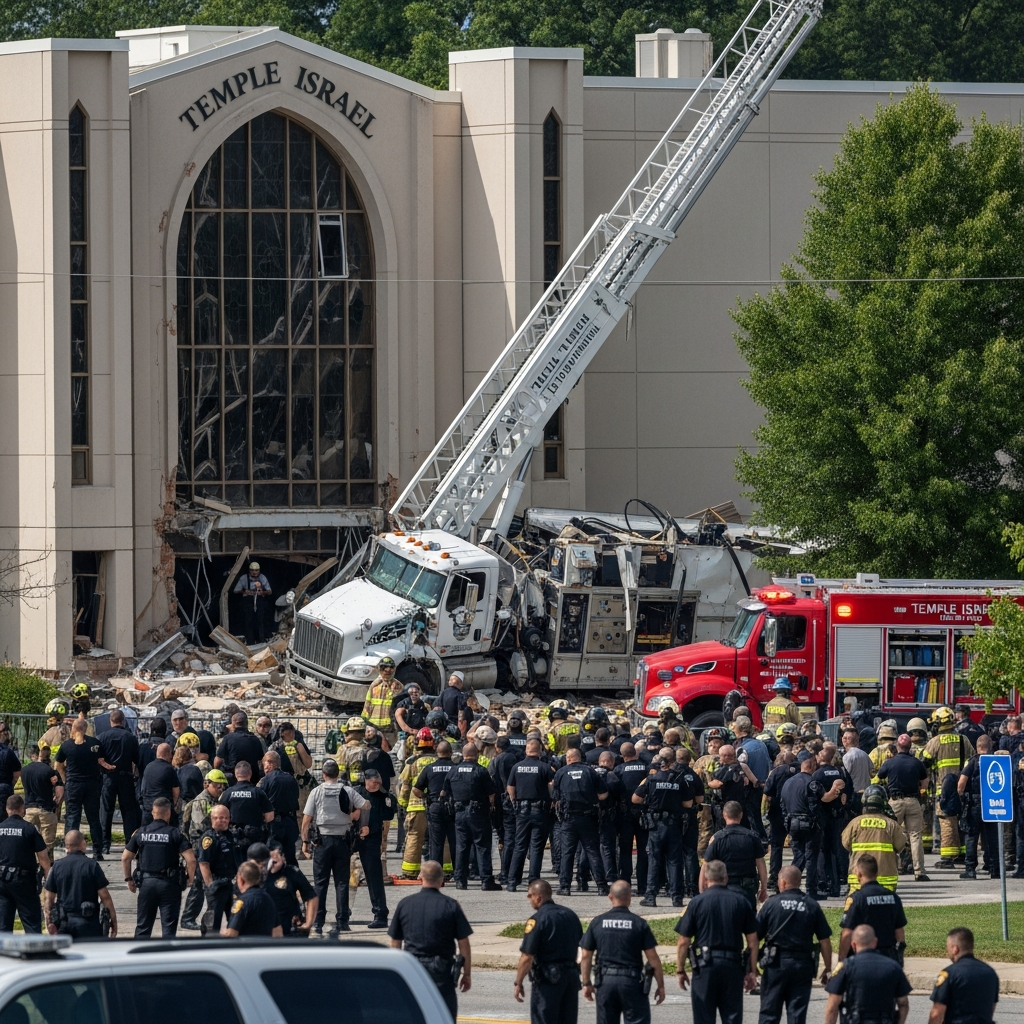
On March 12, 2026, a shocking incident unfolded at Temple Israel in West Bloomfield, Michigan, when a truck rammed into the synagogue building, followed by gunfire. This comprehensive report delves into the critical moments of the West Bloomfield synagogue attack, detailing the swift and courageous actions of security personnel and an unprecedented law enforcement response that ultimately averted a catastrophic loss of life. Discover how pre-emptive training and immediate reactions were pivotal in safeguarding hundreds during this targeted act of violence against the Jewish community.
Attack Unfolds: Vehicle Ramming and Gunfire at Temple Israel
Early Thursday afternoon on March 12, 2026, the serenity of Temple Israel, a prominent Jewish synagogue located at 5725 Walnut Lake Road in West Bloomfield Township, was shattered. An assailant, identified as Ayman Mohamad Ghazali, 41, intentionally drove a truck through the front entrance, penetrating approximately 40 feet into the facility. This deliberate act immediately plunged the community into an active threat scenario. Police sources quickly identified it as an “active shooting incident” as shots were fired following the crash.
The vehicle, after its forceful entry, caught fire, sending plumes of smoke billowing from the building. The fire quickly intensified, leading to significant damage and creating a perilous environment inside the synagogue. At the time of the attack, the temple’s Early Childhood Center, which enrolls 140 students, was in session, creating an immediate and grave concern for the safety of children and staff.
Heroic Response: Security Thwarts Greater Tragedy
In a testament to rigorous preparation and courage, the on-site security personnel at Temple Israel responded with extraordinary bravery. As the assailant drove the truck inside and engaged in gunfire, security guards engaged him directly. One security guard was tragically struck by the vehicle, sustaining a non-life-threatening injury that required hospitalization. However, their prompt and decisive actions were critical. The assailant was shot and killed inside the vehicle, with authorities later confirming one fatality—that of the attacker—at the scene.
This rapid neutralization of the threat was crucial. Despite the intensity of the situation, the synagogue’s “heroic” security personnel and teachers, having diligently followed their active shooter training protocols, ensured the safe evacuation of all 140 children and staff members. This swift and organized response meant that, beyond the assailant and the injured security guard, no congregants, children, or staff members suffered physical injuries. Parents were later reunited with their children at a designated reunification center, initially the JCC, and later a nearby country club, thanks to robust emergency planning.
Massive Multi-Agency Law Enforcement Response
The immediate aftermath of the Temple Israel attack triggered an immense and coordinated emergency response. Michigan State Police, the Oakland County Sheriff’s Office, West Bloomfield police, and officers from neighboring departments, including Plymouth, Bloomfield Hills, and Farmington Hills, rapidly converged on the scene. The response included numerous ambulances, tactical units, and fire trucks, illustrating the gravity of the incident. Aerial footage captured the dramatic scene, with emergency vehicles saturating the area as smoke billowed from multiple locations within the building.
Initially, authorities issued a shelter-in-place order for residents within at least a one-mile radius of the temple, with area schools also placed on lockdown, as they cautiously investigated the possibility of additional suspects. However, the U.S. Department of Homeland Security later confirmed that the assailant acted alone. The FBI promptly took over the lead in the investigation, treating the incident as a “targeted act of violence against the Jewish community.” Special Agent Jennifer Runyan of the Detroit field office affirmed this classification, underscoring the serious nature of the attack. During their investigation, law enforcement discovered what appeared to be a chemical agent or explosives inside the suspect’s truck, further highlighting the perpetrator’s malicious intent.
The Attacker and Broader Context of Antisemitism
The suspect, Ayman Mohamad Ghazali, a 41-year-old naturalized U.S. citizen born in Lebanon who entered the U.S. in 2011, hailed from Dearborn Heights. While official motives were not immediately released, sources close to the investigation suggested a potential connection to recent geopolitical events, indicating that Ghazali’s family had reportedly been killed in a military strike in Lebanon shortly before the attack. Oakland County Sheriff Mike Bouchard described the crime as a “hateful, terrible thing,” emphasizing the clear intent behind the violence.
This West Bloomfield synagogue attack occurred amidst a documented rise in antisemitic incidents, particularly following recent international conflicts. Community leaders and law enforcement had been on heightened alert, with many Jewish institutions across Michigan and nationwide implementing enhanced security measures. The FBI even conducted an Active Shooter Attack Prevention and Preparedness training session at Temple Israel just six weeks prior to the attack, focusing on “Run, Hide, Fight” principles. This proactive training is widely credited for the swift and effective response by the synagogue’s security team and staff.
Community Resilience and Calls for Unity
In the wake of the attack, public officials and community leaders swiftly condemned the violence. Michigan Governor Gretchen Whitmer expressed that the attack was “heartbreaking,” asserting that “antisemitism and violence have no place in Michigan.” Oakland County Executive Dave Coulter activated the county’s Emergency Operation Center, reiterating that “antisemitism has no place in Oakland County.” U.S. Senators and Representatives from Michigan, including Elissa Slotkin, Haley Stevens, Debbie Dingell, and Rashida Tlaib, voiced solidarity with the Jewish community, emphasizing the right of all communities to worship safely.
As a precautionary measure, Michigan State Police increased patrols at other places of worship, and Jewish congregations across Michigan bolstered their security. The Jewish Federation of Detroit announced temporary lockdowns for Jewish agencies, affirming the community’s resolve: “This will not change us. This will not deter us.” Temple Israel leaders, while heartbroken, expressed profound gratitude for their staff, security, law enforcement, and the overwhelming community support received. The resilience shown by the West Bloomfield community and the effectiveness of preparedness measures underscore the importance of ongoing vigilance and unity in the face of targeted hate.
Frequently Asked Questions
What happened during the West Bloomfield synagogue attack on March 12, 2026?
On March 12, 2026, an individual identified as Ayman Mohamad Ghazali drove a truck into Temple Israel in West Bloomfield, Michigan, then engaged in gunfire. The truck subsequently caught fire, causing significant damage. Security personnel at the synagogue quickly engaged the assailant, ultimately neutralizing the threat. The incident was classified by the FBI as a “targeted act of violence against the Jewish community.”
How did Temple Israel’s security measures contribute to saving lives during the attack?
Temple Israel’s robust security measures and pre-emptive training were crucial. On-site security guards immediately confronted the assailant, preventing further harm. Additionally, staff and teachers, following recent FBI-led “Run, Hide, Fight” active shooter training, successfully evacuated all 140 children and staff from the Early Childhood Center. This swift and coordinated response ensured that no congregants or civilians suffered injuries, aside from one security guard who was non-fatally injured.
What was the broader impact of the Temple Israel attack on the Jewish community and local area?
The attack deeply impacted the local Jewish community, fostering a sense of vulnerability but also inspiring resilience. It prompted increased police patrols at Jewish facilities and other places of worship across Michigan and intensified discussions around combating rising antisemitism. Political leaders widely condemned the attack, reiterating commitments to protecting communities from hate-fueled violence and emphasizing the importance of continued vigilance, preparedness, and community unity.
Conclusion: A Community’s Vigilance and Resolve
The West Bloomfield synagogue attack on March 12, 2026, serves as a stark reminder of the persistent threats faced by religious communities, particularly the Jewish community, in an increasingly volatile world. Yet, it also stands as a powerful testament to the effectiveness of preparedness, the bravery of security personnel, and the resilience of a community. The swift actions of Temple Israel’s security team and the coordinated efforts of law enforcement prevented an even greater tragedy. As investigations continue and the community heals, the incident underscores the critical importance of robust security protocols, ongoing training, and a united stand against hate and antisemitism in all its forms.