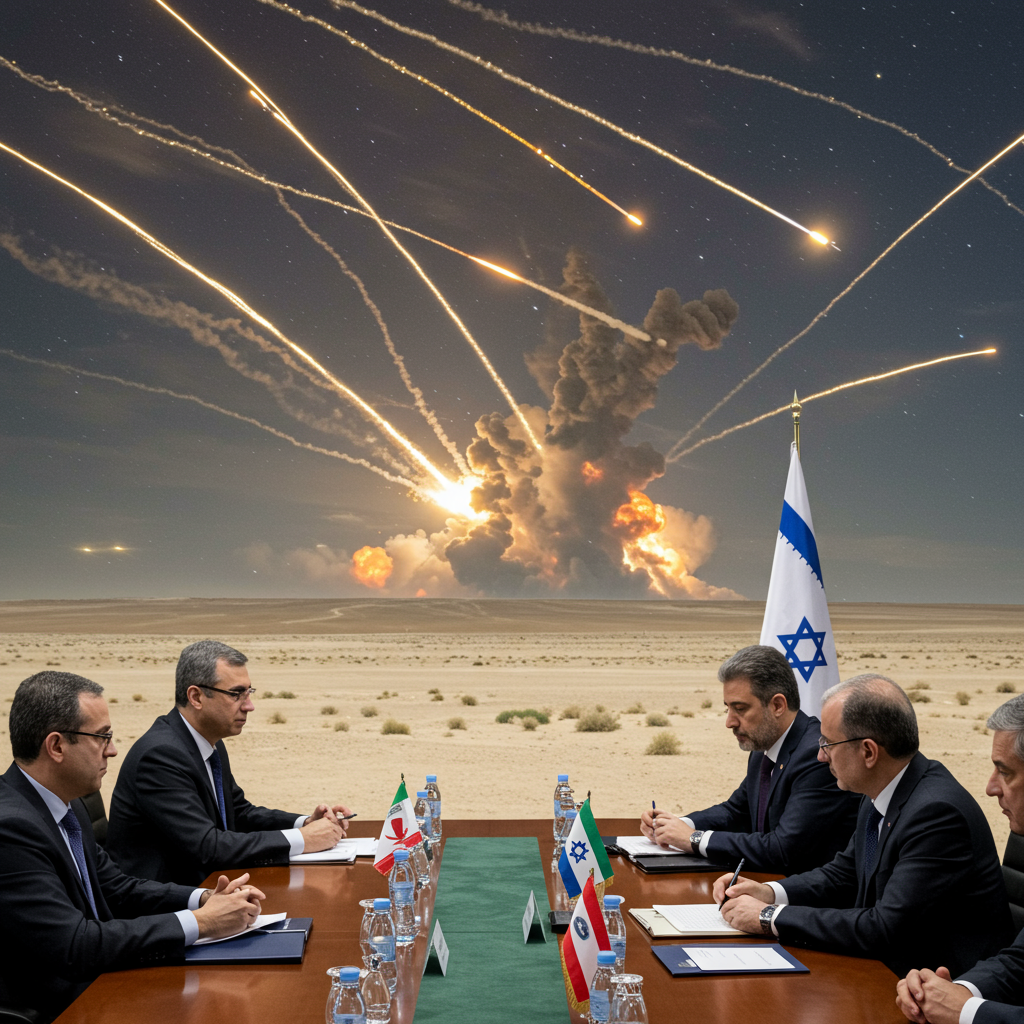
The Middle East is gripped by rapidly escalating hostilities after an Iranian counterattack claimed the lives of three U.S. service members and seriously wounded five others. This unprecedented development follows joint U.S.-Israeli strikes that targeted key Iranian leadership and infrastructure, igniting fears of a broader, more volatile regional conflict. As both sides trade blows, concerns are mounting over the Pentagon’s ability to safeguard its personnel and the potential for a prolonged confrontation.
The Deadly Strikes: A Region on Edge
The recent surge in violence marks a critical turning point in the long-standing tensions between the United States and Iran. What began as a strategic offensive quickly morphed into a deadly exchange, pushing the Persian Gulf to the brink.
Operation Epic Fury: US-Israel Offensive Ignites Crisis
On Saturday, February 28, 2026, the United States, in conjunction with Israel, launched “Operation Epic Fury.” This extensive military operation targeted dozens of Iranian military storage sites, command and control facilities, and naval vessels. A primary objective of these strikes was to dismantle Iran’s leadership. Remarkably, the strikes resulted in the death of Iran’s Supreme Leader, Ayatollah Ali Khamenei. High-ranking officials, including Defense Minister Gen. Aziz Nasirzadeh and Revolutionary Guard Corps head Gen. Mohammad Pakpour, were also killed. President Donald Trump later described Khamenei as a “wretched and vile man” and asserted that U.S. forces had “knocked out nine Iranian ships” within minutes. These actions were framed as a response to an “existential threat” posed by Iran.
Iran’s Swift Retaliation: Widespread Attacks Across the Gulf
Iran’s response was immediate and sweeping. On March 1, 2026, hundreds of retaliatory attacks were unleashed across the Persian Gulf, directly targeting U.S. military bases and interests.
Key impacts of Iran’s retaliatory strikes include:
Kuwait: Three U.S. Army sustainment unit members were killed, and five seriously injured, at a base in Kuwait. Ali Al-Salem Air Base also came under ballistic missile attack.
Bahrain: U.S. Naval Forces Central Command headquarters at Naval Support Activity Bahrain was struck by missiles and drones. Bahrain’s international airport and residential buildings also sustained damage.
Qatar: Al Udeid Air Base, the largest U.S. military base in the Middle East, was hit by two missiles and a drone.
United Arab Emirates (UAE): Dozens of missiles and hundreds of drones targeted areas hosting U.S. Air Force and Army assets at Al Dhafra Air Base. Three non-American nationals were killed, and 58 sustained minor injuries.
Jordan: Jordanian armed forces intercepted two ballistic missiles.
Iraq: A U.S. base near Irbil airport saw rising smoke after an attack.
U.S. Central Command (CENTCOM) confirmed the American casualties, reporting three fatalities and five serious injuries, with many more suffering minor shrapnel injuries and concussions. CENTCOM declared that “major combat operations continue and our response effort is ongoing,” underscoring the fluid nature of the conflict.
Trump’s Stance: Vows of Vengeance and Shifting Diplomacy
The unfolding crisis has been defined by President Trump’s strong rhetoric and, at times, contrasting messages regarding a path forward. His public statements have largely focused on avenging fallen U.S. troops while also hinting at diplomatic avenues.
“Righteous Mission” and “Punishing Blows”
President Trump has publicly committed to continuing a “righteous mission” against Iran until “all objectives are achieved.” He vowed that America would “avenge their deaths and deliver the most punishing blow to the terrorists who have waged war against, basically, civilization.” Trump asserted that U.S. forces had struck “hundreds of targets” inside Iran, including Revolutionary Guard facilities, air defense systems, and naval assets. He also boasted of largely destroying Iran’s naval headquarters. Acknowledging the inherent dangers, he issued a somber warning that “sadly, there will likely be more before it ends.” Furthermore, Trump called for regime change in Iran, offering amnesty to members of the Iranian Revolutionary Guard Corps (IRGC), military, and police who “lay down” their arms, while threatening “certain death” for those who refuse.
Diplomatic Off-Ramps Amidst Aggression
Despite the aggressive posturing, Trump’s stance was not entirely consistent. Earlier on the day of his Sunday speech, he had floated diplomatic off-ramps in several interviews. He even expressed willingness to engage with Iran’s “new leadership” — the three-member interim council formed after Khamenei’s death. A White House official confirmed Trump’s readiness for talks. Trump acknowledged that some of the Iranian negotiators he had been dealing with were among those killed in the recent strikes. However, in his Sunday speech, all mention of diplomatic overtures was omitted, replaced by an explicit call for regime change. Analysts suggest Iran’s new leadership may be wary of engaging with the Trump administration given its aggressive track record.
Regional Fallout: Casualties, Damage, and Global Repercussions
The escalating conflict has unleashed widespread chaos and destruction across the Middle East, leading to a significant human toll and fears of broader global instability. The ripple effects are already being felt far beyond the immediate battle zones.
Human Cost and Infrastructure Damage
Beyond the U.S. casualties, the human cost of the conflict has been staggering. Iranian state media, citing the Red Crescent, claimed over 200 people killed in the U.S.-Israeli operation, including over 150 schoolchildren in a strike on a school in Minab. Israel’s Magen David Adom emergency service reported at least nine people killed in Israel due to Iranian strikes. Other nations also suffered losses: one killed in Kuwait, three in the UAE (Pakistani, Nepalese, and Bangladeshi nationals), and two in Iraq.
Infrastructure across the region has also been severely impacted. In Bahrain, residential buildings and a five-star hotel were hit. Kuwait’s air defenses intercepted 97 ballistic missiles and 283 drones, with debris causing minor material damage. Qatar intercepted several waves of missiles, resulting in eight injuries. The UAE faced dozens of missiles and hundreds of drones, with debris causing property damage. The widespread attacks led to significant restrictions on airspace across much of the Middle East, disrupting travel and commerce.
International Reactions and Security Concerns
The conflict has drawn international attention and concern. Britain’s Prime Minister Keir Starmer granted permission for the United States to use British bases for “specific and limited defensive purposes.” He clarified that British warplanes were deployed defensively and were not participating in offensive strikes. Across the globe, anti-war protests have erupted in U.S. cities, and diplomatic tensions have heightened near American embassies. Domestically, U.S. authorities are investigating a recent shooting in Austin as a potentially related act of terrorism. Federal and local law enforcement agencies have boosted security measures, particularly on Capitol Hill, though no specific, credible threats have been identified.
The Path Ahead: Nuclear Talks and Escalation Risks
The future of the region, and indeed international relations, hangs precariously in the balance. The immediate cessation of hostilities appears distant, with underlying geopolitical issues like Iran’s nuclear program adding layers of complexity to the unfolding crisis.
Nuclear Negotiations Derailed?
Crucially, these attacks occurred in the midst of ongoing U.S.-Iran talks concerning Iran’s nuclear program. This mirrors a previous instance in June last year when the U.S. and Israel launched attacks during similar negotiations, potentially signaling a pattern of disrupting diplomatic efforts. President Trump had previously indicated a goal of preventing Iran from acquiring nuclear weapons. However, the article highlights a lack of evidence presented by Trump’s administration to support claims that Iran is developing long-range missiles capable of hitting the U.S. or is close to developing nuclear weapons. Experts assess that if Iran were to pursue nuclear weapons, their development would still be several years off, and Tehran has consistently denied seeking such weapons.
A Protracted Conflict?
The current trajectory points towards a potentially protracted conflict. Iranian Minister of Foreign Affairs Abbas Araghchi acknowledged that Iran’s military command had been interrupted, with units operating “independently and somewhat isolated” based on pre-given general instructions. Nevertheless, Araghchi affirmed Iran sees “no limit for ourselves to defend our people.” Analysts suggest Iran’s new leadership might opt for a drawn-out conflict, potentially aiming to inflict political damage on the Trump administration. The large-scale U.S. naval buildup in the Persian Gulf, including two aircraft carrier strike groups, indicates a commitment to sustained operations. This volatile situation leaves the region on edge, with global implications for energy markets and international security.
Frequently Asked Questions
What triggered the latest escalation of conflict between the US and Iran?
The recent escalation was triggered by “Operation Epic Fury,” a joint U.S.-Israeli offensive launched on Saturday, February 28, 2026. This operation targeted key Iranian military sites and leadership, resulting in the death of Supreme Leader Ayatollah Ali Khamenei. Iran swiftly retaliated with widespread missile and drone attacks across the Persian Gulf, leading to the deaths of three U.S. service members and numerous casualties in other countries.
Where were the primary US military bases targeted in Iran’s retaliatory strikes?
Iran’s retaliatory strikes targeted several U.S. military installations across the Middle East. Key bases hit included Ali Al-Salem Air Base in Kuwait, Naval Support Activity Bahrain, Al Udeid Air Base in Qatar, Al Dhafra Air Base in the United Arab Emirates, and a U.S. base near Irbil airport in Iraq. These attacks utilized ballistic missiles and drones, causing varying degrees of damage and casualties.
What are the immediate concerns for regional stability and international policy following these events?
Immediate concerns include the potential for a prolonged and expanding conflict, increased civilian casualties, and further destabilization of the Middle East. The attacks occurred amid U.S.-Iran nuclear negotiations, now likely jeopardized, raising fears about Iran’s nuclear program. International reactions, including limited military support from allies like the UK, underscore the global impact. Domestic security concerns in the U.S. have also risen, highlighting the far-reaching consequences of this escalating conflict.
Conclusion
The recent deaths of U.S. service members amidst intense Iranian counterattacks underscore the perilous trajectory of the Middle East. What began as a strategic offensive has rapidly spiraled into a deadly, widespread conflict, fueling deep-seated fears about regional stability and the broader implications for international security. With both Washington and Tehran showing resolve, and President Trump vowing retribution while simultaneously hinting at diplomatic paths, the path ahead remains shrouded in uncertainty. The human cost is mounting, and the potential for a protracted, destabilizing conflict looms large, demanding urgent attention and a clear strategy to prevent further loss and chaos.