The Middle East has plunged into an unprecedented crisis following the confirmed death of Iran’s Supreme Leader, Ayatollah Ali Khamenei, in a joint U.S. and Israeli aerial bombardment. This catastrophic event, which unfolded on February 28, 2026, has ignited a full-scale regional conflict, drawing swift and violent retaliation from Tehran and sparking global alarm. As the dust settles from initial strikes and counter-strikes, the future of the Islamic Republic hangs in the balance, and world leaders grapple with the potential for widespread instability and devastating economic repercussions.
The Unfolding Crisis: Airstrikes and Confirmations
The dramatic escalation began on a Sunday morning, February 29, 2026, when Iranian state television and IRNA news confirmed the death of the 86-year-old Supreme Leader, Ayatollah Ali Khamenei. Hours earlier, U.S. President Donald Trump had announced the leader’s demise, asserting it was “the greatest chance” for the Iranian people to reclaim their nation. He characterized Khamenei as “one of the most evil people in history,” framing the operation as a path toward “PEACE THROUGHOUT THE MIDDLE EAST AND, INDEED, THE WORLD!”
This lethal assault marked the Trump administration’s second military intervention in Iran within eight months, occurring amidst delicate ongoing nuclear program negotiations. The operation, codenamed “Epic Fury” by the U.S. Central Command, represented the “largest regional concentration of American military firepower in a generation.” Satellite imagery from Airbus later corroborated heavy bombing at Khamenei’s compound in downtown Tehran, the primary target of the initial strikes. Israeli officials, including Prime Minister Benjamin Netanyahu, also acknowledged the leader’s absence, citing “growing signs.”
Precision Strikes on Iranian Strategic Targets
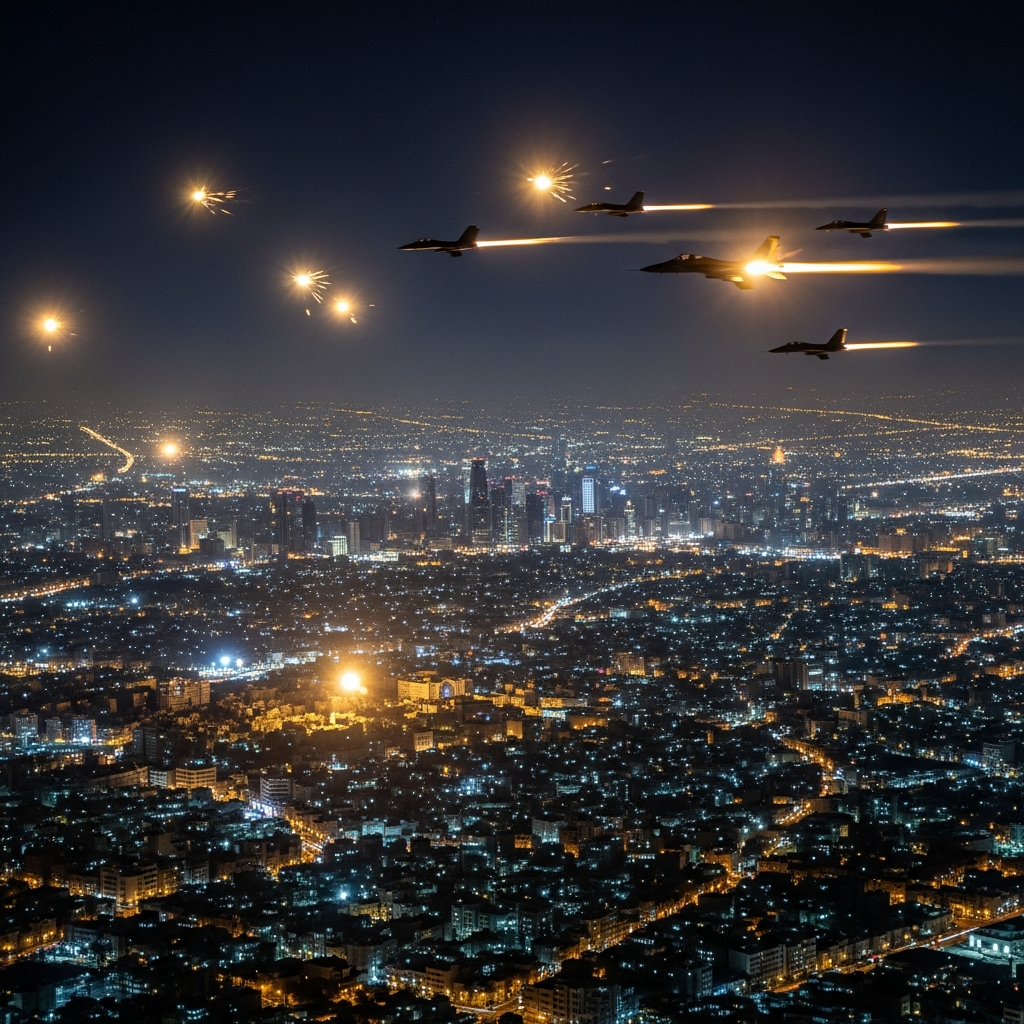
The joint U.S.-Israeli offensive specifically targeted critical Iranian military and governmental infrastructure. U.S. Central Command detailed strikes on Islamic Revolutionary Guard Corps (IRGC) command and control facilities, air defense capabilities, missile and drone launch sites, and military airfields. The operation utilized precision munitions and, for the first time in combat, low-cost one-way attack drones. Israel’s military reported an even broader scale, with approximately 200 fighter jets participating in the initial assault, hitting around 500 targets across Iran.
Israeli U.N. Ambassador Danny Danon justified these actions as an essential response to an “existential threat” from Iran. He emphasized that diplomatic avenues had been exhausted, and the operation was aimed directly at the Iranian regime. A senior U.S. administration official further articulated the justification, citing Iran’s accelerating conventional missile program and its unwillingness to negotiate on ballistic missiles. Intelligence, they claimed, indicated Iran was rebuilding nuclear infrastructure and developing advanced centrifuges for highly enriched uranium, leaving military action as the only viable option despite previous assertions that Iran’s nuclear program had been incapacitated.
A Nation in Shock: Casualties and a Leadership Vacuum
The repercussions inside Iran were immediate and devastating. Beyond Ayatollah Ali Khamenei, Iranian state media confirmed the deaths of several other high-ranking officials. These included Maj. Gen. Mohammad Pakpour, the head of Iran’s Revolutionary Guard, and Ali Shamkhani, a top security adviser. The semiofficial Fars news agency, reportedly close to the Revolutionary Guard, also indicated that several of Khamenei’s relatives—a daughter, son-in-law, daughter-in-law, and a grandchild—perished in the airstrikes.
Civilian casualties were also tragically high. Iranian state TV reported 201 fatalities and 747 injuries across 24 of Iran’s 31 provinces due to the U.S.-Israeli strikes. Horrifically, five students were killed at a girls’ school in southern Iran, an incident initially reported with higher casualty figures but later clarified. Explosions were heard near the Intelligence Ministry building in northern Tehran, and residents experienced heavy traffic attempting to evacuate the capital, stocking up on essentials amid official advice to consider leaving for safety.
Khamenei’s death creates a profound leadership vacuum within Iran. Having held final authority on all major policies for decades and leading both the clerical establishment and the powerful Revolutionary Guard, his absence leaves no clear successor. A temporary council has been swiftly formed to govern the country, with the Assembly of Experts mandated to select a new Supreme Leader “as soon as possible.” In response to the national tragedy, the Iranian government declared 40 days of public mourning and a seven-day nationwide public holiday. However, eyewitnesses in Tehran reported mixed reactions, with some residents seen rejoicing and cheering in the streets, while others mourned deeply, signified by the raising of a black flag over the Imam Reza shrine in Mashhad.
Iran’s Fierce Retaliation: Operation Truthful Promise 4
True to its vows, Iran swiftly launched a “decisive response” named “Truthful Promise 4.” This massive retaliatory operation involved a barrage of missiles and drones fired toward Israel and U.S. military bases across the region, including installations in Bahrain, Qatar, and the United Arab Emirates. The Revolutionary Guard had earlier threatened its “most-intense offensive operation” ever against Israeli and American targets.
The retaliatory attacks inflicted casualties and damage across several nations. In Israel, a woman in the Tel Aviv area died from an Iranian missile strike, marking the first Israeli fatality in the conflict, while 90 others sustained light injuries. Elsewhere, one person was killed by Iranian missile shrapnel in the UAE capital, and four employees were injured at Dubai International Airport. Air defense systems across the region were activated, with reports of strikes in Kuwait (where three troops were injured at Ali Al-Salem air base and a drone targeted the international airport) and Bahrain (where the U.S. Navy’s 5th Fleet headquarters was targeted, and three buildings in Manama and Muharraq were damaged). Kuwait and Saudi Arabia also reported repelling Iranian attacks. Iran-backed militias in Iraq, specifically the Islamic Resistance, claimed drone strikes on U.S. bases in Irbil. Iranian National Security Council Secretary Ali Larijani vowed that Israel and America would “regret their actions.”
Global Ripple Effects: International Reactions and Calls for Calm
The rapid escalation triggered a diverse range of international reactions, reflecting the complexity and inherent dangers of the conflict. Russia and China swiftly condemned the U.S.-Israeli strikes, with Russia labeling it an “unprovoked act of armed aggression” aimed at regime change and warning of potential catastrophe. At Russia’s request, the IAEA Board of Governors scheduled a special session to address the threats, particularly near nuclear facilities.
Conversely, most Middle Eastern governments, including Syria (which notably condemned Iran’s retaliatory attacks on Gulf monarchies without mentioning the U.S.-Israeli strikes), along with the UK, Canada, and Ukraine, condemned Iran’s counter-attacks. Ukrainian President Volodymyr Zelenskyy specifically supported the U.S. actions, drawing a link to Iran’s involvement in Russia’s war effort. Australia and Argentina also voiced support for the U.S., with Argentina linking Khamenei to the 1994 AMIA bombing.
Calls for de-escalation, restraint, and a return to diplomacy emanated from the UN Secretary-General, EU leaders, Egypt, Oman, and Pakistan. The UN Secretary-General, while condemning both the U.S./Israeli strikes for violating Iran’s sovereignty, also criticized Iran’s retaliatory attacks for violating the sovereignty of Gulf states, cautioning against a “wider conflict.” Domestically, U.S. Senator Tim Kaine and Representative Jim Himes criticized the U.S. strikes as a “colossal mistake” and a “war of choice” unauthorized by Congress, despite the White House stating it had briefed some Republican and Democratic leaders.
Economic Fallout and Geopolitical Instability
The conflict has already led to severe logistical disruptions across the region and beyond. Airspace closures in the UAE, Qatar, Kuwait, and other regional hubs caused widespread flight disruptions. Dubai International Airport, a major global hub, was among those affected. Israel further compounded regional tensions by closing Gaza crossings and religious sites in Jerusalem’s Old City.
Perhaps the most significant global implication is the threat to economic stability. Analysts have warned of substantial economic repercussions, particularly potential oil price spikes. This concern is heightened if the conflict impacts shipping through the Strait of Hormuz, a critical choke point through which one-third of worldwide oil exports pass. A global shipping firm, CMA CGM, has already instructed vessels to shelter in the Persian Gulf and rerouted traffic via the Cape of Good Hope, suspending Suez Canal passage due to the rapid military escalation. China, reflecting broader international anxieties, initiated large-scale evacuation preparations for its citizens in Iran and advised those in Israel to seek safe areas.
The Path Forward: Leadership Succession and Nuclear Tensions
With Ayatollah Ali Khamenei gone, Iran faces an unprecedented leadership transition. The temporary council and the Assembly of Experts confront the monumental task of selecting a new Supreme Leader, a decision that will profoundly shape the future direction of the Islamic Republic. Meanwhile, the underlying tensions surrounding Iran’s nuclear program remain at the forefront. U.S. officials maintain that Iran’s pursuit of enriched uranium for nuclear weapons, despite offers for peaceful programs, necessitated military action.
The operational context reveals that this joint U.S.-Israel operation was reportedly planned for months. Furthermore, intelligence indicates that Iran had met with Iraqi militias two months prior to plan a coordinated response targeting U.S. interests should Iran be attacked. This long-simmering animosity and the pre-meditated nature of both the initial strike and the retaliation underscore the deep-seated grievances and strategic calculations driving this conflict. President Trump’s ultimatum to the Iranian Revolutionary Guard—to lay down arms for immunity or face “certain death”—highlights the intensity of the confrontation. The world watches with bated breath as this rapidly evolving crisis continues to unfold, its ultimate trajectory uncertain but undeniably transformative.
Frequently Asked Questions
What were the immediate impacts of Ayatollah Ali Khamenei’s confirmed death?
The confirmed death of Ayatollah Ali Khamenei on February 29, 2026, instantly created a significant leadership vacuum in Iran, prompting the swift formation of a temporary council to govern and a mandate for the Assembly of Experts to select a new Supreme Leader. The strikes also killed other high-ranking officials and hundreds of civilians. Nationally, 40 days of public mourning and a seven-day public holiday were declared, though public reaction varied between mourning and celebration. Regionally, Iran launched massive retaliatory missile and drone attacks, causing casualties and disruptions across the Middle East.
Which regions and military sites were primarily targeted in the initial attacks and retaliations?
The initial joint U.S.-Israeli “Epic Fury” operation on February 28, 2026, targeted Iranian military and governmental sites, including Ayatollah Ali Khamenei’s compound in downtown Tehran, IRGC command facilities, air defense systems, missile and drone launch sites, and military airfields across Iran. In retaliation, Iran’s “Truthful Promise 4” operation launched missiles and drones toward Israel, killing one woman in Tel Aviv, and at U.S. military bases in Bahrain, Qatar, and the United Arab Emirates. Attacks also affected Kuwait, Saudi Arabia, and Iraq, leading to casualties and damage at various civilian and military installations across the Gulf states.
How might this escalating Middle East conflict affect global markets and stability?
This escalating conflict carries severe potential impacts on global markets and stability. Immediate disruptions include widespread airspace closures across the Middle East and significant flight delays, affecting international travel and logistics. Economically, there is a high risk of substantial oil price spikes, particularly if the conflict disrupts shipping through the Strait of Hormuz, a critical transit point for one-third of global oil exports. The geopolitical instability could also deter foreign investment in the region, trigger wider regional conflicts, and prompt further humanitarian crises, as demonstrated by evacuation preparations for foreign nationals.
—