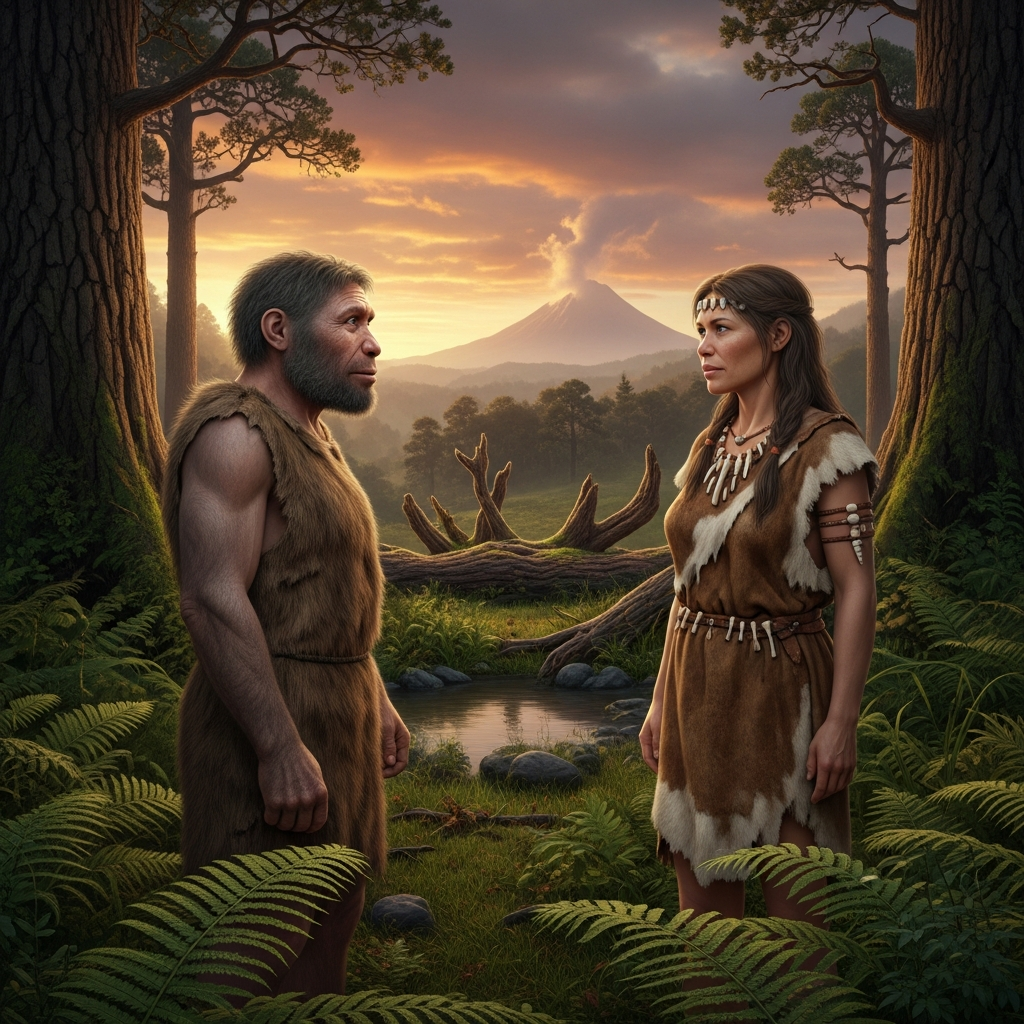
For years, genetic evidence confirmed that Neanderthals and our species, Homo sapiens, interbred, leaving a fascinating legacy in the DNA of many modern humans. Now, groundbreaking research takes this understanding a crucial step further, revealing a surprising and consistent pattern in these prehistoric pairings: Neanderthal men predominantly had children with Homo sapiens women. This discovery moves beyond simply knowing that interbreeding occurred to uncovering profound clues about how these ancient human populations interacted on a social and individual level.
A new study published in the journal Science, spearheaded by scientists at the University of Pennsylvania, offers compelling genetic insights into the intimate encounters between these two closely related human species. By meticulously analyzing ancient Neanderthal DNA alongside modern human genomes, researchers have identified a distinct sex bias in interbreeding events that appears to have persisted for hundreds of thousands of years. This finding fundamentally reshapes our view of archaic introgression – the exchange of genes between distinct ancient human groups – transforming an abstract concept into a vivid glimpse of our ancestors’ complex social lives.
Unpacking the Genetic Legacy: The X Chromosome Mystery
Since the first sequencing of the Neanderthal genome in 2010, scientists have known that people of non-African descent carry a small but significant percentage of Neanderthal DNA. This genetic footprint is a direct result of Homo sapiens populations migrating out of Africa into Eurasia, where they lived alongside and interbred with Neanderthals for an extended period, particularly between 45,000 and 49,000 years ago. However, this genetic mixing was not uniform across the human genome.
One of the most persistent puzzles in this field has been the existence of “Neanderthal deserts”—genomic regions in modern humans with surprisingly low amounts of Neanderthal DNA. The X chromosome, one of the sex chromosomes (females have two X chromosomes, males have an X and a Y), stands out as a particularly prominent Neanderthal desert. For over a decade, scientists grappled with why this specific chromosome harbored so little Neanderthal ancestry.
Initial theories suggested that Neanderthal genes on the X chromosome might have been “toxic” or disadvantageous to Homo sapiens, leading to their natural selection and eventual purging from the gene pool. This evolutionary incompatibility hypothesis posited that hybrid offspring might have faced health issues, particularly males who carry only one X chromosome, making them more vulnerable to any detrimental genes.
Cracking the X Chromosome Code
The Penn research team, led by evolutionary geneticists Sarah Tishkoff and Alexander Platt, devised a clever approach to test this. Their reasoning was simple: if Neanderthal genes on the X chromosome were truly problematic for Homo sapiens, then the reverse should also be true. That is, Neanderthal genomes should show similar “deserts” or a low presence of Homo sapiens DNA on their own X chromosomes.
To investigate this, they compared Neanderthal genomes with genetic data from modern sub-Saharan African populations, chosen because these groups have minimal to no Neanderthal ancestry. The results were striking and unexpected. Far from exhibiting a scarcity of Homo sapiens DNA, Neanderthal X chromosomes showed a significantly higher proportion of modern human ancestry than their other chromosomes – up to 62% more in the oldest Neanderthal genome analyzed.
This finding was crucial. It effectively ruled out the evolutionary incompatibility hypothesis as the primary driver for the Neanderthal deserts on the human X chromosome. If human DNA was thriving on the Neanderthal X chromosome, it suggested that the genes themselves were not inherently problematic. Instead, the asymmetry pointed strongly towards a sex-biased mating pattern.
The Surprising Sex Bias in Ancient Interbreeding
With the incompatibility theory disproven, the research strongly supports the alternative explanation: interbreeding events predominantly involved male Neanderthals and female Homo sapiens. This consistent bias over thousands of years would naturally lead to a lower contribution of Neanderthal X chromosomes to the modern human gene pool. Since females pass one X chromosome to all offspring, while males pass their single X only to daughters, a preference for Neanderthal fathers and Homo sapiens mothers would explain the observed genetic patterns.
This finding adds significant depth to our understanding of Neanderthal-human interbreeding. It moves beyond the simple fact of genetic exchange to suggest specific social dynamics. As Sohini Ramachandran, a human population geneticist at Brown University, noted, “What was happening at an individual and community level?” While DNA cannot explicitly describe the context—whether these were peaceful, consensual pairings, instances of sexual coercion, or even scenarios where Neanderthal males migrated into Homo sapiens groups—it certainly opens avenues for speculation. The researchers refer to this simply as “mate preference,” a broad scientific term encompassing many possibilities.
Experts not involved in the study, like Joshua Akey of Princeton University, lauded the research. He called it a “fascinating and provocative hypothesis,” emphasizing the extraordinary ability of genomic sequences to infer social dynamics from hundreds of thousands of years ago.
Glimpses of Ancient Social Dynamics
The genetic evidence, combined with archaeological findings, paints a picture of prolonged interaction rather than isolated incidents. For example, the 140,000-year-old skull of a child from Skhul Cave in Israel, re-analyzed as a potential Neanderthal-Homo sapiens hybrid, further supports sustained contact.
The idea of sex-biased mating introduces intriguing possibilities about ancient social structures. Researchers like Israel Hershkovitz of Tel Aviv University, who studied the Skhul child, propose scenarios where Neanderthal males might have initially captured Homo sapiens females in the Levant region as modern humans first arrived around 250,000 years ago. As Homo sapiens populations grew and outnumbered Neanderthals, the gene flow might have reversed, leading to a greater incorporation of male Neanderthal genes into the expanding human population.
Other experts, like José Yravedra, suggest that a scarcity of women in late Neanderthal groups could have driven their males to seek mates among Homo sapiens populations. Evidence from the Sidrón Neanderthal group, where males showed close kinship but females were genetically unrelated, supports the idea of female exogamy (females moving to live with a male’s group). This “patrilocality,” where males remain in their birthplace, could reduce inbreeding and explain why Homo sapiens women might integrate into Neanderthal clans.
Broader Implications and Future Directions
The distinct pattern of Neanderthal-human interbreeding revealed by this study also sheds light on another long-standing paradox. While modern human nuclear DNA clearly shows Neanderthal influence, mitochondrial DNA (mtDNA), which is exclusively passed down through the maternal line, does not carry Neanderthal traces. This absence aligns perfectly with the new finding: if Neanderthal women rarely, if ever, mated with Homo sapiens men to produce offspring that contributed to the modern human lineage, then their mtDNA would not be present in our modern genetic makeup.
This research, while highly insightful, also acknowledges its limitations. The number of high-quality Neanderthal genomes available for study remains small. As more ancient DNA is discovered and analyzed, a clearer, more comprehensive picture of these ancient interactions will undoubtedly emerge. Alexander Platt underscores the philosophical importance of looking beyond just human DNA to truly understand our ancestry. By studying the genetic legacy of both sides of these ancient interactions, scientists gain a far richer understanding of human evolutionary history.
This new genetic evidence profoundly impacts how we reconstruct the complex interactions between different Homo populations. It confirms that the arrival of anatomically modern humans in Eurasia was not solely about competition or replacement but also about significant, intimate hybridization.
Frequently Asked Questions
Why is the X chromosome so important for understanding Neanderthal-human mating?
The X chromosome is crucial because its inheritance patterns differ for males and females. Females have two X chromosomes, inheriting one from each parent, while males have one X (from their mother) and one Y (from their father). Scientists observed “Neanderthal deserts” – surprisingly low amounts of Neanderthal DNA – on the human X chromosome. By comparing Neanderthal X chromosomes with human ones, researchers could deduce if this scarcity was due to genetic incompatibility or a sex-biased mating pattern. Their findings pointed strongly to the latter, ruling out incompatibility.
What does “sex-biased mating” mean in the context of Neanderthals and modern humans?
Sex-biased mating, in this context, refers to a consistent pattern where reproductive pairings predominantly occurred between male Neanderthals and female Homo sapiens. This means that the majority of successful interbreeding events that contributed to the genetic legacy we see today involved a Neanderthal father and a Homo sapiens mother. This pattern helps explain the unique distribution of Neanderthal DNA in the modern human genome, especially the scarcity on the human X chromosome, and is supported by the unexpected abundance of human DNA found on Neanderthal X chromosomes.
How does this new research change our understanding of ancient human and Neanderthal social dynamics?
This study significantly deepens our understanding by moving beyond the fact of interbreeding to infer specific social dynamics. It suggests that interactions between Homo sapiens and Neanderthals were not random but followed a consistent pattern, implying forms of mate preference or social structures. This could involve scenarios like Neanderthal males relocating into Homo sapiens groups (patrilocality), or even more complex dynamics related to demographic imbalances or power structures. It highlights that the relationship between these ancient human groups was one of sustained interaction and hybridization, not just competition or simple coexistence.
This breakthrough in Neanderthal-human interbreeding research offers a compelling new window into the intimate lives of our ancient ancestors. By meticulously analyzing genetic material, scientists are piecing together not just the biological story of our lineage but also hints of the social tapestry that connected these distinct human species. As paleogenomics continues to advance, we can expect even more detailed insights into the complex history that shaped who we are today.