Humanity stands on the cusp of a historic return to deep space. NASA’s Artemis II mission, targeting an early March launch, will send four astronauts on an unprecedented journey around the Moon. This 10-day orbital flight marks the first time humans have ventured to our celestial neighbor’s vicinity in over 50 years. Beyond proving vital new technologies, Artemis II promises to offer unparalleled views of the lunar far side. This mission sets the stage for a new era of lunar exploration. It seeks to answer enduring questions about our natural satellite.
A Historic Orbit: Beyond Apollo’s Reach
The Artemis II mission represents a monumental leap in human spaceflight. Following a successful “wet dress rehearsal” at Kennedy Space Center, the Space Launch System (SLS) rocket and Orion capsule are prepared for liftoff. The mission’s target date is early March. This timeline is contingent on a detailed flight readiness review. The crew for this groundbreaking voyage includes NASA astronauts Reid Wiseman, Victor Glover, and Christina Koch, alongside Canadian Space Agency astronaut Jeremy Hansen. They have already entered a “health stabilization program,” a standard quarantine to ensure peak health for their flight.
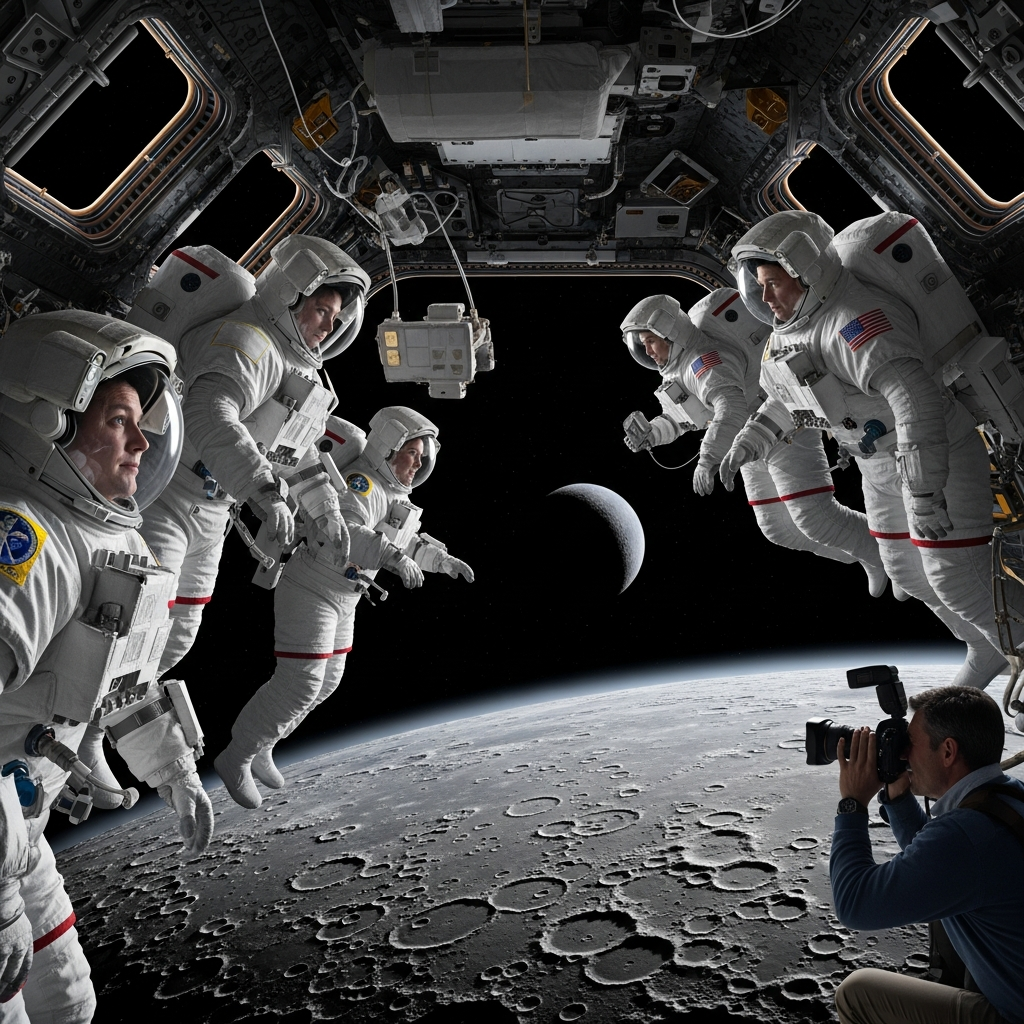
The Orion capsule, roughly the size of two minivans, will be home to the crew. For 10 days, these astronauts will navigate an intricate flight path. The first day involves orbital checks around Earth. After this, Orion will journey towards the Moon over four days. It will then circumnavigate the mysterious lunar far side. This part of the Moon perpetually faces away from Earth. The capsule will fly between 4,000 and 6,000 miles above the surface. This distance will take the crew further from Earth than any human has traveled before. During their lunar fly-by, astronauts will dedicate hours to studying and photographing the Moon. The mission concludes with a four-day return trip. A splashdown in the Pacific Ocean awaits their arrival.
Peering into the Unseen Lunar Far Side
As Artemis II’s Orion capsule makes its closest approach, the Moon will appear massive. It will be the size of a basketball held at arm’s length. The crew will witness features no human has ever seen with the naked eye. Apollo missions flew much closer, about 70 miles above the surface. However, their orbits prevented them from viewing the entire lunar far side. The Artemis II trajectory will reveal a much broader perspective. Normally shadowed regions near the lunar poles will also be on display.
Lunar and Planetary Laboratory professor Jeff Andrews-Hanna highlights a critical point. “We’ve been looking at the moon throughout human history,” he explains. “Yet there’s still so many things we don’t understand.” The Artemis program aims to fill these gaps. Exploring different lunar regions promises a more complete portrait of the Moon’s landscape and composition. It could uncover why the near and far sides differ so dramatically. It may also reveal how much water the Moon contains. And crucially, it could shed light on how our silvery orb has evolved over time.
Unraveling the Moon’s Deepest Mysteries
Crucial samples from the Apollo missions provided our foundational understanding of the Moon. Collected in the late 1960s and early 1970s, these rocks and soil offered novel insights. They revealed details about the Moon’s origin and composition. More recent analyses have made surprising discoveries. Previously untouched Apollo samples, along with robotic mission retrievals, uncovered water trapped in rocks thought to be dry.
However, the Apollo missions largely focused on similar sites. These were near the lunar equator on the Moon’s near side. The terrain there was flat. Astronauts could easily maintain communication. Experts now realize these samples aren’t entirely representative. The Moon is far more diverse than initially thought. Studying the Moon can also illuminate lost chapters of Earth’s early history. It could help confirm or refute the prevailing theory of the Moon’s formation. This theory suggests a Mars-sized object impacted Earth millions of years ago.
“I think of the moon as the eighth continent of Earth,” says Noah Petro. He is chief of NASA’s Planetary, Geology, Geophysics and Geochemistry Laboratory. “When we study the moon, we’re actually really studying an extension of the Earth.” And Petro adds, the unexpected is always a possibility. “We will have surprises. That’s why we explore. If we knew what we would find, we wouldn’t have to go.”
Decoding the Moon’s Violent Genesis
The Apollo missions returned samples that rewrote our textbooks. Before these landings, scientists debated the Moon’s origin. Did it form elsewhere and get captured by Earth’s gravity? Did it form alongside Earth? Or did it spin off a rapidly rotating Earth? The Apollo samples pointed to a novel theory: the giant-impact hypothesis.
Among the samples was anorthosite. This igneous rock is rare on Earth in isolation. However, it was prevalent on the Moon’s near side. Its presence suggested specific conditions for its formation. Geologist Carolyn Crow explains, “What you need is a really big magma pond that slowly crystallizes.” If it cools slowly enough, anorthosite floats to the top. This implies the entire Moon was once a magma ocean, completely molten. Furthermore, isotopes, the chemical fingerprints of planetary bodies, in lunar rocks matched those in Earth’s mantle. This suggested a shared origin. Together, these insights led to the prevailing theory: a Mars-sized object slammed into Earth, ejecting molten material that coalesced into the Moon.
Jeff Andrews-Hanna stresses the profound impact. “The Earth would not be the planet it is today had it not been for the moon-forming impact.” He explains that the Moon stabilizes Earth’s climate. This stability was critical for life’s development. “There’s no question that without a moon stabilizing the Earth, humans would not have been able to evolve.”
The Moon’s Lopsided Mysteries and Future Exploration
Apollo unveiled much about the lunar near side. But data from orbiters showed the far side is entirely different. This has left scientists with significant questions. “The moon is lopsided in nearly every respect, and we don’t know why,” Andrews-Hanna notes. “This global asymmetry has affected every aspect of the moon’s evolution and remains one of the biggest mysteries.”
The near side has a thin crust and low topography. It also contains KREEP. This geochemical component is rich in heat-producing radioactive elements. KREEP formed when the Moon’s magma ocean solidified. It comprises potassium, rare Earth elements, and phosphorus. Apollo landing sites were also clustered around lunar maria. These dark patches are where ancient lava once flowed. They create the familiar “man in the moon” image. In contrast, the far side boasts a thick crust and higher elevations. It shows far fewer signs of past volcanic activity.
The Moon might seem like a dead rock. However, Apollo instruments revealed it is seismically active. Moonquakes occur as the celestial body cools. “One of the big questions that we’d like to answer is what’s going on inside the moon,” says Paul Hayne, an associate professor.
The lunar surface is also a pristine record of the early solar system. It is littered with craters from a chaotic era of impacts. Earth’s record has largely been erased by erosion. The Moon, however, is a perfect time capsule. “Understanding the history of the early impact bombardment… is really key for understanding the origin of life on Earth,” Andrews-Hanna explains. “All evidence seems to indicate that as soon as the rate of impacts dropped… life arose.”
Scientists now seek the age of other impact craters. The South Pole-Aitken basin is a prime target. This colossal crater spans nearly a quarter of the lunar surface. It is the largest, measuring roughly 1,550 miles across and over 5 miles deep. Located on the far side, it may have caused the Moon’s lopsided nature. Its exact age remains unknown. “Understanding its age is like finding this Rosetta stone of the early history of the solar system,” Petro remarks.
Life Aboard Orion: Sustaining Humans Beyond Earth
The Artemis II crew has already entered quarantine. This health stabilization program prevents illness before launch. Living in the compact Orion capsule presents unique challenges. NASA has meticulously planned for daily life needs. These include hygiene, nutrition, fitness, and sleep.
Waste management has evolved significantly from Apollo. Artemis II utilizes a system similar to the International Space Station’s. Airflow draws urine and feces away in microgravity. Urine will be vented into space. Feces will be collected and stowed. A contingency plan involves bags for urine. Nutrition is also carefully managed. The astronauts helped select their food. Options include chicken curry, shrimp cocktail, and chocolate pudding cake. They will have a food re-hydrator and reheater. Drinking water supplies will be plentiful.
Personal hygiene occurs in a dedicated bay. It houses the toilet and space for personal kits. These contain tooth-brushing equipment, liquid soap, and shaving supplies. Even simple tasks are complex without gravity. Physical fitness is vital. The crew will exercise for 30 minutes daily. They use a compact ‘flywheel’ device. This allows for exercises like rowing and squats. It helps preserve muscle and bone density. Astronauts are scheduled for 8 hours of sleep. They will use hammock-like sleeping bags. These tether to handrails and attach to walls for stability.
The Road to Mars: Artemis Program’s Ambitious Future
Artemis II is a crucial stepping stone. It directly precedes Artemis III. That mission aims to land astronauts on the lunar surface by 2028. Future missions like Artemis IV and V will continue this trajectory. They plan to establish a sustained human presence. Technology and infrastructure developed for these lunar missions will lay groundwork for Mars. As Noah Petro notes, “Artemis is often lauded as the moon to Mars program.” He believes understanding Earth, Moon, and Mars is key to understanding how planets work. “The moon is the best place to start.”
The international space race adds another layer of urgency. Elon Musk’s SpaceX holds a contract for the Artemis III lander. Delays in the Starship program have prompted NASA to seek accelerated plans. Blue Origin, led by Jeff Bezos, has also been asked to propose a faster lunar strategy. Meanwhile, China is steadily advancing its own lunar ambitions. It aims for a Moon landing by 2030. Both the US and China are eyeing the Moon’s south pole. This indicates a looming competition for prime locations for future lunar bases.
Ultimately, Artemis II is more than a test flight. It is a return to a fundamental human drive. “The way we have explored the moon is diverse: landed missions, orbital missions, crewed missions,” Petro says. “We’re a long way from having a comprehensive picture of the moon, but we’re building the story.” This mission ignites curiosity and pushes the boundaries of human endeavor.
Frequently Asked Questions
What is the primary goal of the Artemis II mission?
The Artemis II mission’s main objective is to test NASA’s Orion spacecraft life support systems and demonstrate crew capabilities in deep space. This 10-day journey around the Moon will send four astronauts further from Earth than any human before. It serves as a critical precursor to Artemis III, which plans to land humans on the lunar surface. The mission also aims to assess operational procedures and gather vital data for future lunar and Mars expeditions, ensuring human safety and mission success.
What unique sights will Artemis II astronauts see around the Moon?
The Artemis II crew will witness portions of the lunar surface never before seen by human eyes. Unlike Apollo missions, which flew lower and focused on the near side, Orion’s trajectory will provide expansive views of the mysterious lunar far side. This includes features like the South Pole-Aitken basin, the Moon’s largest and oldest crater. Astronauts will also observe normally shadowed regions near the lunar poles and collect images of impact craters and ancient lava flows, providing a more complete visual record of our Moon.
How does Artemis II pave the way for future lunar and Mars missions?
Artemis II is fundamental to the broader Artemis program’s long-term goals. By proving Orion’s capabilities and validating deep-space human operations, it directly enables Artemis III’s planned lunar landing. Success in Artemis II builds confidence and gathers data necessary for establishing sustained human presence on the Moon, a crucial step for developing technologies and infrastructure needed for crewed missions to Mars. The mission also reinforces the US’s leadership in space exploration amidst international competition, including from China, for lunar resources and future bases.