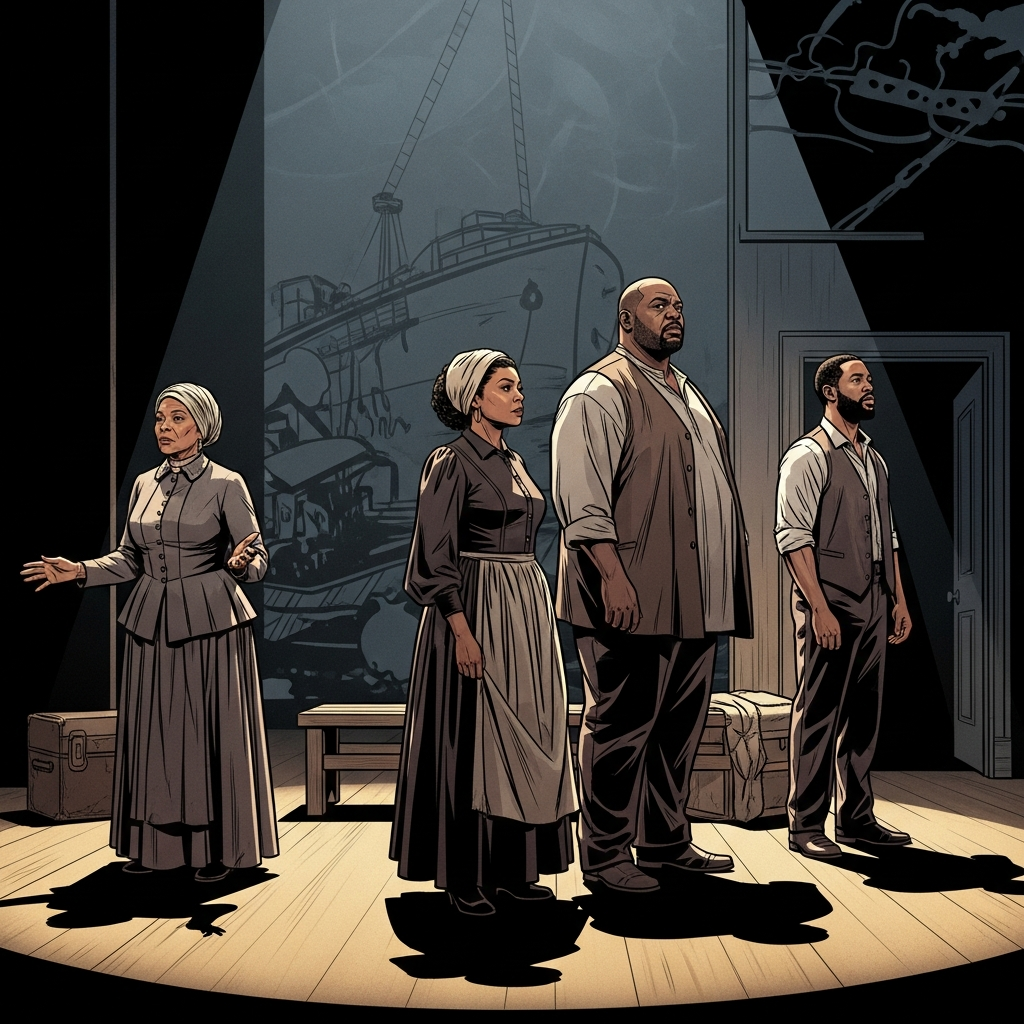
August Wilson’s powerful Joe Turner’s Come and Gone makes a significant return to Broadway, captivating audiences at the Ethel Barrymore Theatre. This compelling revival, helmed by the esteemed Debbie Allen, brings to life the profound struggles and spiritual journeys of Black Americans navigating the tumultuous post-slavery era. Featuring an acclaimed cast including Taraji P. Henson, Cedric The Entertainer, and Ruben Santiago-Hudson, this production offers an essential window into the rich tapestry of American history and the enduring search for identity. Prepare for a theatrical experience that delves into the very core of human resilience and the ancestral echoes that shape our present.
A Visionary Revival: August Wilson’s Enduring Legacy on Broadway
August Wilson stands as one of America’s most celebrated playwrights, his monumental “Century Cycle” a testament to the African American experience throughout the 20th century. Joe Turner’s Come and Gone, chronologically the second play in this ten-part saga, continues to resonate with its exploration of freedom, legacy, and the pursuit of selfhood. Set against the vibrant, yet challenging, backdrop of 1911 Pittsburgh, the play unfolds within a bustling boardinghouse. This space acts as a liminal zone, a temporary sanctuary for Black travelers migrating north, seeking new beginnings but often carrying the heavy burdens of the past.
The Heart of the Century Cycle: A Timeless Story
The play immerses its audience in the era of the Great Migration, a period when Black Americans left the Jim Crow South in droves, seeking opportunity and escape from systemic oppression. Within this Pittsburgh boardinghouse, characters grapple with the lingering trauma of slavery and the immediate injustices of the time. At its core, Joe Turner’s Come and Gone centers on Herald Loomis, a haunted figure desperately searching for his lost wife and, more profoundly, for the “song” of his own identity. His past is irrevocably tied to the titular Joe Turner, a man who illegally abducted and forced him into seven years of brutal labor—a stark reminder of the loopholes in the 13th Amendment that perpetuated forms of enslavement. Wilson masterfully blends naturalism with a powerful sense of the otherworldly, introducing elements of mysticism and spiritual awakening that highlight the characters’ deep connection to their ancestral roots and the unseen forces at play. This powerful narrative explores how memory, spirituality, and community intersect in the enduring quest for salvation.
Behind the Curtain: Debbie Allen’s Direction and Design
Directing an August Wilson play demands a delicate balance between realism and the profound spiritual undertones woven into his text. For this Joe Turner’s Come and Gone Broadway revival, Golden Globe and Emmy winner Debbie Allen took the helm, returning the play to its original Broadway home, the Ethel Barrymore Theatre. Her direction aimed for an “unfussy and relaxed” approach, allowing Wilson’s lyrical prose to breathe.
Directorial Choices: Striking a Balance
Allen’s staging has drawn varied critical responses. While praised for its “admirable production” and occasional moments of “sublime transcendence,” some critiques highlight an unevenness, particularly in conveying the play’s essential “otherworldliness.” Reviewers noted a tendency for the production to feel “earthbound to a fault,” with a “softness” that could sometimes “slide into sleepiness.” This contrasts with other acclaimed Wilson revivals, such as Ruben Santiago-Hudson’s “disquieting intensity” in Jitney or LaTanya Richardson Jackson’s “spooky” The Piano Lesson, which expertly conjured the mystical elements.
Specific directorial choices also sparked discussion. The visual representation of Herald Loomis, clad in a “slick, dark coat and murderous wide-brimmed hat” designed by Paul Tazewell, was seen by some as overemphasizing his menace, potentially disrupting the ensemble nature of the piece. Furthermore, while David Gallo’s set design handsomely captured the “twilight zone” of the boardinghouse, some observers felt the staging sometimes confined actors, leaving significant portions of the well-appointed set “frustratingly unexplored.” Stacey Derosier’s lighting design was largely “naturalistic,” with Justin Ellington’s sound design and Steve Bargonetti’s underscoring sometimes criticized for heavy-handedly highlighting dramatic moments rather than subtly enhancing the play’s mystical aura. Despite these points, the sheer power of Wilson’s text, especially in its shattering conclusion, ensures the play “still packs a punch.”
Star Power on Stage: Captivating Performances
The success of any August Wilson play hinges on its ensemble, and the cast of this Joe Turner’s Come and Gone Broadway production features a lineup of seasoned talents and rising stars who deliver compelling performances, often shining brightly even amidst mixed directorial assessments.
Taraji P. Henson and Cedric The Entertainer: Anchoring the Hollys
Leading the household are Taraji P. Henson as Bertha Holly and Cedric The Entertainer as Seth Holly, the boardinghouse proprietors. Henson, in a superb Broadway debut, brings her “instant charisma” and ease to the role of the open-hearted Bertha. Her delivery of Bertha’s pivotal monologue about life’s purpose is a particular highlight, marking a moment where her character truly owns the space. Cedric The Entertainer imbues the curmudgeonly Seth with “insightful exasperation,” expertly navigating the character’s pragmatism and often disdainful dismissal of the “heebie-jeebie stuff.” While some critics noted they occasionally felt like “background players” in Allen’s more relaxed staging, their foundational presence anchors the narrative, portraying a resilient couple striving for stability amidst transience.
Ruben Santiago-Hudson: The Transcendent Conjure Man
Ruben Santiago-Hudson, a deeply “seasoned interpreter of Wilson’s work,” delivers an “authoritative” and “transcendent” performance as Bynum Walker, the spiritual “conjure man.” His portrayal of Bynum, who claims to have met a “shiny man” and possesses the gift of “binding people,” is consistently praised as the “chief draw” and an “invaluable” asset to the production. Santiago-Hudson’s monologues are delivered with “natural ease,” making Bynum’s profound wisdom and connection to the otherworldly truly palpable. His performance, often described as belonging “in a different production all of his own,” underscores his masterful understanding of Wilson’s intricate language and spiritual depth.
Joshua Boone: The Haunted Herald Loomis
Joshua Boone offers a powerfully intense portrayal of Herald Loomis, the central figure whose desperate search for his wife Martha becomes a spiritual quest for self-liberation. Boone is “terrific,” crafting a “fiery and brutishly intense” character. He makes Loomis a “genuinely frightening figure” while skillfully embracing his instability and maintaining his “essential goodness.” Loomis’s trauma from forced labor under Joe Turner and his apocalyptic visions are central to the play, and Boone masterfully navigates both the fury and poetry of Wilson’s dialogue. His captivating final scene, where Loomis confronts his long-lost wife, Martha (played with “fierce command” by Abigail Onwunali, hailed as a “star born”), culminates in a profound act of self-revelation.
Rising Stars and Ensemble Strength
The strong supporting cast further enriches the boardinghouse community. Nimene Sierra Wureh is “excellent” as the “heartbreakingly gentle” Mattie Campbell, a dejected young woman yearning for connection. Maya Boyd “steals a few scenes” as Molly Cunningham, portraying her as sharp-edged and disillusioned with love. Tripp Taylor plays Jeremy Furlow, the callow guitar-playing newcomer. Savannah Commodore and Dominique Skye Turner share the role of young Zonia Loomis, Herald’s daughter, with Jackson Edward Davis appearing as Reuben. Bradley Stryker rounds out the principal cast as Rutherford Selig, the “People Finder,” adding another layer to the themes of searching and loss.
Why “Joe Turner” Resonates Today: Themes of Search and Salvation
Joe Turner’s Come and Gone remains powerfully relevant in its exploration of themes that transcend its historical setting. Wilson’s narrative brilliantly dissects the complexities of identity, particularly for a people whose history was fractured by forced migration and systemic dehumanization. The characters’ relentless search – for loved ones, for purpose, for their “song” – echoes a universal human desire for belonging and self-discovery.
The play’s spiritual elements, from Bynum’s “shiny man” visions to Loomis’s harrowing spells and ultimate breakthrough, speak to a deep-seated need for spiritual grounding and liberation. It reminds us that the past is never truly dead, influencing the present and future in profound ways. In a world still grappling with issues of displacement, historical trauma, and the quest for identity, Joe Turner’s Come and Gone offers a timeless meditation on resilience, memory, and the enduring human spirit. It’s a testament to Wilson’s monumental talent that the play continues to provoke thought and stir the soul, urging audiences to consider their own connections to history and the ongoing search for an authentic self.
Frequently Asked Questions
What are the main themes of Joe Turner’s Come and Gone?
August Wilson’s Joe Turner’s Come and Gone explores several profound themes central to the African American experience. Key among these are the legacy of slavery and post-slavery trauma, particularly through Herald Loomis’s story of forced labor. The play also delves into the Great Migration, examining the search for identity, freedom, and belonging as people move from the rural South to urban industrial centers like 1911 Pittsburgh. Spirituality, mysticism (represented by Bynum Walker’s “shiny man” visions), and the quest for one’s personal “song” or purpose are also vital, highlighting the interplay between the physical and spiritual worlds in the characters’ journeys.
Who are the key actors and creative team in the Broadway revival of Joe Turner’s Come and Gone?
The current Broadway revival of Joe Turner’s Come and Gone is directed by the acclaimed Debbie Allen. The star-studded cast features Taraji P. Henson as Bertha Holly, Cedric The Entertainer as Seth Holly, Joshua Boone as Herald Loomis, and Ruben Santiago-Hudson as Bynum Walker. The creative team includes Oscar, Emmy, and Tony-winning costume designer Paul Tazewell, Tony-winning scenic designer David Gallo, Drama Desk-nominated lighting designer Stacey Derosier, and Tony-nominated sound designer Justin Ellington, bringing a wealth of experience to this August Wilson classic at the Ethel Barrymore Theatre.
Why is August Wilson’s Joe Turner’s Come and Gone considered an important play to see on Broadway?
Joe Turner’s Come and Gone is a vital theatrical experience for several reasons. It is a pivotal part of August Wilson’s Pulitzer Prize-winning “Century Cycle,” offering an indispensable perspective on 20th-century African American history and identity. The play’s themes of migration, the lingering scars of slavery, spiritual searching, and the universal quest for self-discovery remain deeply relevant today. The current Broadway revival, despite varied critical opinions on direction, features powerfully captivating performances from its lead actors, particularly Ruben Santiago-Hudson and Joshua Boone, ensuring that Wilson’s lyrical prose and shattering conclusion deliver a profound and unforgettable impact.
Conclusion: A Powerful Theatrical Experience
The Broadway revival of Joe Turner’s Come and Gone reaffirms August Wilson’s unparalleled genius and the enduring power of his storytelling. While Debbie Allen’s directorial choices have prompted nuanced discussions, the sheer force of Wilson’s text, coupled with a cast delivering often transcendent individual performances, ensures a rich and thought-provoking experience. From Taraji P. Henson’s charisma to Ruben Santiago-Hudson’s authoritative spiritual guidance and Joshua Boone’s searing portrayal of Herald Loomis, the production shines. This is more than just a play; it’s a deep dive into the soul of a nation, a testament to resilience, and a reminder of the ancestral echoes that continue to shape our world. To witness Joe Turner’s Come and Gone on Broadway is to engage with an essential piece of American theatre, offering an unparalleled glimpse into the human spirit’s unending search for liberation and identity. Don’t miss the opportunity to experience this powerful revival.