A monumental scientific endeavor has culminated in the creation of the most detailed 3D map of the universe ever assembled, offering unprecedented insights into the cosmos. Scientists using the Dark Energy Spectroscopic Instrument (DESI) have completed a five-year survey, meticulously charting over 47 million galaxies and quasars across 11 billion years of cosmic history. This groundbreaking achievement isn’t just a stunning visual; it’s a critical tool in humanity’s quest to decode the universe’s most profound mysteries, particularly the elusive force known as dark energy.
This cosmic “CT scan” significantly expands our understanding of the universe’s structure and evolution. The data collected by DESI vastly surpasses all previous cosmological measurements combined, providing six times more information on distant galaxies and quasars. This new blueprint of the cosmos promises to revolutionize our theories about the universe’s accelerating expansion and its ultimate fate.
Charting the Cosmic Web: An Unprecedented View
Imagine mapping the entire Earth, but instead of continents and oceans, you’re detailing every city, town, and village across billions of years of its history. That’s the scale of what DESI has achieved. Since 2021, its 5,000 robotic fiber-optic “eyes” have systematically locked onto distant pinpricks of light in the night sky. These observations, concluding recently near the Little Dipper constellation, mark the completion of the primary survey phase.
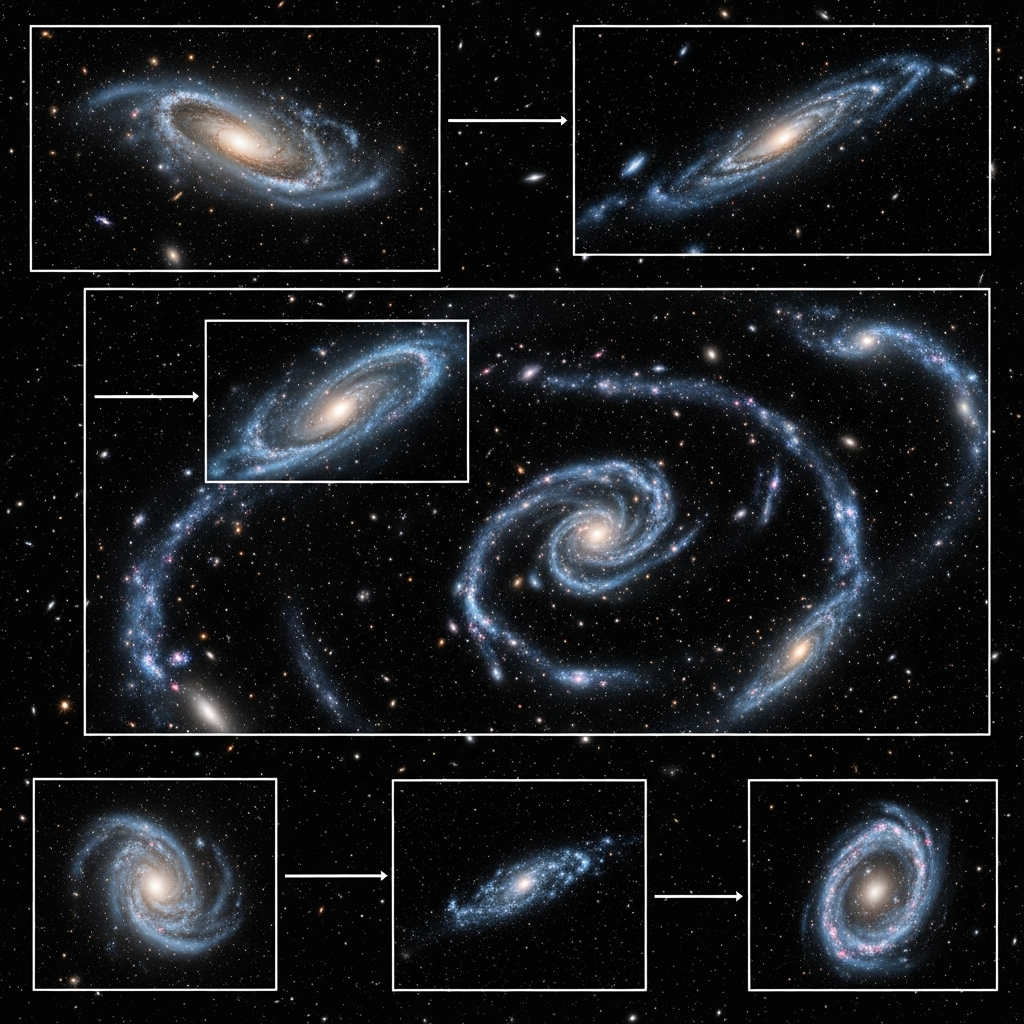
The resulting 3D map of the universe is a staggering tapestry of luminous red galaxies, quasars (bright signals from supermassive black holes), and stars. Each dot in this intricate diagram represents an individual galaxy, with denser, brighter regions illustrating how galaxies clump together, forming the vast, interconnected strands of the cosmic web. The light from the most distant objects captured by DESI began its journey over 11 billion years ago, almost reaching back to the universe’s infancy.
Dr. Seshadri Nadathur, a researcher and co-chair of DESI’s galaxy and quasar clustering working group, emphasized the map’s profound importance for cosmology. He remarked, “We’ve barely scratched the surface so far, and I’m excited to see what else we can learn.” This sentiment is echoed across the scientific community, as the sheer volume and precision of the data promise a decade of intense discovery.
The DESI Instrument: A Marvel of Engineering
The Dark Energy Spectroscopic Instrument (DESI) is a testament to cutting-edge astrophysical engineering. Mounted on the Nicholas U. Mayall 4-meter Telescope at the Kitt Peak National Observatory in Arizona, DESI’s 5,000 fiber-optic positioners are its core. Every 20 minutes, these robotic arms precisely align each lens to within 10 microns—less than the width of a human hair—capturing light from new celestial targets.
This light is then channeled into ten spectrographs, which split it into its constituent colors. This spectroscopic analysis reveals crucial information: an object’s precise distance (redshift), its velocity, and its chemical composition. By measuring the redshift, scientists can determine how much the universe has expanded since the light left the galaxy, effectively mapping its position in time and space. The precision and scale of this data stream, approximately 80 gigabytes every night, are unparalleled, streamed directly to supercomputers at Berkeley Lab for immediate processing and quality assurance.
The DESI collaboration, a global effort involving over 900 scientists from 70 institutions, overcame significant hurdles, including the COVID-19 pandemic and the 2022 Contreras Fire that threatened Kitt Peak. Despite these challenges, continuous optimization of hardware, software, and observing protocols allowed DESI to not only meet but exceed its initial data collection targets, observing 47 million galaxies and quasars compared to the planned 34 million.
Unmasking Dark Energy: The Universe’s Driving Force
The primary mission of DESI is to unravel the enigma of dark energy. This invisible, mysterious force makes up an estimated 70% of the universe and is responsible for its accelerating expansion. For decades, the prevailing cosmological model, known as lambda-CDM, posited dark energy as a “cosmological constant”—a steady, unchanging force. However, early findings from DESI’s first three years of data have thrown this assumption into question.
These preliminary results hinted that dark energy might not be constant after all; it could be evolving or weakening over time. If confirmed, this would represent a monumental paradigm shift in fundamental physics, requiring a complete re-evaluation of our understanding of the cosmos and its ultimate fate. The destiny of the universe—whether it expands forever, rips itself apart, or eventually collapses—hinges critically on the balance between matter and dark energy.
David Schlegel of Lawrence Berkeley National Laboratory points out the historical trend of cosmic maps growing tenfold every decade, projecting that at this rate, every observable galaxy within 10 billion light-years could be mapped by 2061. This exponential growth in data is exactly what DESI is built to deliver, pushing the boundaries of what’s possible in observational cosmology.
What Lies Ahead for the DESI Project?
With the initial five-year survey concluded ahead of schedule, the DESI team is now processing the vast dataset. The first comprehensive dark energy results from the full survey are eagerly anticipated in 2027. This rich trove of information is expected to occupy researchers for many years, leading to a cascade of new discoveries. Ofer Lahav of University College London, reflecting on his own PhD studies, noted that such a map would have seemed like science fiction, and his current students will face the challenge of being “flooded with data.”
The DESI project isn’t stopping there. Observations will continue through 2028, with plans to expand the mapped area by approximately 20%, from 14,000 to 17,000 square degrees of sky. This extended mission will tackle more challenging regions, including areas closer to the dense plane of our Milky Way galaxy, where bright stars can obscure distant objects, and further south, requiring compensation for increased atmospheric interference.
Scientists will also revisit previously mapped areas and target new classes of objects. This includes hunting for fainter, more distant “luminous red galaxies,” studying nearby dwarf galaxies, and analyzing stellar streams – bands of stars torn from smaller galaxies by the Milky Way’s gravity. These additional observations aim to create an even denser, more detailed historical record of the universe, and importantly, shed more light on dark matter, another enigmatic component of the cosmos yet to be directly detected.
As Stephanie Juneau, an associate astronomer for DESI, articulates, “Ultimately, we are doing this for all humanity, to better understand our Universe and its eventual fate.” The DESI map is not merely a collection of data points; it is a profound step forward in comprehending our place within the vast, unfolding narrative of the cosmos.
Frequently Asked Questions
What is the Dark Energy Spectroscopic Instrument (DESI), and what is its main achievement?
The Dark Energy Spectroscopic Instrument (DESI) is a state-of-the-art astronomical instrument located at the Kitt Peak National Observatory in Arizona. Its main achievement is completing the creation of the largest and most detailed 3D map of the universe ever made. Over five years, DESI meticulously charted more than 47 million galaxies and quasars, covering 11 billion years of cosmic history, far exceeding its initial data collection goals. This unprecedented map provides a comprehensive blueprint of the universe’s structure and expansion.
How does the DESI 3D map contribute to our understanding of dark energy?
The DESI 3D map is specifically designed to investigate dark energy, the mysterious force causing the universe’s accelerating expansion. By mapping the distribution and clustering patterns of galaxies across vast cosmic timescales, DESI allows scientists to trace the influence of dark energy over 11 billion years. Crucially, preliminary data from DESI challenges the long-held theory of dark energy being a constant force, suggesting it might actually be evolving. Confirming this could fundamentally alter our understanding of the universe’s behavior and its ultimate fate.
What are the next steps for the DESI project, and when can we expect more results?
While the primary data collection for the DESI 3D map is complete, the project is far from over. Scientists are currently processing the immense dataset, with the first comprehensive results concerning dark energy from the full five-year survey anticipated in 2027. The DESI instrument will continue observations through 2028, expanding its mapped sky area by 20% and targeting new types of celestial objects, including fainter luminous red galaxies and nearby dwarf galaxies. This continued research aims to fill remaining gaps and provide an even richer understanding of cosmic structures and dark matter.
This extraordinary 3D map of the universe forged by DESI marks a pivotal moment in cosmology. It’s a testament to human ingenuity and collaboration, offering an unparalleled window into the universe’s structure, expansion, and the enigmatic force driving it all. As scientists delve deeper into this cosmic treasure trove, we stand on the precipice of discoveries that could redefine our understanding of existence itself.