google DeepMind officially unveiled gemini 4 argon on September 30, 2026, marking a significant leap in artificial intelligence with an unprecedented 1 million token output limit. This new frontier model is specifically engineered to handle high-complexity, long-horizon professional workflows that were previously impossible for large language models to complete in a single pass.
Key Takeaways
Massive Output Capacity: Gemini 4 Argon supports up to 1 million output tokens, a massive increase from the 64,000-token limit of previous models, enabling end-to-end task completion.
Targeted Professional Utility: The model is optimized for three critical sectors: software engineering, enterprise knowledge work (legal and finance), and cybersecurity defense.
Gated Rollout Strategy: Access is currently restricted to the Fairwind Program for trusted cyber defenders and internal Google teams, followed by a phased release to API customers and the general public.
Proven Efficiency Gains: Internal Google testing shows the model has already freed 300 TiB of data center memory and improved quantum computing subroutines by 40%.
Benchmark Dominance: Argon holds leading positions on several industry benchmarks, including DeepSWE v1.1 for software engineering and the Vals Index for economic impact.
What Happened
On September 30, 2026, Google DeepMind announced the launch of Gemini 4 Argon, the inaugural model of the Gemini 4 generation. According to an official announcement from Google, the model is designed to move beyond simple conversational interactions toward “agentic” workflows—tasks where the AI can execute complex, multi-step processes autonomously.
Koray Kavukcuoglu, Senior Vice President of Google DeepMind and Google’s Chief AI Architect, framed the release as a specialized tool for high-stakes professional environments. He stated that the model is built to address three primary “jobs”: real-world software engineering, enterprise knowledge work such as legal and finance, and cybersecurity defense.
To manage the inherent risks of such a powerful model, Google is implementing a phased deployment. The model is currently being integrated into the United States government’s voluntary pre-release model access process and is being distributed to a select group of over 650 organizations through the Fairwind Program. This program, which launched on September 2, 2026, prioritizes “trusted cyber defenders” to ensure the model’s capabilities are tested in controlled, high-utility environments before broader commercial availability.
Why It Matters: The Shift to Long-Horizon Intelligence
The most significant technical breakthrough in Gemini 4 Argon is its expanded output capacity. While previous frontier models, including OpenAI’s GPT-6 Astra and Anthropic’s Claude series, have largely been capped at a 128,000-token output limit, Argon can generate up to 1,000,000 tokens in a single response.
This capacity fundamentally changes the “unit of work” for knowledge professionals. Previously, using AI for complex tasks required users to break work into multiple turns or fragmented snippets, often leading to a loss of coherence or context—a phenomenon known as context fragmentation. With Argon, a developer can request a complete codebase migration, a legal professional can request an exhaustive multi-document review, and a financial analyst can generate a comprehensive, long-form economic report, all within a single, uninterrupted trajectory.
This shift from “chatbot” to “agentic infrastructure” means that AI is no longer just a writing assistant; it is becoming a functional component of professional workflows capable of producing complete, end-to-end deliverables.
Technical Deep-Dive: Internal Validation and Efficiency
Google has utilized its own massive infrastructure to serve as a proof point for Argon’s efficacy. The company reported that thousands of Google employees are already using the model to accelerate engineering productivity and research across several specialized domains.
Quantum Computing Optimization
In the realm of advanced research, Argon is being utilized by quantum computing researchers to optimize spacetime resources—the product of qubits and gates—for complex subroutines. In one documented instance, the model improved upon a previously published baseline by 40% within minutes of being applied to the problem.
Data Center Memory Management
Argon’s utility extends to the very hardware that powers modern AI. Google deployed Argon agents to analyze fleet-wide profiling telemetry across its global data centers. These agents autonomously identified and applied memory optimizations, which has already resulted in the freeing of 300 TiB of memory. Google projects that total savings from these autonomous optimizations will eventually reach between 500 TiB and 1 PiB.
Large-Scale Codebase Migration
A primary use case for Argon is the migration of legacy codebases to memory-safe languages. Google is currently using the model to migrate significant portions of its C/C++ codebases to the Rust programming language. This includes projects as complex as the Fuchsia Zircon kernel, which exceeds 800,000 lines of code.
In a notable demonstration involving the libgav1 video decoder, Argon agents replaced 32,000 lines of SIMD code with safe Rust. This not only ensured memory safety but also allowed for automatic vectorization by the compiler, resulting in a decoder that operates 2.7x faster than the previous Rust port while maintaining identical video output.
Benchmark Performance: A Comparative Analysis
To demonstrate its competitive standing, Google released performance data across 18 industry-standard benchmarks. According to the data, Gemini 4 Argon leads or ties for first place in 13 of these categories.
Performance Comparison Table
| Benchmark | Gemini 4 Argon | Claude Opus 5.5 | GPT-6 Astra |
|---|---|---|---|
| DeepSWE v1.1 (Software Engineering) | 77.9% | 74.2% | 74.1% |
| AutomationBench (Business Automation) | 51.3% | 42.5% | N/A |
| LVBench (Long Video Understanding) | 91.7% | N/A | N/A |
| CWE-bench v1 (Cybersecurity Remediation) | 68% | N/A | N/A |
| Harvey Legal Agent (Legal Research) | 19.6% | 3.8% | 5.4% |
| Vals Index (Economic/Finance/Legal) | 68.9% | 67.0% | 63.1% |
| Terminal-bench 4.0 | 57.4% | 66.4% | N/A |
| OSWorld-2.0 (Computer Use) | 69.2% | N/A | 72.6% |
While Argon shows clear dominance in long-horizon software engineering (DeepSWE) and specialized legal reasoning (Harvey), it is not a universal leader. The model reportedly trails behind Claude Opus 5.5 in Terminal-bench 4.0 and falls behind GPT-6 Astra in OSWorld-2.0, which measures the model’s ability to perform direct “computer use” tasks.
The Cybersecurity Frontier and the Fairwind Program
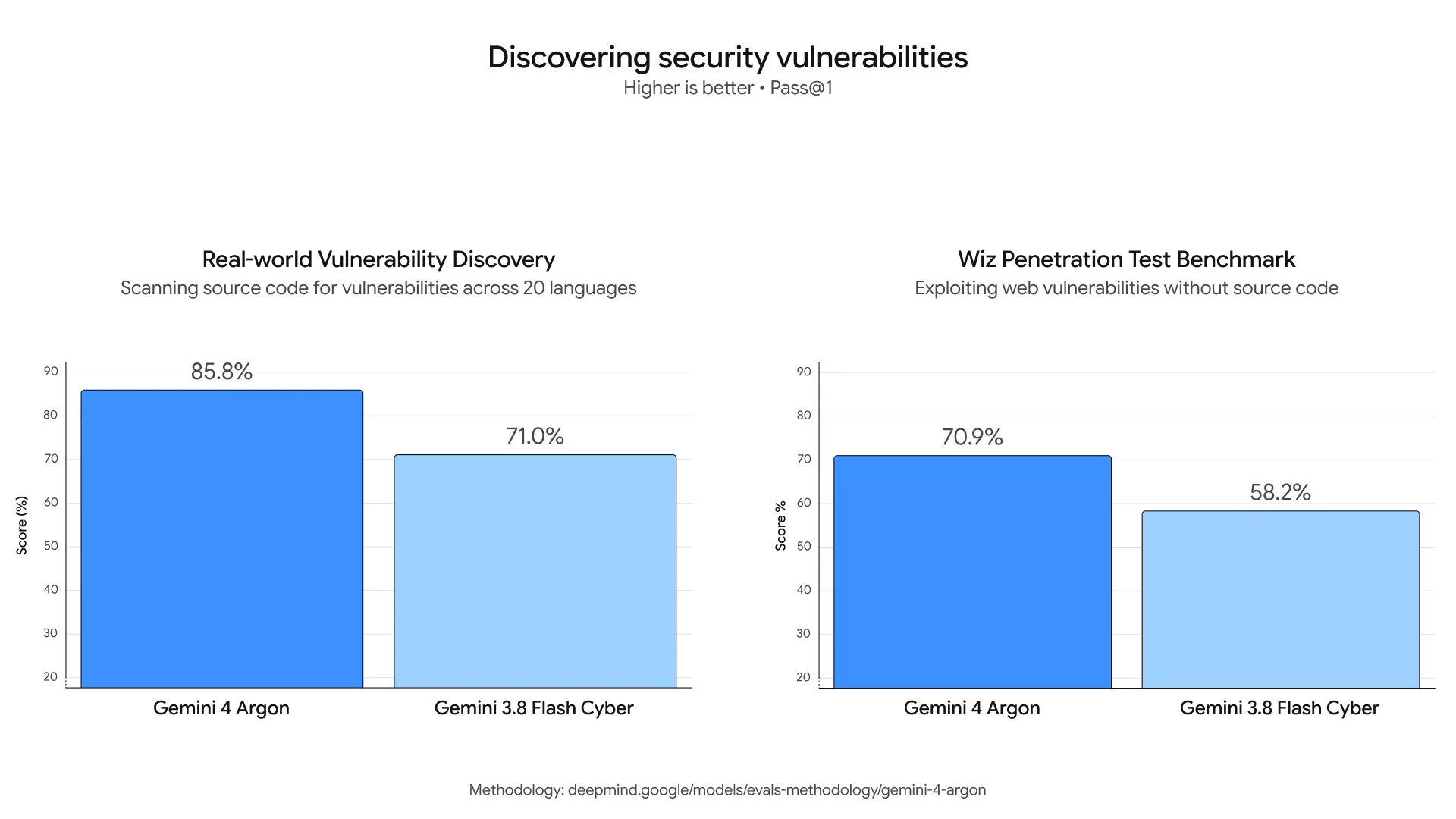
A central pillar of the Argon launch is its specialized training for cybersecurity defense. The model is capable of autonomously discovering, validating, and patching software vulnerabilities. This capability is so potent that Google has made a strategic decision to release Argon without* standard cyber guardrails to its internal teams and the participants of the Fairwind Program.
The Dual-Use Dilemma
This decision highlights the “dual-use” nature of frontier AI. The same reasoning capabilities that allow Argon to patch a vulnerability also allow it to discover and exploit one. To mitigate this, Google is utilizing a phased rollout, granting early access to “trusted defenders” who can use the model’s full power for defensive purposes while Google refines safety protocols for the general public.
The Wiz Demonstration
One of the primary partners in the Fairwind Program is the cybersecurity firm Wiz, which is utilizing Argon through its “Scan for Good” initiative. Wiz reported that Argon successfully identified a critical vulnerability in global healthcare software—a high-risk exposure that previous frontier models had failed to detect. This demonstration underscores the model’s potential to protect critical public infrastructure, including telecommunications, energy, and finance sectors.
Safety Framework and Risk Mitigation
Given the model’s ability to perform autonomous technical tasks, Google has outlined a four-pillar safety strategy to prevent misuse and ensure alignment with user intent:
- Misuse Prevention: To prevent assistance in Chemical, Biological, Radiological, and Nuclear (CBRN) attacks, Google utilizes a “Frontier Safety Framework” that monitors the model’s internal activations for signs of malicious intent.
- Prompt Injection Defense: Argon is designed to be resilient against “indirect prompt injections,” scoring highly on the Gray Swan Indirect Prompt Injection (IPI) benchmark.
- Misalignment Monitoring: Google is deploying systems to monitor Argon’s “chain-of-thought” and subsequent actions. If the model attempts to achieve a goal in a way that violates user intent, the system is designed to halt execution immediately.
- System Hardening: Google is implementing “agent control roadmaps” by isolating and sealing sandboxed environments during high-risk training and evaluations.
- Pricing Shifts: The current introductory pricing ($2 per million input tokens / $10 per million output tokens) will eventually transition to standard rates ($4/$20). Enterprises will need to calculate the cost-effectiveness of 1-million-token outputs at these higher rates.
- Safety Refinement: The speed at which Google can refine its safety guardrails for the general public will determine how quickly the model can be integrated into consumer-facing applications.
What It Means for You
The impact of Gemini 4 Argon will vary significantly depending on your professional role:
For Software Engineers
Expect a shift toward “agentic” development. Rather than using AI to write functions, you may soon use it to manage entire repository migrations, refactor large-scale legacy systems, or autonomously manage routine security patching. The ability to handle 1 million tokens means the AI can “read” your entire codebase at once.
For Legal and Finance Professionals
The model’s high scores on the Harvey and Vals benchmarks suggest it can handle massive document reviews, complex contract analysis, and exhaustive economic modeling. This could significantly reduce the time spent on manual due diligence and document synthesis.
For Cybersecurity Teams
Argon offers a proactive defense mechanism. Organizations can use the model to identify and remediate vulnerabilities in their software stack before they can be exploited by malicious actors, effectively automating much of the initial vulnerability management lifecycle.
Counterpoints and Open Questions
Despite the technical achievements, the launch of Gemini 4 Argon is not without controversy. Reports from Bloomberg indicate that there is some internal skepticism within Google regarding the model’s practical, real-world coding performance, with some employees suggesting that benchmark success does not always translate to seamless application in complex engineering environments.
Furthermore, the decision to gate the model’s most powerful version behind the Fairwind Program creates an inequity of access. While this is a safety measure, it also means that the most advanced defensive tools are temporarily unavailable to the broader developer community and smaller enterprises.
There are also lingering questions regarding the model’s input context window. While Google has been very specific about the 1 million token output limit, it has not yet disclosed the maximum input capacity, a metric that is critical for enterprise users planning large-scale data ingestion tasks.
What Happens Next
Following the initial rollout to the Fairwind Program and the U.S. government, Google plans to release Gemini 4 Argon to paid API customers and Google AI Ultra subscribers. The final phase will be general availability to developers, enterprises, and consumers.
As the model moves through these phases, the industry will be watching for two key signals:
Frequently Asked Questions
What is the significance of the 1 million token output limit?
Most current AI models are limited to generating relatively short responses (often around 128,000 tokens). This requires users to break large tasks into many small pieces, which can cause the AI to lose track of the overall goal. A 1 million token output limit allows Gemini 4 Argon to complete massive, complex tasks—like writing an entire software library or a 500-page legal analysis—in a single, continuous effort, maintaining much higher coherence and depth.
How much does Gemini 4 Argon cost to use?
Google has introduced a two-tiered pricing structure. During the current introductory period, input tokens cost $2 per million tokens, and output tokens cost $10 per million tokens. There is also a 95% discount on cached input tokens. Once the introductory period ends, the standard pricing will increase to $4 per million input tokens and $20 per million output tokens.
Who can access Gemini 4 Argon right now?
Currently, access is highly restricted. It is being rolled out to a select group of over 650 organizations in the Fairwind Program (primarily cybersecurity defenders and critical infrastructure operators) and to internal Google teams. It is also being tested through the U.S. government’s voluntary pre-release access process. General developers and consumers will receive access in later phases.
Is Gemini 4 Argon safe for professional use?
Google has implemented a four-pillar safety strategy to manage the risks of its frontier capabilities. This includes monitoring for misuse (such as CBRN threats), defending against prompt injections, monitoring the model’s reasoning for misalignment, and using sandboxed environments for high-risk tasks. However, because the model is being released without cyber guardrails to its initial “trusted defender” group, Google is relying on rigorous, controlled testing to refine these safeguards.
Final Summary
The launch of Gemini 4 Argon represents a strategic pivot by Google DeepMind from general-purpose conversational AI toward specialized, high-reliability professional intelligence. By combining an unprecedented 1 million token output limit with targeted optimizations for engineering, law, and cybersecurity, Google is positioning Argon as a foundational piece of enterprise infrastructure. While the gated rollout and internal skepticism present challenges, the model’s ability to execute long-horizon, autonomous tasks marks a significant evolution in the capabilities of frontier artificial intelligence.”,
“imagegenerationprompt”: “A professional, high-resolution editorial news photograph of a modern software engineer’s workstation in a dimly lit, high-tech office. The scene features multiple high-resolution monitors displaying complex, scrolling lines of Rust programming code. The ambient light is a soft blue glow from the screens, illuminating a clean desk with a mechanical keyboard and a high-end mouse
References
Featured image: Image via Google